Anatomy
1 questionsArrange the following in the sequence of auditory pathway: 1. Cochlear nucleus 2. Spiral ganglion 3. Superior olivary nucleus 4. Inferior colliculus 5. Medial geniculate body
INI-CET 2022 - Anatomy INI-CET Practice Questions and MCQs
Question 31: Arrange the following in the sequence of auditory pathway: 1. Cochlear nucleus 2. Spiral ganglion 3. Superior olivary nucleus 4. Inferior colliculus 5. Medial geniculate body
- A. 5-4-3-2-1
- B. 3-4-5-1-2
- C. 2-1-3-4-5 (Correct Answer)
- D. 1-2-3-4-5
Explanation: ***2-1-3-4-5*** - The auditory pathway begins with the **spiral ganglion**, which contains the cell bodies of the first-order neurons that innervate the hair cells of the cochlea. - Signals then proceed to the **cochlear nucleus** in the brainstem, followed by the **superior olivary nucleus**, the **inferior colliculus**, and finally the **medial geniculate body** in the thalamus before reaching the auditory cortex [1]. *5-4-3-2-1* - This sequence represents a nearly reverse order of the ascending auditory pathway, starting from a higher processing center (medial geniculate body) and moving backward, which is incorrect for sensory input. - The **medial geniculate body** is the thalamic relay for auditory information, receiving input from lower centers and projecting to the auditory cortex [1]. *3-4-5-1-2* - This sequence incorrectly places the **superior olivary nucleus** as the initial processing stage, preceding the lower-level **spiral ganglion** and **cochlear nucleus**. - Auditory information must first be transduced by hair cells and then relayed by the spiral ganglion neurons to the cochlear nucleus before further processing in the olivary complex. *1-2-3-4-5* - This sequence incorrectly places the **cochlear nucleus** before the **spiral ganglion**. - The **spiral ganglion** contains the primary afferent neurons that receive input from the hair cells and project their axons to the cochlear nucleus.
Biochemistry
2 questionsDeamination of methylated cytosine forms which of the following?
Increased H+ ions in the intermembrane space of mitochondria are due to?
INI-CET 2022 - Biochemistry INI-CET Practice Questions and MCQs
Question 31: Deamination of methylated cytosine forms which of the following?
- A. Uracil
- B. Thymine (Correct Answer)
- C. Cytosine
- D. Guanine
Explanation: ***Thymine*** - Deamination of **5-methylcytosine** removes the amine group at the 4-position and replaces it with a keto group, forming **thymine**. - This reaction can lead to a common type of point mutation, as the DNA repair machinery might fail to distinguish this naturally occurring base from normal thymine. *Uracil* - **Uracil** is formed by the deamination of **unmethylated cytosine**, not methylated cytosine. - Uracil is a base found in RNA but not typically in DNA, so its presence in DNA signals a repair event. *Cytosine* - **Cytosine** is the original base before deamination occurs; deamination is a chemical modification that changes cytosine into another base. - If a base remains cytosine, it means deamination has not taken place. *Guanine* - **Guanine** is a purine base and is structurally unrelated to cytosine or its deamination products. - Deamination primarily affects pyrimidine bases like cytosine and uracil, not purines like guanine.
Question 32: Increased H+ ions in the intermembrane space of mitochondria are due to?
- A. Decreased ATP synthase activity
- B. Reduced proton pumping
- C. Impaired inner mitochondrial membrane integrity
- D. Increased electron transport chain activity (Correct Answer)
Explanation: ***Increased electron transport chain activity*** - The **electron transport chain (ETC)** complexes (I, III, and IV) actively pump **protons (H+)** from the mitochondrial matrix into the intermembrane space during electron transfer. - **Increased ETC activity** directly causes more protons to be pumped, creating a higher H+ concentration in the intermembrane space. - This is the **primary mechanism** for establishing the proton-motive force used in ATP synthesis. *Decreased ATP synthase activity* - While decreased ATP synthase activity would cause **passive accumulation** of protons in the intermembrane space (since fewer H+ flow back through ATP synthase), it does **not actively increase** proton pumping. - The question asks what causes the **increase** in H+ ions, which requires active transport by the ETC, not passive accumulation. - This option confuses the consequence (accumulation) with the cause (active pumping). *Reduced proton pumping* - **Reduced proton pumping** by the ETC would lead to a **decrease** in H+ concentration in the intermembrane space, as fewer protons are being actively transported. - This produces the opposite effect of what the question describes. *Impaired inner mitochondrial membrane integrity* - **Impaired membrane integrity** would cause protons to **leak back** into the mitochondrial matrix, dissipating the proton gradient. - This would **decrease**, not increase, the H+ concentration in the intermembrane space. - This is seen in uncoupling conditions where the membrane becomes permeable to protons.
ENT
1 questionsA 35-year-old female patient presents with complaints of nasal obstruction and post-nasal drip. There is a past history of FESS for failed conservative management 5 years ago. Uncinectomy and maxillary ostium dilation was done during the previous FESS. A DNE done now shows patent ostia and mucosal edema of the maxillary sinus lining. What is the next best step in management? FESS - Functional endoscopic sinus surgery
INI-CET 2022 - ENT INI-CET Practice Questions and MCQs
Question 31: A 35-year-old female patient presents with complaints of nasal obstruction and post-nasal drip. There is a past history of FESS for failed conservative management 5 years ago. Uncinectomy and maxillary ostium dilation was done during the previous FESS. A DNE done now shows patent ostia and mucosal edema of the maxillary sinus lining. What is the next best step in management? FESS - Functional endoscopic sinus surgery
- A. Tissue biopsy for histopathological examination (Correct Answer)
- B. Immediate revision FESS
- C. High-dose systemic steroids
- D. Topical antifungal therapy
Explanation: ***Tissue biopsy for histopathological examination*** - The patient has persistent **mucosal edema** despite previous FESS and patent ostia, raising suspicion for less common etiologies such as **eosinophilic mucin rhinosinusitis** or even a **neoplastic process**, which require histological confirmation. - A biopsy is essential to differentiate between inflammatory conditions not responsive to standard medical therapy and other distinct pathologies, guiding further specific treatment. *Immediate revision FESS* - Revision FESS is usually considered when there is evidence of **recurrent obstruction** or **sinus scarring**, neither of which is indicated by the "patent ostia" observed during DNE. - Performing FESS without addressing the underlying cause of persistent mucosal edema is unlikely to be curative and risks repeat failure. *High-dose systemic steroids* - While systemic steroids can reduce inflammation, persistent symptoms despite prior surgical intervention and observed mucosal edema warrant investigating the underlying cause before resorting to high-dose systemic therapy. - Prolonged use of high-dose systemic steroids carries significant side effects and should be reserved for cases where the etiology is well-defined and responsive, such as severe asthma or certain inflammatory conditions. *Topical antifungal therapy* - While fungal elements can contribute to rhinosinusitis, the broad application of topical antifungals without specific evidence of fungal infection (e.g., fungal balls, invasive fungal sinusitis) is not standard initial management. - The description of "mucosal edema" and absence of specific fungal features (like thick, inspissated mucin or fungal hyphae) makes empirical antifungal therapy less appropriate as the primary next step.
Internal Medicine
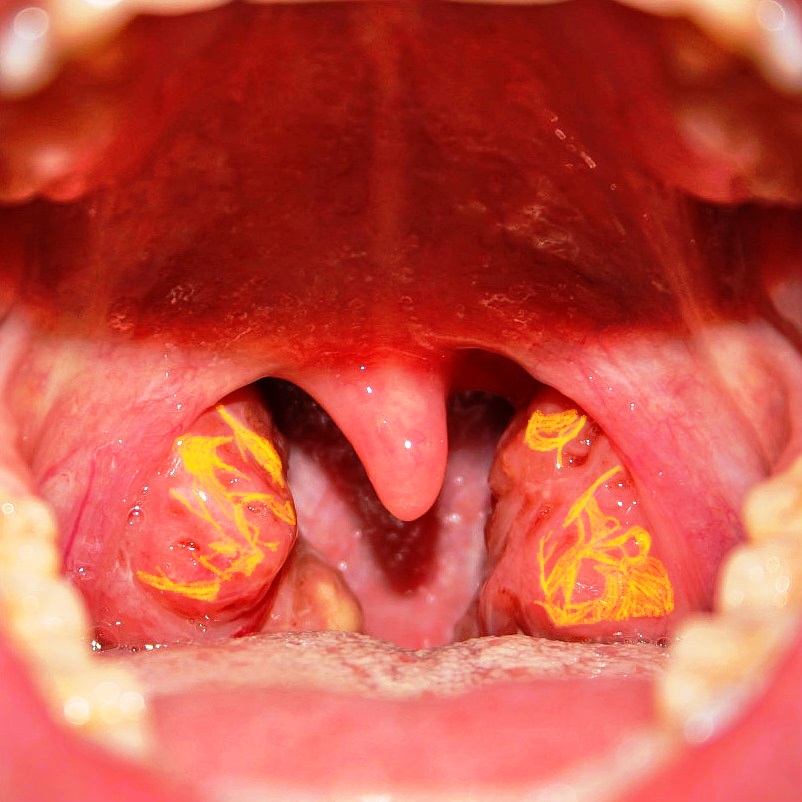
1 questionsA patient presented with reduced levels of high-density lipoprotein, and ABCA1 mutation. On examination, tonsils appeared as shown in the image. What is the diagnosis?
INI-CET 2022 - Internal Medicine INI-CET Practice Questions and MCQs
Question 31: A patient presented with reduced levels of high-density lipoprotein, and ABCA1 mutation. On examination, tonsils appeared as shown in the image. What is the diagnosis?
- A. Tangier disease (Correct Answer)
- B. Fabry disease
- C. Niemann-Pick disease
- D. Gaucher disease
Explanation: ***Tangier disease*** - This condition is characterized by **very low HDL levels** due to mutations in the **ABCA1 gene**, which impairs cholesterol efflux from cells. - The classic physical finding is **enlarged, orange-yellow tonsils** due to cholesterol ester deposition, seen in the provided image. *Fabry disease* - This is an **X-linked lysosomal storage disorder** caused by a deficiency of **alpha-galactosidase A**, leading to globotriaosylceramide accumulation. - Clinical features include **neuropathic pain**, **angiokeratomas**, **corneal opacities**, and early renal and cardiac disease, not orange-yellow tonsils. *Niemann-Pick disease* - This is a group of **autosomal recessive lysosomal storage disorders** caused by deficiencies in enzymes like acid sphingomyelinase or proteins involved in cholesterol processing. - It typically presents with **hepatosplenomegaly**, **neurodegeneration** (especially type A and B), and **lung involvement**, but not oral lesions as depicted. *Gaucher disease* - This is an **autosomal recessive lysosomal storage disease** resulting from a deficiency of the enzyme **beta-glucosidase**, leading to accumulation of glucocerebroside. - Characteristic features include **hepatosplenomegaly**, **bone pain** and crises, and **pancytopenia**, without any specific tonsillar findings.
Microbiology
2 questionsAntigen presented on MHC class I molecules activates which of the following cells?
Which of the following is true about anti-CMV IgG antibodies?
INI-CET 2022 - Microbiology INI-CET Practice Questions and MCQs
Question 31: Antigen presented on MHC class I molecules activates which of the following cells?
- A. NK cells
- B. Helper cells
- C. B cells
- D. Cytotoxic T cells (Correct Answer)
Explanation: ***Cytotoxic T cells*** - **MHC class I** molecules present **intracellular antigens** (e.g., viral or tumor antigens) to **CD8+ T cells** (cytotoxic T cells). - This binding activates the cytotoxic T cells, leading to the destruction of the **infected** or **abnormal host cell**. *NK cells* - **Natural Killer (NK) cells** recognize and kill target cells that have **reduced or absent MHC class I** expression, which often occurs in virally infected or tumor cells, not cells presenting antigens on MHC class I. - They are part of the **innate immune system** and do not require prior sensitization or MHC-peptide presentation for activation. *Helper cells* - **Helper T cells** (CD4+ T cells) recognize antigens presented on **MHC class II** molecules, typically expressed by **antigen-presenting cells** (APCs) like macrophages, B cells, and dendritic cells. - Their primary role is to **orchestrate immune responses** by releasing cytokines. *B cells* - **B cells** are primarily involved in **humoral immunity**, producing antibodies after recognizing specific antigens directly via their B cell receptors or with T cell help. - While they can present antigens on **MHC class II** to helper T cells, direct antigen binding to **MHC class I** does not activate B cells.
Question 32: Which of the following is true about anti-CMV IgG antibodies?
- A. IgG avidity assay helps in differentiating past and primary infection (Correct Answer)
- B. Denotes latent CMV infection
- C. Denotes chronic CMV infection with immunity to other serotypes
- D. Indicates acute CMV infection
Explanation: ***IgG avidity assay helps in differentiating past and primary infection*** - **IgG avidity** measures the binding strength of IgG antibodies to their antigen. In a **primary infection**, IgG antibodies have low avidity. - As the immune response matures over several months, the avidity of IgG antibodies increases, indicating a **past infection**. *Denotes latent CMV infection* - While the presence of IgG antibodies indicates a past exposure and often a latent infection, it doesn't solely *denote* latency, as primary infection also involves IgG production. - **Latent CMV infection** specifically refers to the persistence of the virus in cells without active replication, which is usually confirmed by the presence of IgG antibodies but needs further contextual information like negative IgM and viral load. *Denotes chronic CMV infection with immunity to other serotypes* - CMV typically exists as one serotype, and IgG antibodies confer protection against *re-activation* of that specific virus, not immunity to "other serotypes." - **Chronic infection** usually implies ongoing active replication or persistent symptoms, which a positive IgG alone does not confirm. *Indicates acute CMV infection* - **Acute CMV infection** is primarily indicated by the presence of **IgM antibodies**, which appear early in the infection. - While IgG antibodies also rise during acute infection, their presence alone is not specific for an **acute phase** as they persist after the infection resolves.
Pathology
2 questionsA baby is being evaluated for delayed developmental milestones. On examination, the child has hepatosplenomegaly. A microscopic image of the bone marrow evaluation is shown below. What is the most appropriate treatment?

Which of the following structures is pathognomonic for chromoblastomycosis?
INI-CET 2022 - Pathology INI-CET Practice Questions and MCQs
Question 31: A baby is being evaluated for delayed developmental milestones. On examination, the child has hepatosplenomegaly. A microscopic image of the bone marrow evaluation is shown below. What is the most appropriate treatment?
- A. Macrolides for 4 months
- B. Steroid irrigation and antihistamines
- C. Repeat surgery
- D. Biological therapy (Correct Answer)
Explanation: ***Biological therapy*** - The image likely shows a **Gaucher cell** (macrophage engorged with glucocerebroside, characterized by a "crinkled paper" or "crumpled tissue paper" cytoplasm) [1]. This is pathognomonic for **Gaucher disease**, which presents with **hepatosplenomegaly** and **developmental delay** in infants. - The standard treatment for Gaucher disease is **enzyme replacement therapy (ERT)**, which is a form of biological therapy replacing the deficient glucocerebrosidase enzyme [2]. *Macrolides for 4 months* - Macrolides are a class of **antibiotics** used to treat bacterial infections. - They are not indicated for lysosomal storage disorders like Gaucher disease, which is a **genetic metabolic disorder** [2]. *Steroid irrigation and antihistamines* - This treatment regimen is typically associated with allergic conditions or localized inflammatory responses, such as **allergic rhinitis** or **sinusitis**. - It bears no relevance to the systemic accumulation of lipids seen in Gaucher disease. *Repeat surgery* - While splenectomy was historically performed for massive splenomegaly in Gaucher disease, it does not address the underlying metabolic defect or systemic manifestations. - Furthermore, this case does not suggest a previous surgical intervention that requires repeating, and surgery is not the primary treatment for the metabolic disorder itself. **References:** [1] Kumar V, Abbas AK, et al.. Robbins and Cotran Pathologic Basis of Disease. 9th ed. Genetic Disorders, pp. 162-163. [2] Kumar V, Abbas AK, et al.. Robbins and Cotran Pathologic Basis of Disease. 9th ed. Genetic Disorders, p. 159.
Question 32: Which of the following structures is pathognomonic for chromoblastomycosis?
- A. Asteroid body
- B. Sclerotic body (Correct Answer)
- C. Budding yeast
- D. Negri body
Explanation: ***Sclerotic body*** - **Sclerotic bodies**, also known as **Medlar bodies** or **fumagoid cells**, are characteristic coin-shaped, thick-walled, septate, dematiaceous structures observed histologically in affected tissues. - Their presence is **pathognomonic** for chromoblastomycosis, a chronic fungal infection of the skin and subcutaneous tissue. *Asteroid body* - **Asteroid bodies** are typically found in **sporotrichosis**, representing an antigen-antibody complex surrounding fungal elements. - They are not characteristic of chromoblastomycosis. *Budding yeast* - **Budding yeast** forms are commonly seen in various fungal infections, such as **candidiasis** or **cryptococcosis**, but are not specific to chromoblastomycosis. [1] - This morphology indicates yeast proliferation but lacks the distinctive sclerotic appearance. *Negri body* - **Negri bodies** are eosinophilic, sharply demarcated neuronal cytoplasmic inclusions found in the diagnostic examination of **rabies** infection. - They are entirely unrelated to fungal infections like chromoblastomycosis. **References:** [1] Kumar V, Abbas AK, et al.. Robbins and Cotran Pathologic Basis of Disease. 9th ed. The Lung, p. 717.
Pediatrics
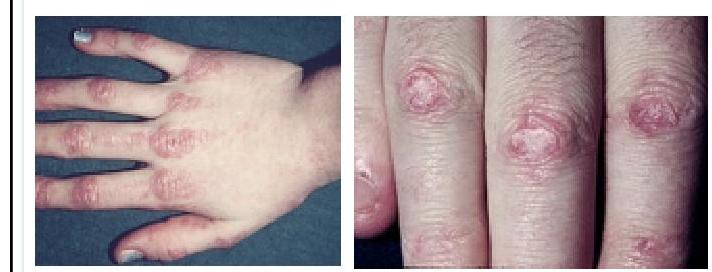
1 questionsA 10-year-old boy presents with fever, joint pain, and a lesion over his hand, as seen in the image below. Which of the following is the clinical finding, and what is the likely diagnosis?

INI-CET 2022 - Pediatrics INI-CET Practice Questions and MCQs
Question 31: A 10-year-old boy presents with fever, joint pain, and a lesion over his hand, as seen in the image below. Which of the following is the clinical finding, and what is the likely diagnosis?
- A. Malar rash - Systemic lupus erythematosus
- B. Heliotrope rash - Dermatomyositis
- C. Erythema multiforme - Stevens-Johnson syndrome
- D. Gottron's papules - Juvenile dermatomyositis (Correct Answer)
Explanation: ***Gottron's papules - Juvenile dermatomyositis*** - The image clearly displays **Gottron's papules**, which are **erythematous, scaling papules** symmetrically distributed over the **dorsal aspects of the interphalangeal joints** (MCP and PIP joints). - The clinical presentation of a 10-year-old boy with **fever, joint pain**, and these characteristic skin lesions is highly indicative of **juvenile dermatomyositis (JDM)**, an inflammatory myopathy. *Malar rash - Systemic lupus erythematosus* - A **malar rash** is a common finding in **systemic lupus erythematosus (SLE)**, but it typically presents as an **erythematous rash over the cheeks and bridge of the nose**, sparing the nasolabial folds, and does not exhibit the papular, scaly appearance over the knuckles seen in the image. - While SLE can cause fever and joint pain, the specific skin lesion depicted is not consistent with a malar rash. *Heliotrope rash - Dermatomyositis* - A **heliotrope rash** is another classic skin manifestation of **dermatomyositis**, characterized by a **purplish discoloration around the eyelids**, often accompanied by periorbital edema. - This is distinct from the lesions shown on the knuckles, which are diagnostic of Gottron's papules, not a heliotrope rash. *Erythema multiforme - Stevens-Johnson syndrome* - **Erythema multiforme** is characterized by **targetoid lesions** with concentric rings, often appearing acutely in response to infections or medications. - **Stevens-Johnson syndrome (SJS)** is a severe form of erythema multiforme, involving extensive epidermal detachment and mucosal involvement, which does not match the chronic-appearing, papular lesions on the knuckles in the image.