Anatomy
1 questionsFroment's sign (book test) is used to assess the function of adductor pollicis. Which of the following nerves supplies this muscle?
INI-CET 2022 - Anatomy INI-CET Practice Questions and MCQs
Question 151: Froment's sign (book test) is used to assess the function of adductor pollicis. Which of the following nerves supplies this muscle?
- A. Radial nerve
- B. Posterior interosseous nerve
- C. Median nerve
- D. Ulnar nerve (Correct Answer)
Explanation: The adductor pollicis muscle is primarily innervated by the deep branch of the ulnar nerve [1]. This muscle is crucial for thumb adduction, and its function is assessed by the Froment's sign (often referred to as the book test) to detect ulnar nerve palsy. The radial nerve primarily innervates the muscles of the posterior compartment of the arm and forearm, responsible for wrist and finger extension [1]. It does not supply any intrinsic muscles of the hand, including the adductor pollicis [1]. The posterior interosseous nerve is a terminal branch of the deep radial nerve, supplying most of the extensors in the forearm [1]. It does not innervate any of the intrinsic hand muscles. The median nerve innervates most of the flexors of the forearm and the thenar muscles of the hand (abductor pollicis brevis, opponens pollicis, and superficial head of flexor pollicis brevis) [1]. It does not supply the adductor pollicis muscle; median nerve palsy would affect thumb opposition and abduction, not adduction [1].
Community Medicine
1 questionsUnder the Anaemia Mukt Bharath initiative, mild to moderate anaemia in pregnant women <34 weeks of gestation is treated using:
INI-CET 2022 - Community Medicine INI-CET Practice Questions and MCQs
Question 151: Under the Anaemia Mukt Bharath initiative, mild to moderate anaemia in pregnant women <34 weeks of gestation is treated using:
- A. IM ferric carboxy maltose (FCM)
- B. IV iron sucrose for non-compliance with oral tablets
- C. 2 iron and folic acid tablets OD+IV iron sucrose
- D. 1-2 IFA tablets daily (depending on severity) (Correct Answer)
Explanation: ***1-2 IFA tablets daily (depending on severity)*** - The **Anaemia Mukt Bharat (AMB)** guidelines recommend **oral iron and folic acid (IFA)** supplementation as the primary treatment for mild to moderate anaemia in pregnant women <34 weeks gestation. - **Mild anaemia (Hb 10-10.9 g/dL):** 1 IFA tablet daily (100 mg elemental iron + 500 mcg folic acid) - **Moderate anaemia (Hb 7-9.9 g/dL):** 2 IFA tablets twice daily (total 200 mg elemental iron per day) - Oral IFA is safe, cost-effective, and addresses the underlying nutritional deficiency. *IM ferric carboxy maltose (FCM)* - **Intramuscular (IM) iron** formulations like FCM are generally reserved for cases of severe anaemia, malabsorption, or intolerance to oral iron. - For mild to moderate anaemia, IM iron is not the **first-line treatment** under AMB guidelines due to potential injection site reactions and the effectiveness of oral alternatives. *IV iron sucrose for non-compliance with oral tablets* - **Intravenous (IV) iron sucrose** is indicated for specific situations such as severe anaemia (Hb <7 g/dL), significant malabsorption, documented intolerance, or persistent non-compliance with oral iron. - However, for mild to moderate anaemia, efforts are made to ensure compliance with oral treatment before resorting to **parenteral iron**, particularly given its higher cost and need for administration in a healthcare setting. *2 iron and folic acid tablets OD+IV iron sucrose* - Combining **oral iron tablets with IV iron sucrose** is not recommended for mild to moderate anaemia under AMB guidelines. - This approach would be considered **overtreatment** for mild to moderate anaemia in the absence of severe anaemia or documented failure of oral therapy despite good compliance.
Obstetrics and Gynecology
1 questionsWhat is the age group distribution for vulval cancer?
INI-CET 2022 - Obstetrics and Gynecology INI-CET Practice Questions and MCQs
Question 151: What is the age group distribution for vulval cancer?
- A. 65-85 years
- B. 35-55 years
- C. Not age specific
- D. Both age groups (35-55 and 65-85 years) (Correct Answer)
Explanation: ***Both age groups (35-55 and 65-85 years)*** - Vulval cancer demonstrates a **bimodal age distribution**, meaning it presents with two distinct peaks of incidence. - The first peak occurs in younger women, typically aged **35-55 years**, often associated with **HPV infection** and vulvar intraepithelial neoplasia (VIN). - The second peak is seen in older women, aged **65-85 years**, where the disease is more commonly linked to **chronic inflammatory conditions** such as lichen sclerosus, often without HPV involvement. - This bimodal pattern reflects the **two distinct pathogenic pathways** of vulval cancer: HPV-related and non-HPV-related disease. *65-85 years* - While this age group represents a significant peak of vulval cancer incidence, particularly in cases **unrelated to HPV**, it does not encompass the entire distribution. - Focusing solely on this age range would **miss cases occurring in younger women**, which are increasingly recognized due to HPV-related disease. *35-55 years* - This age group does indeed represent a distinct peak for vulval cancer, especially in cases linked to **Human Papillomavirus (HPV) infection**. - However, ignoring the incidence in older women would provide an **incomplete understanding** of the disease's overall epidemiology. *Not age specific* - Vulval cancer is definitely **age-specific** with distinct age group distributions. - The incidence is **not uniformly distributed** across all ages but rather shows an increased likelihood within specific age ranges, demonstrating clear bimodal peaks.
Pediatrics
1 questionsA child presents with poor growth and swelling at joints. A radiograph of his wrist is given below. Lab investigations reveal serum ALP levels of >1500. What is the possible diagnosis?

INI-CET 2022 - Pediatrics INI-CET Practice Questions and MCQs
Question 151: A child presents with poor growth and swelling at joints. A radiograph of his wrist is given below. Lab investigations reveal serum ALP levels of >1500. What is the possible diagnosis?
- A. Rickets (Correct Answer)
- B. Osteoporosis
- C. Osteomalacia
- D. Osteogenesis imperfecta
Explanation: ***Rickets*** - The combination of **poor growth**, **joint swelling**, and **elevated alkaline phosphatase (ALP)** in a child strongly indicates rickets, a condition of defective bone mineralization in growing bones. - The radiograph of the wrist would likely show typical findings like **widened growth plates**, **fraying** and **cupping of metaphyses**, and **decreased bone density**, which are characteristic of rickets. *Osteoporosis* - This condition is characterized by **reduced bone mass** and **fragile bones**, typically seen in older adults or due to secondary causes, and is not primarily linked to joint swelling in children. - While ALP levels can be normal or slightly elevated in osteoporosis, a level of >1500 is highly suggestive of active bone formation or breakdown, not typically seen in osteoporosis. *Osteomalacia* - This is defective bone mineralization in adults after growth plates have fused, leading to **bone softening** and **pain**, typically not presenting with joint swelling as a primary symptom. - While it also involves high ALP and bone demineralization, the clinical context of a *child* with growth issues points more specifically to rickets. *Osteogenesis imperfecta* - This is a group of **genetic disorders** characterized by **brittle bones** that fracture easily, often accompanied by **blue sclerae** and **hearing loss**, which are not mentioned in the presentation. - While bone fragility is present, it does not typically cause the described joint swelling or the significantly elevated ALP levels seen in this case.
Pharmacology
1 questionsMatch the following drugs with the targets of their actions: Drugs: A. Trastuzumab B. Infliximab C. Sirolimus D. Imatinib Targets: 1. BCR-ABL tyrosine kinase 2. mTOR 3. TNF alpha 4. HER2/neu
INI-CET 2022 - Pharmacology INI-CET Practice Questions and MCQs
Question 151: Match the following drugs with the targets of their actions: Drugs: A. Trastuzumab B. Infliximab C. Sirolimus D. Imatinib Targets: 1. BCR-ABL tyrosine kinase 2. mTOR 3. TNF alpha 4. HER2/neu
- A. A-2, B-3, C-1, D-4
- B. A-3, B-4, C-2, D-1
- C. A-4, B-3, C-1, D-2
- D. A-4, B-3, C-2, D-1 (Correct Answer)
Explanation: ***Correct Answer: A-4, B-3, C-2, D-1*** - **Trastuzumab** (Herceptin) is a **monoclonal antibody** that targets the **HER2/neu receptor (4)** [1], [2], commonly overexpressed in certain breast cancers and gastric cancers. - **Infliximab** is another **monoclonal antibody** that specifically targets and neutralizes **TNF-alpha (3)**, an inflammatory cytokine, making it useful in treating autoimmune diseases like rheumatoid arthritis and Crohn's disease. - **Sirolimus** is an **immunosuppressant** drug that inhibits the mammalian target of rapamycin (**mTOR (2)**), a protein kinase involved in cell growth and proliferation, used in transplant medicine and as an anticancer agent. - **Imatinib** is a **tyrosine kinase inhibitor** that primarily targets the **BCR-ABL fusion protein (1)** [1], [2], which is characteristic of chronic myeloid leukemia. *Incorrect: A-2, B-3, C-1, D-4* - This option incorrectly matches Trastuzumab with mTOR and Sirolimus with BCR-ABL, which are not their primary targets. - Trastuzumab targets HER2/neu [1], [2], and Sirolimus targets mTOR. *Incorrect: A-3, B-4, C-2, D-1* - This option incorrectly matches Trastuzumab with TNF-alpha and Infliximab with HER2/neu. - Infliximab targets TNF-alpha, and Trastuzumab targets HER2/neu [1], [2]. *Incorrect: A-4, B-3, C-1, D-2* - This option incorrectly matches Sirolimus with BCR-ABL and Imatinib with mTOR. - Sirolimus inhibits mTOR, and Imatinib inhibits BCR-ABL [1], [2].
Physiology
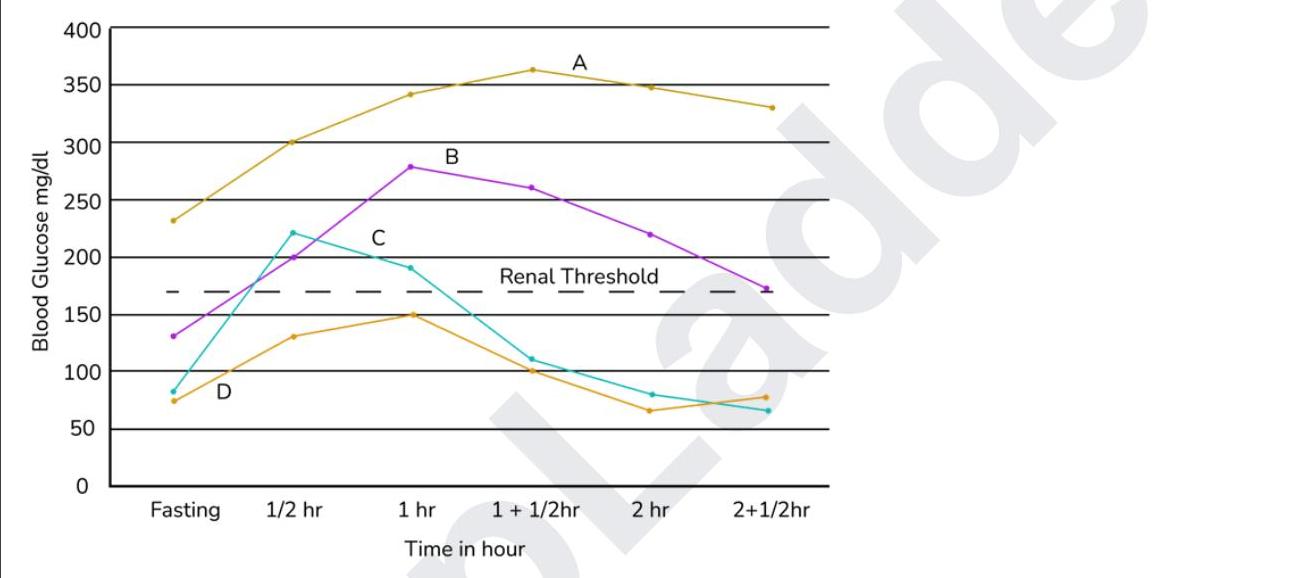
1 questionsWhich of the following represents a normal response to an OGTT?
INI-CET 2022 - Physiology INI-CET Practice Questions and MCQs
Question 151: Which of the following represents a normal response to an OGTT?
- A. Graph A
- B. Graph B
- C. Graph D (Correct Answer)
- D. Graph C
Explanation: ***Graph D*** - Graph D shows a **fasting glucose level** below 100 mg/dL, a peak below the renal threshold around 1 hour, and a return to baseline or below within 2-2.5 hours. This pattern is characteristic of normal glucose regulation. - A healthy individual can efficiently clear the glucose load from circulation, preventing sustained hyperglycemia. *Graph A* - Graph A shows significantly **elevated fasting glucose levels** (above 200 mg/dL) and a sustained, very high blood glucose response, peaking above 350 mg/dL and remaining well above the renal threshold. - This pattern is indicative of **diabetes mellitus**, where insulin production or sensitivity is severely impaired. *Graph B* - Graph B displays a high fasting glucose level (above 125 mg/dL) and a blood glucose curve that peaks very high (above 250 mg/dL), staying significantly above the renal threshold even at 2.5 hours. - This profile is suggestive of **impaired glucose tolerance** or **diabetes mellitus**, as the body struggles to effectively lower blood glucose after the glucose load. *Graph C* - Graph C shows a normal fasting glucose level but an **extremely rapid and high peak** much earlier than usual, followed by a precipitous drop below normal fasting levels after 1.5 hours, indicating **reactive hypoglycemia**. - This rapid rise and fall, with a nadir below fasting levels, is not a normal response and may be seen in conditions like **dumping syndrome** or early-stage diabetes with a delayed insulin response.
Surgery
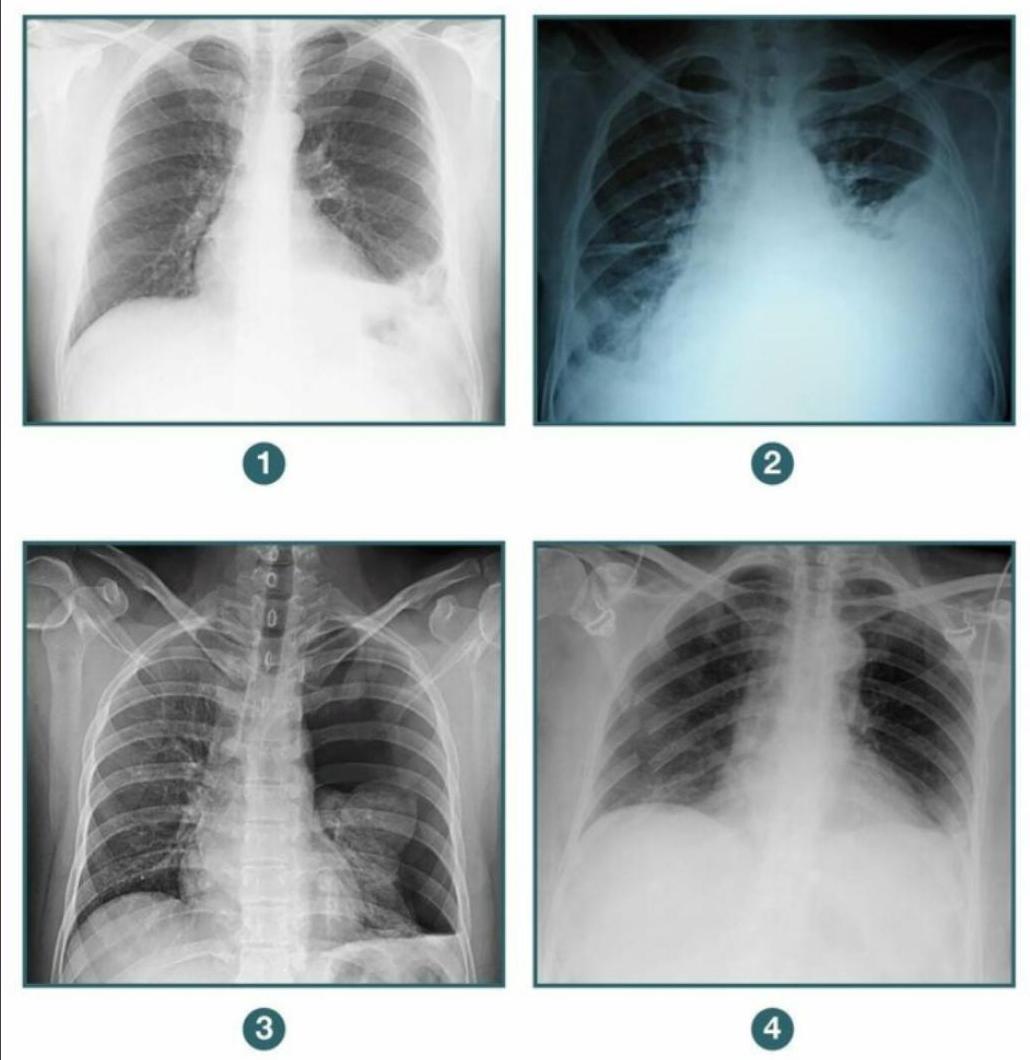
1 questionsA patient presents to the casualty following blunt trauma to the chest. A chest X-ray was done. Among the following radiographs, in which case would you further evaluate the patient before putting a chest tube? 1. Diaphragmatic hernia 2. Hemothorax 3. Pneumothorax 4. Flail chest

INI-CET 2022 - Surgery INI-CET Practice Questions and MCQs
Question 151: A patient presents to the casualty following blunt trauma to the chest. A chest X-ray was done. Among the following radiographs, in which case would you further evaluate the patient before putting a chest tube? 1. Diaphragmatic hernia 2. Hemothorax 3. Pneumothorax 4. Flail chest
- A. Flail chest
- B. Pneumothorax
- C. Diaphragmatic hernia (Correct Answer)
- D. Hemothorax
Explanation: ***Correct Option: Diaphragmatic hernia*** - A **diaphragmatic hernia** (showing elevated hemidiaphragm with loops of bowel in the hemithorax) requires **further evaluation before chest tube placement** - **CT scan with contrast** or **nasogastric tube with X-ray** should be performed to delineate the anatomy and confirm herniated abdominal contents - **Chest tube placement is contraindicated** or requires extreme caution as it could perforate herniated abdominal organs (stomach, bowel, liver, spleen) - This condition requires **surgical repair**, not chest drainage - The key principle: **Always evaluate thoroughly before intervention when diaphragmatic injury is suspected** *Incorrect Option: Pneumothorax* - A **pneumothorax** (characterized by absence of lung markings in the periphery and visceral pleural line) has a straightforward indication for chest tube - **Chest tube is the definitive management** for significant or symptomatic pneumothorax to re-expand the lung - No additional evaluation needed before chest tube placement in hemodynamically stable patients with confirmed pneumothorax *Incorrect Option: Hemothorax* - A **hemothorax** (showing opacification in the lower lung field with blunting of costophrenic angle and fluid level) has a clear indication for chest tube - **Chest tube is indicated** to drain blood, relieve lung compression, and monitor for ongoing bleeding - Immediate chest tube placement is appropriate once diagnosed *Incorrect Option: Flail chest* - A **flail chest** (multiple rib fractures in two or more places creating unstable chest wall segment) primarily requires **pain management and ventilatory support** - A chest tube is **not indicated for flail chest itself** unless there is an associated pneumothorax or hemothorax - If flail chest is isolated, you would not place a chest tube at all, making this option incorrect for the question asked