Community Medicine
3 questionsWhich of the following indicators can help determine whether the health system is effective at identifying leprosy cases early in the community?
Abdominal TB can occur through all of the following EXCEPT
Which of the following regarding the vaccine vial monitor (VVM) is true? 1. It is used for monitoring heat exposure of the vaccine by healthcare workers in primary healthcare. 2. It shows cumulative exposure of the vaccine to the heat. 3. It can be used to assess the potential efficacy of the vaccine 4. Calculation of the expiry date can be done using VVM. 5. The expiry date of the vaccine can be relaxed if VVM is an acceptable range. 6. If the square and the circle are the same in color, then the vaccine can be safely used.
INI-CET 2022 - Community Medicine INI-CET Practice Questions and MCQs
Question 141: Which of the following indicators can help determine whether the health system is effective at identifying leprosy cases early in the community?
- A. Proportion of newly diagnosed patients with grade 2 disability (Correct Answer)
- B. Annual new case detection rate per lac
- C. Treatment initiation rate
- D. Treatment completion rate
Explanation: ***Proportion of newly diagnosed patients with grade 2 disability*** - A **high proportion of newly diagnosed patients with grade 2 disability** indicates late detection of leprosy, suggesting shortcomings in the health system's ability to identify cases early. - Grade 2 disability in leprosy signifies **visible and irreversible damage** to eyes, hands, or feet, which would likely have been prevented with earlier diagnosis and treatment. *Annual new case detection rate per lac* - The **annual new case detection rate** reflects the number of new cases identified but does not directly indicate the timeliness of detection or the effectiveness of early case-finding efforts. - A high new case detection rate could be due to intensive active case-finding campaigns, but without knowing the disability status at diagnosis, it doesn't confirm early detection by the routine health system. *Treatment initiation rate* - The **treatment initiation rate** measures the percentage of diagnosed patients who start treatment, which is crucial for disease control but does not reflect how early cases are identified. - A high initiation rate indicates good patient adherence to treatment protocols after diagnosis, but not the efficiency of the health system in finding cases before they develop advanced disability. *Treatment completion rate* - The **treatment completion rate** indicates the effectiveness of the treatment program and patient adherence, which is vital for preventing drug resistance and relapse. - This metric does not provide information about when the diagnosis was made in the disease progression or the health system's ability to identify cases early.
Question 142: Abdominal TB can occur through all of the following EXCEPT
- A. Direct spread from mesenteric lymph nodes
- B. Feco - oral route
- C. Direct contact with infected animal (Correct Answer)
- D. Hematogenous spread
Explanation: ***Direct contact with infected animal*** - While animal products like **unpasteurized milk** can transmit *Mycobacterium bovis* to humans, direct contact with an infected animal is not a primary mode of transmission for **abdominal TB**. - **Abdominal TB** is usually caused by *Mycobacterium tuberculosis* which is primarily a human pathogen, not typically transmitted through direct contact with animals. *Direct spread from mesenteric lymph nodes* - **Mesenteric lymph nodes** are often involved in abdominal TB, and the infection can directly spread from these nodes to adjacent abdominal organs. - This is a common mechanism for localized propagation within the abdominal cavity. *Feco - oral route* - The **ingestion of contaminated food or milk** (from infected cattle) containing *Mycobacterium bovis* or swallowing of **infected sputum** (from pulmonary TB) containing *Mycobacterium tuberculosis* are common ways the bacteria can reach the gastrointestinal tract. - This leads to primary intestinal infection or reactivation of previously ingested bacteria. *Hematogenous spread* - **Hematogenous dissemination** from a primary pulmonary or other mycobacterial focus is a significant mode of transmission for abdominal TB. - Bacteria can travel through the bloodstream and seed distant abdominal organs, including the **peritoneum**, **intestines**, or **mesenteric lymph nodes**.
Question 143: Which of the following regarding the vaccine vial monitor (VVM) is true? 1. It is used for monitoring heat exposure of the vaccine by healthcare workers in primary healthcare. 2. It shows cumulative exposure of the vaccine to the heat. 3. It can be used to assess the potential efficacy of the vaccine 4. Calculation of the expiry date can be done using VVM. 5. The expiry date of the vaccine can be relaxed if VVM is an acceptable range. 6. If the square and the circle are the same in color, then the vaccine can be safely used.
- A. 1,2,3,4,5
- B. 3,4
- C. 1,2 (Correct Answer)
- D. 5,6
Explanation: ***Correct: Statements 1, 2*** **Statement 1 - TRUE**: The VVM is primarily designed for **healthcare workers** to monitor vaccine heat exposure at all levels, including primary healthcare settings. This is a key WHO tool for cold chain monitoring. **Statement 2 - TRUE**: VVMs provide a **cumulative record** of time and temperature exposure, reflecting the total heat stress a vaccine has experienced throughout its journey from manufacturer to administration. *Statement 3 - FALSE* - While VVMs assess heat exposure that affects vaccine stability, they do **not directly measure vaccine efficacy** or provide quantitative measures of immune response potential. - Heat damage indicated by VVM indirectly suggests reduced potency, but the VVM itself cannot assess efficacy. *Statement 4 - FALSE* - VVMs are **not used to calculate expiry dates**. Manufacturing expiry dates are determined through stability studies under controlled conditions by the manufacturer. *Statement 5 - FALSE* - The **expiry date cannot be relaxed or extended** based on VVM status. The manufacturer's stated expiry date must always be respected regardless of how favorable the VVM reading is. *Statement 6 - FALSE* - This is the **opposite** of how VVM works. If the **inner square is the same color or darker than the outer circle**, the vaccine has been exposed to excessive heat and **should NOT be used**. - The vaccine is safe when the inner square is lighter than the outer circle.
ENT
1 questionsWhat test is not used for testing olfaction?
INI-CET 2022 - ENT INI-CET Practice Questions and MCQs
Question 141: What test is not used for testing olfaction?
- A. Arnold stick test (Correct Answer)
- B. UPSIT
- C. CC-SIT
- D. Smell diskettes
Explanation: ***Arnold stick test*** - The **Arnold stick test** is primarily used for evaluating **hearing**, specifically for assessing **eardrum mobility** and the integrity of the **ossicular chain**. - It involves a small speculum connected to a rubber bulb, and the movement of the eardrum is observed with a microscope, making it unrelated to olfaction. *UPSIT* - The **University of Pennsylvania Smell Identification Test (UPSIT)** is a widely used and well-validated test for **olfactory function**. - It consists of 40 scratch-and-sniff odorants, and the patient identifies each odor from a set of four choices. *CC-SIT* - The **Cross-Cultural Smell Identification Test (CC-SIT)** is a shorter, 12-item version derived from the UPSIT, designed for **cross-cultural applicability** in testing olfaction. - It also uses a scratch-and-sniff method to assess the ability to identify various odors. *Smell diskettes* - **Smell diskettes**, or smell identification tests using diskettes, are various types of **odor identification kits** where different odors are impregnated onto small disks. - These are common tools used to assess **olfaction** by requiring patients to identify specific smells.
Microbiology
1 questionsOn Ziehl-Neelsen (ZN) staining oocysts of size 8-10 µm are visible. Identify the organism.
INI-CET 2022 - Microbiology INI-CET Practice Questions and MCQs
Question 141: On Ziehl-Neelsen (ZN) staining oocysts of size 8-10 µm are visible. Identify the organism.
- A. Microsporidium
- B. Cryptosporidium
- C. Isospora belli
- D. Cyclospora (Correct Answer)
Explanation: ***Cyclospora*** - *Cyclospora cayetanensis* oocysts are **spherical** and measure **8-10 µm** in diameter, exactly matching the size described in the question. - They are **partially acid-fast** on ZN staining and may show **internal structures** or appear **wrinkled**, making them visible under microscopic examination. *Microsporidium* - *Microsporidium* are extremely small (**1-4 µm**) **intracellular obligate parasites**, much smaller than the 8-10 µm oocysts described. - They require **special staining methods** and are not typically visible with standard ZN staining due to their minute size. *Cryptosporidium* - *Cryptosporidium parvum* oocysts are **spherical** and measure **4-6 µm** in diameter, which is smaller than the 8-10 µm described. - While they are **acid-fast** on ZN staining, their smaller size distinguishes them from the oocysts in question. *Isospora belli* - *Isospora belli* oocysts are **elongated or oval** and measure **20-30 µm** in length, making them significantly larger than the 8-10 µm oocysts described. - Although they are **acid-fast** and visible on ZN staining, their larger size and oval morphology do not match the question parameters.
Obstetrics and Gynecology
3 questionsThe given image depicts:

All of the following can be used in first-trimester medical termination of pregnancy (MTP), except
A woman with eclampsia is started on magnesium sulfate. What is the first sign of magnesium sulfate toxicity?
INI-CET 2022 - Obstetrics and Gynecology INI-CET Practice Questions and MCQs
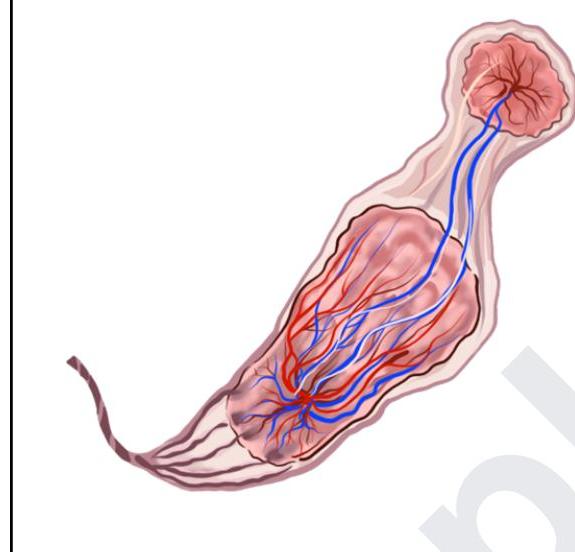
Question 141: The given image depicts:
- A. Normal placenta
- B. Succenturiate lobe
- C. Both succenturiate lobe and velamentous insertion (Correct Answer)
- D. Velamentous insertion of the cord
Explanation: ***Both succenturiate lobe and velamentous insertion*** - The image clearly depicts two distinct placental lobes (**succenturiate lobes**), with a smaller accessory lobe separate from the main placental body. - The **umbilical vessels** are also seen running through the fetal membranes before reaching the placental tissue, which is characteristic of **velamentous insertion**. *Normal placenta* - A normal placenta consists of a **single, unified organ** directly attached to the decidua, with the umbilical cord inserting centrally or eccentrically into this main mass. - The **umbilical cord** in a normal placenta would insert directly into the placental tissue, not into the membranes. *Succenturiate lobe* - A succenturiate lobe (or accessory lobe) refers to one or more small lobes of the placenta located at a distance from the main placental body. - While a succenturiate lobe is present, the image also shows the umbilical vessels traversing the membranes, indicating an additional anomaly known as **velamentous insertion**, making this option incomplete. *Velamentous insertion of the cord* - Velamentous insertion is characterized by the **umbilical blood vessels** separating before reaching the placental disc, traveling through the fetal membranes. - While velamentous insertion is evident, the presence of a **separate accessory lobe** makes this option incomplete as it doesn't account for both depicted abnormalities.
Question 142: All of the following can be used in first-trimester medical termination of pregnancy (MTP), except
- A. Manual vacuum aspiration
- B. Dilatation and curettage
- C. Extra-amniotic instillation of ethacridine lactate (Correct Answer)
- D. Mifepristone + misoprostol
Explanation: ***Extra-amniotic instillation of ethacridine lactate*** - **Extra-amniotic instillation of ethacridine lactate** is a method primarily used for **second-trimester** pregnancy terminations. - Its mechanism involves causing inflammation and contraction of the uterus, which is less effective and carries higher risks in the first trimester. *Manual vacuum aspiration* - **Manual vacuum aspiration (MVA)** is a common and effective surgical method for **first-trimester MTP**. - It involves using a syringe and cannula to remove the uterine contents directly. *Dilatation and curettage* - **Dilatation and curettage (D&C)** is another standard surgical procedure used for **first-trimester MTP**. - It involves dilating the cervix and using a curette to scrape the uterine lining and remove the pregnancy tissue. *Mifepristone + misoprostol* - The combination of **mifepristone and misoprostol** is the most common and effective medical method for **first-trimester MTP**. - **Mifepristone** blocks progesterone, while **misoprostol** causes uterine contractions and cervical ripening, expelling the pregnancy.
Question 143: A woman with eclampsia is started on magnesium sulfate. What is the first sign of magnesium sulfate toxicity?
- A. Respiratory depression
- B. Hypotension
- C. Loss of knee jerk (Correct Answer)
- D. Reduced muscle tone
Explanation: ***Loss of knee jerk*** - **Diminished or absent deep tendon reflexes**, particularly the knee jerk, is the **earliest clinical sign** of magnesium sulfate toxicity. - This occurs at serum magnesium levels between **7-10 mEq/L** (8.5-12 mg/dL) due to magnesium's depressant effect on the nervous system and neuromuscular transmission. *Respiratory depression* - **Respiratory depression** is a more severe and later sign of magnesium toxicity, occurring at higher serum levels (typically >12 mEq/L). - It indicates significant central nervous system depression and potential for respiratory arrest, usually after reflexes are already lost. *Hypotension* - While magnesium sulfate can cause **vasodilation** and a subsequent drop in blood pressure, it is generally **not the first sign of toxicity** and often occurs concurrently with other mild to moderate signs. - Hypotension may be part of the therapeutic effect to reduce blood pressure in eclampsia, rather than an initial indicator of toxicity. *Reduced muscle tone* - **Reduced muscle tone** or **flaccidity** is also a consequence of magnesium's neuromuscular blocking effect but typically manifests **after the loss of deep tendon reflexes**. - It signifies more profound neuromuscular impairment, closer to the progression towards respiratory depression.
Ophthalmology
1 questionsWhich of the following is not a feature of keratoconus?
INI-CET 2022 - Ophthalmology INI-CET Practice Questions and MCQs
Question 141: Which of the following is not a feature of keratoconus?
- A. Haab's striae (Correct Answer)
- B. Irregular astigmatism
- C. Scissoring reflex
- D. Munson's sign
Explanation: ***Haab's striae*** - **Haab's striae** are characteristic of congenital glaucoma, presenting as horizontal breaks in Descemet's membrane due to increased intraocular pressure and corneal stretching. - In contrast, keratoconus involves **vertical breaks in Descemet's membrane** (due to corneal thinning and protrusion), known as Vautin's striae or Vogt's striae, not Haab's striae. *Irregular astigmatism* - **Irregular astigmatism** is a hallmark of keratoconus, resulting from the asymmetric and non-uniform thinning and protrusion of the cornea. - This irregular corneal shape leads to a significant reduction in visual acuity that cannot be fully corrected with spherical or regular cylindrical lenses. *Scissoring reflex* - The **scissoring reflex** (or scissoring phenomena) is an objective finding observed during retinoscopy in patients with keratoconus, indicating significant irregular astigmatism. - It refers to the opposing movements of the retinoscopic reflex, resembling the opening and closing of scissors, as the light across the pupil is neutralized. *Munson's sign* - **Munson's sign** is a classic clinical finding in advanced keratoconus, where the lower eyelid protrudes in a V-shape when the patient looks downwards. - This protrusion is caused by the conical shape of the cornea pushing against the eyelid.
Surgery
1 questionsThe following procedure is performed for the management of?

INI-CET 2022 - Surgery INI-CET Practice Questions and MCQs
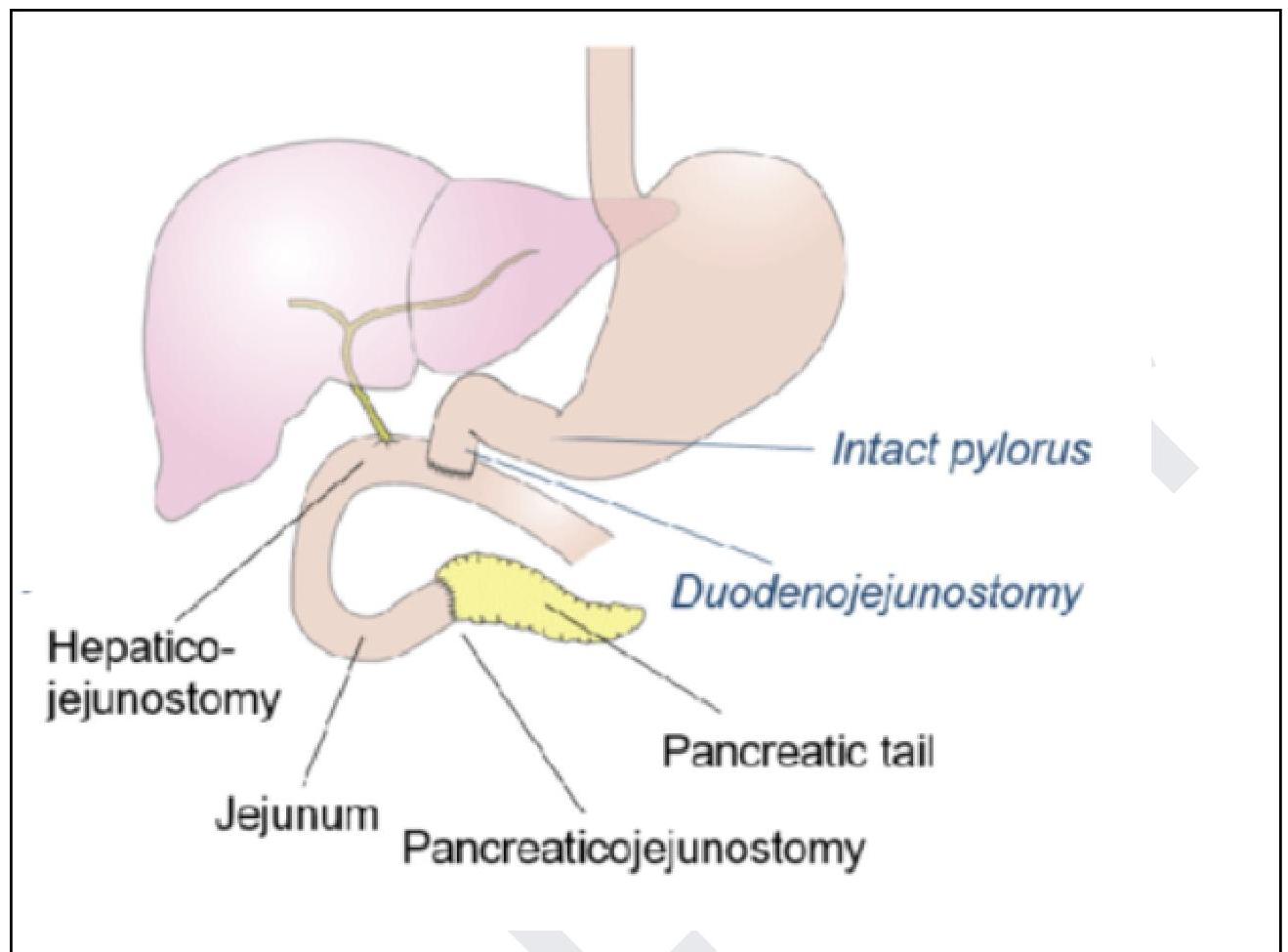
Question 141: The following procedure is performed for the management of?
- A. Gallbladder carcinoma
- B. Distal cholangiocarcinoma (Correct Answer)
- C. Chronic calcific pancreatitis
- D. Advanced gastric carcinoma
Explanation: ***Distal cholangiocarcinoma*** - The image shows a **Pylorus-preserving Whipple procedure (PPPD)**, which involves resection of the pancreatic head, duodenum, gallbladder, and part of the common bile duct, followed by reconstruction. - This procedure is primarily performed for malignancies of the **pancreatic head**, **distal bile duct (cholangiocarcinoma)**, and **ampulla of Vater**, as they often cause obstructive jaundice and are resectable. *Gallbladder carcinoma* - While gallbladder carcinoma can involve the bile ducts, this specific reconstruction (PPPD) is more commonly associated with tumors of the pancreatic head or distal bile duct rather than the gallbladder itself, which might be managed with a **cholecystectomy** and possibly **liver resection**. - The type of resection and reconstruction varies significantly based on the extent and location of gallbladder cancer. *Chronic calcific pancreatitis* - Surgical management for chronic pancreatitis, especially with calcifications, typically involves drainage procedures (e.g., **Puestow procedure** due to dilated pancreatic duct or **Frey procedure**) or resection of the pancreatic head (e.g., **Beger procedure**). - While some resections of the pancreatic head are performed for chronic pancreatitis, the depicted procedure is specifically designed for malignancies of the pancreatic head region, not primarily for the sequelae of chronic calcific pancreatitis unless associated with a mass suspicious for malignancy. *Advanced gastric carcinoma* - Advanced gastric carcinoma is typically managed by **gastrectomy** (partial or total) with lymphadenectomy, not a Whipple procedure. - The image clearly shows an **intact pylorus** and the stomach mostly preserved, which is inconsistent with advanced gastric carcinoma requiring major gastric resection.