Community Medicine
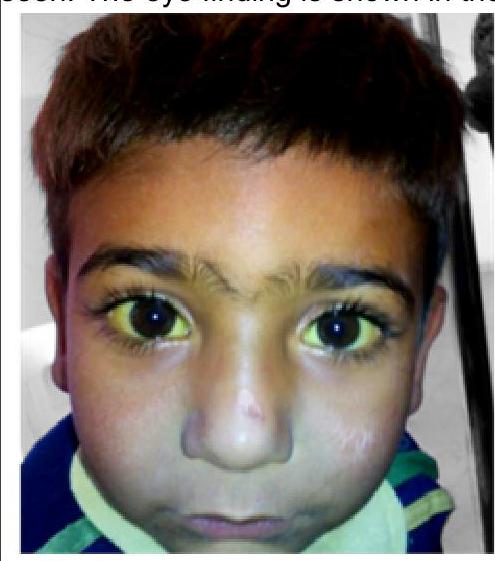
1 questionsWhich of the following statements is true regarding the tape shown in the image?

INI-CET 2022 - Community Medicine INI-CET Practice Questions and MCQs
Question 111: Which of the following statements is true regarding the tape shown in the image?
- A. Reading of 13.5 to 14.5 cm is considered undernourished.
- B. It is called Shelter's tape.
- C. It is used to assess severe acute malnutrition. (Correct Answer)
- D. It is useful mainly for frontline field workers.
Explanation: ***It is used to assess severe acute malnutrition.*** - The tape shown is a **Mid-Upper Arm Circumference (MUAC)** tape, which is a simple and effective tool for screening children aged 6-59 months for **severe acute malnutrition (SAM)**. - The color-coded sections (red, yellow, green) on the tape directly indicate nutritional status to facilitate rapid assessment and decision-making for intervention. *Reading of 13.5 to 14.5 cm is considered undernourished.* - A MUAC reading between **11.5 cm and 12.5 cm** often indicates **moderate acute malnutrition (MAM)**, falling in the yellow zone on many MUAC tapes. - A reading of **13.5 to 14.5 cm** would typically fall in the **green zone**, indicating a **healthy nutritional status** for children aged 6-59 months, not undernourished. *It is called Shelter's tape.* - The tape shown is known as a **MUAC tape** (Mid-Upper Arm Circumference tape), not Shelter's tape. - There is no widely recognized medical assessment tool called "Shelter's tape" for nutritional assessment. *It is useful mainly for frontline field workers.* - While it is indeed a valuable tool for **frontline field workers** due to its simplicity and ease of use in community settings, it is also utilized by **healthcare professionals** in clinics and hospitals for rapid screening and assessment of malnutrition. - Its utility extends beyond just field workers, making it an essential tool in various healthcare settings, especially in low-resource environments.
Forensic Medicine
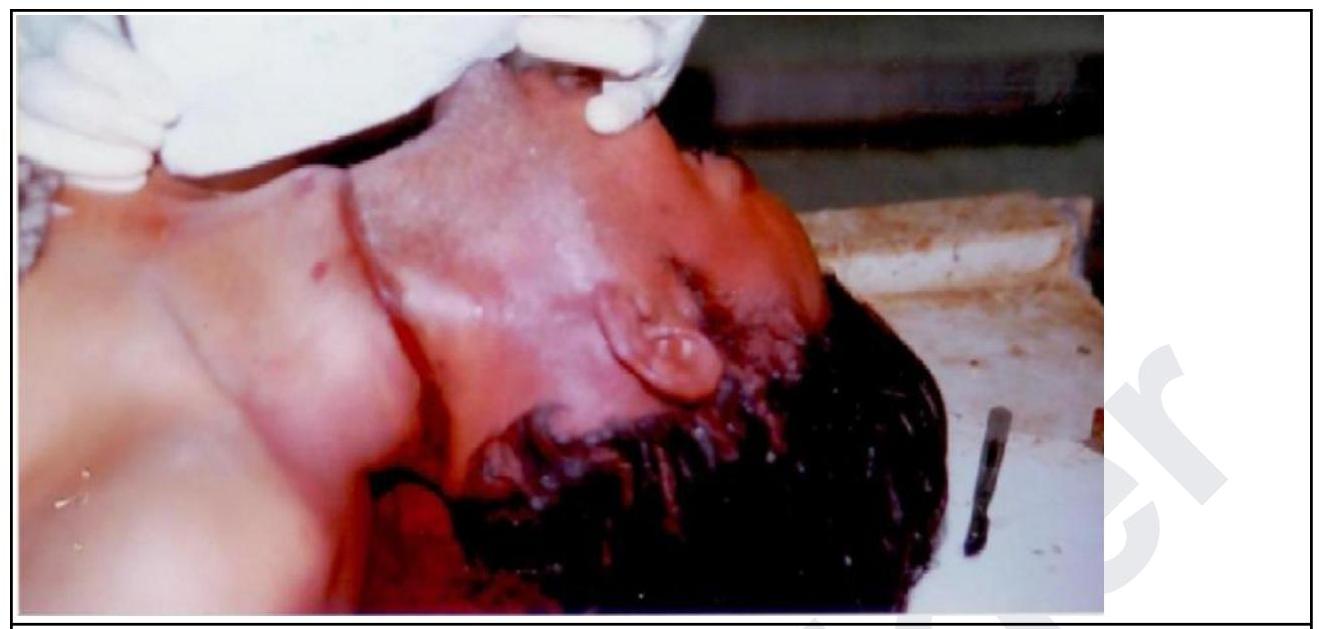
2 questionsIdentify the pattern of abrasion shown in the image below.

Hooch tragedy is related to:
INI-CET 2022 - Forensic Medicine INI-CET Practice Questions and MCQs
Question 111: Identify the pattern of abrasion shown in the image below.
- A. Pressure abrasion
- B. Ligature mark (Correct Answer)
- C. Graze abrasion
- D. Imprint abrasion
Explanation: ***Ligature mark*** - The image clearly displays a **linear impression** on the neck, consistent with a **ligature mark**, which is an abrasion caused by a constricting object. - This type of abrasion is often seen in cases of **strangulation or hanging**, where a cord or similar item tightens around the neck. *Pressure abrasion* - Pressure abrasions are typically caused by **blunt forceful contact** with a surface, resulting in a scraped or grazed appearance, which differs from the distinct linear mark shown. - They are usually broad and irregular, not forming a clear, thin line as seen in the image. *Graze abrasion* - Graze abrasions, also known as scrapes, involve the **superficial removal of the epidermis** due to friction against a rough surface. - They tend to be spread out and irregular, lacking the deep, circumscribed linear pattern characteristic of a ligature mark. *Imprint abrasion* - Imprint abrasions reflect the **exact pattern of the impacting object** (e.g., tire track, weapon pattern), which is not evident in the image. - While a ligature itself can leave an imprint, the term "imprint abrasion" is usually reserved for more complex patterns than a simple linear groove.
Question 112: Hooch tragedy is related to:
- A. Methanol (Correct Answer)
- B. Mercury
- C. Ethanol
- D. Phosphorus
Explanation: ***Methanol*** - **Hooch tragedy** refers to incidents of mass poisoning caused by the consumption of adulterated alcoholic beverages, most commonly with **methanol**. - **Methanol poisoning** leads to severe metabolic acidosis, visual disturbances, and organ damage, often resulting in death or permanent disability. *Mercury* - **Mercury poisoning** is typically associated with exposure to elemental mercury, inorganic mercury salts, or organic mercury compounds, leading to neurological and renal symptoms. - It is not directly related to the "hooch tragedy" involving adulterated alcohol. *Ethanol* - **Ethanol** is the type of alcohol consumed in alcoholic beverages and is not typically associated with the "hooch tragedy" unless consumed excessively or in combination with other substances. - While excessive ethanol consumption can lead to **alcohol poisoning**, it does not cause the specific toxic reactions seen in hooch tragedies. *Phosphorus* - **Phosphorus poisoning** can occur from exposure to white phosphorus or ingestion of various phosphorus-containing compounds, affecting multiple organ systems including the liver and cardiovascular system. - It is not a common adulterant in alcoholic beverages and is unrelated to hooch tragedies.
Internal Medicine
2 questionsSeminal vesicles and vas deferens would be bilaterally absent congenitally in which of the following conditions?
All the following are criteria for SIRS, except
INI-CET 2022 - Internal Medicine INI-CET Practice Questions and MCQs
Question 111: Seminal vesicles and vas deferens would be bilaterally absent congenitally in which of the following conditions?
- A. Cystic fibrosis (Correct Answer)
- B. Kartagener syndrome
- C. Klinefelter syndrome
- D. Kallmann syndrome
Explanation: ***Cystic fibrosis*** - **Congenital bilateral absence of the vas deferens (CBAVD)** is found in over 95% of males with cystic fibrosis, often leading to infertility. - This condition results from mutations in the **CFTR gene**, which is responsible for chloride transport, causing thick, viscous secretions that block or prevent the development of these structures. *Kartagener syndrome* - This syndrome is a subgroup of **primary ciliary dyskinesia**, characterized by a triad of *situs inversus*, chronic sinusitis, and bronchiectasis. - While it causes **infertility due to immotile sperm**, the male reproductive tract organs like the vas deferens and seminal vesicles are typically present. *Klinefelter syndrome* - Individuals with Klinefelter syndrome have a **47,XXY karyotype** and typically present with small testes, azoospermia, and hypogonadism [1]. - However, the **vas deferens and seminal vesicles are usually present**, though they may be underdeveloped or dysfunctional. *Kallmann syndrome* - This is a form of **hypogonadotropic hypogonadism** associated with anosmia or hyposmia (impaired sense of smell). - It results from a failure of GnRH-producing neurons to migrate to the hypothalamus, affecting hormone production, but the **anatomical structures of the vas deferens and seminal vesicles are usually intact**.
Question 112: All the following are criteria for SIRS, except
- A. Heart rate >90/min
- B. Systolic blood pressure <90 mmHg (Correct Answer)
- C. Respiratory rate >20 bpm
- D. Temperature >38 degree Celsius or <36 degree Celsius
Explanation: ***Systolic blood pressure <90 mmHg*** - This criterion is associated with **septic shock** or **hypotension**, indicating organ dysfunction, which is a more severe stage beyond **SIRS**. - While low blood pressure can be seen in severe infections, it is not a direct diagnostic criterion for **SIRS** itself. *Heart rate >90/min* - An elevated **heart rate** (tachycardia) is a common physiological response to systemic stress and inflammation. - This criterion fulfills one of the four clinical parameters to diagnose **SIRS**. *Respiratory rate >20 bpm* - An increased **respiratory rate** (tachypnea) reflects the body's attempt to compensate for metabolic acidosis or increased oxygen demand during a systemic inflammatory response. - This criterion is one of the four clinical parameters used to diagnose **SIRS**. *Temperature >38 degree Celsius or <36 degree Celsius* - Both **fever** (>38°C) and **hypothermia** (<36°C) are indicators of a systemic inflammatory response, as the body's thermoregulation is affected [1]. - This criterion is one of the four principal parameters used to diagnose **SIRS** [1].
Obstetrics and Gynecology
4 questionsWhich of the following is false regarding management of diabetes in pregnancy?
The following cost-effective investigations are routinely recommended in the screening of antenatal mothers, EXCEPT:
Kassowitz rule is related to:
Which hormone is secreted by the placenta?
INI-CET 2022 - Obstetrics and Gynecology INI-CET Practice Questions and MCQs
Question 111: Which of the following is false regarding management of diabetes in pregnancy?
- A. In active labor, if RBS <70 mg/dL, D5 is started at 100-150 ml/hr till the RBS is >70 mg/dL
- B. In a patient being planned for induction of labor, night dose of intermediate insulin is given as planned, and the morning dose is withheld
- C. Elective C-section has no role in reducing incidence of brachial plexus injury (Correct Answer)
- D. Capillary blood glucose monitoring levels are kept at fasting- 95 mg/dL; 1 hr postprandial- 140 mg/dL; 2 hrs postprandial- 120 mg/dL
Explanation: ***Elective C-section has no role in reducing incidence of brachial plexus injury*** - This statement is **false** because **elective C-section** can significantly reduce the incidence of **brachial plexus injury** (BPI), especially in cases of suspected fetal macrosomia. - While not universally recommended for all diabetic pregnancies, an elective C-section is considered when the estimated **fetal weight** is substantial or when there's a history of **shoulder dystocia** to prevent birth trauma. *In active labor, if RBS <70 mg/dL, D5 is started at 100-150 ml/hr till the RBS is >70 mg/dL* - This is a **correct** management strategy for **hypoglycemia in labor**. Maintaining stable blood glucose levels (above 70 mg/dL) is crucial to prevent adverse outcomes for both mother and fetus. - The administration of **D5 (dextrose 5% in water)** intravenous solution at a specific rate helps to quickly raise and maintain blood glucose levels. *In a patient being planned for induction of labor, night dose of intermediate insulin is given as planned, and the morning dose is withheld* - This is a common and generally **correct** practice for insulin management before **induction of labor**. The night dose of intermediate insulin helps maintain basal glucose levels overnight. - Withholding the morning dose prevents **hypoglycemia** during labor when food intake is restricted, and insulin sensitivity may increase. Glucose is then typically supplemented through IV fluids as needed. *Capillary blood glucose monitoring levels are kept at fasting- 95 mg/dL; 1 hr postprandial- 140 mg/dL; 2 hrs postprandial- 120 mg/dL* - These are the generally accepted and **correct** target blood glucose levels for **diabetes in pregnancy** (both pre-existing and gestational diabetes). - Achieving these targets is essential to minimize the risk of **fetal macrosomia**, **neonatal hypoglycemia**, and other adverse perinatal outcomes.
Question 112: The following cost-effective investigations are routinely recommended in the screening of antenatal mothers, EXCEPT:
- A. Blood sugar levels for GDM
- B. VDRL for syphilis
- C. Urine analysis for bacteriuria
- D. Echocardiography for cardiac disease (Correct Answer)
Explanation: ***Echocardiography for cardiac disease*** - **Echocardiography** is not a *routinely recommended* screening investigation for all antenatal mothers due to its cost and the relatively low prevalence of significant congenital heart disease requiring universal screening. - It is typically performed only if there are **specific risk factors** or suspicious findings suggesting cardiac pathology. *Blood sugar levels for GDM* - Screening for **gestational diabetes mellitus (GDM)** with blood sugar levels (e.g., glucose challenge test) is routinely recommended due to the potential maternal and fetal complications if untreated. - GDM is a common condition that can be effectively managed with early diagnosis, making screening a **cost-effective** preventive measure. *VDRL for syphilis* - Screening for **syphilis** using tests like VDRL (Venereal Disease Research Laboratory) is a standard and *routinely recommended* antenatal investigation. - Early detection and treatment of syphilis in pregnant women prevent serious adverse outcomes such as **congenital syphilis**, which can cause severe fetal morbidity and mortality. *Urine analysis for bacteriuria* - **Urine analysis** for **asymptomatic bacteriuria** is routinely recommended during pregnancy because untreated bacteriuria can lead to pyelonephritis, preterm labor, and low birth weight. - It is a simple, **cost-effective** test with significant benefits for maternal and fetal health.
Question 113: Kassowitz rule is related to:
- A. Congenital syphilis (Correct Answer)
- B. Primary syphilis
- C. Latent syphilis
- D. Secondary syphilis
Explanation: ***Congenital syphilis*** - The **Kassowitz rule** specifically describes the high rate of perinatal mortality (abortion, stillbirth, or death shortly after birth) in cases of untreated maternal syphilis, especially during early stages of infection. - It highlights that the risk is highest when the mother acquires syphilis shortly before or during pregnancy, leading to severe fetal disease. *Primary syphilis* - This stage is characterized by a **chancre** at the site of infection and is the initial presentation in the infected individual, not directly related to fetal outcomes. - While primary syphilis in the mother can lead to congenital syphilis, the Kassowitz rule itself describes the outcome of congenital infection, not the primary infection in the mother. *Latent syphilis* - **Latent syphilis** refers to a stage where the infection is present but asymptomatic, potentially for years. - While it can be transmitted vertically and lead to congenital syphilis, the Kassowitz rule specifically quantifies the mortality risk of congenital syphilis, not the mother's latent infection itself. *Secondary syphilis* - This stage involves a systemic rash and other widespread symptoms in the infected individual, appearing weeks to months after the chancre. - Though highly infectious and a significant risk for vertical transmission, the rule focuses on the severe consequences *for the fetus* when congenital syphilis occurs, not the symptoms of secondary syphilis in the mother.
Question 114: Which hormone is secreted by the placenta?
- A. GnRH
- B. FSH
- C. hCG (Correct Answer)
- D. LH
Explanation: ***hCG*** - **Human Chorionic Gonadotropin (hCG)** is produced by the **syncytiotrophoblast** of the placenta shortly after implantation. - Its primary role is to maintain the **corpus luteum**, ensuring continued production of **progesterone** to support the pregnancy. *GnRH* - **Gonadotropin-releasing hormone (GnRH)** is secreted by the **hypothalamus** in the brain, not the placenta. - It stimulates the pituitary gland to release FSH and LH. *FSH* - **Follicle-stimulating hormone (FSH)** is produced by the **anterior pituitary gland**. - It plays a crucial role in ovarian follicular development in females and spermatogenesis in males. *LH* - **Luteinizing hormone (LH)** is also secreted by the **anterior pituitary gland**. - Its functions include triggering ovulation in females and stimulating testosterone production in males.
Pediatrics
1 questionsAn unconscious child is brought to the casualty. What is the correct sequence of the management?
INI-CET 2022 - Pediatrics INI-CET Practice Questions and MCQs
Question 111: An unconscious child is brought to the casualty. What is the correct sequence of the management?
- A. Circulation, Airway, Breathing
- B. Breathing, Circulation, Airway
- C. Circulation, Breathing, Airway
- D. Airway, Breathing, Circulation (Correct Answer)
Explanation: ***Airway, Breathing, Circulation*** - The **ABC sequence** is the cornerstone of pediatric resuscitation as per **PALS (Pediatric Advanced Life Support) guidelines** - In an unconscious child, a patent **airway** is the absolute first priority - without this, no oxygen can reach the lungs regardless of breathing effort - Once airway patency is ensured, **breathing** must be assessed and supported to provide adequate ventilation and oxygenation - Only after securing airway and breathing should **circulation** be addressed, as effective circulation without oxygenation is futile - This sequence prevents **hypoxic brain injury**, which can occur within 4-6 minutes of oxygen deprivation *Circulation, Airway, Breathing* - This violates the fundamental **ABC principle** of emergency management - Prioritizing **circulation** before establishing a patent **airway** means attempting to circulate deoxygenated blood - Without airway patency, any circulatory support will fail to deliver oxygen to vital organs, leading to **irreversible hypoxic damage** - In pediatric emergencies, respiratory failure is more common than primary cardiac arrest, making airway management even more critical *Breathing, Circulation, Airway* - Attempting to support **breathing** before securing the **airway** is physiologically ineffective - An obstructed airway prevents air entry despite breathing efforts or bag-mask ventilation attempts - This sequence can lead to **gastric distension, aspiration**, and worsening hypoxia - Delays in airway management increase the risk of **cardiac arrest** from prolonged hypoxemia *Circulation, Breathing, Airway* - This sequence dangerously delays **airway management**, the most time-critical intervention - In an unconscious child, airway obstruction from tongue falling back or secretions is common and immediately life-threatening - Without a patent airway, neither breathing support nor circulatory measures can prevent **brain death** from anoxia - Following this sequence contradicts all **international resuscitation guidelines** (PALS, AHA, ERC)