Thrombolysis can be considered in all of these conditions, except:
A young patient presents to the clinic with erythematous lesions over the exposed areas of the skin like hands, arms, chest, etc. she also complaints of arthralgia and breathlessness. Which among the following antibodies will be useful in diagnosing this condition?
A patient presented with violent, flinging movements. Where is the lesion causing the hemiballismus seen?
What is the most common site of abdominal tuberculosis?
A woman presents with altered sensorium, breathlessness, hypotension and bradycardia. Examination revealed non-pitting edema of the extremities. She has a long -standing history of weight gain, constipation, cold intolerance, and menorrhagia. What is the most likely diagnosis?
A patient presented with ipsilateral Horner's syndrome, ipsilateral loss of pain and temperature sensations in the face, vertigo with numbness and loss of sweating and dysarthria on the contralateral side. All these symptoms are caused due to a lesion in:
Seminal vesicles and vas deferens would be bilaterally absent congenitally in which of the following conditions?
All the following are criteria for SIRS, except
INI-CET 2022 - Internal Medicine INI-CET Practice Questions and MCQs
Question 11: Thrombolysis can be considered in all of these conditions, except:
- A. Blood pressure of more than 185/110 mmHg (Correct Answer)
- B. Ischemic stroke within 2 hours
- C. Onset of symptoms <4 hours
- D. MRI showing density in less than 1/3rd of the area supplied by MCA
Explanation: ***Blood pressure of more than 185/110 mmHg*** - A **blood pressure** greater than **185/110 mmHg** is an absolute contraindication for thrombolysis due to the significantly increased risk of developing **hemorrhagic transformation**. - **Aggressive blood pressure control** is necessary to reduce the risk of intracranial hemorrhage before considering thrombolytics. *Ischemic stroke within 2 hours* - This is within the **therapeutic window** for thrombolysis, which typically extends up to **4.5 hours** from symptom onset [1]. - Earlier administration of thrombolytics within this window generally leads to **better outcomes** and reduced disability [1]. *Onset of symptoms <4 hours* - An onset of symptoms less than **4.5 hours** is a primary **inclusion criterion** for intravenous thrombolysis in acute ischemic stroke [1]. - This timeframe allows for the maximum benefit from **clot dissolution** while minimizing the risk of adverse events. *MRI showing density in less than 1/3rd of the area supplied by MCA* - A **diffusion-weighted MRI** showing an infarct core of less than one-third of the **Middle Cerebral Artery (MCA)** territory is an indicator that the amount of **irreversibly damaged tissue** is small. - This suggests a larger volume of **salvageable penumbra**, making thrombolysis more likely to be beneficial.
Question 12: A young patient presents to the clinic with erythematous lesions over the exposed areas of the skin like hands, arms, chest, etc. she also complaints of arthralgia and breathlessness. Which among the following antibodies will be useful in diagnosing this condition?
- A. Anti-centromere antibodies
- B. Anti-RNP antibodies
- C. Anti-dsDNA antibodies (Correct Answer)
- D. Anti-Scl 70 antibodies
Explanation: Anti-dsDNA antibodies - The clinical presentation with erythematous lesions in sun-exposed areas (consistent with photosensitivity [1] or malar rash), arthralgia, and breathlessness (suggesting serositis [4] or pulmonary involvement) is highly suggestive of Systemic Lupus Erythematosus (SLE) [3]. - Anti-dsDNA antibodies are highly specific for SLE and are included in the diagnostic criteria [4]. Their levels often correlate with disease activity, especially in lupus nephritis. *Anti-centromere antibodies* - These antibodies are typically associated with CREST syndrome (a limited form of systemic sclerosis), characterized by Calcinosis, Raynaud's phenomenon, Esophageal dysmotility, Sclerodactyly, and Telangiectasias. - This clinical picture does not align with the patient's symptoms, which point more towards an inflammatory multi-systemic disease. *Anti-RNP antibodies* - Anti-ribonucleoprotein (RNP) antibodies are characteristic of Mixed Connective Tissue Disease (MCTD) [2], which features overlapping symptoms of SLE, systemic sclerosis, and polymyositis [3]. - While some features like arthralgia might overlap, the classic erythematous lesions and breathlessness are more directly linked to SLE in this presentation, and anti-dsDNA is more specific for distinguishing SLE. *Anti-Scl 70 antibodies* - Also known as anti-topoisomerase I antibodies, these are highly specific for diffuse cutaneous systemic sclerosis. - This condition is characterized by widespread skin thickening, interstitial lung disease, and other visceral organ involvement, which is not fully supported by the patient's primary symptoms of prominent erythematous rashes and isolated arthralgia.
Question 13: A patient presented with violent, flinging movements. Where is the lesion causing the hemiballismus seen?
- A. Putamen
- B. Subthalamic nucleus (Correct Answer)
- C. Globus pallidus
- D. Caudate nucleus
Explanation: ***Subthalamic nucleus*** - **Hemiballismus** is characterized by **violent, flinging movements** of one side of the body, most commonly affecting the proximal limbs [1]. - This involuntary movement disorder is typically caused by a lesion, often an **infarct** or **hemorrhage**, in the **contralateral subthalamic nucleus (STN)** [1]. *Putamen* - Lesions in the **putamen** are more commonly associated with other movement disorders such as **dystonia** or **chorea**. - The putamen is part of the **striatum** and plays a key role in the direct and indirect pathways of the basal ganglia. *Globus pallidus* - Damage to the **globus pallidus (GP)**, particularly the external segment (GPe), can lead to conditions like **dystonia** or contribute to Parkinsonian symptoms depending on the specific region affected [2]. - The globus pallidus is a central component of the **basal ganglia output** to the thalamus. *Caudate nucleus* - Lesions in the **caudate nucleus** are closely linked to **Huntington's disease**, which primarily manifests as **chorea** and cognitive decline [1]. - The caudate nucleus is primarily involved in **cognitive functions** and motor control planning.
Question 14: What is the most common site of abdominal tuberculosis?
- A. Colon
- B. Small intestine
- C. Rectum
- D. Ileocecal junction (Correct Answer)
Explanation: ***Ileocecal junction*** - The **ileocecal junction** is the most common site for abdominal tuberculosis due to its rich lymphoid tissue (Peyer's patches) and physiological stasis. - Tuberculous infection at this site can lead to **mucosal ulceration**, stricture formation, and mass lesions. *Colon* - While the colon can be affected by abdominal tuberculosis, it is **less common** than the ileocecal region. - Colonic involvement often presents with symptoms such as abdominal pain, diarrhea, and weight loss. *Small intestine* - Though other parts of the small intestine can be involved, the **distal ileum** and its junction with the cecum are disproportionately affected. - Involvement of the jejunum and duodenum is less frequent. *Rectum* - **Rectal involvement** in abdominal tuberculosis is rare and typically occurs in conjunction with more extensive colonic or disseminated disease. - Symptoms may include tenesmus, rectal bleeding, or fistula formation.
Question 15: A woman presents with altered sensorium, breathlessness, hypotension and bradycardia. Examination revealed non-pitting edema of the extremities. She has a long -standing history of weight gain, constipation, cold intolerance, and menorrhagia. What is the most likely diagnosis?
- A. Myxedema coma (Correct Answer)
- B. Hyperthyroidism
- C. Cardiogenic shock
- D. Septic shock
Explanation: ***Myxedema coma*** - The constellation of **altered sensorium**, **hypotension**, **bradycardia**, and **non-pitting edema** in a patient with a history of **weight gain**, **constipation**, **cold intolerance**, and **menorrhagia** (symptoms of hypothyroidism) is highly suggestive of myxedema coma [2]. - This is an **extreme manifestation of severe, untreated hypothyroidism**, characterized by decompensation of multiple organ systems. *Hyperthyroidism* - Hyperthyroidism usually presents with symptoms like **tachycardia**, **tremors**, **weight loss**, and **heat intolerance** [1], [3], which are contrary to the patient's presentation. - It would not explain the **bradycardia**, **non-pitting edema**, or chronic symptoms like **constipation** and **cold intolerance**. *Cardiogenic shock* - While cardiogenic shock can cause **hypotension** and **altered sensorium**, it is typically characterized by signs of **cardiac dysfunction** such as elevated JVP, crackles, and often **tachycardia** (reflexive or primary), not bradycardia [4]. - It does not account for the **long-standing hypothyroid symptoms** like weight gain, constipation, and cold intolerance. *Septic shock* - Septic shock is primarily due to a severe infection, leading to **fever** (though hypothermia can occur in severe cases), **leukocytosis**, and signs of systemic inflammatory response (SIRS), which are not mentioned. - The patient's chronic symptoms are inconsistent with an acute infectious process as the primary cause of shock.
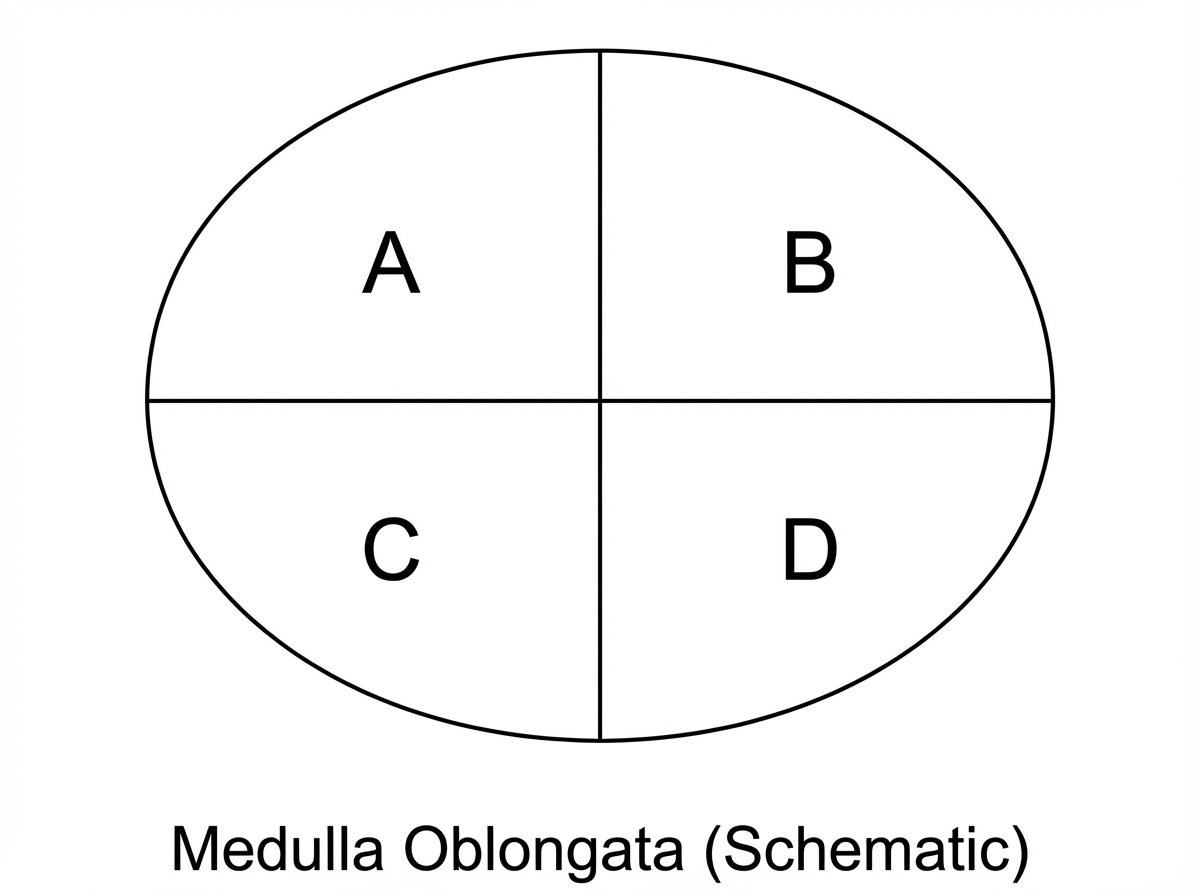
Question 16: A patient presented with ipsilateral Horner's syndrome, ipsilateral loss of pain and temperature sensations in the face, vertigo with numbness and loss of sweating and dysarthria on the contralateral side. All these symptoms are caused due to a lesion in:
- A. A and B
- B. B and D (Correct Answer)
- C. B, C, D
- D. A, B, C
Explanation: ***B and D*** - This complex of symptoms, including ipsilateral **Horner's syndrome**, ipsilateral facial **pain and temperature loss**, **vertigo**, and contralateral **pain and temperature loss** on the body, is characteristic of **Wallenberg syndrome**, also known as **lateral medullary syndrome**. - Wallenberg syndrome is caused by an infarction in the **vertebral artery** (dorsal portion) or its branch, the **posterior inferior cerebellar artery (PICA)**, which supplies the lateral medulla. *A and B* - This option refers to lesions in the **medial medulla**, which would present with completely different symptoms such as contralateral **hemiplegia**, contralateral **loss of proprioception**, and ipsilateral **tongue deviation**. - While both medulla, the distinct clinical presentations differentiate **medial from lateral medullary lesions**. *B, C, D* - This combination attempts to incorporate a lesion in the **medial medulla** (C) with the other relevant areas. - However, the symptom complex clearly points to **lateral medullary involvement**, and including the medial medulla would suggest a different or more extensive stroke. *A, B, C* - This option includes the **anterior spinal artery**, which primarily supplies the **medial medulla** and spinal cord, leading to distinct symptoms. - Involvement of the **anterior spinal artery** would result in motor deficits and loss of pain/temperature on the contralateral side, but would not typically cause **Horner's syndrome** or the intense **vertigo** seen in lateral medullary syndrome.
Question 17: Seminal vesicles and vas deferens would be bilaterally absent congenitally in which of the following conditions?
- A. Cystic fibrosis (Correct Answer)
- B. Kartagener syndrome
- C. Klinefelter syndrome
- D. Kallmann syndrome
Explanation: ***Cystic fibrosis*** - **Congenital bilateral absence of the vas deferens (CBAVD)** is found in over 95% of males with cystic fibrosis, often leading to infertility. - This condition results from mutations in the **CFTR gene**, which is responsible for chloride transport, causing thick, viscous secretions that block or prevent the development of these structures. *Kartagener syndrome* - This syndrome is a subgroup of **primary ciliary dyskinesia**, characterized by a triad of *situs inversus*, chronic sinusitis, and bronchiectasis. - While it causes **infertility due to immotile sperm**, the male reproductive tract organs like the vas deferens and seminal vesicles are typically present. *Klinefelter syndrome* - Individuals with Klinefelter syndrome have a **47,XXY karyotype** and typically present with small testes, azoospermia, and hypogonadism [1]. - However, the **vas deferens and seminal vesicles are usually present**, though they may be underdeveloped or dysfunctional. *Kallmann syndrome* - This is a form of **hypogonadotropic hypogonadism** associated with anosmia or hyposmia (impaired sense of smell). - It results from a failure of GnRH-producing neurons to migrate to the hypothalamus, affecting hormone production, but the **anatomical structures of the vas deferens and seminal vesicles are usually intact**.
Question 18: All the following are criteria for SIRS, except
- A. Heart rate >90/min
- B. Systolic blood pressure <90 mmHg (Correct Answer)
- C. Respiratory rate >20 bpm
- D. Temperature >38 degree Celsius or <36 degree Celsius
Explanation: ***Systolic blood pressure <90 mmHg*** - This criterion is associated with **septic shock** or **hypotension**, indicating organ dysfunction, which is a more severe stage beyond **SIRS**. - While low blood pressure can be seen in severe infections, it is not a direct diagnostic criterion for **SIRS** itself. *Heart rate >90/min* - An elevated **heart rate** (tachycardia) is a common physiological response to systemic stress and inflammation. - This criterion fulfills one of the four clinical parameters to diagnose **SIRS**. *Respiratory rate >20 bpm* - An increased **respiratory rate** (tachypnea) reflects the body's attempt to compensate for metabolic acidosis or increased oxygen demand during a systemic inflammatory response. - This criterion is one of the four clinical parameters used to diagnose **SIRS**. *Temperature >38 degree Celsius or <36 degree Celsius* - Both **fever** (>38°C) and **hypothermia** (<36°C) are indicators of a systemic inflammatory response, as the body's thermoregulation is affected [1]. - This criterion is one of the four principal parameters used to diagnose **SIRS** [1].