INI-CET 2022 — Forensic Medicine
4 Previous Year Questions with Answers & Explanations
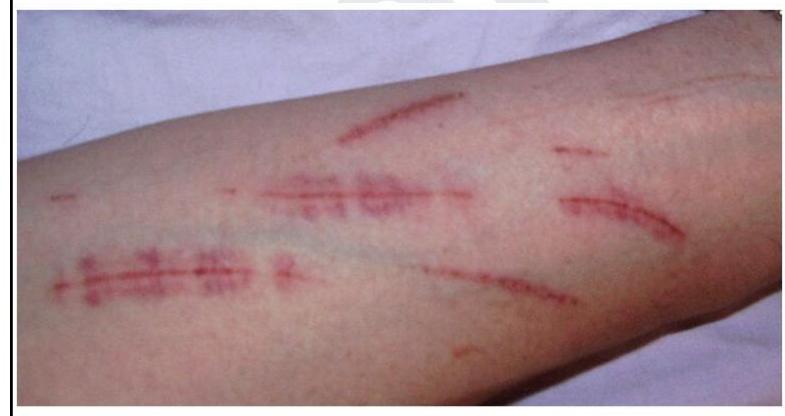
Post-mortem examination of a patient reveals the following. What is this finding known as?
The dead body of a child was recovered from a river with froth around his mouth, which reappeared even after wiping it off. Which postmortem finding is not seen in this case?
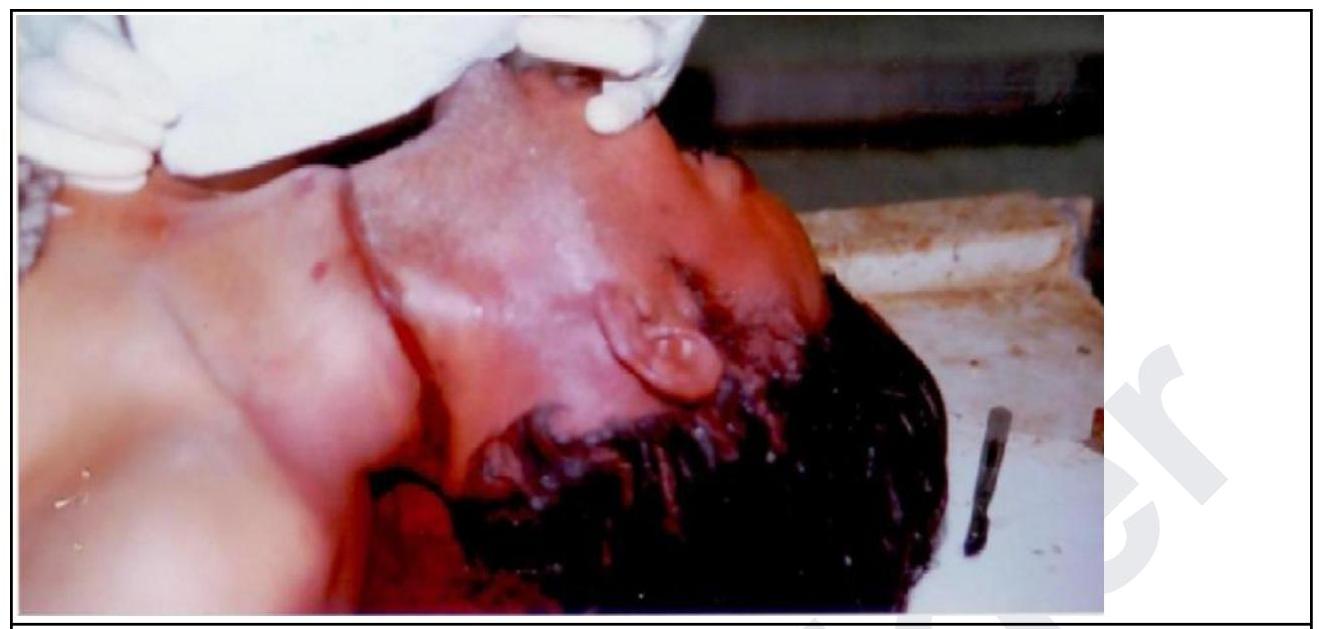
Identify the pattern of abrasion shown in the image below.
Hooch tragedy is related to:
INI-CET 2022 - Forensic Medicine INI-CET Practice Questions and MCQs
Question 1: Post-mortem examination of a patient reveals the following. What is this finding known as?
- A. Grazed abrasion
- B. Hesitation cuts (Correct Answer)
- C. Defense wounds
- D. Chop wounds
Explanation: ***Hesitation cuts*** - The image displays multiple, parallel or semi-parallel **superficial incised wounds**, often with varying depths, which are characteristic of **hesitation cuts** (also called hesitation marks or tentative cuts). - These cuts are frequently observed in cases of **suicide attempts** where the individual makes several tentative or trial cuts before making a more serious or fatal wound. - Typically found on **wrists, neck, or antecubital fossa** and run parallel to each other with progressively increasing depth. - The pattern of multiple superficial parallel cuts is **pathognomonic** of hesitation marks. *Grazed abrasion* - A **grazed abrasion** is a superficial injury where the epidermis is scraped off, typically caused by friction against a rough surface, resulting in a broad, irregular area of skin loss. - The injuries in the image are clearly distinct **incised wounds** (clean cuts), not broad areas of scraped or abraded skin. *Defense wounds* - **Defense wounds** are injuries sustained while attempting to ward off an attack, typically found on the **palmar surface of hands and forearms**. - These are usually deeper, irregular cuts from grabbing or blocking a weapon during homicidal assault. - The pattern in the image shows **organized, parallel, superficial cuts** in one location, inconsistent with defensive injuries sustained during a struggle. *Chop wounds* - **Chop wounds** are deep incised wounds caused by heavy cutting instruments like axes, cleavers, or machetes, often with underlying **bone injury**. - These are characterized by **deep tissue damage** with a wedge-shaped wound profile. - The wounds shown are **superficial and parallel**, not deep chopping injuries.
Question 2: The dead body of a child was recovered from a river with froth around his mouth, which reappeared even after wiping it off. Which postmortem finding is not seen in this case?
- A. High concentration of arsenic from shaft of hair (Correct Answer)
- B. Voluminous and ballooned out lungs
- C. Cadaveric spasm with mud in closed fist
- D. Paltauf's hemorrhage in sub pleura
Explanation: ***High concentration of arsenic from the shaft of hair*** - The presence of arsenic in hair is indicative of chronic **arsenic poisoning**, which is unrelated to drowning. - The scenario describes a body recovered from a river with froth, suggesting **drowning**, not poisoning. *Voluminous and ballooned out lungs* - This is a classic postmortem finding in drowning due to the aspiration of water and air trapping, leading to **pulmonary emphysema acquosum**. - The lungs appear large and distended, often with impressions of the ribs on their surfaces. *Cadaveric spasm with mud in a closed fist* - **Cadaveric spasm** (instantaneous rigor) can occur in cases of violent death, intense physical exertion, or emotional stress just before death, often seen in drowning victims. - Finding foreign material like mud or weeds clutched tightly in the hand is a significant indicator that the victim was **alive and struggling** in the water during submersion. *Paltauf's hemorrhage in subpleura* - **Paltauf's hemorrhages** are small, pinpoint hemorrhages found under the pleural surface (subpleural) and are a characteristic sign of drowning. - They result from the rupture of capillaries due to the sudden increase in intrathoracic pressure during the struggle to breathe underwater.
Question 3: Identify the pattern of abrasion shown in the image below.
- A. Pressure abrasion
- B. Ligature mark (Correct Answer)
- C. Graze abrasion
- D. Imprint abrasion
Explanation: ***Ligature mark*** - The image clearly displays a **linear impression** on the neck, consistent with a **ligature mark**, which is an abrasion caused by a constricting object. - This type of abrasion is often seen in cases of **strangulation or hanging**, where a cord or similar item tightens around the neck. *Pressure abrasion* - Pressure abrasions are typically caused by **blunt forceful contact** with a surface, resulting in a scraped or grazed appearance, which differs from the distinct linear mark shown. - They are usually broad and irregular, not forming a clear, thin line as seen in the image. *Graze abrasion* - Graze abrasions, also known as scrapes, involve the **superficial removal of the epidermis** due to friction against a rough surface. - They tend to be spread out and irregular, lacking the deep, circumscribed linear pattern characteristic of a ligature mark. *Imprint abrasion* - Imprint abrasions reflect the **exact pattern of the impacting object** (e.g., tire track, weapon pattern), which is not evident in the image. - While a ligature itself can leave an imprint, the term "imprint abrasion" is usually reserved for more complex patterns than a simple linear groove.
Question 4: Hooch tragedy is related to:
- A. Methanol (Correct Answer)
- B. Mercury
- C. Ethanol
- D. Phosphorus
Explanation: ***Methanol*** - **Hooch tragedy** refers to incidents of mass poisoning caused by the consumption of adulterated alcoholic beverages, most commonly with **methanol**. - **Methanol poisoning** leads to severe metabolic acidosis, visual disturbances, and organ damage, often resulting in death or permanent disability. *Mercury* - **Mercury poisoning** is typically associated with exposure to elemental mercury, inorganic mercury salts, or organic mercury compounds, leading to neurological and renal symptoms. - It is not directly related to the "hooch tragedy" involving adulterated alcohol. *Ethanol* - **Ethanol** is the type of alcohol consumed in alcoholic beverages and is not typically associated with the "hooch tragedy" unless consumed excessively or in combination with other substances. - While excessive ethanol consumption can lead to **alcohol poisoning**, it does not cause the specific toxic reactions seen in hooch tragedies. *Phosphorus* - **Phosphorus poisoning** can occur from exposure to white phosphorus or ingestion of various phosphorus-containing compounds, affecting multiple organ systems including the liver and cardiovascular system. - It is not a common adulterant in alcoholic beverages and is unrelated to hooch tragedies.