A 50-year-old male patient presented with left -sided hemiparesis. Damage to which part of the internal capsule leads to this presentation?
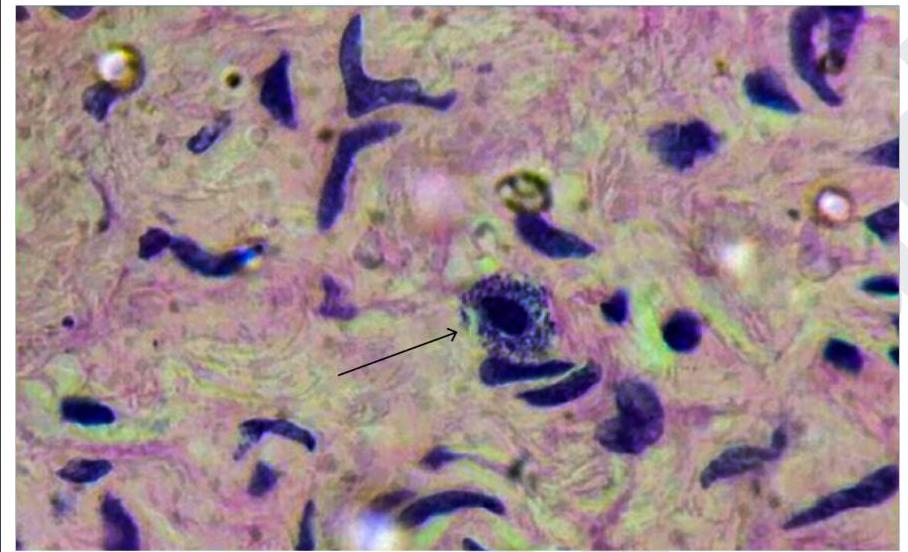
Identify the cell marked in the image below
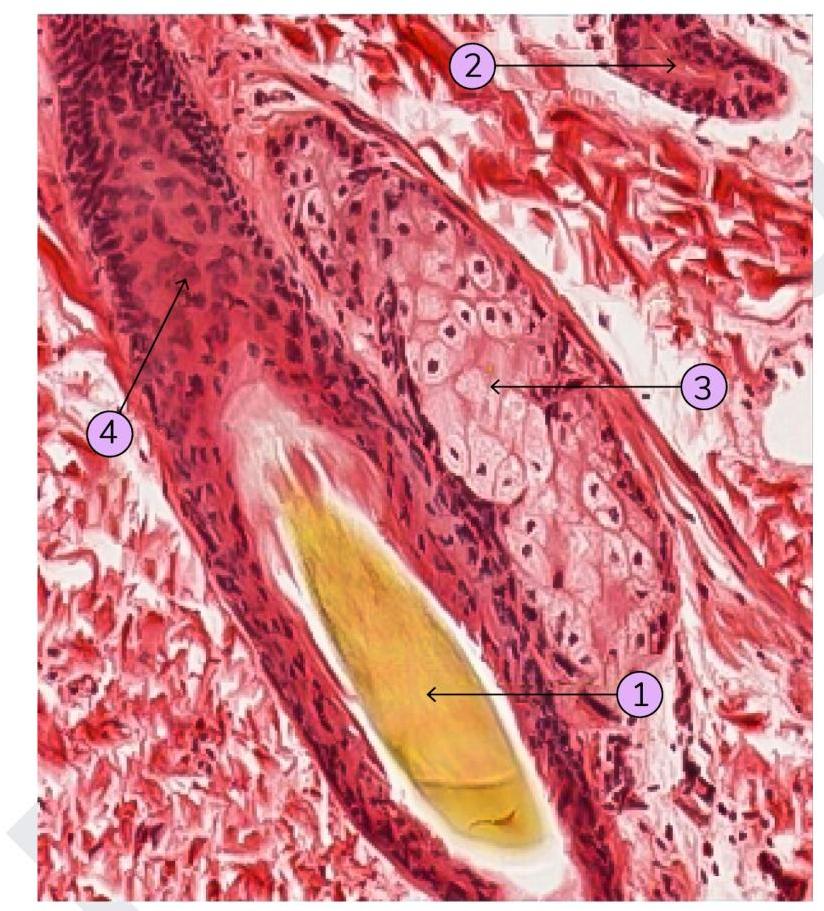
Identify which of the following structure is a sebaceous gland:
Fingerprint first develops in how many weeks of intrauterine life?
Froment's sign (book test) is used to assess the function of adductor pollicis. Which of the following nerves supplies this muscle?
INI-CET 2022 - Anatomy INI-CET Practice Questions and MCQs
Question 11: A 50-year-old male patient presented with left -sided hemiparesis. Damage to which part of the internal capsule leads to this presentation?
- A. Anterior limb
- B. Posterior limb (Correct Answer)
- C. Retrolentiform
- D. Sublentiform
Explanation: Posterior limb - The posterior limb of the internal capsule contains the corticospinal tracts, which carry motor commands from the brain to the spinal cord [1]. - Damage to this area typically results in contralateral hemiparesis or hemiplegia, matching the patient's left-sided weakness. Anterior limb - The anterior limb of the internal capsule primarily contains tracts connecting the thalamus to the frontal lobe and the pontine nuclei to the cerebellum. - Lesions here typically cause dysarthria or behavioral changes, not hemiparesis. Retrolentiform - The retrolentiform part of the internal capsule carries visual (optic radiation) and auditory pathways. - Damage to this area would primarily cause contralateral visual field deficits or auditory agnosia, not motor weakness. Sublentiform - The sublentiform part of the internal capsule contains auditory radiations and temporopontine fibers. - Injury here would result in auditory symptoms or potentially aphasia if dominant hemisphere is affected, not hemiparesis.
Question 12: Identify the cell marked in the image below
- A. Macrophage
- B. Plasma cell
- C. Fibroblast
- D. Mast cell (Correct Answer)
Explanation: ***Mast cell*** - The cell indicated by the arrow displays characteristic features of a **mast cell**, including its large size, prominent central nucleus, and cytoplasm densely packed with numerous large, basophilic (darkly stained) granules. - These granules contain powerful inflammatory mediators like **histamine** and **heparin**, which are key in allergic reactions and inflammation. *Macrophage* - Macrophages are typically larger than mast cells with an **irregular shape**, a kidney-shaped nucleus, and often contain phagocytosed material in their cytoplasm, which is not clearly visible here. - While they are also immune cells, they lack the characteristic dense, uniform basophilic granulation seen in the indicated cell. *Plasma cell* - Plasma cells are characterized by an **eccentric nucleus** with **chromatin clumping** (cartwheel or clock-face appearance) and a prominent Golgi apparatus (perinuclear halo), none of which are evident in the marked cell. - Their cytoplasm is typically basophilic but lacks the distinct large granules. *Fibroblast* - Fibroblasts are typically **spindle-shaped** or stellate cells with elongated nuclei and a sparse cytoplasm, responsible for producing extracellular matrix. - They do not possess the abundant, dense cytoplasmic granules that are a hallmark of the cell shown.
Question 13: Identify which of the following structure is a sebaceous gland:
- A. 2 (Correct Answer)
- B. 3
- C. 4
- D. 1
Explanation: ***Correct: (2) Sebaceous gland*** - The structure labeled (2) is a **sebaceous gland**, characterized by its **multicellular alveolar structure** typically associated with a hair follicle - Sebaceous glands are **holocrine glands** where the entire cell disintegrates to release sebum (oily secretion) - These glands are found throughout the body except on palms and soles, and produce **sebum for lubrication** of hair and skin - Histologically identified by **grape-like clusters of cells** with foamy cytoplasm due to lipid content *Incorrect: (3) Inner root sheath* - The structure labeled (3) represents the **inner root sheath** of the hair follicle - This is a **structural component**, not a glandular structure - Functions to provide support and guidance to the developing hair shaft - Composed of three layers: Henle's layer, Huxley's layer, and the cuticle *Incorrect: (4) Hair matrix* - The structure labeled (4) indicates the **hair matrix**, located at the base of the hair follicle - This is a **proliferative zone** with actively dividing cells responsible for hair growth - Not a glandular structure, but rather the germinative region where hair cells differentiate - Contains melanocytes that provide pigment to the growing hair *Incorrect: (1) Hair shaft* - The structure labeled (1) is the **hair shaft**, the visible keratinized portion of the hair - This is the **final product** of the hair follicle, composed of dead, keratinized cells - Not a glandular structure, but rather a modified epidermal structure - Extends from the hair follicle through the skin surface
Question 14: Fingerprint first develops in how many weeks of intrauterine life?
- A. 20-24
- B. 12-16 (Correct Answer)
- C. 28-32
- D. 32-36
Explanation: ***12-16*** - **Fingerprint patterns**, specifically the **friction ridges** on the fingers, begin to form between 12 and 16 weeks of gestation. - This period marks the development of the **dermal papillae** and epidermal ridges that create the unique patterns. *20-24* - By 20-24 weeks, the fingerprint patterns are already **well-established** and clearly visible. - This stage is beyond the initial developmental period when the patterns first emerge. *28-32* - At 28-32 weeks, the fingerprint patterns are **fully formed** and permanent. - This timeframe is too late for the initial development of these unique dermal features. *32-36* - By 32-36 weeks, the fetus is nearing full term, and the **fingerprint morphology** is complete and stable. - The initial formation process has long since concluded before this stage.
Question 15: Froment's sign (book test) is used to assess the function of adductor pollicis. Which of the following nerves supplies this muscle?
- A. Radial nerve
- B. Posterior interosseous nerve
- C. Median nerve
- D. Ulnar nerve (Correct Answer)
Explanation: The adductor pollicis muscle is primarily innervated by the deep branch of the ulnar nerve [1]. This muscle is crucial for thumb adduction, and its function is assessed by the Froment's sign (often referred to as the book test) to detect ulnar nerve palsy. The radial nerve primarily innervates the muscles of the posterior compartment of the arm and forearm, responsible for wrist and finger extension [1]. It does not supply any intrinsic muscles of the hand, including the adductor pollicis [1]. The posterior interosseous nerve is a terminal branch of the deep radial nerve, supplying most of the extensors in the forearm [1]. It does not innervate any of the intrinsic hand muscles. The median nerve innervates most of the flexors of the forearm and the thenar muscles of the hand (abductor pollicis brevis, opponens pollicis, and superficial head of flexor pollicis brevis) [1]. It does not supply the adductor pollicis muscle; median nerve palsy would affect thumb opposition and abduction, not adduction [1].