Dermatology
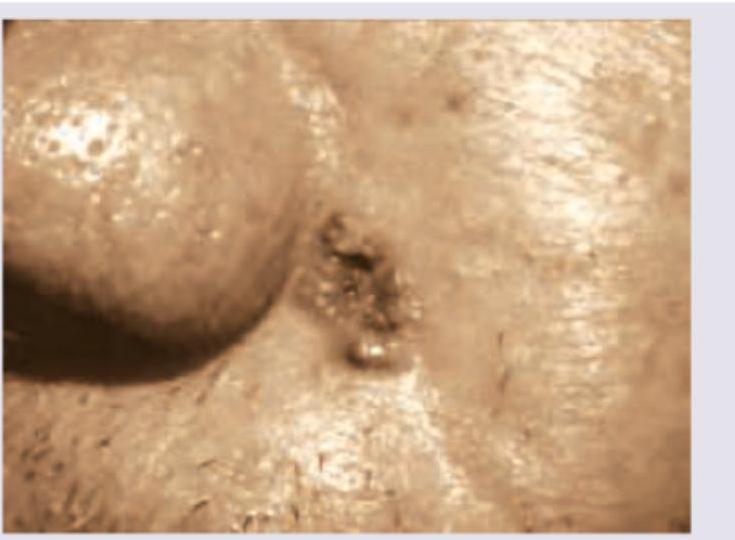
1 questionsA female had a thorn prick 5 years ago. She presents with development of slowly growing $2 \times 2 \mathrm{~cm}$ verrucous lesion which on KOH mount shows the following image. Diagnosis is: (AIIMS Nov 2017)

INI-CET 2017 - Dermatology INI-CET Practice Questions and MCQs
Question 71: A female had a thorn prick 5 years ago. She presents with development of slowly growing $2 \times 2 \mathrm{~cm}$ verrucous lesion which on KOH mount shows the following image. Diagnosis is: (AIIMS Nov 2017)
- A. Chromoblastomycosis (Correct Answer)
- B. Sporotrichosis
- C. Blastomycosis
- D. Phaeohyphomycosis
Explanation: ***Chromoblastomycosis*** - The image shows **sclerotic bodies** (also known as **Medlar bodies**, muriform cells, or fumagoid cells) which are characteristic of *Chromoblastomycosis*. These are thick-walled, septate, dematiaceous (darkly pigmented) fungal cells that reproduce by septation in multiple planes. - The history of a **thorn prick** (trauma allowing inoculation of fungal spores from soil/vegetation), the **slowly growing verrucous lesion**, and the presence of sclerotic bodies on KOH mount are all highly specific for chromoblastomycosis. *Sporotrichosis* - **Sporotrichosis** typically presents with subcutaneous nodules that ulcerate, often forming a **lymphocutaneous spread** along lymphatic vessels. - On microscopy (KOH mount or biopsy), *Sporothrix schenckii* appears as **cigar-shaped budding yeasts** in tissue, which are not seen in the provided image. *Blastomycosis* - **Blastomycosis** is caused by *Blastomyces dermatitidis* and can cause pulmonary, cutaneous, and disseminated infections. Cutaneous lesions can be verrucous but are typically granulomatous with microabscesses. - Microscopic examination (KOH mount) reveals **large, broad-based budding yeast cells**, which are distinct from the sclerotic bodies shown. *Phaeohyphomycosis* - **Phaeohyphomycosis** encompasses a diverse group of infections caused by dematiaceous (pigmented) fungi that, in tissue, grow as **septate hyphae**, yeast-like cells, or a combination of both, but **do not form sclerotic bodies**. - While it can manifest as subcutaneous nodules or cysts, the diagnostic feature in tissue is the presence of pigmented hyphal forms, unlike the characteristic sclerotic bodies in the image.
Microbiology
4 questionsIdentify the organism seen in the slide shown below.

Which of the following bacteria has the flagellar characteristic shown in the image?

Amongst the four choices, select the virus whose life cycle is shown. (AIIMS Nov 2017)

Identify the fungal organism in this slide stained with Gomori-methenamine silver stain. (AIIMS Nov 2017)

INI-CET 2017 - Microbiology INI-CET Practice Questions and MCQs
Question 71: Identify the organism seen in the slide shown below.
- A. Streptococcus pyogenes
- B. M. tuberculosis
- C. Nocardia asteroides (Correct Answer)
- D. Corynebacterium diphtheriae
Explanation: ***Nocardia asteroides*** - The image exhibits **branching, beaded, filamentous rods** that stain **acid-fast**, key characteristics of *Nocardia*. - These morphological features, especially the irregular acid-fast staining and branching, differentiate it from other bacteria. *Streptococcus pyogenes* - *Streptococcus pyogenes* are Gram-positive cocci typically arranged in **chains**, showing none of the filamentous or branching forms seen in the image. - They are **not acid-fast** and would not appear as pink/red rods on an acid-fast stain. *M. tuberculosis* - While *M. tuberculosis* is **acid-fast** and appears as red rods, it typically presents as **straight or slightly curved rods**, not the extensively branching, beaded filaments observed. - It does not form the complex filamentous structures characteristic of *Nocardia*. *Corynebacterium diphtheriae* - *Corynebacterium diphtheriae* are Gram-positive, **club-shaped rods** that often assume V or L forms (palisades), and are not acid-fast. - This bacterium does not exhibit the extensive branching or beaded appearance characteristic of the organism in the image.
Question 72: Which of the following bacteria has the flagellar characteristic shown in the image?
- A. Helicobacter pylori
- B. Mycobacterium tuberculosis
- C. Leptospira icterohaemorrhagicae (Correct Answer)
- D. Vibrio cholerae
Explanation: ***Leptospira icterohaemorrhagicae*** - The image displays **endoflagella** (axial filaments) located beneath the **outer membrane**, which is characteristic of **spirochetes**. - *Leptospira icterohaemorrhagicae* is a spirochete and possesses these internal flagella, allowing for its distinctive corkscrew motility. *Helicobacter pylori* - *Helicobacter pylori* is a gram-negative bacterium that typically has **lophotrichous flagella** (multiple flagella at one pole), which are external, not internal. - Its motility is crucial for penetrating the gastric mucus, but it does not utilize endoflagella. *Mycobacterium tuberculosis* - *Mycobacterium tuberculosis* is a non-motile bacterium and **lacks flagella** altogether. - Its cell wall structure, rich in mycolic acid, contributes to its pathogenicity and resistance but not to motility via flagella. *Vibrio cholerae* - *Vibrio cholerae* is a gram-negative bacterium that possesses a **single polar flagellum** (monotrichous), which is external. - This external flagellum is essential for its motility in aquatic environments and in the human intestine.
Question 73: Amongst the four choices, select the virus whose life cycle is shown. (AIIMS Nov 2017)
- A. Hepatitis B (Correct Answer)
- B. Herpes simplex
- C. HIV
- D. Influenza
Explanation: ***Hepatitis B*** - The image clearly depicts the formation of **cccDNA (covalently closed circular DNA)** in the host cell nucleus, a unique and defining characteristic of the Hepatitis B virus life cycle. - The process of **reverse transcription** (synthesis of DNA from an RNA template) occurring within the core particle in the cytoplasm, followed by its movement to the nucleus to form cccDNA, is specific to Hepatitis B. *Herpes simplex* - Herpes simplex viruses are **DNA viruses** that replicate entirely within the nucleus, and their replication does not involve an RNA intermediate or the formation of cccDNA. - They also undergo **budding from the inner nuclear membrane** into the perinuclear space, which differs from the ER budding shown. *HIV* - HIV is a **retrovirus** that utilizes reverse transcriptase to convert its RNA genome into DNA, which then integrates into the host genome. However, it does not form cccDNA. - While it does involve reverse transcription, the overall replication strategy, particularly the integration step and the budding from the cell membrane, differs significantly from the depicted process. *Influenza* - Influenza is an **RNA virus** that replicates in the nucleus (unlike most RNA viruses) but does not involve a DNA intermediate or cccDNA formation. - Its replication cycle involves transcription of viral RNA into mRNA and replication of viral RNA genomes, which is distinct from the complex DNA to RNA to DNA cycle shown.
Question 74: Identify the fungal organism in this slide stained with Gomori-methenamine silver stain. (AIIMS Nov 2017)
- A. Acute angle branching, rhizopus
- B. Right angle branching, aspergillus
- C. Acute angle branching, aspergillus (Correct Answer)
- D. Right angle branching, mucor
Explanation: **Acute angle branching, aspergillus** - The image shows **septate hyphae** with **acute angle (45-degree) branching**, which is characteristic of *Aspergillus* species. - While *Aspergillus* can be identified by conidial heads in culture, in tissue sections stained with Gomori-methenamine silver (GMS) stain, these morphological features are key. *Acute angle branching, rhizopus* - **Rhizopus** species typically exhibit **non-septate or sparsely septate hyphae** with **irregular branching**, often at wide angles. - This morphology differs from the regularly septate, acutely branching hyphae seen in the image. *Right angle branching, aspergillus* - **Aspergillus** hyphae characteristically show **acute angle (45-degree) branching**, not right-angle branching. - The hyphae are also **septate**, a feature that is clearly visible in the image. *Right angle branching, mucor* - **Mucor** species, like other Mucorales (e.g., *Rhizopus*, *Lichtheimia*), are known for their **non-septate or sparsely septate hyphae** with **wide-angle (often right-angle) branching**. - The hyphae in the image are clearly septate and branch acutely, ruling out *Mucor*.
Orthopaedics
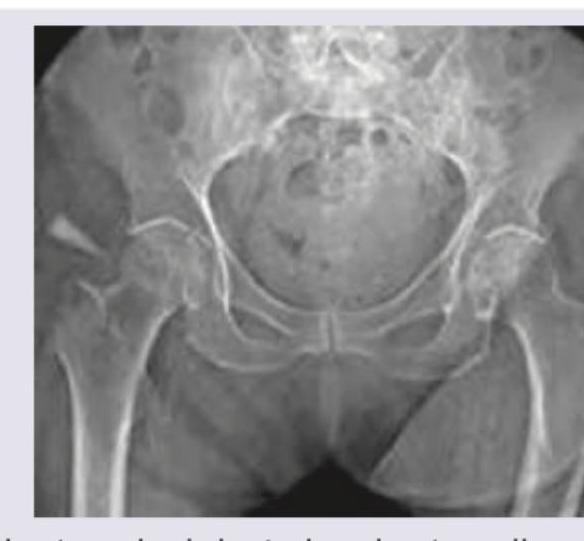
5 questionsAn elderly patient slipped in the bathroom and sustained injury over the hip joint. X- Ray is shown below. Her attitude of leg will be?

Which position is being tested on the patient in the image shown below?

A patient came with inability to move his 4th and 5th digit and cannot hold pen or paper between his fingers. Which of the following sites shown below is the probable cause of nerve injury to this patient?

Which is the suggested treatment of the lesion shown in the X-ray?

Which of the following is the bone holding instrument used in orthopaedic surgeries?

INI-CET 2017 - Orthopaedics INI-CET Practice Questions and MCQs
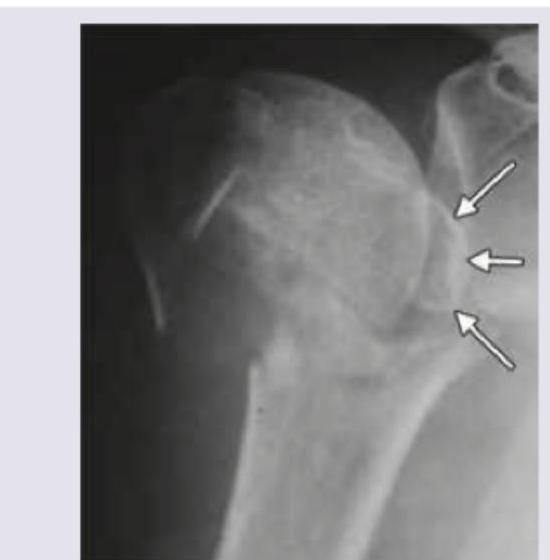
Question 71: An elderly patient slipped in the bathroom and sustained injury over the hip joint. X- Ray is shown below. Her attitude of leg will be?
- A. Shortened, abducted and externally rotated (Correct Answer)
- B. Shortened and abducted
- C. Lengthened and internally rotated
- D. Flexed and adducted and internally rotated
Explanation: ***Shortened, abducted and externally rotated*** - The X-ray image reveals an **intertrochanteric fracture** of the right hip, characterized by a fracture line between the greater and lesser trochanters. - Due to the pull of strong muscles acting on the fractured fragments (e.g., iliopsoas, gluteal muscles), the limb typically assumes a position of **shortening, abduction, and external rotation**. *Shortened and abducted* - While **shortening** and **abduction** are present in intertrochanteric fractures, this answer is incomplete as it misses the crucial component of **external rotation**. - The powerful **external rotators** and the **gravity** acting on the unstable distal fragment contribute significantly to the external rotation. *Lengthened and internally rotated* - This attitude is characteristic of a **posterior hip dislocation**, where the femoral head is driven posteriorly and superiorly, typically leading to limb lengthening and internal rotation. - This is opposite to the typical presentation of an intertrochanteric fracture as seen in the X-ray. *Flexed and adducted and internally rotated* - A flexed, adducted, and internally rotated position is also seen in **posterior hip dislocations**, which is not consistent with the X-ray findings of an intertrochanteric hip fracture. - Hip fractures usually result in some degree of **external rotation** due to the muscle forces.
Question 72: Which position is being tested on the patient in the image shown below?
- A. Internal rotation
- B. External rotation (Correct Answer)
- C. Abduction
- D. Flexion
Explanation: ***External rotation*** - In the image, the patient's hip is flexed and the examiner is rotating the lower leg *medially*, which causes **external rotation** of the hip joint. - This maneuver assesses the range of motion for **external rotation** at the hip. *Internal rotation* - Internal rotation of the hip would involve rotating the lower leg **laterally**, which is the opposite of what is depicted. - This motion brings the front of the thigh closer to the midline when the hip is flexed. *Abduction* - **Abduction** is the movement of the leg away from the midline of the body, which is not being performed in this image. - This movement primarily involves muscles like the **gluteus medius** and **minimus**. *Flexion* - While the hip is maintained in a **flexed position**, the primary motion being tested by the examiner's manipulation is the *rotation* of the femur within the hip socket, not further flexion. - **Flexion** involves lifting the leg towards the torso, often with a bent knee.
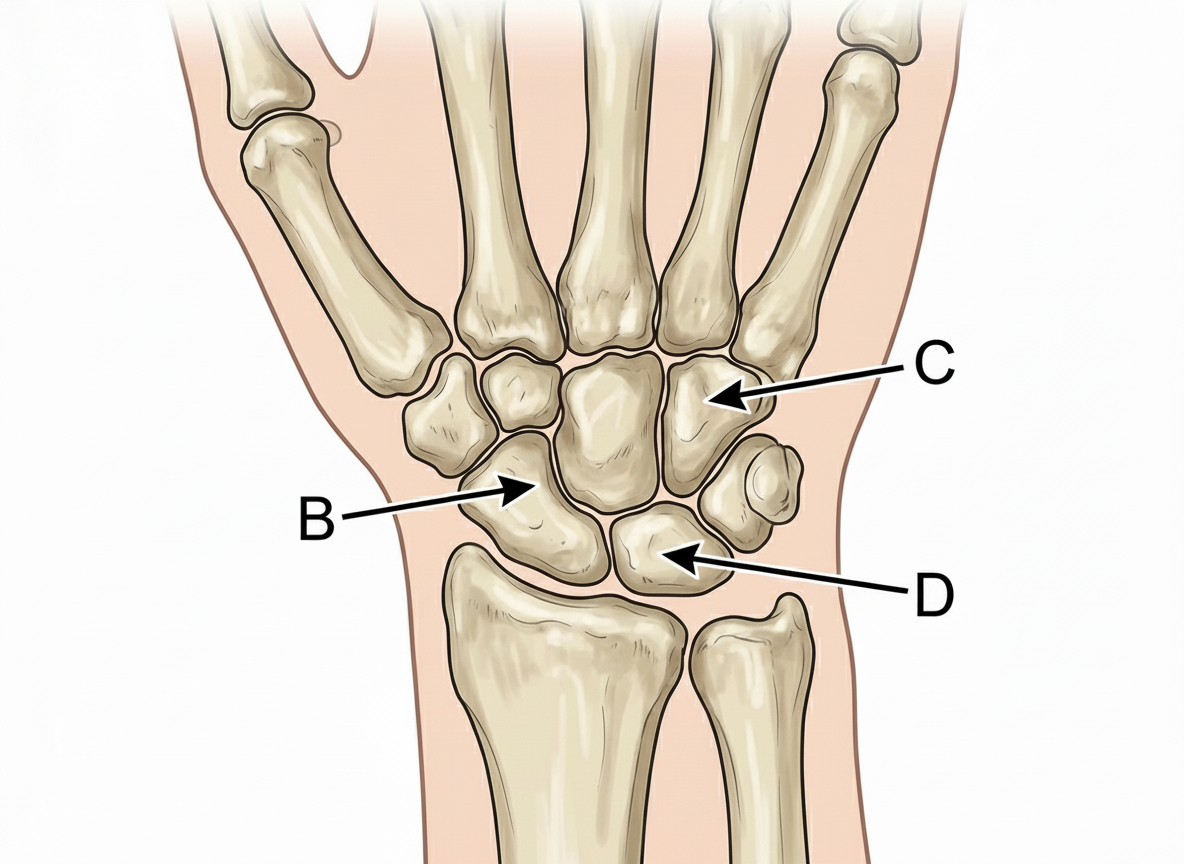
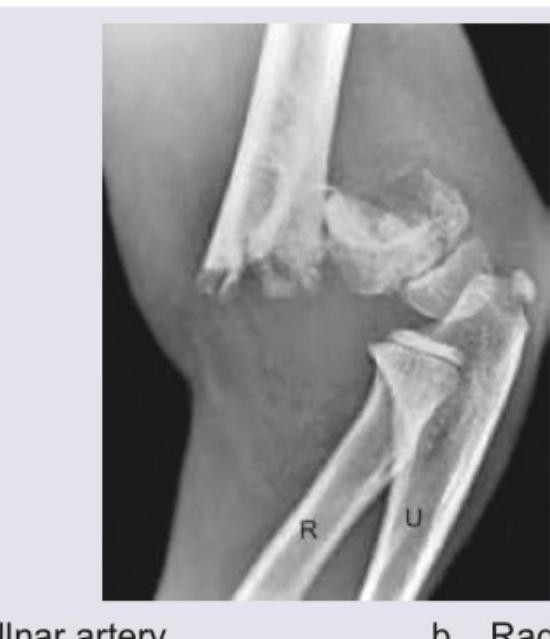
Question 73: A patient came with inability to move his 4th and 5th digit and cannot hold pen or paper between his fingers. Which of the following sites shown below is the probable cause of nerve injury to this patient?
- A. A
- B. B
- C. C (Correct Answer)
- D. D
Explanation: **C** - The symptoms described (inability to move the 4th and 5th digits and difficulty with adduction/abduction of fingers, e.g., holding a pen) are characteristic of **ulnar nerve injury**. - The ulnar nerve passes behind the **medial epicondyle** of the humerus, which corresponds to location **C** in the image, making it vulnerable to injury here. *A* - Location **A** represents the surgical neck of the humerus. Injury here primarily affects the **axillary nerve**, leading to weakness in shoulder abduction and loss of sensation over the deltoid. - This does not explain the specific loss of function in the 4th and 5th digits. *B* - Location **B** represents the mid-shaft of the humerus. Fractures here commonly injure the **radial nerve**, leading to "wrist drop" and sensory loss over the posterior forearm and hand. - This injury pattern does not match the patient's symptoms affecting the ulnar side of the hand. *D* - Location **D** represents the lateral epicondyle of the humerus. This area is associated with conditions like **tennis elbow** (lateral epicondylitis), which involves inflammation of the common extensor origin. - Nerve injuries related to this area typically involve the deep branch of the **radial nerve** (posterior interosseous nerve), leading to weakness in finger and thumb extension, not ulnar nerve symptoms.
Question 74: Which is the suggested treatment of the lesion shown in the X-ray?
- A. Intramedullary nail
- B. Tension band wiring (Correct Answer)
- C. Patellectomy
- D. Above knee cast
Explanation: ***Tension band wiring*** - The X-ray image shows a **transverse patellar fracture** with some displacement, which is well-suited for tension band wiring. - This technique converts tensile forces on the anterior surface of the patella into compressive forces at the fracture site during knee flexion. *Intramedullary nail* - **Intramedullary nailing** is primarily used for **long bone fractures** (e.g., femur, tibia, humerus) and is not appropriate for patellar fractures. - This method is designed to stabilize diaphyseal or metaphyseal fractures in load-bearing long bones by placing a rod within the medullary canal. *Patellectomy* - **Patellectomy** (surgical removal of the patella) is typically reserved for **severely comminuted** or irreparable patellar fractures, or in cases of infection, which is not indicated by the X-ray. - This procedure can lead to significant functional impairment, including reduced quadriceps strength and increased tibiofemoral joint stress. *Above knee cast* - While an **above-knee cast** can provide - An above-knee cast does not provide **sufficient reduction and compression** for displaced patellar fractures, which are subjected to significant tensile forces. - Conservative management is generally reserved for **non-displaced or minimally displaced** patellar fractures where the extensor mechanism remains intact.
Question 75: Which of the following is the bone holding instrument used in orthopaedic surgeries?
- A. Instrument in upper right quadrant (Correct Answer)
- B. Instrument in upper left quadrant
- C. Instrument in lower left quadrant
- D. Instrument in lower right quadrant
Explanation: ***The image in the upper right quadrant*** - This instrument is a **bone-holding clamp/forceps**, characterized by its robust construction and jaws designed to securely grasp and stabilize bone fragments during orthopedic procedures. - The **ratchet mechanism** visible on the handles allows for maintaining a constant grip on the bone without continuous manual pressure. *The image in the upper left quadrant* - This instrument appears to be a **sponge-holding forceps**, distinguishable by its generally lighter build and oval/circular fenestrated (windowed) tips, which are used to hold sponges or swabs. - Its primary role is for **aseptic preparation** of the surgical site or for absorbing fluids, not for bone manipulation. *The image in the lower left quadrant* - This instrument is a **bone rongeur** or **bone cutter**, designed with sharp, cup-like jaws to bite off small pieces of bone or cartilage. - It is used for **debridement**, shaping bone, or extracting bone fragments, rather than holding them. *The image in the lower right quadrant* - This instrument is a **bone awl** or **trephine**, typically used to create holes or puncture the bone marrow cavity. - It has a pointed, sharp tip and a handle for applying force, but it does not have any mechanism for grasping or holding bone.