General Medicine
1 questionsA 50-year-old smoker and hypertensive patient presents with the lesion shown below. It is painful and present bilaterally. Peripheral pulses are palpable. What is the diagnosis?

INI-CET 2017 - General Medicine INI-CET Practice Questions and MCQs
Question 41: A 50-year-old smoker and hypertensive patient presents with the lesion shown below. It is painful and present bilaterally. Peripheral pulses are palpable. What is the diagnosis?
- A. Arterial ulcer
- B. Martorell ulcer (Correct Answer)
- C. Trophic ulcer
- D. Bairnsdale ulcer
Explanation: ***Martorell ulcer*** - This is a **hypertensive ischemic leg ulcer** primarily associated with uncontrolled hypertension, often seen in older patients who smoke. - Key features include extreme pain, location on the **anterolateral aspect of the lower leg**, and frequently bilateral presentation, despite palpable peripheral pulses. *Arterial ulcer* - **Arterial ulcers** are typically caused by **peripheral artery disease (PAD)**, leading to reduced blood flow. - While they can be painful, PAD is usually associated with **diminished or absent peripheral pulses**, which are present in this case. *Trophic ulcer* - A **trophic ulcer** is a general term for an ulcer caused by **poor nutrition** to the tissues, often due to neuropathy or chronic venous insufficiency. - While they can be chronic, the specific presentation with palpable pulses, severe pain, and association with hypertension points away from a generic trophic ulcer. *Bairnsdale ulcer* - Also known as **Buruli ulcer**, this is a **mycobacterial infection** caused by *Mycobacterium ulcerans*. - It typically starts as a painless nodule and slowly progresses to a large, often painless ulcer with undermined edges, which is not consistent with the painful lesion described.
Pathology
1 questionsA patient with chronic cholelithiasis develops the complication shown in the image below. This leads to development of:

INI-CET 2017 - Pathology INI-CET Practice Questions and MCQs
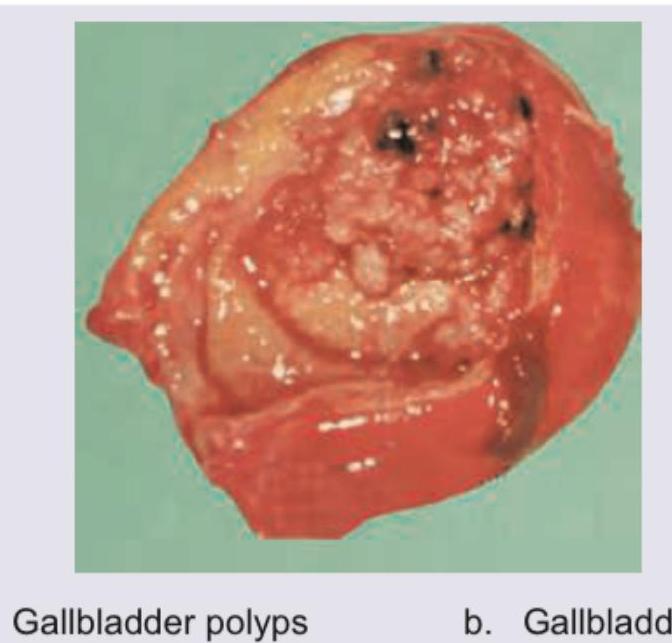
Question 41: A patient with chronic cholelithiasis develops the complication shown in the image below. This leads to development of:
- A. Bouveret syndrome (Correct Answer)
- B. Emphysematous cholecystitis
- C. Cholesterolosis
- D. Carcinoma of gallbladder
Explanation: ***Bouveret syndrome*** - The image shows gallstones in the gallbladder (GB) moving into the duodenum through a **cholecystoenteric fistula**, specifically into the stomach and duodenum, which is the mechanism leading to **Bouveret syndrome** [3]. - **Bouveret syndrome** is a rare form of gastric outlet obstruction caused by a large gallstone eroding through the gallbladder wall into the duodenum or stomach [3]. *Emphysematous cholecystitis* - This condition is characterized by the presence of **gas in the gallbladder wall or lumen** due to infection by gas-forming organisms, which is not depicted in the image. - It's a severe form of acute cholecystitis, often seen in diabetics or immunocompromised patients, and does not involve stone migration into the gut as shown. *Cholesterolosis* - **Cholesterolosis** (also known as "strawberry gallbladder") is a benign condition characterized by an accumulation of cholesterol esters in the macrophages of the gallbladder wall. - It does not involve the migration of gallstones into the gastrointestinal tract or the formation of fistulas and is not represented by the stones shown entering the duodenum. *Carcinoma of gallbladder* - **Gallbladder carcinoma** is a malignant tumor arising from the epithelial lining of the gallbladder [1]. - While chronic gallstones can be a risk factor for gallbladder cancer, the image specifically illustrates a mechanical complication of gallstone migration, not a neoplastic process [1][2]. **References:** [1] Kumar V, Abbas AK, et al.. Robbins and Cotran Pathologic Basis of Disease. 9th ed. Liver and Gallbladder, p. 886. [2] Kumar V, Abbas AK, et al.. Robbins and Cotran Pathologic Basis of Disease. 9th ed. Liver and Gallbladder, pp. 883-884. [3] Cross SS. Underwood's Pathology: A Clinical Approach. 6th ed. Common Clinical Problems From Liver And Biliary System Disease, pp. 404-405.
Pediatrics
1 questionsThe image shows:

INI-CET 2017 - Pediatrics INI-CET Practice Questions and MCQs
Question 41: The image shows:
- A. Bladder exstrophy (Correct Answer)
- B. Urachal anomalies
- C. Systolic bladder
- D. Congenital adrenal hyperplasia
Explanation: ***Bladder exstrophy*** - The image clearly displays an **exposed bladder mucosa** projecting from the lower abdominal wall, which is characteristic of bladder exstrophy. - This congenital anomaly results from a **failure of fusion of the anterior abdominal wall** and bladder during embryonic development. *Urachal anomalies* - Urachal anomalies involve persistent remnants of the **urachus**, connecting the bladder to the umbilicus, leading to cysts, sinuses, or fistulas. - They typically appear as lesions at or near the **umbilicus** and do not involve the direct exposure of the bladder. *Systolic bladder* - "Systolic bladder" is **not a recognized medical term** for a congenital anomaly. - Bladder function is described in terms of contraction (systole) and relaxation (diastole) but does not refer to a structural malformation. *Congenital adrenal hyperplasia* - This is an **endocrine disorder** affecting hormone production by the adrenal glands, leading to ambiguous genitalia in some cases. - It does not involve a **visible external defect of the bladder** or abdominal wall.
Radiology
1 questionsA 50-year-old man went for his annual medical check-up. CT scan is shown below. Diagnosis is?

INI-CET 2017 - Radiology INI-CET Practice Questions and MCQs
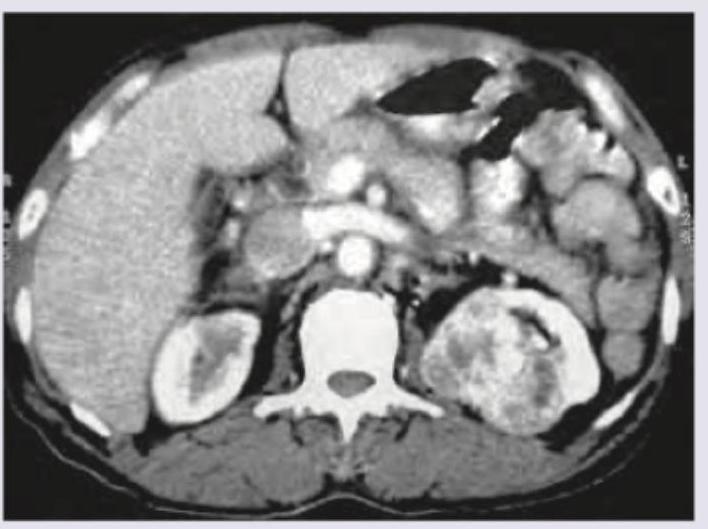
Question 41: A 50-year-old man went for his annual medical check-up. CT scan is shown below. Diagnosis is?
- A. Renal cell carcinoma
- B. Renal angiomyolipoma (Correct Answer)
- C. Renal cyst
- D. Rhabdomyosarcoma
Explanation: ***Renal angiomyolipoma*** - The CT scan shows a renal mass with areas of **macroscopic fat density**, which is the hallmark of an angiomyolipoma. - Angiomyolipomas are **benign renal tumors** composed of variable amounts of smooth muscle, vascular tissue, and mature adipose tissue. *Renal cell carcinoma* - While renal cell carcinoma can present as a solid renal mass, it typically does **not contain macroscopic fat**. - It usually enhances heterogeneously with contrast and may show areas of necrosis or hemorrhage, but the presence of fat rules out typical RCC. *Renal cyst* - Renal cysts are typically **simple fluid-filled structures** with very low attenuation values (close to water) and **do not contain solid components or fat**. - They also have thin, imperceptible walls and do not enhance with contrast. *Rhabdomyosarcoma* - Rhabdomyosarcomas are **malignant soft tissue tumors** rarely found in the kidney, and would appear as a solid, often heterogeneous mass on CT. - They do **not contain fat** and are aggressive tumors, often associated with a different patient demographic (e.g., children).
Surgery
6 questionsWhich is incorrect about the procedure shown in the patient with right flank pain?

Identify the instrument shown in the image:

Which is correct about hematemesis (upper GI bleeding) in this patient?

What type of choledochal cyst is shown in the image?

Which classification is used to evaluate the condition shown in the image below?

A 30-year-old construction worker had a partial traumatic nail avulsion. 3 weeks later he presents with the presentation shown below. What is the diagnosis?

INI-CET 2017 - Surgery INI-CET Practice Questions and MCQs
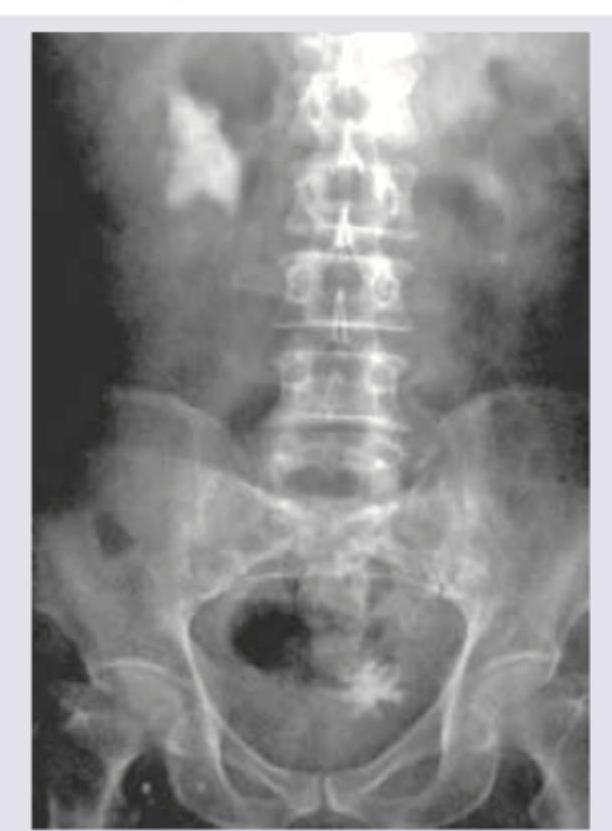
Question 41: Which is incorrect about the procedure shown in the patient with right flank pain?
- A. No anesthesia is required (Correct Answer)
- B. Done as outpatient procedure
- C. Contraindicated in hard stones
- D. Shockwaves pass through a water bath
Explanation: In the provided image, there is a large, irregularly shaped, radio-opaque density in the right renal area, consistent with a **staghorn calculus**, likely causing the right flank pain. This type of calculus typically fills the renal pelvis and calyces. The question asks what is *incorrect* about the procedure shown, referring to **Extracorporeal Shockwave Lithotripsy (ESWL)**, a common treatment for kidney stones. ***Correct: No anesthesia is required*** - This statement is **incorrect** and is the correct answer to this negation question - ESWL typically requires some form of **analgesia or sedation** (e.g., intravenous fentanyl, midazolam, or even general anesthesia in selected cases) - The shockwaves cause significant discomfort as they are delivered, making **pain management essential** for patient comfort and compliance - While some patients with high pain tolerance may undergo the procedure with minimal analgesia, most require sedation *Incorrect: Contraindicated in hard stones* - This statement is partially correct, making it NOT the best answer - While hard stones (e.g., **calcium oxalate monohydrate, cystine, brushite**) are **more resistant** to ESWL with lower stone-free rates, ESWL is **not absolutely contraindicated** - ESWL can still be attempted for hard stones, though it may require multiple sessions, higher energy settings, or may ultimately fail, necessitating alternative treatments like **ureteroscopy** or **percutaneous nephrolithotomy (PCNL)** - True contraindications include pregnancy, uncorrected bleeding disorders, obstruction distal to the stone, and severe skeletal deformities *Incorrect: Done as outpatient procedure* - This statement is **correct** about ESWL, so it is NOT the answer to this negation question - ESWL is routinely performed on an **outpatient basis**, with patients typically going home the same day - Patients are monitored for a short period post-procedure (usually 1-2 hours) to ensure there are no immediate complications like significant hematuria or pain before discharge - Rarely, patients may require overnight observation if complications arise *Incorrect: Shockwaves pass through a water bath* - This statement is **outdated** but historically accurate - **First-generation ESWL machines** (1980s) utilized a **water bath** in which the patient was partially submerged to couple the shockwaves - **Modern lithotripters** (second and third generation) use a **gel pad** or **water cushion** placed directly on the skin, eliminating the need for water immersion while maintaining acoustic coupling - While technically incorrect for modern ESWL, the statement was historically true, making "no anesthesia required" a more definitively incorrect statement
Question 42: Identify the instrument shown in the image:
- A. Asepto syringe (Correct Answer)
- B. Trocar for tapping hydrocele
- C. Czerny retractor
- D. Malecot catheter
Explanation: ***Asepto syringe*** - The image displays a **red rubber bulb** attached to a glass or plastic barrel ending in a nozzle, which is characteristic of an **Asepto syringe**. - Asepto syringes are commonly used for **irrigation** of wounds or surgical sites, and for various procedures where precise suction or fluid delivery is needed without a needle. *Trocar for tapping hydrocele* - A **trocar** is a pointed medical instrument with a sharp tip, typically used with a cannula to introduce instruments or drain fluids from a body cavity. - Trocars for hydrocele tapping would differ significantly in appearance, featuring a pointed tip and often a stylet, which are absent here. *Czerny retractor* - A **Czerny retractor** is a surgical instrument with two blades, used primarily to hold back tissue during surgery to provide a clear view of the surgical field. - The instrument shown here is focused on fluid suction/delivery, not on tissue retraction. *Malecot catheter* - A **Malecot catheter** is a type of self-retaining catheter, typically made from soft, flexible material, with a distinctive mushroom-shaped tip that helps anchor it within a viscus. - This image clearly depicts a syringe-like device with a bulb, not a flexible catheter with a four-winged tip.
Question 43: Which is correct about hematemesis (upper GI bleeding) in this patient?
- A. Most common is variceal bleeding
- B. Occurs only if bleeding occurs proximal to ligament of Treitz
- C. MC management is endoscopic banding
- D. Rockall scoring is used for risk stratification (Correct Answer)
Explanation: ***Rockall scoring is used for risk stratification*** - The image shows a patient with significant **hematemesis**, indicating an upper gastrointestinal bleed. The **Rockall score** is a validated tool used to assess the risk of rebleeding and mortality in patients with upper GI bleeding. - This scoring system considers factors such as **age**, **shock**, **comorbidity**, and endoscopic findings to guide management. *Most common is variceal bleeding* - While variceal bleeding is a serious cause of upper GI hemorrhage, **peptic ulcer disease** (gastric or duodenal ulcers) is the most common cause of non-variceal upper GI bleeding, accounting for 40-50% of cases. - Variceal bleeding is common in patients with **portal hypertension**, often due to liver cirrhosis. *Occurs only if bleeding occurs proximal to ampulla of Vater* - **Hematemesis** (vomiting blood) specifically indicates bleeding **proximal to the ligament of Treitz**, which is superior to the ampulla of Vater. - Bleeding from the small intestine distal to the ligament of Treitz or the colon typically results in **melena** or **hematochezia**, not hematemesis. *MC management is endoscopic banding* - **Endoscopic banding** is the primary treatment for **esophageal variceal bleeding**. - For non-variceal bleeding, such as from **peptic ulcers**, the most common endoscopic management is **epinephrine injection** followed by **thermal coagulation** or **clip placement**.
Question 44: What type of choledochal cyst is shown in the image?
- A. 1
- B. 2 (Correct Answer)
- C. 3
- D. 4
Explanation: ***2*** - The image displays a **diverticulum** protruding from the side of the **common bile duct (CBD)**, which is characteristic of a **Type II choledochal cyst**. - Type II choledochal cysts are rare, focal diverticula of the CBD, typically managed by excision. *1* - Type I choledochal cysts involve **fusiform or cystic dilation** of the extrahepatic bile duct, not a diverticulum protruding from the side. - They are the most common type and are usually treated with cyst excision and Roux-en-Y hepaticojejunostomy. *3* - Type III choledochal cysts, also known as **choledochoceles**, involve **dilation of the intraduodenal portion** of the CBD. - This typically appears as an intraduodenal cyst, which is not depicted in the image. *4* - Type IV choledochal cysts involve **multiple dilations** of the intrahepatic and/or extrahepatic bile ducts. - The image shows a single diverticular outpouching, not multiple dilations.
Question 45: Which classification is used to evaluate the condition shown in the image below?
- A. Todani classification (Correct Answer)
- B. Bismuth classification
- C. Johnson classification
- D. Maastricht classification
Explanation: ***Todani classification*** - The image provided shows an **ERCP (Endoscopic Retrograde Cholangiopancreatography)** with contrast in the biliary tree, demonstrating a dilated common bile duct (CBD) marked with an arrow. This appearance is characteristic of a **choledochal cyst**. - The **Todani classification** is a widely used system for categorizing choledochal cysts, which are congenital dilations of the biliary tree. *Bismuth classification* - The Bismuth classification is used to categorize **cholangiocarcinomas** (cancers of the bile ducts), particularly those affecting the hepatic confluence (Klatskin tumors). - It describes the extent of involvement of the hepatic duct bifurcation, which is distinct from the diffuse or localized dilations seen in choledochal cysts. *Johnson classification* - The Johnson classification is used for categorizing **duodenal ulcers**, specifically related to their location within the duodenum (e.g., gastric acid hypersecretion vs. normal acid production). - This classification is entirely unrelated to biliary tree pathologies. *Maastricht classification* - The Maastricht classification is used for grading **hepatic encephalopathy**, which is a neuropsychiatric complication of liver failure. - It describes the severity of neurological symptoms in patients with liver disease and has no relevance to imaging findings of biliary anomalies.
Question 46: A 30-year-old construction worker had a partial traumatic nail avulsion. 3 weeks later he presents with the presentation shown below. What is the diagnosis?
- A. Pyoderma gangrenosum
- B. Pott's puffy tumor
- C. Pyogenic granuloma (Correct Answer)
- D. Acute paronychia
Explanation: ***Pyogenic granuloma*** - The image shows a **fleshy, red, often ulcerated nodule** following a partial traumatic nail avulsion, which is highly characteristic of a pyogenic granuloma. - These lesions are **reactive vascular proliferations** that typically develop rapidly at sites of trauma or inflammation. *Pyoderma gangrenosum* - Pyoderma gangrenosum characteristically presents as a rapidly enlarging, painful **ulcer with violaceous undermined borders** and often a purulent base, which differs from the described lesion. - It is typically associated with **systemic diseases**, such as inflammatory bowel disease or hematologic malignancies, and does not typically present as a focal, exophytic growth after localized trauma. *Pott's puffy tumor* - Pott's puffy tumor is a subperiosteal abscess of the frontal bone, usually caused by sinusitis, leading to a **forehead swelling** with osteomyelitis and epidural abscess. - This condition involves the **skull** and brain, not the nail bed, and presents with different clinical features like fever, headache, and periorbital edema. *Acute paronychia* - Acute paronychia is an **infection of the nail fold**, presenting with pain, redness, and swelling around the nail, often with pus accumulation. - While it can follow minor trauma, it is characterized by **inflammatory signs of infection** in the paronychial area, not a rapidly growing, exuberant granulation-like tissue as shown.