Dermatology
1 questionsA child has a pruritic rash as shown below. His mother is an asthmatic. Comment on the diagnosis:

INI-CET 2017 - Dermatology INI-CET Practice Questions and MCQs
Question 21: A child has a pruritic rash as shown below. His mother is an asthmatic. Comment on the diagnosis:
- A. Seborrheic dermatitis
- B. Atopic dermatitis (Correct Answer)
- C. Allergic contact dermatitis
- D. Erysipelas
Explanation: ***Atopic dermatitis*** - The image shows a classic presentation of **eczematous rash** in the **flexural areas** (knees), which is characteristic of atopic dermatitis. - The history of a **mother with asthma** suggests an **atopic diathesis**, increasing the likelihood of atopic dermatitis in the child due to its strong genetic component and association with other atopic conditions (asthma, allergic rhinitis). *Seborrheic dermatitis* - Typically presents as **greasy, yellowish scales** on an erythematous base, commonly affecting the scalp, face (eyebrows, nasolabial folds), and chest. - While it can occur in infants ("cradle cap"), its morphology and locations are distinct from the rash seen in the image. *Allergic contact dermatitis* - This rash would typically be localized to areas of direct contact with an **allergen** and would not necessarily show the typical flexural distribution seen in the image. - It often presents with more acute **vesicles, bullae, and intense pruritus** strictly limited to the exposure site. *Erysipelas* - Erysipelas is a **superficial bacterial skin infection** characterized by a **well-demarcated, erythematous, raised, and warm plaque**, often with systemic symptoms like fever and chills. - The rash in the image does not present with the characteristic features of an acute bacterial infection.
Internal Medicine
5 questionsA middle-aged patient presents with history of left sided weakness for 2 days. Currently the patient is extremely drowsy and underwent a NCCT brain. Which of the following is the best treatment for this patient? (AIIMS Nov 2017)

A 50-year-old man presents with frontal bossing, enlarged tongue and following appearance of hand. Which of the following tests should be done in this patient?

This 50-year-old patient developed syncope after having a coffee. ECG was done .Which is the most appropriate therapy for a patient suffering from the condition shown below?

Identify the sleep stage in the following Polysomnograph.

A patient presents with complaints of fever and abdominal distention. He is having history of bloody diarrhea off and on for previous 6 months. X-ray abdomen is shown below. What is the diagnosis?

INI-CET 2017 - Internal Medicine INI-CET Practice Questions and MCQs
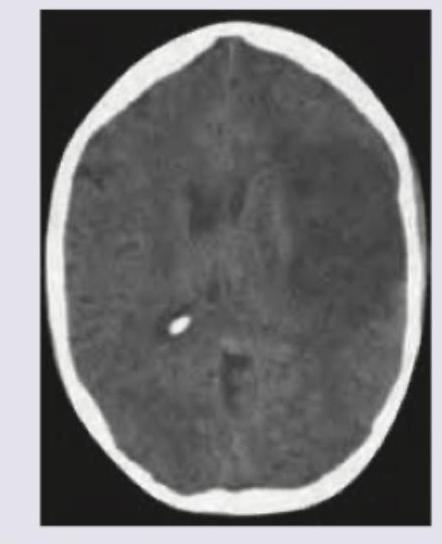
Question 21: A middle-aged patient presents with history of left sided weakness for 2 days. Currently the patient is extremely drowsy and underwent a NCCT brain. Which of the following is the best treatment for this patient? (AIIMS Nov 2017)
- A. Aspirin/Clopidogrel
- B. Mechanical thrombectomy
- C. Mannitol
- D. Decompressive surgery (Correct Answer)
Explanation: ***Decompressive surgery*** - The NCCT image shows a **large, well-demarcated hypodensity in the right cerebral hemisphere**, characteristic of a **subacute to chronic ischemic infarct with significant edema and mass effect**. This is evidenced by the effaced sulci, compressed ventricles on the right, and likely midline shift, causing the patient's **drowsiness** and **left-sided weakness**. - Given the patient's **drowsiness** (indicating rising intracranial pressure) and significant mass effect from the large infarct, **decompressive craniectomy** is often a life-saving measure to reduce intractable intracranial pressure and prevent further herniation in cases of malignant middle cerebral artery (MCA) infarction. *Aspirin/Clopidogrel* - These are **antiplatelet medications used for secondary stroke prevention** after an acute ischemic event. - They are not the primary treatment for an **existing large infarct with mass effect and neurological deterioration** (drowsiness), as they do not address the acute intracranial pressure. *Mechanical thrombectomy* - This procedure is indicated for **acute ischemic stroke due to large vessel occlusion**, typically performed within a very narrow time window (usually up to 6-24 hours) from symptom onset. - The patient presents two days after symptom onset, and the CT findings suggest a **subacute to chronic infarct that has completed evolution**, making thrombectomy ineffective and potentially harmful. *Mannitol* - Mannitol is an **osmotic diuretic used to acutely reduce intracranial pressure (ICP)** in situations like cerebral edema. - While it can provide temporary relief, it is often insufficient for profound edema and mass effect from a **large, evolving infarct** that is causing significant neurological decline (drowsiness), and it does not treat the underlying structural issue.
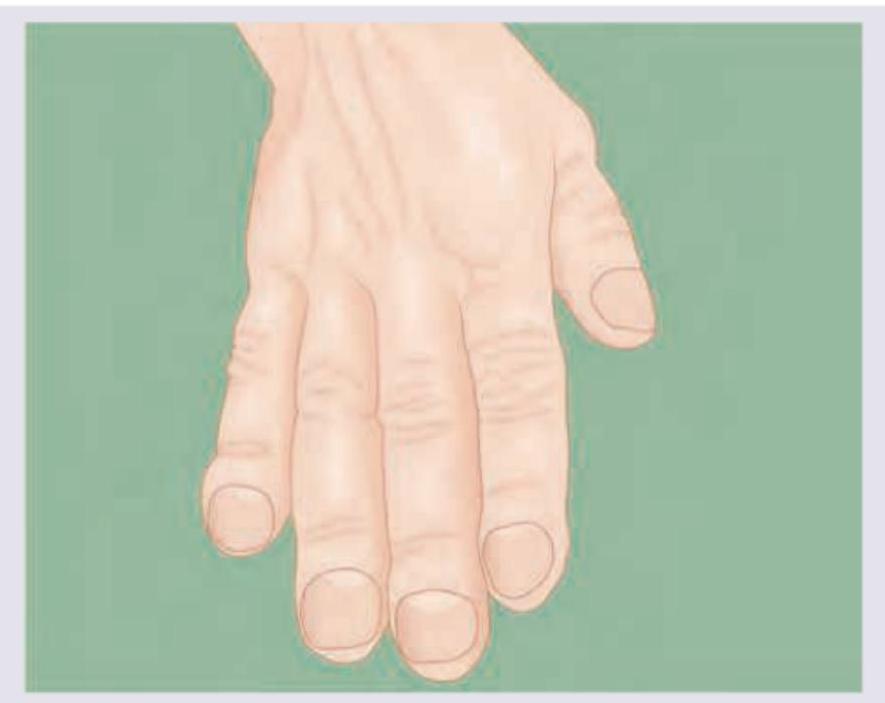
Question 22: A 50-year-old man presents with frontal bossing, enlarged tongue and following appearance of hand. Which of the following tests should be done in this patient?
- A. Insulin like growth factor (Correct Answer)
- B. Thyroid hormone assay
- C. Serum prolactin
- D. Serum Testosterone
Explanation: ***Insulin like growth factor*** - The patient's symptoms of **frontal bossing**, **enlarged tongue (macroglossia)**, and the image showing an **enlarged hand** (suggestive of **acral enlargement**) are classic features of **acromegaly**. - **Insulin-like growth factor 1 (IGF-1)** is the best screening test for acromegaly because its levels are stable throughout the day and reflect integrated GH secretion; elevated IGF-1 is indicative of the condition. *Thyroid hormone assay* - This test measures **thyroid function** and is primarily used to diagnose conditions like **hypothyroidism** or **hyperthyroidism**. - While some symptoms of thyroid disorders can overlap with other conditions, the specific constellation of **acral enlargement**, **macroglossia**, and **frontal bossing** is not typical for thyroid dysfunction. *Serum prolactin* - **Serum prolactin** is primarily used to assess for **hyperprolactinemia**, which can cause symptoms like **galactorrhea** or **hypogonadism**. - While a **prolactinoma** (a pituitary tumor secreting prolactin) can sometimes coexist with a **growth hormone-secreting tumor**, prolactin itself is not the direct cause of acromegalic features, and its assay is not the initial diagnostic test for acromegaly. *Serum Testosterone* - **Serum testosterone** levels are assessed in cases of suspected **hypogonadism** or other **androgen-related disorders**. - The clinical presentation with **acral enlargement** and **facial changes** is not characteristic of testosterone deficiency or excess.
Question 23: This 50-year-old patient developed syncope after having a coffee. ECG was done .Which is the most appropriate therapy for a patient suffering from the condition shown below?
- A. Lignocaine
- B. DC shock (Correct Answer)
- C. Amiodarone
- D. Esmolol
- E. Magnesium sulfate
Explanation: ***DC shock*** - The ECG shows **polymorphic ventricular tachycardia (PVT)**, characterized by rapid, irregular QRS complexes that vary in morphology. This is consistent with **Torsades de Pointes**, a type of PVT. - In a patient presenting with syncope (indicating **hemodynamic instability**), **immediate synchronized direct current (DC) cardioversion** is the most appropriate and life-saving therapy to terminate the arrhythmia. - Unstable patients require **immediate electrical cardioversion** before pharmacological measures. *Magnesium sulfate* - **Magnesium sulfate (2g IV bolus)** is the **first-line pharmacological treatment** for **stable Torsades de Pointes** and helps prevent recurrence. - It works by stabilizing cardiac membranes and shortening the QT interval. - However, in this **unstable patient with syncope**, **DC cardioversion takes priority** over magnesium administration, though magnesium should be given immediately after successful cardioversion to prevent recurrence. *Lignocaine* - **Lignocaine (Lidocaine)** is a Class IB antiarrhythmic drug primarily used for **monomorphic ventricular tachycardia** and ventricular fibrillation. - It is **contraindicated** in Torsades de Pointes because it can prolong the QT interval further, worsening the arrhythmia. *Amiodarone* - **Amiodarone** is a Class III antiarrhythmic drug effective for various arrhythmias, including some ventricular tachycardias. - It is **not the first-line treatment for Torsades de Pointes** due to its slower onset of action and potential to prolong the QT interval, which can worsen Torsades de Pointes. *Esmolol* - **Esmolol** is a short-acting beta-blocker that primarily works to lower heart rate and can be used in some supraventricular tachycardias or to control ventricular rate in atrial fibrillation/flutter. - It is **not effective for Torsades de Pointes** and could potentially worsen the condition by further slowing the heart rate or increasing QT prolongation in some underlying conditions.
Question 24: Identify the sleep stage in the following Polysomnograph.
- A. NREM stage 2 (Correct Answer)
- B. NREM stage 3
- C. REM
- D. NREM stage 1
Explanation: ***NREM stage 2*** - The **EEG** shows prominent **sleep spindles** (bursts of 12-14 Hz waves) and **K-complexes** (high-amplitude biphasic waves), which are characteristic features of NREM stage 2 sleep. - The EOG channels indicate slow eye movements or an absence of rapid eye movements, consistent with NREM sleep, while the **EMG shows moderate muscle tone**, higher than in REM sleep but lower than wakefulness. *NREM stage 3* - This stage is characterized by **delta waves**, which are slow waves with high amplitude (0.5-2 Hz, often >75 μV) on the EEG, comprising 20% or more of the epoch, and are not significantly visible here. - While muscle tone is still present, the EEG would primarily show widespread **slow-wave activity**, distinguishing it from the sleep spindles and K-complexes seen in the image. *REM* - **Rapid eye movements** would be clearly visible on the EOG channels, which are not prevalent in this polysomnograph. - The **EMG would show very low muscle tone** (atonia), which is not the case here, and the EEG would largely consist of low-voltage, mixed-frequency activity, similar to wakefulness. *NREM stage 1* - This stage is typically characterized by a **disappearance of alpha waves** from the EEG and the presence of **theta waves** (4-7 Hz). - While there may be slow eye movements on the EOG, **sleep spindles and K-complexes are absent** in NREM stage 1, making it distinct from the presented polysomnograph.
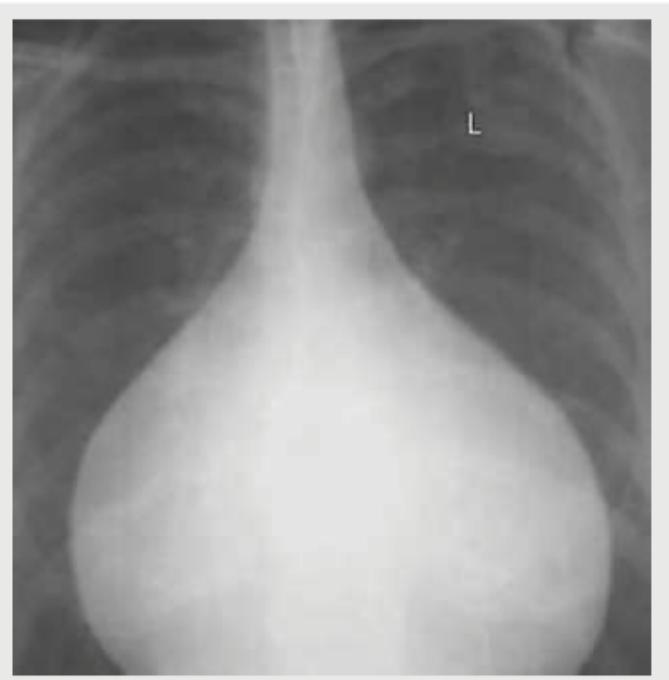
Question 25: A patient presents with complaints of fever and abdominal distention. He is having history of bloody diarrhea off and on for previous 6 months. X-ray abdomen is shown below. What is the diagnosis?
- A. Pneumatosis intestinalis
- B. Toxic megacolon (Correct Answer)
- C. Volvulus
- D. Intestinal perforation
- E. Paralytic ileus
Explanation: ***Toxic megacolon*** - The image shows **marked dilation of the colon** with loss of haustral markings, consistent with megacolon. - The clinical picture of fever, abdominal distention, and bloody diarrhea in a patient with a history of inflammatory bowel disease (implied by chronic bloody diarrhea) strongly suggests **toxic megacolon**. - Toxic megacolon is a life-threatening complication of IBD requiring urgent management. *Pneumatosis intestinalis* - This condition involves **gas within the wall of the bowel**, which would appear as characteristic lucencies outlining the bowel wall on X-ray. - While it can be seen in severe bowel ischemia, it is not the primary finding of diffuse colonic dilation seen here. *Volvulus* - Volvulus is a **twisting of a loop of intestine** around its mesentery, leading to obstruction and ischemia. - While it can cause colonic dilation, the dilation is typically localized to the twisted segment (e.g., a "coffee bean" sign in sigmoid volvulus) rather than the diffuse involvement seen here. *Intestinal perforation* - Intestinal perforation is characterized by the presence of **free air under the diaphragm** (pneumoperitoneum) on an upright chest X-ray or lateral decubitus abdominal film. - While a severely dilated and inflamed colon can perforate, there is no clear evidence of free air outside the bowel wall in this X-ray. *Paralytic ileus* - Paralytic ileus causes **generalized bowel dilation** and can present with abdominal distention. - However, it typically involves both small and large bowel, lacks the **loss of haustral markings** specific to toxic megacolon, and does not typically present with **fever and bloody diarrhea** in the context of chronic inflammatory bowel disease.
Pediatrics
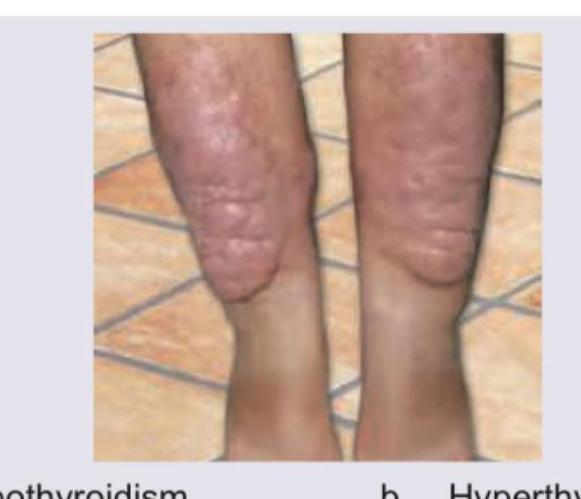
1 questionsComment on the diagnosis of the image shown below. (AIIMS Nov 2017)

INI-CET 2017 - Pediatrics INI-CET Practice Questions and MCQs
Question 21: Comment on the diagnosis of the image shown below. (AIIMS Nov 2017)
- A. Hypothyroidism (Correct Answer)
- B. Hyperthyroidism
- C. Sarcoidosis
- D. Diabetes
Explanation: ***Hypothyroidism*** - The image depicts **myxoedema**, characterized by localized, non-pitting edema and thickened skin, typically on the shins, which is a classic manifestation of severe **hypothyroidism**. - This condition results from the accumulation of **hyaluronic acid** and chondroitin sulfate in the dermis, causing a characteristic doughy texture. *Hyperthyroidism* - While hyperthyroidism (specifically Graves' disease) can cause **pretibial myxoedema**, the image alone showing generalized myxoedematous changes is more indicative of **hypothyroidism**. - Pretibial myxoedema associated with hyperthyroidism typically presents as elevated, firm, non-pitting plaques, whereas the image shows a more widespread thickening. *Sarcoidosis* - Sarcoidosis involves the formation of **non-caseating granulomas** in various organs, including the skin. - Skin manifestations of sarcoidosis can include **erythema nodosum**, plaques, or lupus pernio, which do not match the generalized thickening seen in the image. *Diabetes* - Diabetes mellitus can cause various skin manifestations such as **diabetic dermopathy**, necrobiosis lipoidica diabeticorum, and acanthosis nigricans. - These conditions present with different visual characteristics, like hyperpigmented atrophic macules or waxy yellow plaques, unlike the diffuse thickening shown.
Physiology
1 questionsPhonocardiogram tracing is shown below with corresponding ECG. Identify the phase corresponding with $S_{2}$ in phonocardiogram.

INI-CET 2017 - Physiology INI-CET Practice Questions and MCQs
Question 21: Phonocardiogram tracing is shown below with corresponding ECG. Identify the phase corresponding with $S_{2}$ in phonocardiogram.
- A. Isovolumetric contraction
- B. Isovolumetric relaxation (Correct Answer)
- C. Rapid ejection
- D. Rapid ventricular filling
Explanation: ***Isovolumetric relaxation*** - **S₂ (second heart sound)** occurs due to closure of the **aortic and pulmonary semilunar valves** at the end of systole, marking the onset of isovolumetric relaxation. - On the **ECG**, S₂ corresponds to the **end of the T wave**, when ventricular pressure drops below aortic pressure causing valve closure. *Isovolumetric contraction* - This phase corresponds to **S₁ (first heart sound)** caused by closure of the **mitral and tricuspid valves** at the beginning of systole. - Occurs on the ECG around the **QRS complex**, not at the timing of S₂. *Rapid ejection* - This phase occurs **between S₁ and S₂** when blood is actively ejected from the ventricles into the aorta and pulmonary artery. - The **semilunar valves are open** during this phase, so no heart sounds are produced. *Rapid ventricular filling* - This phase occurs **after S₂** during early diastole when the **AV valves open** and blood rapidly fills the ventricles. - May be associated with **S₃ gallop** in pathological conditions, but not with S₂.
Radiology
1 questionsA patient presented with sudden onset difficulty in breathing with RR 28/min, normal blood pressure. X-ray was taken which is given below. What is the diagnosis?

INI-CET 2017 - Radiology INI-CET Practice Questions and MCQs
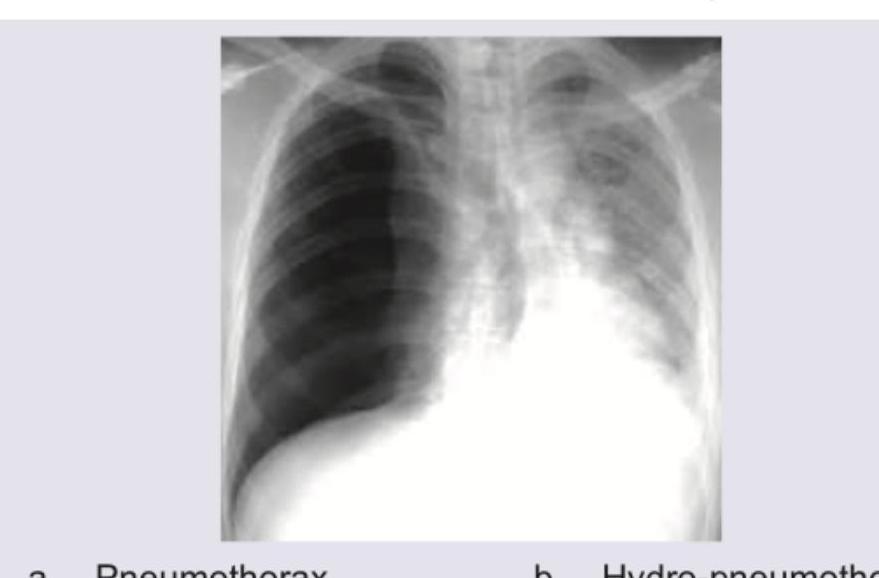
Question 21: A patient presented with sudden onset difficulty in breathing with RR 28/min, normal blood pressure. X-ray was taken which is given below. What is the diagnosis?
- A. Pneumothorax
- B. Hydro-pneumothorax (Correct Answer)
- C. Pleural effusion
- D. Consolidation
Explanation: ***Hydro-pneumothorax*** - The chest X-ray clearly shows a **horizontal air-fluid level** in the right hemithorax, indicating the presence of both air (pneumothorax) and fluid (hydrothorax) within the pleural space. - The patient's sudden onset **difficulty in breathing** and **tachypnea (RR 28/min)** are consistent with significant lung pathology like a hydropneumothorax, which compromises lung function. *Pneumothorax* - A simple pneumothorax would show only **air in the pleural space**, characterized by a visible visceral pleural line and absence of lung markings beyond it. - While there is air present, the prominent **fluid level** rules out a diagnosis of pneumothorax alone. *Pleural effusion* - Pleural effusion presents as a **blunting of the costophrenic angles** and a meniscus sign, where fluid conforms to the shape of the thorax. - This image shows a **straight air-fluid level**, not a typical meniscus, indicating the presence of air in addition to fluid. *Consolidation* - Consolidation refers to the **filling of alveolar spaces with fluid or exudate**, appearing as an opacification within the lung parenchyma. - Consolidations typically do not present with a **horizontal fluid level** in the pleural space; they are intraparenchymal.
Surgery
1 questionsA car accident patient complains of breathlessness. On examination BP is $110 / 70 \mathrm{mmHg}$ with GCS of 15/15. On examination, trachea is deviated to the right side, with reduced breath sounds in left infra-axillary area and inframammary areas. $S_{1}$ and $S_{2}$ are normal in intensity and splitting. CXR is shown below. What is the best step in management of the patient?

INI-CET 2017 - Surgery INI-CET Practice Questions and MCQs
Question 21: A car accident patient complains of breathlessness. On examination BP is $110 / 70 \mathrm{mmHg}$ with GCS of 15/15. On examination, trachea is deviated to the right side, with reduced breath sounds in left infra-axillary area and inframammary areas. $S_{1}$ and $S_{2}$ are normal in intensity and splitting. CXR is shown below. What is the best step in management of the patient?
- A. Needle aspiration
- B. Pericardiocentesis
- C. Chest tube insertion (Correct Answer)
- D. Immediate thoracotomy
Explanation: ***Chest tube insertion*** - The patient's symptoms (breathlessness, tracheal deviation to the right, reduced breath sounds in the left infra-axillary and inframammary areas) combined with the CXR findings indicate a **left-sided hemothorax or pneumothorax** causing mediastinal shift. - A chest tube will **drain the accumulated air or fluid**, re-expand the lung, and relieve the mediastinal shift, thereby improving breathing. - This is **NOT a tension pneumothorax** (patient is hemodynamically stable with BP 110/70 mmHg), so definitive chest tube insertion is preferred over needle decompression. *Needle aspiration* - Needle thoracostomy is indicated for **tension pneumothorax**, which presents with hemodynamic instability, severe respiratory distress, and requires immediate decompression. - This patient is **hemodynamically stable** (normal BP, GCS 15/15), indicating a simple pneumothorax or hemothorax that requires **chest tube** for definitive drainage rather than temporary needle aspiration. *Pericardiocentesis* - **Pericardiocentesis** is indicated for **cardiac tamponade**, which presents with muffled heart sounds, hypotension, and distended neck veins (Beck's triad). - The patient's **normal blood pressure, normal heart sounds** (S₁ and S₂ normal), and clinical findings pointing to pleural pathology rule out cardiac tamponade. *Immediate thoracotomy* - **Immediate thoracotomy** is reserved for massive hemothorax with **>1500 mL initial drainage** or **>200 mL/hour persistent bleeding** after chest tube insertion, or for major vessel/cardiac injuries. - Initial management should be **chest tube insertion** for drainage and assessment before proceeding to thoracotomy.