Anatomy
5 questionsWhich of the following structures will help in opening of jaw?

Identify the structure marked by the arrow in this skull base image:

Which of the following has holocrine secretion?
Which of the following proteins are not seen in the region marked in the image?

Which of the following is the constituent of the marked area in the given electron microscope picture of the muscle?

INI-CET 2017 - Anatomy INI-CET Practice Questions and MCQs
Question 91: Which of the following structures will help in opening of jaw?
- A. A
- B. B
- C. C (Correct Answer)
- D. D
Explanation: ***C*** - Structure C represents the **lateral pterygoid muscle**, which is the primary muscle responsible for **opening the jaw (depression of the mandible)**, as well as protrusion and contralateral excursion. - It is the only muscle of mastication that actively participates in jaw opening. *A* - Structure A appears to be the **medial pterygoid muscle**, which is primarily involved in **elevation of the mandible** (jaw closing) and side-to-side movements. - Its action is antagonistic to jaw opening. *B* - Structure B likely represents the **masseter muscle**, a powerful muscle of mastication that primarily functions to **elevate the mandible** and close the jaw. - It is a strong jaw closer, not an opener. *D* - Structure D points to the **temporalis muscle**, another major muscle of mastication that is responsible for **elevating and retracting the mandible** (closing the jaw). - Its primary actions are in jaw closing, not opening.
Question 92: Identify the structure marked by the arrow in this skull base image:
- A. Spinal accessory nerve
- B. Vertebral artery (Correct Answer)
- C. Labyrinthine artery
- D. Abducens nerve
Explanation: ***Vertebral artery*** - The arrow indicates the **vertebral artery** as it ascends through the **foramen magnum** into the posterior fossa, appearing as a prominent paired vascular structure lateral to the **medulla oblongata**. - In skull base imaging, vertebral arteries appear as **cylindrical structures** running alongside the brainstem, distinguishable from nerves by their **larger caliber** and **bilateral symmetry** at the craniovertebral junction. *Spinal accessory nerve* - The **spinal accessory nerve (CN XI)** has a much **smaller diameter** than the indicated structure and would appear as a thin nerve bundle coursing toward the **jugular foramen**. - It enters the skull through the foramen magnum but quickly turns laterally toward the **jugular foramen**, not maintaining the vertical course shown by the arrow. *Labyrinthine artery* - The **labyrinthine artery** is a **small branch** of the AICA that enters the **internal acoustic meatus** to supply the inner ear, too small to be clearly visible at this magnification. - It would be located more **anterolaterally** near the cerebellopontine angle, not in the **midline posterior fossa** location indicated by the arrow. *Abducens nerve* - The **abducens nerve (CN VI)** emerges from the **pontomedullary junction** and travels anteriorly through the **cavernous sinus**, located much more **superiorly and anteriorly** than the marked structure. - It would appear as a **thin nerve** rather than the **robust vascular structure** indicated, and would not be visible at the **foramen magnum level**.
Question 93: Which of the following has holocrine secretion?
- A. Sebaceous gland (Correct Answer)
- B. Salivary gland
- C. Mammary gland
- D. Sweat gland
Explanation: ***Sebaceous gland*** - Sebaceous glands use **holocrine secretion**, in which the **entire cell disintegrates** to release its secretory product (sebum) - Cells progressively accumulate lipid in the cytoplasm, undergo degeneration, and ultimately lyse completely to form the secretion - This is the **only example of holocrine secretion** in the human body - Histologically, sebaceous glands show large, pale, lipid-filled cells arranged in lobules with a central duct opening into the hair follicle *Sweat gland* - Eccrine sweat glands use **merocrine (eccrine) secretion** - Secretory product is released via **exocytosis** without any loss of cellular material - The cell remains fully intact after secretion *Salivary gland* - Salivary glands use **merocrine secretion** - Secretory granules (zymogen granules in serous cells) are released by exocytosis - No cellular material is lost during the secretion process *Mammary gland* - Mammary glands use **apocrine secretion** for lipid components - The apical portion of the cytoplasm containing lipid droplets is pinched off and released - Only part of the cell is lost, not the entire cell as in holocrine secretion
Question 94: Which of the following proteins are not seen in the region marked in the image?
- A. Macula adherens
- B. Fascia adherens
- C. Connexons
- D. Zona occludens (Correct Answer)
Explanation: ***Zona occludens*** - The image shows **cardiac muscle** tissue, and the arrow points to an **intercalated disc**. - Intercalated discs are primarily composed of **fascia adherens**, **maculae adherentes (desmosomes)**, and **gap junctions (connexons)**, but not tight junctions (zona occludens). *Macula adherens* - **Maculae adherentes**, also known as **desmosomes**, are abundant in intercalated discs. - They provide **strong adhesion** between cardiac muscle cells and are crucial for resisting mechanical stress. *Fascia adherens* - **Fascia adherens** are the most extensive type of junction in the transverse portion of the intercalated disc. - They anchor the **actin filaments** of the terminal sarcomeres to the plasma membrane. *Connexions* - **Connexons** are the structural proteins that form **gap junctions**. - Gap junctions in intercalated discs allow for the rapid **passage of ions** and small molecules, facilitating electrical coupling and coordinated contraction.
Question 95: Which of the following is the constituent of the marked area in the given electron microscope picture of the muscle?
- A. $\alpha$-actinin (Correct Answer)
- B. Nebulin
- C. Titin
- D. Tropomodulin
Explanation: ***$\alpha$-actinin*** - The image highlights the **Z-disc**, which is primarily composed of **$\alpha$-actinin**. - **$\alpha$-actinin** anchors the **thin filaments (actin)** at the Z-disc and helps maintain the structural integrity of the sarcomere. *Nebulin* - **Nebulin** is a large protein associated with thin filaments, regulating their **length** and contributing to their **stability**, but it is not the main constituent of the Z-disc. - It extends along the entire length of the thin filament, rather than forming the Z-disc itself. *Titin* - **Titin** is the largest known protein, responsible for the **elasticity** of muscle and connecting the Z-disc to the M-line. - While it associates with the Z-disc, it does not constitute the primary structural component of the Z-disc itself. *Tropomodulin* - **Tropomodulin** caps the **pointed (minus) end** of the **actin filaments**, regulating their length and ensuring stability in the sarcomere. - It is located at the ends of the thin filaments, away from the Z-disc.
Biochemistry
1 questionsWhich type of bonds are represented by the dotted lines in the image? (AIIMS Nov 2017)

INI-CET 2017 - Biochemistry INI-CET Practice Questions and MCQs
Question 91: Which type of bonds are represented by the dotted lines in the image? (AIIMS Nov 2017)
- A. Hydrogen bond (Correct Answer)
- B. Covalent bond
- C. Ionic bond
- D. Phosphodiester
Explanation: ***Hydrogen bond*** - The dotted lines in the image represent the weak, non-covalent interactions between the **nitrogenous bases** on opposite strands of the DNA double helix. - Specifically, these are **hydrogen bonds** formed between complementary base pairs (Adenine with Thymine via two hydrogen bonds, and Guanine with Cytosine via three hydrogen bonds). *Covalent bond* - **Covalent bonds** involve the sharing of electron pairs between atoms and are much stronger than hydrogen bonds. - In DNA, covalent bonds form the **sugar-phosphate backbone** of each strand and link the nitrogenous bases to the deoxyribose sugars. *Ionic bond* - **Ionic bonds** involve the electrostatic attraction between oppositely charged ions, formed by the complete transfer of electrons. - While ions (like magnesium or sodium) interact with DNA, the dotted lines specifically represent the inter-strand forces between bases, which are not ionic. *Phosphodiester* - A **phosphodiester bond** is a specific type of covalent bond that links the 3' carbon of one deoxyribose sugar to the 5' carbon of the next deoxyribose sugar via a phosphate group, forming the backbone of a single DNA strand. - The dotted lines are between the two DNA strands, not within a single strand's backbone.
Pathology
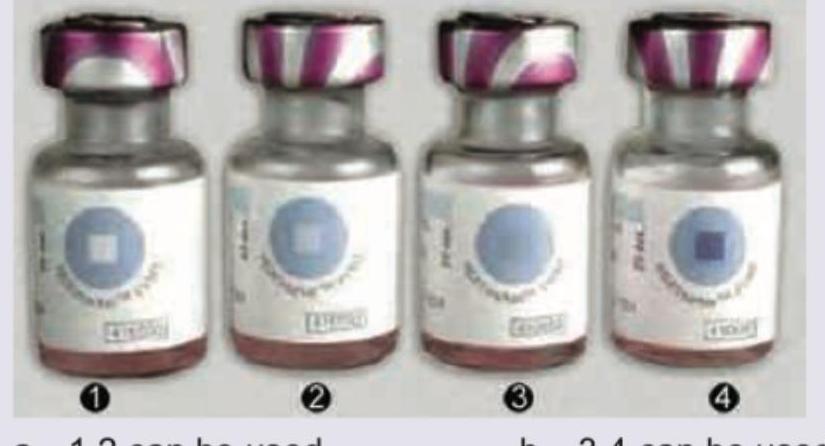
1 questionsThe vacutainer shown below is used for collecting sample for? (AIIMS Nov 2017)

INI-CET 2017 - Pathology INI-CET Practice Questions and MCQs
Question 91: The vacutainer shown below is used for collecting sample for? (AIIMS Nov 2017)
- A. Serum electrolytes (Correct Answer)
- B. Serum lactate
- C. Serum cholesterol
- D. Serum uric acid
- E. Coagulation studies
Explanation: ***Serum electrolytes*** - The image shows a **green-top vacutainer**, which typically contains **lithium heparin** as an anticoagulant. - **Lithium heparin** is the preferred anticoagulant for collecting samples for **serum electrolyte** measurements, as it does not interfere with the analysis of ions like sodium, potassium, and chloride. *Serum lactate* - Serum lactate measurements usually require a **gray-top tube** containing **sodium fluoride** and **potassium oxalate** to inhibit glycolysis and stabilize lactate levels. - A green-top tube with lithium heparin is not ideal for lactate analysis due to continued glycolysis in the absence of a glycolysis inhibitor. *Serum cholesterol* - Serum cholesterol, along with other lipid profiles, is typically collected in a **red-top tube** (no additive) or a **SST (serum separator tube)**, which has a gel barrier. - While cholesterol can be measured from a heparinized plasma sample, a plain red-top or SST is more commonly used for routine lipid panels. *Serum uric acid* - Serum uric acid measurement can be performed on a sample collected in a **red-top tube** (no additive) or a **SST (serum separator tube)**. - Although lithium heparin tubes can sometimes be used, plain serum tubes are generally preferred as they yield serum directly without an anticoagulant. *Coagulation studies* - Coagulation studies (PT, PTT, INR) require a **blue-top tube** containing **sodium citrate** as the anticoagulant. - The citrate-to-blood ratio must be precise (1:9) for accurate coagulation testing, making the blue-top tube specifically designed for this purpose. - A green-top tube with heparin cannot be used for coagulation studies as heparin itself is an anticoagulant that would interfere with the test results.
Physiology
3 questionsHysteresis is observed between the deflation and inflation curves in an isolated lung compliance diagram. What is the best description for the same?

The blood levels of hormones are elevated during exercise and sleep as shown. Which hormone would exhibit this diurnal pattern?

Calculate the tetanizing frequency based on the contraction dynamics of gastrocnemius muscle of frog shown in the image?

INI-CET 2017 - Physiology INI-CET Practice Questions and MCQs
Question 91: Hysteresis is observed between the deflation and inflation curves in an isolated lung compliance diagram. What is the best description for the same?
- A. Stretching of elastic elements of lung parenchyma
- B. Decrease in surface tension in air-water interface at higher lung volumes
- C. Variation in surface tension forces at air- liquid interface (Correct Answer)
- D. Hering Breuer reflex is operational at higher lung volumes
Explanation: ***Variation in surface tension forces at air-liquid interface*** - The phenomenon of **hysteresis** in lung compliance, particularly the larger loop seen with air-filled lungs compared to saline-filled lungs, is primarily attributable to the **dynamic changes in surface tension** at the air-liquid interface within the alveoli. - During inflation, more energy is required to overcome the opening forces of collapsed alveoli and recruit new ones, leading to a lower volume for a given pressure, while during deflation, previously opened alveoli remain open or close at lower pressures, contributing to the observed difference. *Stretching of elastic elements of lung parenchyma* - While the **elastic elements** of the lung parenchyma contribute to lung compliance, their contribution to hysteresis is relatively minor and would be observed even in saline-filled lungs to a lesser extent. - The difference in hysteresis between air-filled and saline-filled lungs strongly suggests that factors beyond the tissue elasticity are predominantly responsible for the larger hysteresis with air. *Decrease in surface tension in air-water interface at higher lung volumes* - This statement is partially correct regarding surfactant's action. **Surfactant** does reduce surface tension, especially at lower lung volumes, and prevents alveolar collapse. - However, the overall *variation* in surface tension forces throughout the breathing cycle, not just a decrease at higher volumes, is what creates the inspiratory and expiratory limbs of the pressure-volume curve. *Hering Breuer reflex is operational at higher lung volumes* - The **Hering-Breuer reflex** is a protective neurological reflex that terminates inspiration and initiates expiration when the lungs are overinflated. - This reflex is a **neurophysiological control mechanism** for breathing and does not directly explain the physical properties of the lung that contribute to the pressure-volume hysteresis loop.
Question 92: The blood levels of hormones are elevated during exercise and sleep as shown. Which hormone would exhibit this diurnal pattern?
- A. Growth hormone (Correct Answer)
- B. Insulin
- C. Cortisol
- D. Thyroid hormones
Explanation: ***Growth hormone*** - **Growth hormone (GH)** secretion is known to increase significantly during both **strenuous exercise** and **sleep**, particularly during deep sleep stages. - The elevated levels during exercise promote **lipolysis** and **glucose production**, while during sleep, it facilitates **tissue repair** and **growth**. *Insulin* - **Insulin** levels typically **decrease during exercise** to promote the utilization of fat as fuel and increase during sleep in response to reduced metabolic demand and preparation for morning. - Its primary role is to regulate blood glucose, and its secretion is mainly stimulated by **high blood glucose** rather than exercise or sleep directly in this pattern. *Cortisol* - **Cortisol** secretion follows a **circadian rhythm**, peaking in the early morning and gradually decreasing throughout the day, reaching its lowest point at night. - While exercise can acutely increase cortisol, its **sleep-related pattern** is the opposite of what is shown, typically decreasing during early sleep. *Thyroid* - **Thyroid hormones (T3 and T4)** maintain a relatively **stable level** throughout the day and night, with minor diurnal fluctuations. - Their primary function is to regulate **metabolism** and they do not exhibit sharp, distinct peaks in response to exercise or sleep in the manner depicted.
Question 93: Calculate the tetanizing frequency based on the contraction dynamics of gastrocnemius muscle of frog shown in the image?
- A. 10-15 Hz
- B. 15-20 Hz
- C. 20-25 Hz (Correct Answer)
- D. 30-35 Hz
Explanation: **20-25 Hz** - Tetanizing frequency (or fusion frequency) is the stimulation rate at which individual muscle twitches fuse to produce a **smooth, sustained contraction** (tetanus). - For the **frog gastrocnemius muscle**, a common model in physiology, this frequency typically falls within the **20-25 Hz range**. *10-15 Hz* - At this lower frequency, the muscle would likely exhibit **incomplete tetanus** or summation, where individual twitches are still discernible, but tension is increasing. - This range is generally insufficient to achieve a **smooth, fused tetanic contraction** in the frog gastrocnemius. *15-20 Hz* - This range might produce **treppe** or early stages of incomplete tetanus, where successive contractions are slightly stronger, but the relaxation phase is still partially visible between stimuli. - While closer to the tetanizing frequency, it's generally not high enough to achieve **complete fusion** for the frog gastrocnemius. *30-35 Hz* - While this frequency would certainly result in a **fused tetanic contraction**, it's higher than the minimum required for the frog gastrocnemius, which means the muscle is already in complete tetanus at a lower frequency. - Using excessively high frequencies beyond the fusion frequency does not significantly increase tension and can lead to **faster fatigue**.