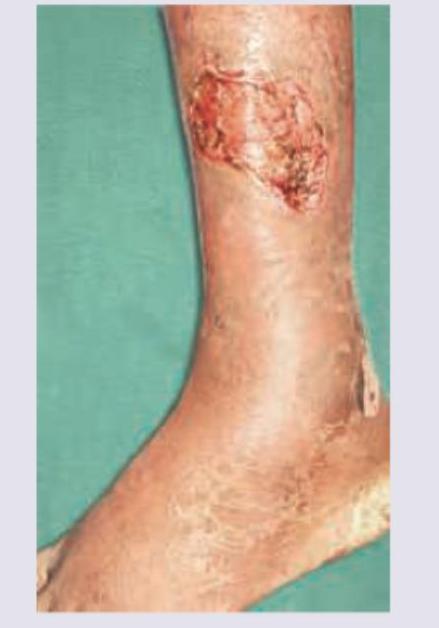
Question 1: A 50-year-old smoker and hypertensive patient presents with the lesion shown below. It is painful and present bilaterally. Peripheral pulses are palpable. What is the diagnosis?
- A. Arterial ulcer
- B. Martorell ulcer (Correct Answer)
- C. Trophic ulcer
- D. Bairnsdale ulcer
Explanation: ***Martorell ulcer***
- This is a **hypertensive ischemic leg ulcer** primarily associated with uncontrolled hypertension, often seen in older patients who smoke.
- Key features include extreme pain, location on the **anterolateral aspect of the lower leg**, and frequently bilateral presentation, despite palpable peripheral pulses.
*Arterial ulcer*
- **Arterial ulcers** are typically caused by **peripheral artery disease (PAD)**, leading to reduced blood flow.
- While they can be painful, PAD is usually associated with **diminished or absent peripheral pulses**, which are present in this case.
*Trophic ulcer*
- A **trophic ulcer** is a general term for an ulcer caused by **poor nutrition** to the tissues, often due to neuropathy or chronic venous insufficiency.
- While they can be chronic, the specific presentation with palpable pulses, severe pain, and association with hypertension points away from a generic trophic ulcer.
*Bairnsdale ulcer*
- Also known as **Buruli ulcer**, this is a **mycobacterial infection** caused by *Mycobacterium ulcerans*.
- It typically starts as a painless nodule and slowly progresses to a large, often painless ulcer with undermined edges, which is not consistent with the painful lesion described.
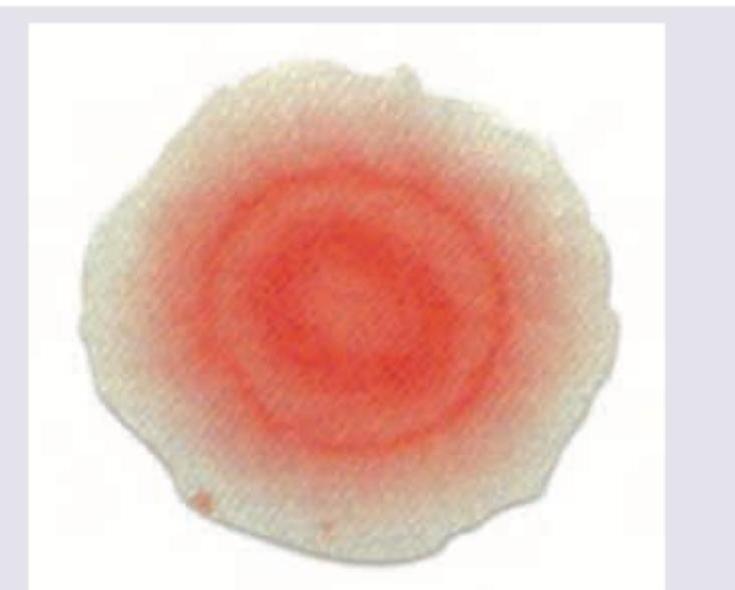
Question 2: In a patient of head injury, the following sign is noted on his handkerchief. Which is the next test to confirm the diagnosis? (AIIMS Nov 2017)
- A. Beta 2 micro-globulin
- B. Beta trace protein (Correct Answer)
- C. Beta amyloid
- D. Beta glucuronidase
Explanation: ***Beta trace protein***
- The image shows a "double ring" or "halo" sign, where blood spreads in a central area and is surrounded by a clear ring of fluid, indicating the presence of **cerebrospinal fluid (CSF) mixed with blood**.
- **Beta trace protein (BTP)**, also known as protoprostaglandin D synthase, is a specific and sensitive marker for the detection of CSF leakage, differentiating it from other body fluids.
*Beta 2 micro-globulin*
- **Beta 2 micro-globulin** is a protein found on the surface of most nucleated cells and is elevated in various conditions like renal failure, inflammatory diseases, and lymphomas.
- While it can be present in CSF, it is not a specific marker for CSF leakage and can be influenced by other factors.
*Beta amyloid*
- **Beta amyloid** is a protein primarily associated with Alzheimer's disease, forming plaques in the brain.
- Its detection is used in the diagnosis and research of neurodegenerative disorders, not acute CSF leaks after head injury.
*Beta glucuronidase*
- **Beta glucuronidase** is a lysosomal enzyme found in various tissues and bodily fluids.
- It is associated with conditions like bacterial vaginosis or urinary tract infections, and it is not a recognized marker for CSF leakage.