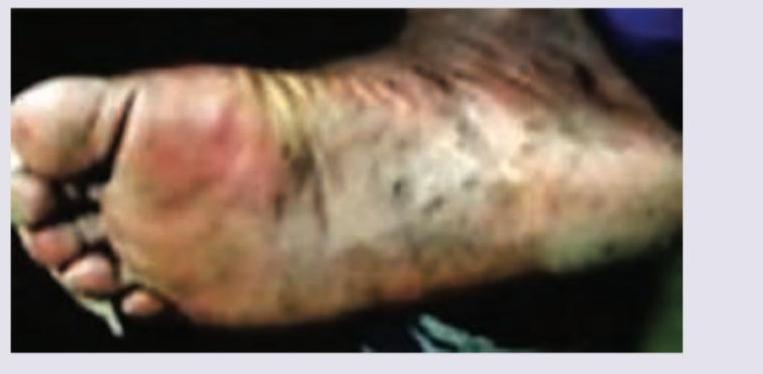
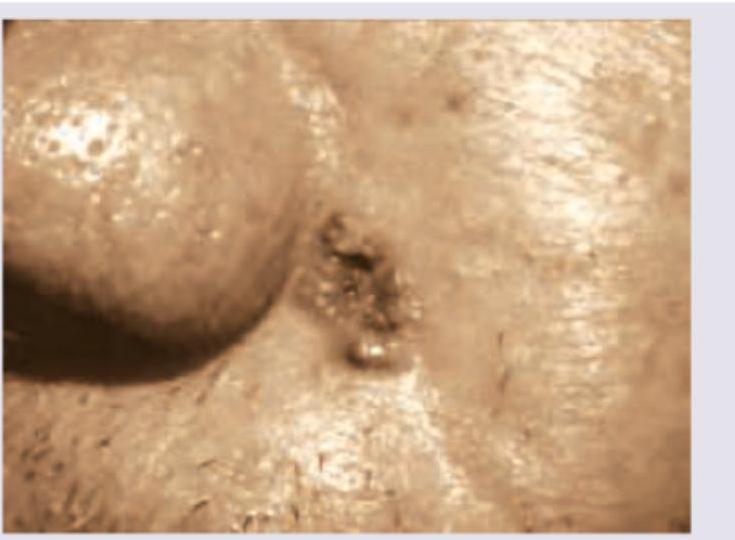
Question 11: A patient presents with ulcer on the side of the nose, as shown, which bleeds on itching. What is the diagnosis? (AIIMS Nov 2017)
- A. Squamous cell carcinoma
- B. Basal cell carcinoma (Correct Answer)
- C. Marjolin ulcer
- D. Nevus
Explanation: ***Basal cell carcinoma***
- The image shows a **pearly appearance** with a **central ulceration** and **rolled borders**, which are classic clinical features of **nodular basal cell carcinoma**.
- **Bleeding upon minor trauma or itching** (friability) is also a common characteristic of basal cell carcinoma, especially the ulcerated form.
*Squamous cell carcinoma*
- Squamous cell carcinoma typically presents as a **crusted, firm, red nodule** or a **patch with scales and ulceration**, often in sun-exposed areas.
- While it can ulcerate and bleed, it usually lacks the distinct **pearly appearance and rolled borders** seen in basal cell carcinoma.
*Marjolin ulcer*
- A Marjolin ulcer is a **malignant degeneration of a chronic ulcer**, burn scar, or chronic inflammatory lesion, most commonly an aggressive squamous cell carcinoma.
- It would present in the context of a **pre-existing long-standing lesion** or scar, which is not indicated here, and generally has a more irregular, indurated appearance.
*Nevus*
- A nevus (mole) is a benign growth of pigment-producing cells which typically presents as a **well-demarcated pigmented lesion**.
- While some nevi can be raised or irregular, they generally do **not ulcerate spontaneously or bleed easily** on scratching unless traumatized, nor do they typically have the pearly, rolled borders of a basal cell carcinoma.
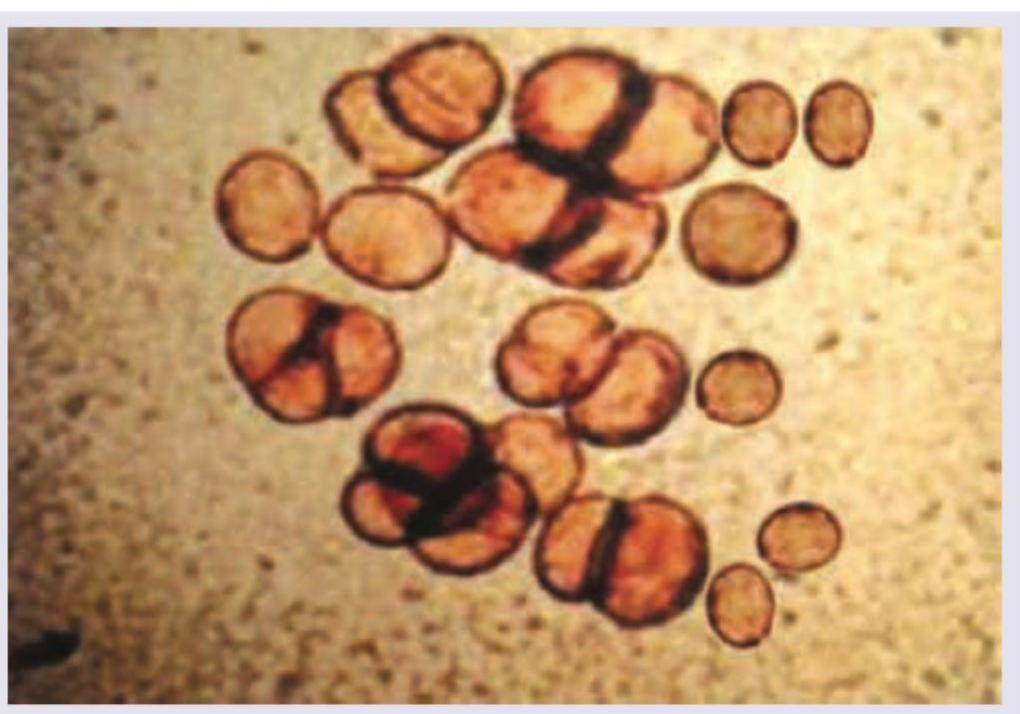
Question 12: A female had a thorn prick 5 years ago. She presents with development of slowly growing $2 \times 2 \mathrm{~cm}$ verrucous lesion which on KOH mount shows the following image. Diagnosis is: (AIIMS Nov 2017)
- A. Chromoblastomycosis (Correct Answer)
- B. Sporotrichosis
- C. Blastomycosis
- D. Phaeohyphomycosis
Explanation: ***Chromoblastomycosis***
- The image shows **sclerotic bodies** (also known as **Medlar bodies**, muriform cells, or fumagoid cells) which are characteristic of *Chromoblastomycosis*. These are thick-walled, septate, dematiaceous (darkly pigmented) fungal cells that reproduce by septation in multiple planes.
- The history of a **thorn prick** (trauma allowing inoculation of fungal spores from soil/vegetation), the **slowly growing verrucous lesion**, and the presence of sclerotic bodies on KOH mount are all highly specific for chromoblastomycosis.
*Sporotrichosis*
- **Sporotrichosis** typically presents with subcutaneous nodules that ulcerate, often forming a **lymphocutaneous spread** along lymphatic vessels.
- On microscopy (KOH mount or biopsy), *Sporothrix schenckii* appears as **cigar-shaped budding yeasts** in tissue, which are not seen in the provided image.
*Blastomycosis*
- **Blastomycosis** is caused by *Blastomyces dermatitidis* and can cause pulmonary, cutaneous, and disseminated infections. Cutaneous lesions can be verrucous but are typically granulomatous with microabscesses.
- Microscopic examination (KOH mount) reveals **large, broad-based budding yeast cells**, which are distinct from the sclerotic bodies shown.
*Phaeohyphomycosis*
- **Phaeohyphomycosis** encompasses a diverse group of infections caused by dematiaceous (pigmented) fungi that, in tissue, grow as **septate hyphae**, yeast-like cells, or a combination of both, but **do not form sclerotic bodies**.
- While it can manifest as subcutaneous nodules or cysts, the diagnostic feature in tissue is the presence of pigmented hyphal forms, unlike the characteristic sclerotic bodies in the image.