INI-CET 2015 — Internal Medicine
1 Previous Year Questions with Answers & Explanations
In the ECG shown below, which drug will not be given?
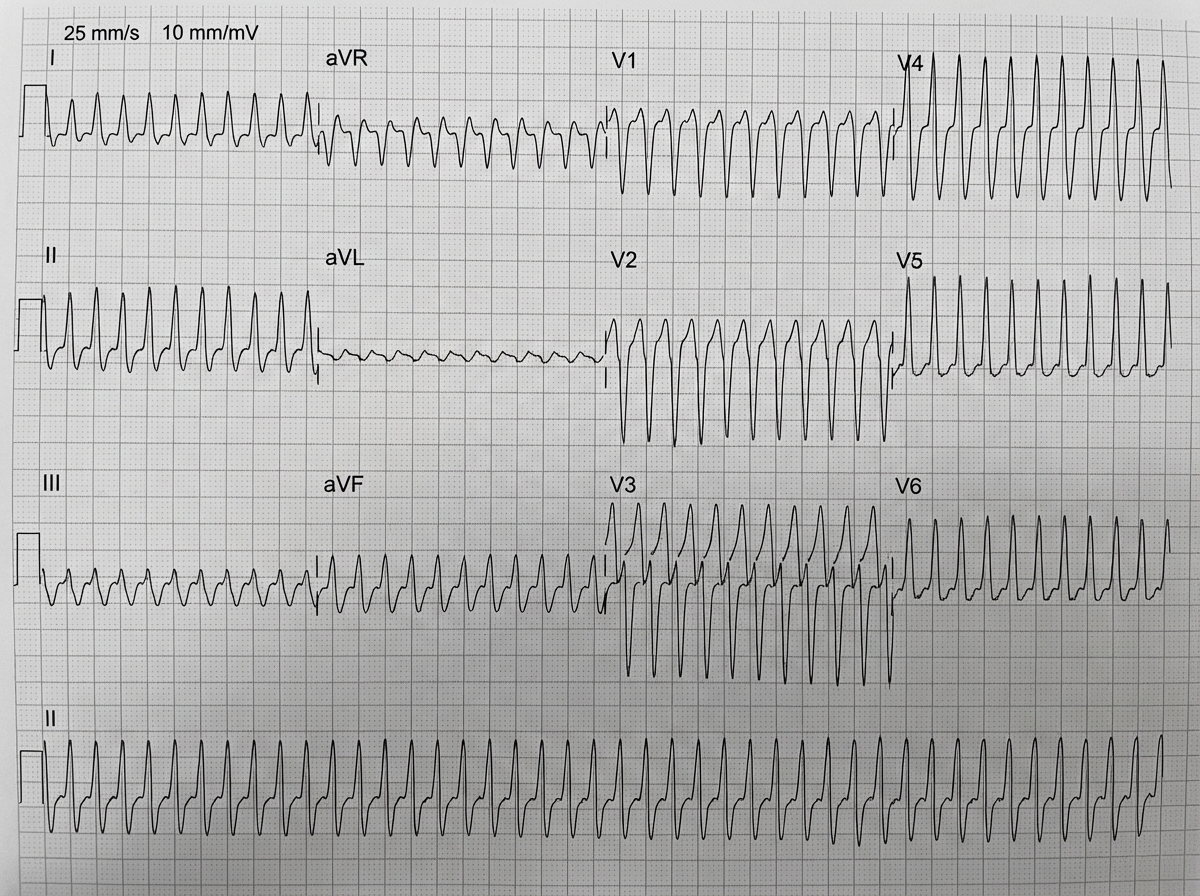
INI-CET 2015 - Internal Medicine INI-CET Practice Questions and MCQs
Question 1: In the ECG shown below, which drug will not be given?
- A. Adenosine (Correct Answer)
- B. Verapamil
- C. Diltiazem
- D. Flecainide
- E. Amiodarone
Explanation: ***Adenosine*** - The ECG shows a **wide complex tachycardia** with a regular rhythm and a rate of approximately 150 bpm. Given the wide QRS, the differential includes **ventricular tachycardia (VT)** or a **supraventricular tachycardia (SVT) with aberrancy**. - In wide complex tachycardia, **Adenosine** is contraindicated if there is suspicion of **ventricular tachycardia (VT)**, as it can cause **hemodynamic collapse** or **degenerate into ventricular fibrillation**. - Adenosine is primarily used for **narrow complex SVT** and should be avoided in wide complex tachycardias when VT cannot be excluded. *Verapamil* - Verapamil, a **calcium channel blocker**, can be used to slow the ventricular response in certain SVTs, but it is generally **contraindicated** in **wide complex tachycardias** of unknown origin because it can worsen hypotension or cause cardiovascular collapse if the rhythm is VT. - Its use in pre-excited atrial fibrillation can lead to **ventricular fibrillation**. *Diltiazem* - Diltiazem is a **non-dihydropyridine calcium channel blocker** similar to Verapamil. - It works by slowing conduction through the **AV node** and is effective for rate control in SVTs. However, it is also generally **contraindicated** in wide complex tachycardias if the origin is uncertain, particularly if **VT** is suspected, due to the risk of further **hemodynamic compromise**. *Flecainide* - Flecainide is a **Class IC antiarrhythmic drug** that prolongs the QRS duration. - It is typically used for the treatment of **supraventricular arrhythmias** and **ventricular arrhythmias** in patients without structural heart disease. However, it is **contraindicated** in patients with **structural heart disease** (e.g., myocardial infarction, heart failure) due to an increased risk of proarrhythmia and mortality. The ECG shows signs of an evolving MI or prior MI in the inferior leads, making flecainide a risky choice for this patient. *Amiodarone* - Amiodarone is a **Class III antiarrhythmic drug** that can be used for both **SVT with aberrancy** and **ventricular tachycardia**. - It is considered a **safe option** in wide complex tachycardia of uncertain etiology, as it is effective for both VT and SVT, and has a lower risk of causing hemodynamic collapse compared to other agents. - Amiodarone is often the preferred drug when the origin of wide complex tachycardia is unclear.