INI-CET 2015 — Anesthesiology
2 Previous Year Questions with Answers & Explanations
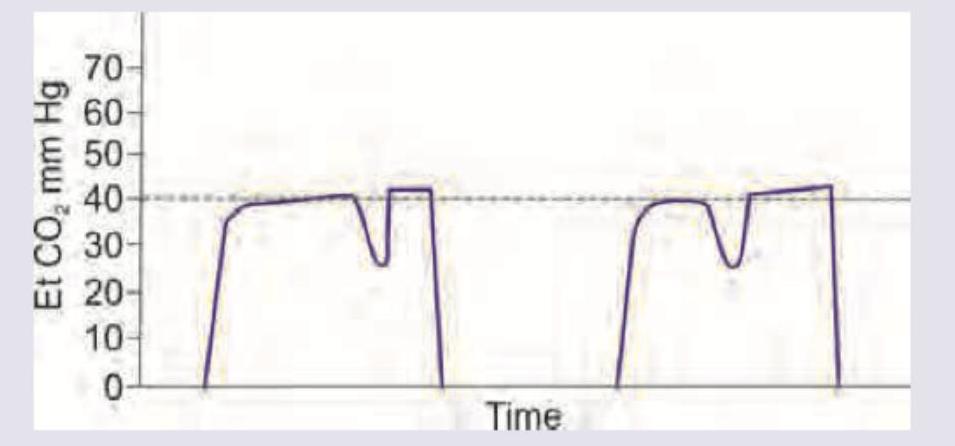
What is the next best step in patient with the following capnography tracing?
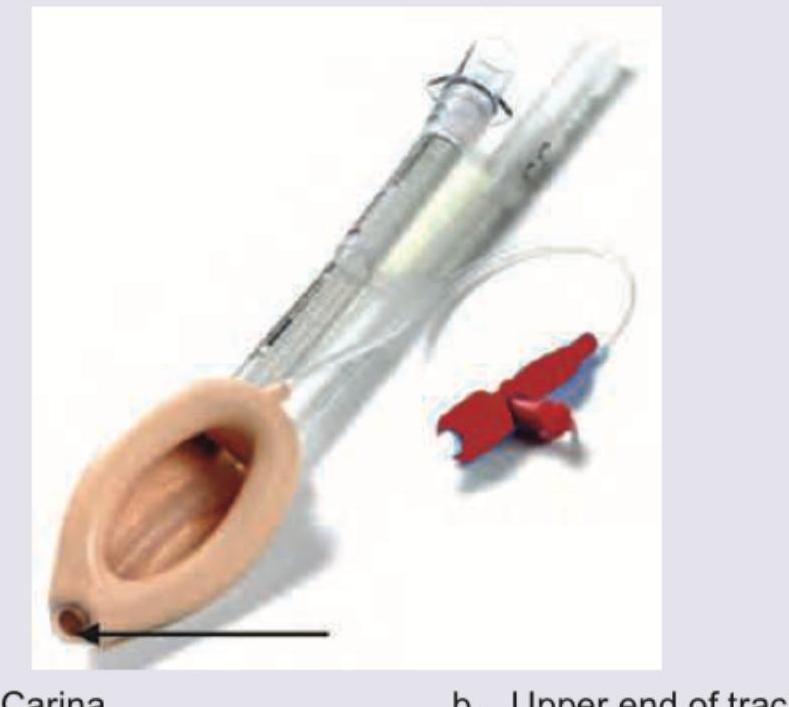
The diagram of a correctly positioned proseal-type Laryngeal Mask Airway is provided below. Above what site is the arrow marked area of the airway positioned?
INI-CET 2015 - Anesthesiology INI-CET Practice Questions and MCQs
Question 1: What is the next best step in patient with the following capnography tracing?
- A. Check for position of endotracheal tube (Correct Answer)
- B. Check for connections of anesthesia machine
- C. Change the soda lime canister
- D. Give skeletal muscle relaxant
Explanation: ***Check for position of endotracheal tube*** - The "curare cleft" or re-curarization pattern on the capnography indicates that the patient is spontaneously breathing against the ventilator, suggesting the effects of **muscle relaxants are wearing off**. - This pattern can also indicate a partially obstructed or dislodged endotracheal tube, where the patient's spontaneous breaths against the obstruction cause a dip in the expiratory plateau. Therefore, checking the **endotracheal tube position** is a critical immediate step. *Check for connections of anesthesia machine* - While machine connections are important for proper ventilation, this specific **"curare cleft" pattern** is more indicative of patient respiratory effort or tube issues rather than a primary machine connection problem. - A machine connection issue would typically manifest as a **loss of waveform** or an abnormal overall shape, not specifically a dip in the expiratory plateau. *Change the soda lime canister* - A depleted soda lime canister causes an **elevation of the baseline** (inspire CO2 not zero) and a rise in end-tidal CO2, as CO2 is not effectively reabsorbed. - This capnography tracing does not show an elevated baseline, making a depleted soda lime canister an **unlikely cause** of the observed "curare cleft." *Give skeletal muscle relaxant* - While the "curare cleft" can indicate that the effects of muscle relaxants are waning and the patient is beginning to spontaneously breathe, the **immediate next step** is to ensure airway patency and security. - Administering a muscle relaxant without first checking the **airway and tube position** could mask a serious issue. Re-dosing relaxants might be considered after ensuring the airway is secure and the tube is correctly positioned if the patient's spontaneous breathing is detrimental.
Question 2: The diagram of a correctly positioned proseal-type Laryngeal Mask Airway is provided below. Above what site is the arrow marked area of the airway positioned?
- A. Carina
- B. Upper end of trachea
- C. Vocal cords (Correct Answer)
- D. Above esophagus
Explanation: ***Vocal cords*** - A correctly positioned laryngeal mask airway (LMA) forms a seal around the **laryngeal inlet**, with its tip resting in the **hypopharynx** superior to the esophagus. - The LMA cuff is designed to sit in the **piriform fossae**, sealing the entry to the esophagus, while the opening of the LMA tube is positioned over the **glottic opening**, which lies between the vocal cords. *Carina* - The **carina** is the bifurcation of the trachea into the main bronchi, which is much lower in the airway than where an LMA is designed to be positioned. - Positioning an LMA near the carina would mean it is deeply intubated into the trachea, which is not its intended use or design. *Upper end of trachea* - While the LMA provides an airway to the trachea, its cuff typically seals the laryngeal structures **above the trachea**, not within it. - The purpose of an LMA is to provide a supraglottic seal, meaning it sits above the true vocal cords and the tracheal opening. *Above esophagus* - Although the LMA's tip rests in the hypopharynx, providing a seal that prevents air from entering the esophagus, the primary target for airflow from the LMA is the **glottic opening (vocal cords)**, not simply "above the esophagus." - The device functions by sitting snugly over the laryngeal inlet, ensuring that ventilation is directed toward the trachea.