A patient presents with lower right abdominal pain and rebound tenderness. Intraoperatively, an inflamed Meckel's diverticulum is found. This clinical presentation most closely mimics which condition?
A 70-year-old patient presents with absolute constipation and abdominal distension. The X-ray abdomen is given below. What is the most likely diagnosis?
Identify the sign given in the image below:
Which instrument is primarily used to establish pneumoperitoneum in closed laparoscopy technique?
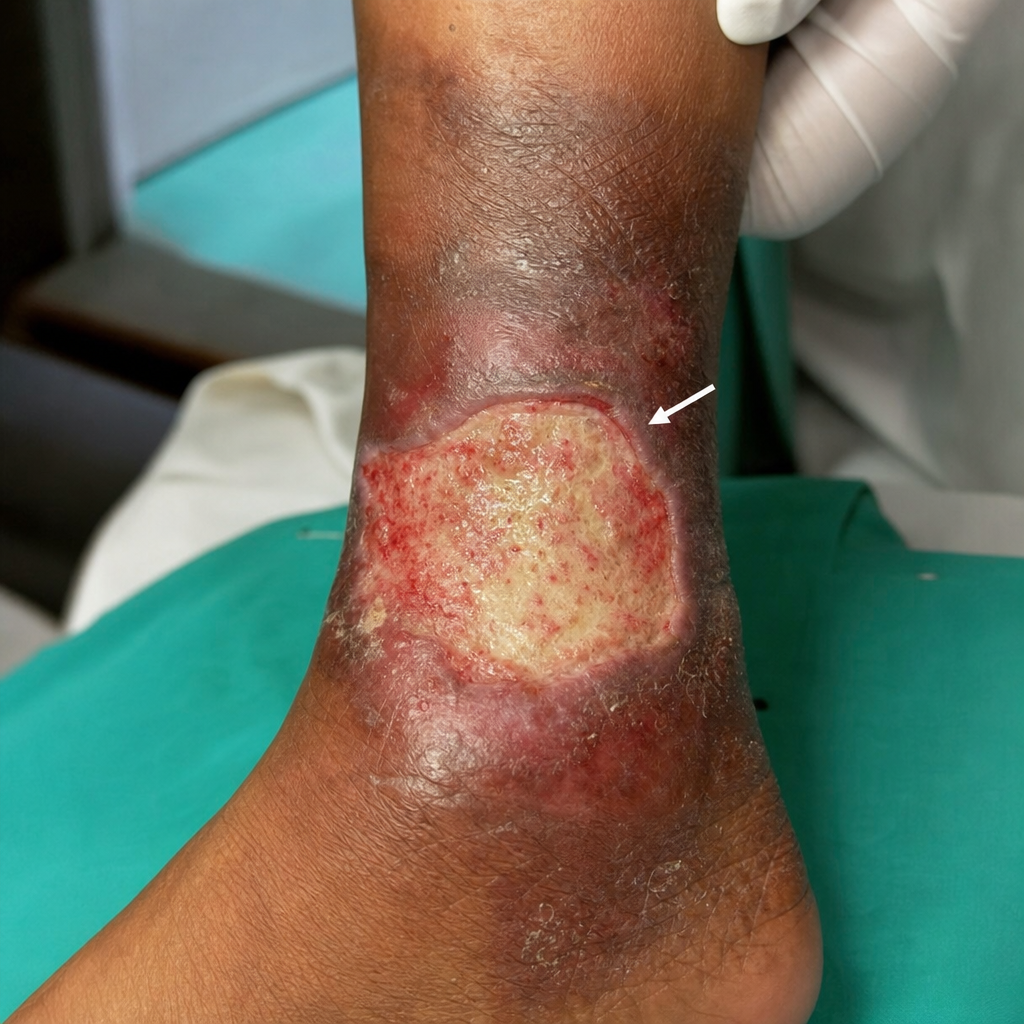
The given image shows an ulcer. Identify the marked structure.
A 33-year-old male presents with sudden onset acute abdominal pain, constipation for 1 day, persistent hiccups, and occasional vomiting. An abdominal X-ray was performed. Identify the pathology.
During laparoscopic surgery, which vessel(s) should be specifically avoided during lateral trocar insertion?
A patient with diffuse severely contaminated peritonitis underwent laparotomy and was left open after surgery. Which of the following might help?
A patient presents to the emergency department with confusion. On examination, he opens his eyes to pain, shows abnormal flexion to pain, and is disoriented in speech. What is his Glasgow Coma Scale (GCS) score?
A 34-year-old male undergoes an open appendectomy for acute appendicitis. The choice of incision was McBurney's incision. Postoperatively, after a few days, he presents with pain and bulging in the right lower quadrant, which is diagnosed as an indirect inguinal hernia. Which nerve injury during the appendectomy is most likely responsible for this complication?
FMGE 2025 - Surgery FMGE Practice Questions and MCQs
Question 11: A patient presents with lower right abdominal pain and rebound tenderness. Intraoperatively, an inflamed Meckel's diverticulum is found. This clinical presentation most closely mimics which condition?
- A. Cholecystitis
- B. Perforation
- C. Appendicitis (Correct Answer)
- D. Intestinal obstruction
Explanation: ***Appendicitis*** (Meckel's Diverticulitis Mimicking Appendicitis) - Inflammation of a Meckel's diverticulum (**Meckel's diverticulitis**) occurs in the right lower quadrant and is clinically indistinguishable from **acute appendicitis**. - Lower right abdominal pain and **rebound tenderness** are classic signs of localized **peritonitis** associated with inflammation of a structure near the ileocecal region. *Perforation* - Perforation causes signs of diffuse peritonitis, marked by generalized abdominal rigidity and severe systemic illness, rather than localized pain and rebound tenderness in the right lower quadrant. - It is generally a subsequent complication of severe diverticulitis, not the primary cause of this initial localized presentation. *Intestinal obstruction* - Obstruction due to Meckel's (e.g., intussusception or volvulus) presents with symptoms like **colicky pain**, abdominal distension, and **bilious vomiting**. - **Rebound tenderness** is not a primary feature unless the obstruction progresses to severe strangulation and localized ischemia. *Cholecystitis* - **Cholecystitis** is inflammation of the gallbladder, causing pain predominantly in the **right upper quadrant** or epigastrium, often linked to fatty meals. - This location is inconsistent with pain and rebound tenderness strictly localized to the **lower right abdomen**.
Question 12: A 70-year-old patient presents with absolute constipation and abdominal distension. The X-ray abdomen is given below. What is the most likely diagnosis?
- A. Caecal Volvulus
- B. Sigmoid Volvulus (Correct Answer)
- C. Intestinal Obstruction
- D. Small Bowel Volvulus
Explanation: ***Sigmoid Volvulus*** - The abdominal X-ray demonstrates the classic **"coffee bean" sign**, which is a massively dilated, haustra-less loop of the sigmoid colon that appears bent upon itself, originating from the pelvis. - This diagnosis aligns with the clinical presentation of an elderly patient with **absolute constipation** and significant **abdominal distension**, which are hallmark features of a closed-loop large bowel obstruction caused by sigmoid volvulus. *Caecal Volvulus* - A caecal volvulus typically presents as a **kidney-bean** or **comma-shaped** dilated structure that is displaced from the right lower quadrant towards the left upper quadrant, which is morphologically distinct from the inverted U-shape seen in the image. - The dilated cecum in a caecal volvulus often retains some **haustral markings**, unlike the smooth, featureless appearance of the dilated sigmoid colon seen here. *Intestinal Obstruction* - While sigmoid volvulus is a cause of intestinal obstruction, this is a non-specific diagnosis. The radiological findings are specific enough to identify the underlying cause. - A general diagnosis of intestinal obstruction doesn't account for the pathognomonic **"coffee bean" sign**, which specifically points to sigmoid volvulus as the etiology. *Small Bowel Volvulus* - The dilated loop in the X-ray lacks **valvulae conniventes** (also known as plicae circulares), which are characteristic transverse folds of the small bowel. The loop's appearance is consistent with the large bowel. - The caliber of the distended loop is exceptionally large, which is more typical for a colonic obstruction rather than a small bowel obstruction, which usually involves multiple, smaller-caliber loops.
Question 13: Identify the sign given in the image below:
- A. Handkerchief sign
- B. Double target sign (Correct Answer)
- C. Beta 2 transferrin sign
- D. Tear drop sign
Explanation: ***Double target sign*** - The image displays the **double target sign**, also known as the **halo sign**, which is highly suggestive of a **basilar skull fracture**. - This sign appears when blood mixed with **cerebrospinal fluid (CSF)** is dropped onto an absorbent surface; the heavier red blood cells accumulate in the center, while the lighter CSF diffuses outward, forming a distinct ring. *Beta 2 transferrin sign* - This is not a visual sign but a highly specific laboratory test used to confirm a **CSF leak**. **Beta-2 transferrin** is a protein almost exclusively found in CSF. - The test involves analyzing fluid collected from the nose or ear (rhinorrhea or otorrhea) to detect the presence of this specific protein, confirming its origin is CSF. *Handkerchief sign* - The **handkerchief sign** (or reservoir sign) refers to the clinical observation of a patient with **CSF rhinorrhea** who constantly has to wipe their nose due to the continuous, watery discharge. - It describes a patient's action rather than the appearance of the fluid itself on a surface. *Tear drop sign* - The **tear drop sign** is a radiological finding seen on orbital imaging (X-ray or CT scan), not a clinical sign on a cloth. - It indicates an **orbital floor (blowout) fracture**, where orbital contents, such as fat and the inferior rectus muscle, herniate into the maxillary sinus, resembling a hanging teardrop.
Question 14: Which instrument is primarily used to establish pneumoperitoneum in closed laparoscopy technique?
- A. Jamshidi needle
- B. 3 mm Trocar
- C. Hasson's cannula
- D. Veress needle (Correct Answer)
Explanation: ***Veress needle***- It is primarily used to establish **pneumoperitoneum** (gas insufflation) in the **closed laparoscopy** technique, before placing trocars.- A key feature is its **blunt inner retractable stylet**. Once the needle passes the abdominal wall and enters the peritoneal cavity, the stylet advances forward automatically, reducing the risk of internal visceral injury.*Hasson's cannula*- This instrument is specifically designed for the **open laparoscopic technique** (Hasson technique), utilized when the closed technique is contraindicated due to scar tissue or risk of injury.- It involves a direct cut-down approach and fixation by sutures, making it a **blunt entry system** unlike the sharp, blind insertion of the Veress needle.*Jamshidi needle*- This is a specialized needle used for **bone marrow aspiration** or **biopsy**, typically used in hematology or oncology.- It is characterized by a **tapered distal end** with a sharpened tip and a stylet designed to penetrate dense bone tissue, which is unrelated to abdominal gas insufflation.*3 mm Trocar*- A trocar system consists of a **cannula and an obturator** and is used to create a working port for the introduction of the camera or surgical instruments, usually *after* pneumoperitoneum has been achieved.- While 3 mm is a small diameter, its function is creating an instrument channel, not the initial **insufflation** itself.
Question 15: The given image shows an ulcer. Identify the marked structure.
- A. Base
- B. Floor
- C. Edge (Correct Answer)
- D. Margin
Explanation: ***Edge*** - The marked structure represents the side of the ulcer, connecting the **margin** to the **floor**, which is correctly termed the **edge**. - The characteristics of the edge (e.g., sloping, punched-out, undermined) are crucial for determining the ulcer's etiology, such as in **tuberculous ulcers** (undermined) or **malignant ulcers** (everted). *Margin* - The **margin** is the area of skin immediately surrounding the ulcer, essentially the "rim" on the surface. - The arrow is pointing into the crater of the ulcer, not the tissue around its periphery. *Floor* - The **floor** is the bottom, visible surface of the ulcer crater itself. - The marked structure is the wall leading down to the floor, not the floor itself. *Base* - The **base** is the tissue deep to the ulcer, upon which it rests, and is typically assessed by palpation for induration. - It is not a visible structure on inspection, unlike the edge which is clearly marked in the diagram.
Question 16: A 33-year-old male presents with sudden onset acute abdominal pain, constipation for 1 day, persistent hiccups, and occasional vomiting. An abdominal X-ray was performed. Identify the pathology.
- A. Sigmoid volvulus (Correct Answer)
- B. Intussusception
- C. Caecal volvulus
- D. Mechanical obstruction
Explanation: ***Sigmoid volvulus*** - The abdominal X-ray demonstrates the classic **"coffee bean" sign**, which is a pathognomonic finding for sigmoid volvulus, representing a massively dilated loop of the sigmoid colon. - The clinical presentation of acute abdominal pain, distension, and constipation is consistent with a **large bowel obstruction**, which is caused by the twisting of the sigmoid colon on its mesentery. *Caecal volvulus* - Radiographically, a caecal volvulus typically appears as a kidney-shaped or comma-shaped dilated loop of bowel displaced towards the **left upper quadrant**, which is not seen in this image. - It is less common than sigmoid volvulus and is often associated with a mobile cecum and the absence of prior abdominal surgery. *Intussusception* - Intussusception, the telescoping of one bowel segment into another, is more common in children and classically presents with a **"target sign"** on ultrasound or CT. - While it can cause obstruction in adults, the radiographic finding of a massive, single, air-filled loop is not characteristic of intussusception. *Mechanical obstruction* - This is a general term for physical blockage of the bowel lumen. While sigmoid volvulus is a specific cause of mechanical obstruction, the X-ray provides specific findings that point to a more precise diagnosis. - Non-specific signs of mechanical obstruction, such as multiple dilated bowel loops with **air-fluid levels**, are different from the characteristic single-loop dilation seen here.
Question 17: During laparoscopic surgery, which vessel(s) should be specifically avoided during lateral trocar insertion?
- A. Superior epigastric artery
- B. Both Superior epigastric artery and Inferior epigastric artery (Correct Answer)
- C. Abdominal aorta
- D. Inferior epigastric artery
Explanation: ***Both Superior epigastric artery and Inferior epigastric artery*** - Both the **superior epigastric** and **inferior epigastric arteries** run vertically in the rectus sheath (within the anterior abdominal wall) and are the most common significant vessels injured during lateral port placement. - Injury to these vessels specifically during secondary port (trocar) insertions is a well-recognized cause of major, potentially fatal **hemorrhage** and subsequent hematoma within the rectus sheath, necessitating their avoidance. *Superior epigastric artery* - Although this artery must be avoided, it is only one component of the major vascular risk; the **inferior epigastric artery** is often more frequently injured due to the location of typical lateral ports. - Selecting only the superior artery makes the answer incomplete, as both the superior and **inferior epigastric arteries** pose serious risks that require specific anatomical knowledge for avoidance. *Inferior epigastric artery* - The **inferior epigastric artery** is a critical structure to avoid, as it runs superomedially from the **external iliac artery** and is typically located medial to lateral port sites below the arcuate line. - This option is insufficient because avoidance of the **superior epigastric artery** is also required, depending on the height of the lateral port placement. *Abdominal aorta* - Puncture of the **abdominal aorta** is a catastrophic, high-mortality complication, but it is typically associated with blind primary entry techniques (e.g., Veress needle or primary trocar) and is located deep, not in the path of lateral port insertion. - While every effort is made to avoid all major vessels, the question concerns vessels directly in the plane of the anterior wall most likely injured by a standard lateral trocar insertion, which are the **epigastric arteries**.
Question 18: A patient with diffuse severely contaminated peritonitis underwent laparotomy and was left open after surgery. Which of the following might help?
- A. VAC (Correct Answer)
- B. Prefer closure after laparotomy
- C. Normal saline soaked gauze
- D. Antibiotic soaked gauze
Explanation: ***VAC***- **VAC (Vacuum-Assisted Closure)** is the gold standard for managing the damage control abdomen (laparostomy) following severe peritonitis, as it actively drains contaminated fluid and reduces **peritoneal edema**.- By applying controlled **negative pressure**, VAC protects the underlying visceral contents, prevents fascial retraction, and facilitates a definitive delayed primary or secondary fascial closure.*Normal saline soaked gauze*- This traditional method provides only passive protection and is inferior because it allows **contaminated exudates** to pool within the abdomen, increasing the risk of residual infection.- It necessitates multiple, often painful, changes and does not effectively prevent **fascial retraction**, making subsequent closure more challenging than with VAC.*Prefer closure after laparotomy*- Immediate closure in the context of **severe diffuse contamination** is contraindicated due to an unacceptably high risk of septic complications and residual **intraperitoneal infection**.- Primary closure may also lead to **Abdominal Compartment Syndrome (ACS)** due to significant bowel and peritoneal edema, which has high associated morbidity and mortality.*Antibiotic soaked gauze*- Local application of **antibiotic-soaked gauze** lacks scientific support and does not replace effective systemic antibiotic therapy combined with adequate drainage.- Like NS gauze, it is unable to create a controlled environment for fluid removal or prevent **fascial domain loss**, making definitive closure difficult.
Question 19: A patient presents to the emergency department with confusion. On examination, he opens his eyes to pain, shows abnormal flexion to pain, and is disoriented in speech. What is his Glasgow Coma Scale (GCS) score?
- A. 12
- B. 9 (Correct Answer)
- C. 11
- D. 10
Explanation: ***9***- The Glasgow Coma Scale (GCS) total score is the sum of scores for Eye (E), Verbal (V), and Motor (M) responses (E+V+M). - **Eye Opening (E)** score is 2 for opening eyes only to **painful stimuli** (4=Spontaneous, 1=None). - **Verbal Response (V)** score is 4 for **disoriented in speech**, which is categorized as disoriented/confused conversation (5=Oriented, 3=Inappropriate Words). - **Motor Response (M)** score is 3 for showing **abnormal flexion** (Decorticate posturing) to pain (6=Obeys Commands, 1=None). Total GCS = 2 + 4 + 3 = **9**. *11* - A GCS of 11 is too high for this clinical presentation, as it implies a much better neurological status, typically requiring higher E, V, and M scores (e.g., E3/4, V4/5, M4/5). - This score conflicts with the patient's severe responses: E=2 (to pain) and M=3 (**abnormal flexion**), which together limit the maximum possible GCS to 11 (2+5+4). *12* - A GCS of 12 represents a moderate head injury, which is inconsistent with the patient demonstrating **abnormal flexion** (M=3), a sign often associated with severe injury or significant cerebral dysfunction. - Achieving a score of 12 would necessitate very strong cognitive responses (e.g., E4, V5, M3), which contradict the observed responses of E=2 and M=3. *10* - While close to the correct score, 10 would require a combination like E2, V5, M3, meaning the patient should be **oriented verbally** (V=5). - The patient is explicitly described as "**disoriented in speech**," which dictates a verbal score of V=4 or less, thus ruling out GCS 10.
Question 20: A 34-year-old male undergoes an open appendectomy for acute appendicitis. The choice of incision was McBurney's incision. Postoperatively, after a few days, he presents with pain and bulging in the right lower quadrant, which is diagnosed as an indirect inguinal hernia. Which nerve injury during the appendectomy is most likely responsible for this complication?
- A. Ilioinguinal nerve (Correct Answer)
- B. Pudendal nerve
- C. Genitofemoral nerve
- D. Femoral nerve
Explanation: ***Ilioinguinal nerve*** - The **ilioinguinal nerve** (L1) runs between the internal oblique and transversus abdominis muscles in the inguinal region and passes through the superficial inguinal ring - During **McBurney's incision** (muscle-splitting incision at McBurney's point), the ilioinguinal nerve is at risk of injury as it traverses the layers of the anterior abdominal wall - **Mechanism of hernia formation:** Injury to the ilioinguinal nerve causes denervation and atrophy of the internal oblique and transversus abdominis muscles, which weakens the posterior wall of the inguinal canal - This muscular weakness predisposes to **indirect inguinal hernia** formation through the internal inguinal ring - **Classic presentation:** Pain and bulging in the inguinal region post-appendectomy *Pudendal nerve* - Arises from S2-S4 and runs through the **pelvis and perineum** (pudendal canal) - Not at risk during appendectomy as it is far from the surgical field - Injury would cause perineal sensory loss and sphincter dysfunction, not hernia *Genitofemoral nerve* - Runs on the psoas muscle and divides into genital and femoral branches - While the genital branch passes through the inguinal canal, injury typically causes **sensory loss** in the groin and scrotum/labia - Does **not** cause motor weakness or hernia formation *Femoral nerve* - Runs beneath the **inguinal ligament** in the femoral triangle - Not at risk during McBurney's incision - Injury would cause quadriceps weakness and loss of knee extension, not hernia