Based on the provided MRI images of the knee (A and B), which show a well-defined fluid collection anterior to the patella, what is the most likely diagnosis?
Which of the following conditions is associated with Holman-Miller sign in the CT image given below?
A patient with CSOM presented to the OPD with seizures. On examination, homonymous hemianopia was present. Identify the condition based on the CT scan given below.
A patient presented to the OPD with a sudden onset of shortness of breath. Identify the condition with the radiological image given below.
Which of the following is shown in the image below (circled)?
A patient presents with SOB and fatigue. CXR was done. What is the diagnosis? 
A patient presents with severe headache. A CT scan of the brain reveals hyperdense areas in the right basal region, marked as 'X'. Which of the following is the most likely diagnosis?
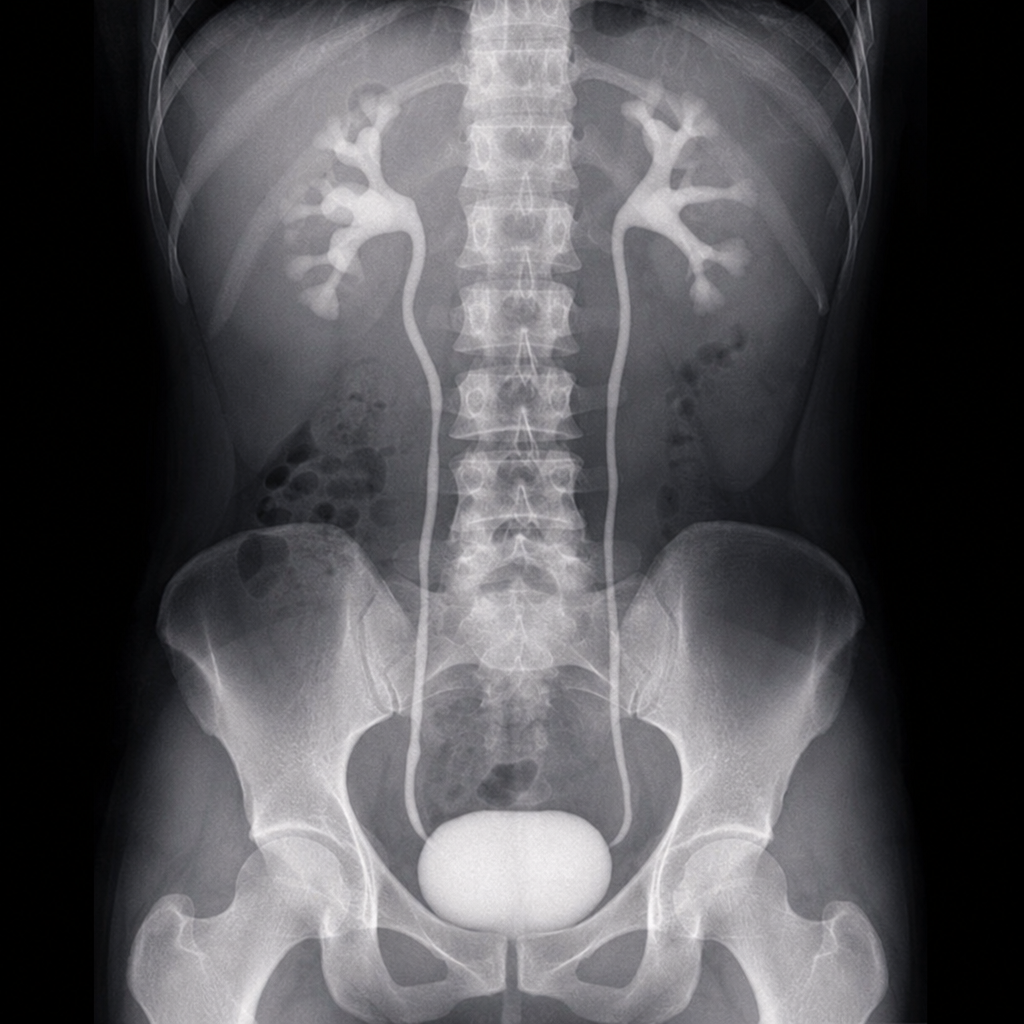
The following radiological image was taken to assess the urinary tract. Identify the investigation shown below.
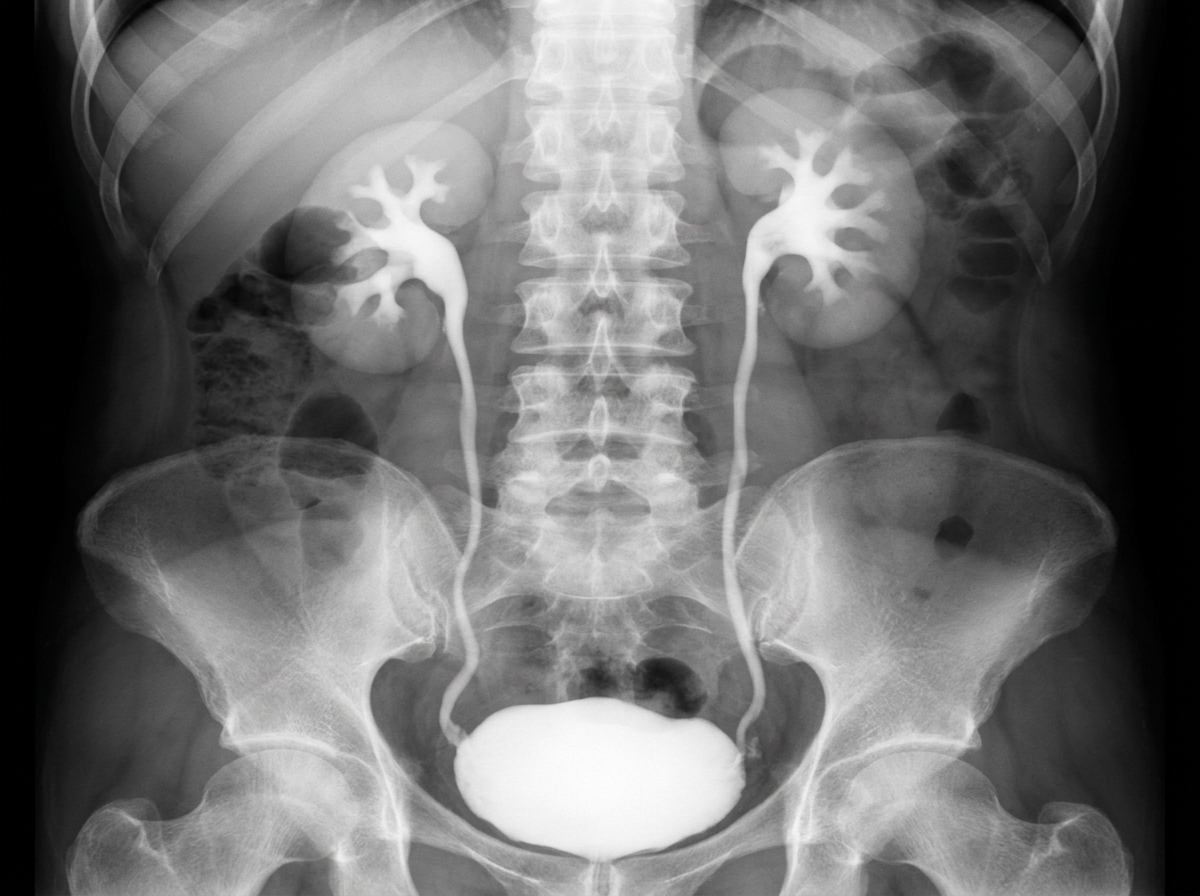
Identify the investigation shown in the image:
What does a linear accelerator (LINAC) produce in radiation therapy?
FMGE 2025 - Radiology FMGE Practice Questions and MCQs
Question 11: Based on the provided MRI images of the knee (A and B), which show a well-defined fluid collection anterior to the patella, what is the most likely diagnosis?
- A. Rheumatoid arthritis
- B. Housemaid's knee (Correct Answer)
- C. Gout
- D. Subdermal abscess
Explanation: ***Housemaid's knee*** - The MRI shows fluid accumulation specifically in the **prepatellar bursa**, which is located anterior to the patella. This finding is the hallmark of prepatellar bursitis. - This condition is colloquially termed **"Housemaid's knee"** as it commonly results from chronic irritation and inflammation of the bursa due to repetitive kneeling. *Subdermal abscess* - A **subdermal abscess** would appear as a collection of pus in the subcutaneous tissue, often with irregular borders and significant surrounding **inflammatory changes (cellulitis)**, which are not the primary findings here. - The fluid collection is well-defined and confined to the anatomical location of the **prepatellar bursa**, not a disorganized subcutaneous collection. *Gout* - Gout typically presents as an acute **intra-articular** inflammation with a large joint effusion. Chronic gout can show characteristic **"rat-bite" erosions** on imaging, which are not visible here. - While gout can cause bursitis, the diagnosis is confirmed by identifying **negatively birefringent urate crystals** in aspirated fluid, and the imaging is less specific than for simple bursitis. *Rheumatoid arthritis* - Rheumatoid arthritis is a systemic disease causing **synovitis** and **pannus formation**, leading to joint destruction and bone erosions, none of which are seen in the image. - While bursitis can be associated with rheumatoid arthritis, it is typically part of a widespread **polyarthritis**, not an isolated finding as shown.
Question 12: Which of the following conditions is associated with Holman-Miller sign in the CT image given below?
- A. Nasal polyp
- B. Rhinosporidiosis
- C. Maxillary sinusitis
- D. Juvenile nasopharyngeal angiofibroma (Correct Answer)
Explanation: ***Juvenile nasopharyngeal angiofibroma***- Holman-Miller sign refers to the classic imaging finding of **anterior bowing** of the posterior wall of the **maxillary sinus** due to the aggressive expansion of this benign tumor originating in the **sphenopalatine foramen**.- This highly **vascular** tumor typically affects **adolescent males** and presents with unilateral, recurrent, and severe epistaxis and nasal obstruction.*Maxillary sinusitis*- CT findings usually include non-specific features like **mucoperiosteal thickening**, air-fluid levels, or complete opacification, without significant displacement of the bony walls.- It is an inflammatory condition, caused by infection or allergy, which does not produce the bone displacement characteristic of aggressive local tumor growth like **JNA**.*Nasal polyp*- Nasal polyps arise from the nasal and sinus mucosa (often the **ethmoids**) and cause pressure-induced **bone erosion** or remodeling, but not the specific **anterior bowing** of the posterior maxillary wall.- They are typically associated with conditions such as **allergic rhinitis** or aspirin-exacerbated respiratory disease.*Rhinosporidiosis*- This condition is characterized by proliferative, **friable, strawberry-like masses** within the nasal cavity, caused by the organism *Rhinosporidium seeberi*.- Imaging usually shows only soft tissue masses within the nasal cavity or nasopharynx without the extensive **bony displacement** needed to produce Holman-Miller sign.
Question 13: A patient with CSOM presented to the OPD with seizures. On examination, homonymous hemianopia was present. Identify the condition based on the CT scan given below.
- A. Meningitis
- B. Cerebellar abscess
- C. Extradural abscess
- D. Temporal abscess (Correct Answer)
Explanation: ***Temporal abscess*** - The patient's history of **CSOM** (Chronic Suppurative Otitis Media) is a classic risk factor for an **otogenic brain abscess**, with the temporal lobe being the most common site due to its proximity to the middle ear and mastoid. - The clinical signs of **seizures** and **homonymous hemianopia** (from involvement of optic radiations), combined with the characteristic **ring-enhancing lesion** on the CT scan, are pathognomonic for a temporal lobe abscess. *Cerebellar abscess* - A cerebellar abscess would present with signs of **cerebellar dysfunction**, such as **ataxia**, **nystagmus**, and **dysmetria**, which are absent in this patient's presentation. - While also a potential complication of otitis media, the focal neurological deficit of **homonymous hemianopia** localizes the lesion to the cerebrum, not the cerebellum. *Extradural abscess* - An extradural abscess is located between the dura mater and the skull and appears as a **lens-shaped (biconvex)** collection on CT, which is morphologically distinct from the **intraparenchymal, ring-enhancing lesion** shown. - Such an abscess is less likely to cause focal signs like hemianopia unless there is significant mass effect on the underlying brain parenchyma. *Meningitis* - Meningitis involves diffuse inflammation of the meninges and does not typically form a **focal, ring-enhancing mass** on a CT scan; findings are often normal or show diffuse meningeal enhancement. - The presence of a specific focal neurological deficit like **homonymous hemianopia** strongly points towards a localized lesion like an abscess rather than diffuse meningitis.
Question 14: A patient presented to the OPD with a sudden onset of shortness of breath. Identify the condition with the radiological image given below.
- A. Epiglottitis
- B. Bronchitis
- C. Laryngotracheobronchitis (Correct Answer)
- D. Laryngomalacia
Explanation: ***Laryngotracheobronchitis*** - The AP neck radiograph displays the classic **"steeple sign,"** which is a tapered narrowing of the subglottic trachea (indicated by the arrow) due to inflammation. - This condition, also known as **croup**, is typically caused by a viral infection (most commonly **parainfluenza virus**) and presents with a characteristic **barking cough** and inspiratory stridor. *Epiglottitis* - This condition is characterized by the **"thumb sign"** on a *lateral* neck X-ray, which shows a swollen epiglottis, not the subglottic narrowing seen here. - Patients typically present more severely with high fever, **drooling**, dysphagia, and assume a **"tripod" posture**, which differs from the presentation of croup. *Bronchitis* - Bronchitis is an inflammation of the larger airways (bronchi) and would not produce findings in the subglottic region of a neck X-ray. - The primary symptom is a productive cough, and a **chest X-ray**, not a neck X-ray, would be the relevant imaging, which is often normal. *Laryngomalacia* - This is a congenital condition causing inspiratory stridor due to the collapse of soft laryngeal structures; it is not an acute infectious process. - The diagnosis is typically confirmed with **flexible laryngoscopy**, and plain radiographs are usually normal and do not show a steeple sign.
Question 15: Which of the following is shown in the image below (circled)?
- A. Osteomeatal complex (Correct Answer)
- B. Nasal valve
- C. Columella
- D. Crest of maxilla
Explanation: ***Osteomeatal complex*** - The circled area highlights the **osteomeatal complex (OMC)**, a functional unit of the lateral nasal wall located in the middle meatus. - The OMC is the final common drainage pathway for the **frontal**, **maxillary**, and **anterior ethmoid sinuses**, and its obstruction is a primary cause of chronic rhinosinusitis. *Columella* - The **columella** is the external, soft tissue structure that separates the nostrils at the base of the nose. - It is an external feature and is not an internal bony or mucosal structure visible in this coronal CT view of the paranasal sinuses. *Nasal valve* - The **nasal valve** is the narrowest segment of the nasal airway, located much more anteriorly in the nasal cavity, near the nostril opening. - It is a functional area defined by the junction of the nasal septum and the upper lateral cartilage, not the region shown in the middle meatus. *Crest of maxilla* - The **crest of the maxilla**, or nasal crest, is a bony ridge on the floor of the nasal cavity where the inferior edge of the nasal septum articulates. - The circled structure is located superiorly and laterally within the middle meatus, not on the inferior floor of the nasal cavity.
Question 16: A patient presents with SOB and fatigue. CXR was done. What is the diagnosis? 
- A. Asbestosis (Correct Answer)
- B. Silicosis
- C. TB
- D. Byssinosis
Explanation: ***Asbestosis*** - The chest X-ray demonstrates classic features of asbestosis, including **pleural plaques** (calcifications on the pleura) and diffuse **interstitial fibrosis**, which is most prominent in the **lower lung zones**. - Asbestosis is a type of pneumoconiosis caused by the inhalation of **asbestos fibers**, and these radiographic findings are highly characteristic of long-term exposure. *TB* - Tuberculosis typically presents with findings in the **upper lobes** or apical segments of the lungs, such as **cavitations**, consolidation, or a **Ghon complex**. - The diffuse lower lobe interstitial pattern and pleural plaques seen in this image are not features of a typical TB infection. *Silicosis* - Silicosis is a pneumoconiosis that classically affects the **upper lung zones**, presenting as multiple small, rounded opacities that can coalesce into larger masses. - A characteristic finding, though not always present, is **"eggshell calcification"** of the hilar lymph nodes, which is absent here. Pleural plaques are not a typical feature. *Byssinosis* - Byssinosis, or "brown lung disease," is caused by exposure to cotton dust and often presents with a normal chest X-ray or non-specific findings of hyperinflation. - The diagnosis is primarily clinical, based on a history of chest tightness and dyspnea that improves over the work week. It does not cause the distinct pleural and parenchymal changes seen in asbestosis.
Question 17: A patient presents with severe headache. A CT scan of the brain reveals hyperdense areas in the right basal region, marked as 'X'. Which of the following is the most likely diagnosis?
- A. Brain abscess
- B. Subarachnoid hemorrhage (Correct Answer)
- C. Pneumocephalus
- D. Meningococcal meningitis
Explanation: ***Subarachnoid hemorrhage*** - The non-contrast CT scan shows **hyperdensity** (appears white) within the basal cisterns and Sylvian fissures (indicated by 'X'), which is the classic appearance of acute blood in the subarachnoid space. - This condition classically presents with a sudden, severe "**thunderclap headache**" and is most commonly caused by a ruptured **berry aneurysm**. *Meningococcal meningitis* - A non-contrast CT in meningitis is often normal. Key findings like **meningeal enhancement** would only be visible on a post-contrast CT scan, which is not the pattern seen here. - The clinical presentation typically involves a triad of **fever**, **nuchal rigidity**, and altered mental status, which are classic signs of meningeal irritation. *Brain abscess* - A brain abscess on a non-contrast CT typically appears as a **hypodense** (dark) or isodense mass within the brain parenchyma, often with surrounding vasogenic edema. - On a contrast-enhanced CT, it characteristically shows a **ring-enhancing lesion**, which is not depicted in this image. *Pneumocephalus* - Pneumocephalus refers to air within the cranial cavity, which appears as profoundly **hypodense** (black) on a CT scan. - The primary finding in the image is **hyperdensity** (blood), not the extreme hypodensity characteristic of air.
Question 18: The following radiological image was taken to assess the urinary tract. Identify the investigation shown below.
- A. Intravenous pyelogram (IVP) (Correct Answer)
- B. Pelvic X-ray
- C. Retrograde pyelogram
- D. Micturating cystourethrogram (MCU)
Explanation: ***Intravenous pyelogram (IVP)*** - An **IVP**, also known as intravenous urography (IVU), involves injecting a radiopaque **contrast agent** intravenously, which is then excreted by the kidneys, allowing for visualization of the entire urinary tract including the kidneys, ureters, and bladder. - This investigation provides both anatomical detail, such as identifying obstructions or masses, and functional information about the kidneys' ability to excrete the contrast. *Pelvic X-ray* - A standard **pelvic X-ray** is primarily used to evaluate the bony structures of the pelvis and would not typically involve contrast media to outline the urinary tract. - While it can reveal radiopaque **kidney stones** (calculi) or bladder stones, it does not provide detailed visualization of the kidneys or ureters as an IVP does. *Retrograde pyelogram* - In a **retrograde pyelogram**, contrast dye is injected directly into the ureters or renal pelvis via a catheter inserted through a **cystoscope** into the bladder. - This procedure visualizes the collecting system in a retrograde fashion (from bottom to top) and does not assess renal excretory function. *Micturating cystourethrogram (MCU)* - An **MCU** (also known as voiding cystourethrogram or VCUG) involves retrograde filling of the bladder with contrast through a urethral catheter, followed by fluoroscopic imaging during voiding. - This investigation is primarily used to evaluate **vesicoureteral reflux** and urethral anatomy, not for assessing the upper urinary tract (kidneys and ureters) as shown in an IVP.
Question 19: Identify the investigation shown in the image:
- A. CT
- B. X-ray
- C. Mammography (Correct Answer)
- D. MRI
Explanation: ***Mammography*** - The image displays the characteristic features of a mammogram, which is a specialized **low-dose X-ray** of the breast used for screening and diagnosis. - It clearly delineates the breast's internal structures, including **glandular tissue**, **adipose tissue**, and **ducts**, which is the primary purpose of this imaging modality. *CT* - A **Computed Tomography (CT)** scan produces cross-sectional (slice) images, whereas the image shown is a projectional view of the entire breast, typical of mammography. - CT scans of the chest would typically show surrounding structures like ribs, lungs, and the sternum, which are absent in this focused view. *X-ray* - While mammography is a type of X-ray, in clinical practice, the term "X-ray" usually refers to a standard radiograph (e.g., chest X-ray) that is not optimized for detailed **soft-tissue differentiation** of the breast. - The technique involves breast compression and specific views (like mediolateral oblique or craniocaudal) that are unique to mammography, not general radiography. *MRI* - **Magnetic Resonance Imaging (MRI)** of the breast produces images with different tissue contrast and appearance, often using gadolinium contrast to assess vascularity. - The texture and resolution of an MRI are distinct, and it does not typically show microcalcifications with the same clarity as a mammogram.
Question 20: What does a linear accelerator (LINAC) produce in radiation therapy?
- A. Alpha and beta rays
- B. X-rays and gamma rays
- C. Neutrons and positrons
- D. X-rays and electrons (Correct Answer)
Explanation: ***X-rays and electrons*** - A linear accelerator (LINAC) accelerates **electrons** to high energies, which can be used directly as an **electron beam** to treat superficial tumors. - To treat deeper tumors, these high-energy **electrons** are made to strike a heavy metal target (like tungsten), which then produces high-energy **X-rays** (photons) through a process called **bremsstrahlung**. *Alpha and beta rays* - **Alpha particles** (helium nuclei) and **beta particles** (electrons from nuclear decay) are forms of particulate radiation emitted by radioactive substances, not generated by a LINAC. - While the LINAC beam consists of electrons, it does not produce **alpha particles**, which have very low penetration and are not used in external beam radiotherapy. *X-rays and gamma rays* - A LINAC produces **X-rays**, but not **gamma rays**. Although both are high-energy photons, their origin differs. - **Gamma rays** are emitted from the nucleus of a decaying radioactive atom (e.g., Cobalt-60), whereas **X-rays** from a LINAC are produced extranuclearly when electrons interact with a target. *Neutrons and positrons* - **Neutron therapy** is a specialized form of radiation that requires different equipment, like a cyclotron, and is not a primary output of a standard medical LINAC. - **Positrons** are the antimatter counterpart of electrons and are used in diagnostic imaging (**Positron Emission Tomography or PET**), not for therapeutic purposes in a LINAC.