Community Medicine
1 questionsAn image of the mascot is shown below. Identify the related national health programme.
FMGE 2025 - Community Medicine FMGE Practice Questions and MCQs
Question 81: An image of the mascot is shown below. Identify the related national health programme.
- A. National Anti-Malaria Programme
- B. National Tuberculosis Elimination Programme
- C. National Leprosy eradication programme (Correct Answer)
- D. National Polio Surveillance Program
Explanation: ***National Leprosy eradication programme*** - The mascot shown in the image is **"Sapna"**, who is the official mascot for the **National Leprosy Eradication Programme (NLEP)** in India. - The mascot is used in Information, Education, and Communication (IEC) activities to reduce the stigma associated with leprosy and promote the message that it is completely curable with **Multi-Drug Therapy (MDT)**. *National Tuberculosis Elimination Programme* - The **National Tuberculosis Elimination Programme (NTEP)** does not use this mascot; its campaign is famously known by the slogan **"TB Harega Desh Jeetega"**. - The programme focuses on early diagnosis and treatment of tuberculosis using strategies like the **Directly Observed Treatment, Short-course (DOTS)**. *National Anti-Malaria Programme* - This programme, now under the **National Vector Borne Disease Control Programme (NVBDCP)**, does not have a specific mascot like the one shown. - Its awareness campaigns typically focus on preventive measures like using mosquito nets, repellents, and preventing water stagnation to control the mosquito vector. *National Polio Surveillance Program* - The polio eradication campaign in India is widely recognized by its slogan **"Do Boond Zindagi Ki"** (Two drops of life) and is associated with administering the **Oral Polio Vaccine (OPV)**. - It does not use the "Sapna" mascot; its campaigns often feature prominent celebrities and visuals of health workers administering polio drops.
ENT
2 questionsA 45-year-old male was admitted with respiratory distress. CT showed a nasal polyp with fluid collection in the sinus. Drainage of which of the following is obstructed?
A 49-year-old female from Nagaland presented with right-sided hearing loss and tinnitus. On examination, dull tympanic membrane with lymph nodes in the posterior triangle of the neck was seen. Which of the following is the management for the condition?
FMGE 2025 - ENT FMGE Practice Questions and MCQs
Question 81: A 45-year-old male was admitted with respiratory distress. CT showed a nasal polyp with fluid collection in the sinus. Drainage of which of the following is obstructed?
- A. Ethmoidal sinus
- B. Frontal sinus
- C. Maxillary sinus (Correct Answer)
- D. Sphenoidal sinus
Explanation: ***Maxillary sinus*** - The coronal CT scan clearly shows opacification (fluid collection) in the right **maxillary sinus**, the large air-filled space located inferior to the orbit and lateral to the nasal cavity. - Nasal polyps commonly arise in the **middle meatus**, which is the primary drainage site for the maxillary sinus via the **maxillary ostium**. Obstruction here leads to fluid retention and sinusitis. *Ethmoidal sinus* - The **ethmoidal sinuses** are a complex of small air cells located between the orbits. While some mild mucosal thickening may be present, they are not the site of the large, complete fluid collection seen in the image. - These sinuses also drain into the **middle meatus** (anterior and middle ethmoidal cells) and **superior meatus** (posterior ethmoidal cells), but the primary pathology shown is not within the ethmoid air cells themselves. *Sphenoidal sinus* - The **sphenoidal sinus** is located more posteriorly within the sphenoid bone, behind the ethmoid sinuses, and is not the sinus shown to be opacified in this anterior coronal view. - It drains into the **sphenoethmoidal recess**, a location superior and posterior to the superior turbinate, anatomically distinct from the area affected by the polyp. *Frontal sinus* - The **frontal sinuses** are situated superior to the orbits within the frontal bone. The image shows these sinuses are well-aerated and free of significant fluid. - Drainage of the frontal sinus occurs via the **frontonasal duct** into the **middle meatus**. Obstruction would cause fluid buildup superior to the eye, which is not seen here.
Question 82: A 49-year-old female from Nagaland presented with right-sided hearing loss and tinnitus. On examination, dull tympanic membrane with lymph nodes in the posterior triangle of the neck was seen. Which of the following is the management for the condition?
- A. Grommet insertion + Steroids
- B. Steroids
- C. Radiotherapy (Correct Answer)
- D. Grommet insertion
Explanation: ***Correct: Radiotherapy*** - This clinical presentation is **classic for nasopharyngeal carcinoma (NPC)**: middle-aged patient from **Nagaland** (endemic region for NPC in Northeast India), unilateral serous otitis media (dull TM, hearing loss, tinnitus from Eustachian tube obstruction), and **posterior triangle lymphadenopathy** (most characteristic feature) - **NPC is highly radiosensitive** and radiotherapy is the primary treatment modality for all stages - Concurrent chemoradiotherapy is the standard for locally advanced disease - The geographic origin (Nagaland) is a critical clue as NPC has high incidence in Northeast India, Southeast Asia, and Southern China (associated with EBV infection and dietary factors) *Incorrect: Grommet insertion + Steroids* - Treats only the **secondary middle ear effusion**, not the underlying malignancy - Would delay definitive diagnosis and treatment of NPC - May temporarily relieve hearing symptoms but doesn't address the cancer *Incorrect: Steroids* - No role in the treatment of nasopharyngeal carcinoma - May mask symptoms and delay diagnosis - Does not address the underlying malignancy or lymphadenopathy *Incorrect: Grommet insertion* - Only addresses the **symptomatic serous otitis media**, not the primary pathology - The presence of posterior triangle lymph nodes makes malignancy the priority - Any adult with unilateral serous otitis media + cervical lymphadenopathy requires nasopharyngoscopy and biopsy to rule out NPC before symptomatic treatment
Microbiology
2 questionsWhich of the following is the culture medium used for tuberculosis?
What is the most common causative organism of prosthetic heart valve endocarditis?
FMGE 2025 - Microbiology FMGE Practice Questions and MCQs
Question 81: Which of the following is the culture medium used for tuberculosis?
- A. Chocolate agar
- B. MacConkey medium
- C. Blood agar
- D. LJ medium (Correct Answer)
Explanation: ***LJ medium*** - LJ medium, or **Löwenstein-Jensen medium**, is the standard, egg-based solid medium used worldwide for the culture of ***Mycobacterium tuberculosis*** (M.tb). - It contains **malachite green**, which acts as a selective agent, inhibiting the growth of most common contaminating bacteria but allowing slow growth of mycobacteria. *MacConkey medium* - This is a **selective and differential medium** primarily used for isolating and differentiating **Gram-negative enteric bacilli**, such as *Escherichia coli* and *Salmonella*. - It inhibits Gram-positive bacteria using bile salts and crystal violet, and differentiates organisms based on **lactose fermentation**. *Blood agar* - This is a **general-purpose enrichment medium** used for the cultivation of a wide range of fastidious and non-fastidious bacteria. - It is crucial for assessing the **hemolytic reaction** of bacteria (alpha, beta, or gamma hemolysis), especially for classifying streptococci. *Chocolate agar* - This medium is prepared by heating blood agar, lysing the red blood cells, which releases essential nutrients like **X and V factors** (hematin and NAD). - It is specifically used for the culture of highly **fastidious organisms** such as ***Haemophilus influenzae*** and **pathogenic Neisseria species**.
Question 82: What is the most common causative organism of prosthetic heart valve endocarditis?
- A. S. aureus
- B. S. epidermidis (Correct Answer)
- C. S. viridans
- D. Enterococcus
Explanation: ***S. epidermidis*** - **S. epidermidis** is the most common single causative organism of prosthetic heart valve (PHV) endocarditis, especially in the **early post-operative period** (within 60 days to 1 year of surgery). - This organism is a **coagulase-negative Staphylococcus** known for its ability to produce a **glycocalyx (biofilm)**, which adheres strongly to foreign materials like prosthetic valves. *S. viridans* - Typically the leading cause of **subacute infectious endocarditis** on native, damaged valves, often following minor **dental procedures**. - While it can cause late PHV endocarditis, it is much less frequent than staphylococcal species, which dominate PHV infections. *S. aureus* - **S. aureus** is the most common cause of **acute native valve endocarditis** and frequently implicated in endocarditis in **IV drug users**. - It is a major cause of PHV endocarditis, especially **late-onset** (more than 1 year post-surgery), but overall, **S. epidermidis** is considered the most common pathogen when considering all PHV infections. *Enterococcus* - **Enterococcus species** (especially *E. faecalis*) account for approximately **5-10% of prosthetic valve endocarditis** cases, particularly in late-onset infections. - While significant, enterococci are far less common than staphylococcal species in PHV endocarditis.
Obstetrics and Gynecology
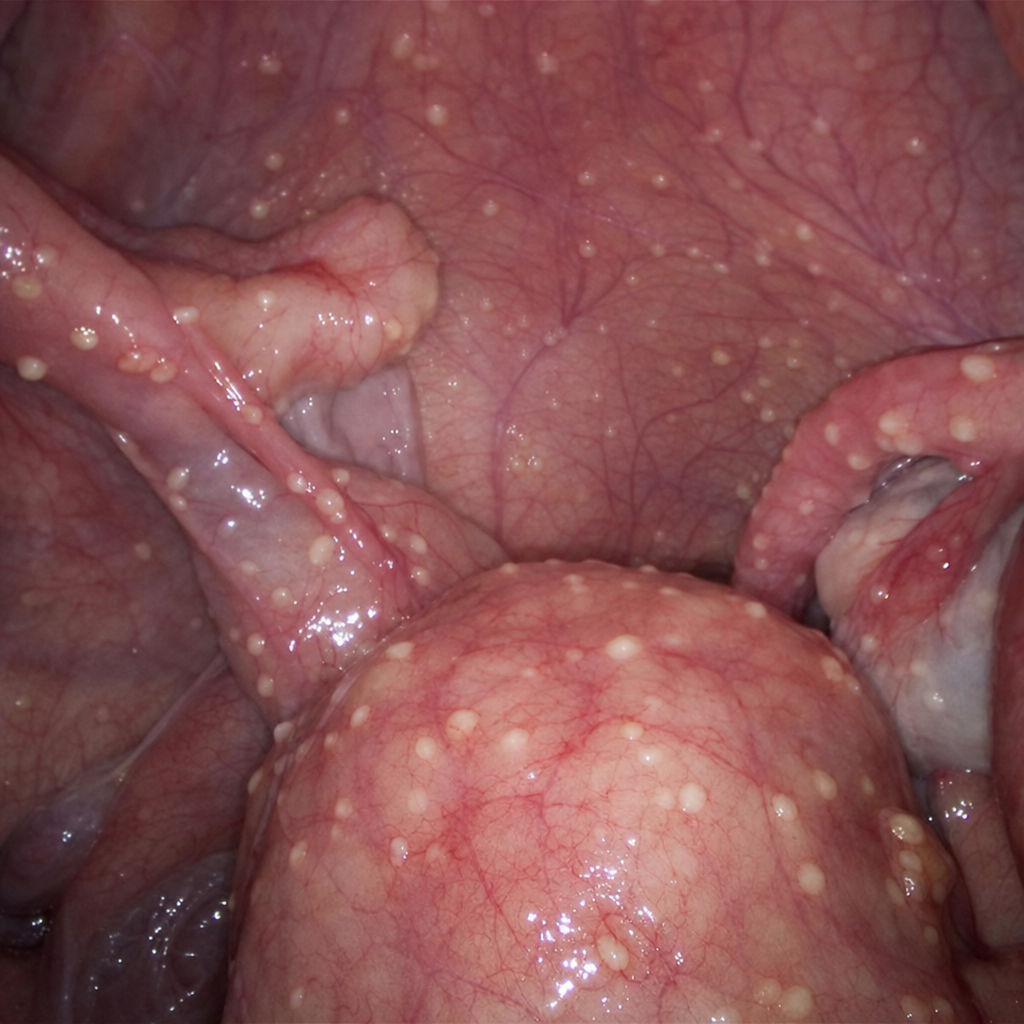
1 questionsWhat is the likely diagnosis for the given image?
FMGE 2025 - Obstetrics and Gynecology FMGE Practice Questions and MCQs
Question 81: What is the likely diagnosis for the given image?
- A. Hydrosalpinx
- B. Normal fallopian tube
- C. Genital TB (Correct Answer)
- D. Endometriosis
Explanation: ***Genital TB*** - The image displays multiple small, yellowish-white nodules, known as **tubercles**, scattered on the peritoneal surfaces and adnexa. This finding is a classic laparoscopic sign of **peritoneal tuberculosis**. - Genital tuberculosis often presents with infertility, menstrual irregularities, or chronic pelvic pain, and the diagnosis is often confirmed by identifying these **caseating granulomas** on biopsy. *Normal fallopian tube* - A normal fallopian tube appears as a smooth, mobile, pinkish structure without any surface lesions, adhesions, or inflammation. - The adnexal structures in the image are clearly abnormal, showing multiple surface nodules inconsistent with normal anatomy. *Hydrosalpinx* - A hydrosalpinx is characterized by a distally blocked fallopian tube that becomes dilated and filled with serous fluid, appearing as a translucent, **sausage-shaped** structure. - While genital TB can cause tubal blockage, the primary finding here is the presence of **tubercles**, not the characteristic gross distension of a hydrosalpinx. *Endometriosis* - Endometriosis typically presents as **"powder-burn" lesions** (dark blue or black), red implants, or "chocolate cysts" (**endometriomas**) on the pelvic organs. - The yellowish, solid nodules seen in the image are characteristic of **tuberculous granulomas** and differ in appearance from typical endometriotic implants.
Orthopaedics
1 questionsA 23 year old male epileptic patient presented with pain in right shoulder region. Examination revealed that right upper limb was abducted and externally rotated and the movements could not be performed. Which of the following is the most likely diagnosis?
FMGE 2025 - Orthopaedics FMGE Practice Questions and MCQs
Question 81: A 23 year old male epileptic patient presented with pain in right shoulder region. Examination revealed that right upper limb was abducted and externally rotated and the movements could not be performed. Which of the following is the most likely diagnosis?
- A. Luxation erecta
- B. Intrathoracic dislocation of shoulder
- C. Subglenoid dislocation of shoulder (Correct Answer)
- D. Posterior dislocation of shoulder
Explanation: ***Subglenoid dislocation of shoulder*** - The presentation of the upper limb held in **abduction** and **external rotation** is the hallmark clinical finding of an **anterior shoulder dislocation**, of which the **subglenoid type** is the most frequent variant. - Subglenoid dislocation accounts for approximately **60-75% of anterior dislocations** and occurs when the humeral head displaces anteriorly and inferiorly to rest below the glenoid fossa. - Although the patient has a history of **epilepsy** (a common cause of posterior dislocation during seizures), the current physical examination findings definitively point to an **anterior presentation**. *Incorrect: Posterior dislocation of shoulder* - **Posterior dislocation** is most commonly associated with events causing unopposed muscle contraction, such as **seizures**, **electric shock**, and **electroconvulsive therapy**. - However, the typical clinical presentation of a posterior dislocation is the arm held in **adduction** and **internal rotation**, directly contradicting the observed **external rotation** in this case. - Posterior dislocations represent only **2-4% of all shoulder dislocations**. *Incorrect: Luxation erecta* - This is an unstable **inferior shoulder dislocation** where the arm is fixed in a position of **extreme abduction** (pointing straight overhead, typically >110-160 degrees). - The humeral head is displaced inferiorly with the humeral shaft positioned vertically. - While it involves abduction, the specific combination of **abduction and external rotation** without explicit maximal elevation fits better with the common anterior (subglenoid) dislocation. *Incorrect: Intrathoracic dislocation of shoulder* - This is an **extremely rare** and severe type of shoulder dislocation resulting from massive trauma, where the humeral head penetrates the chest cavity. - It is not typically associated with muscle contractions from seizures and presents with **dramatic symptoms** including respiratory compromise and hemodynamic instability. - This diagnosis would require high-energy trauma and is inconsistent with the clinical presentation.
Pathology
1 questionsA child diagnosed with von Willebrand disease requires an understanding of the role of von Willebrand factor (vWF). What does von Willebrand factor primarily combine with?
FMGE 2025 - Pathology FMGE Practice Questions and MCQs
Question 81: A child diagnosed with von Willebrand disease requires an understanding of the role of von Willebrand factor (vWF). What does von Willebrand factor primarily combine with?
- A. Prothrombin
- B. ADP
- C. Glycoprotein Ib (Correct Answer)
- D. Platelet factor 3
Explanation: ***Glycoprotein Ib***- vWF bridges exposed subendothelial **collagen** to the platelet surface receptor **Glycoprotein Ib (GPIb)**, which is crucial for initiating platelet **adhesion** during primary hemostasis [1], [2].- A deficiency in vWF (von Willebrand disease) or a defect in GPIb (Bernard-Soulier syndrome) impairs this initial binding step [1], [3].*Platelet factor 3*- Platelet factor 3 (PF3) refers to the **phospholipid surface** (cell membrane) of activated platelets, which serves as a necessary platform for the assembly of clotting factors (e.g., the **tenase** and **prothrombinase** complexes) in secondary hemostasis.- Although critical for clotting, PF3 does not represent the primary receptor that vWF binds to on the platelet surface.*ADP*- **Adenosine diphosphate (ADP)** is a chemical mediator released from platelet dense granules that acts to amplify platelet **activation** and promote **aggregation** (by activating P2Y12 and P2Y1 receptors) [1].- ADP is involved after initial adhesion and promotes platelet-platelet interactions (aggregation) via GP IIb/IIIa receptors, not the binding of vWF (adhesion) via GPIb [1], [3].*Prothrombin*- **Prothrombin (Factor II)** is a circulating zymogen that converts to thrombin (Factor IIa) in the common coagulation pathway, leading to the formation of **fibrin** (secondary hemostasis).- While vWF stabilizes **Factor VIII** (another coagulation factor), it does not primarily bind or activate Prothrombin; its main direct platelet interaction is with GPIb [2]. **References:** [1] Kumar V, Abbas AK, et al.. Robbins and Cotran Pathologic Basis of Disease. 9th ed. Hemodynamic Disorders, Thromboembolic Disease, and Shock, p. 128. [2] Kumar V, Abbas AK, et al.. Robbins and Cotran Pathologic Basis of Disease. 9th ed. Red Blood Cell and Bleeding Disorders, pp. 669-670. [3] Kumar V, Abbas AK, et al.. Robbins and Cotran Pathologic Basis of Disease. 9th ed. Red Blood Cell and Bleeding Disorders, pp. 668-669.
Surgery
2 questionsA patient presents with a transverse fracture at the skull base, described as splitting it and creating a 'hinge' with a 'nodding face sign.' This fracture extends from one petrous ridge across the sella turcica to the other petrous ridge. Which type of fracture is this?
A fracture caused by falls landing on feet/buttocks (force transmitted through the spine), heavy blows to the top of the skull/vertex, twisting of the head on the spine, or blows to the occiput or chin. Which type of fracture is this?
FMGE 2025 - Surgery FMGE Practice Questions and MCQs
Question 81: A patient presents with a transverse fracture at the skull base, described as splitting it and creating a 'hinge' with a 'nodding face sign.' This fracture extends from one petrous ridge across the sella turcica to the other petrous ridge. Which type of fracture is this?
- A. Motorcyclist Fracture (Hinge Fracture) (Correct Answer)
- B. Comminuted Fracture
- C. Depressed Fracture
- D. Ring Fracture
Explanation: ***Motorcyclist Fracture (Hinge Fracture)*** - This is a descriptive term for a high-energy **transverse skull base fracture** that typically runs through the middle cranial fossa, traversing the skull base from one **petrous ridge** across the **sella turcica** to the opposite petrous ridge. - The fracture creates a 'hinge' mechanism that physically separates the facial skeleton from the calvarium, resulting in instability often described clinically as the **'nodding face sign'**. *Depressed Fracture* - A depressed fracture is characterized by bone fragments driven inwards, below the level of the surrounding skull, often leading to potential injury to the underlying **dura mater** and brain parenchyma. - These fractures result from blunt force trauma focused on a small area, and their primary feature is **inward displacement**, not the transverse splitting and hinge mechanism described. *Comminuted Fracture* - A comminuted fracture involves the bone being broken into **multiple pieces** (three or more separate fragments) at the fracture site. - While hinge fractures are often complex, the defining feature of this clinical presentation is the **transverse path** across the sella and the resulting hinge-like instability, which is a structural description differentiating it from a general comminution. *Ring Fracture* - A ring fracture occurs around the **foramen magnum** and is caused by significant axial loading (e.g., severe fall onto the feet or buttocks). - This fracture causes instability at the **craniocervical junction** and is localized to the posterior cranial fossa, not the extensive transverse fracture across the middle cranial fossa described.
Question 82: A fracture caused by falls landing on feet/buttocks (force transmitted through the spine), heavy blows to the top of the skull/vertex, twisting of the head on the spine, or blows to the occiput or chin. Which type of fracture is this?
- A. Diastatic Fracture (Sutural Fracture)
- B. Fissured Fracture (Linear Fracture) (Correct Answer)
- C. Depressed Fracture
- D. Gutter Fracture
Explanation: ***Fissured Fracture (Linear Fracture)*** - This type of fracture, also known as a **linear fracture**, results from forces that cause a simple, nondisplaced crack in the skull vault. - The mechanisms described—such as forces transmitted through the spine (falls on feet/buttocks) or blows to the vertex, chin, or occiput—are classic causes of **linear skull fractures** because the force is typically dispersed over a wide area, rather than focused enough to cause depression. *Depressed Fracture* - These fractures occur due to high-velocity **localized impact**, where the outer table of the skull is driven inward below the level of the inner table, posing a high risk of **dural tear** and underlying brain injury. - The mechanisms listed in the question involve generalized force transmission or twisting, which are inconsistent with the **inward comminution** required for a depressed fracture. *Gutter Fracture* - This term is specifically associated with **penetrating missile injuries**, like low-velocity bullet wounds, where bone fragments are typically driven inward, creating a characteristic groove or channel. - The mechanisms listed in the prompt are **blunt force** injuries or transmission of force, not penetrating trauma that creates a 'gutter.' *Diastatic Fracture (Sutural Fracture)* - This fracture involves the **separation of cranial sutures** due to a fracture line extending into them, primarily observed in infants and young children before the sutures are fully fused. - The forces described result in a break *through* the bone of the vault (a fissure) rather than primarily causing the **separation of existing, fused sutures** in an adult skull.