Anatomy
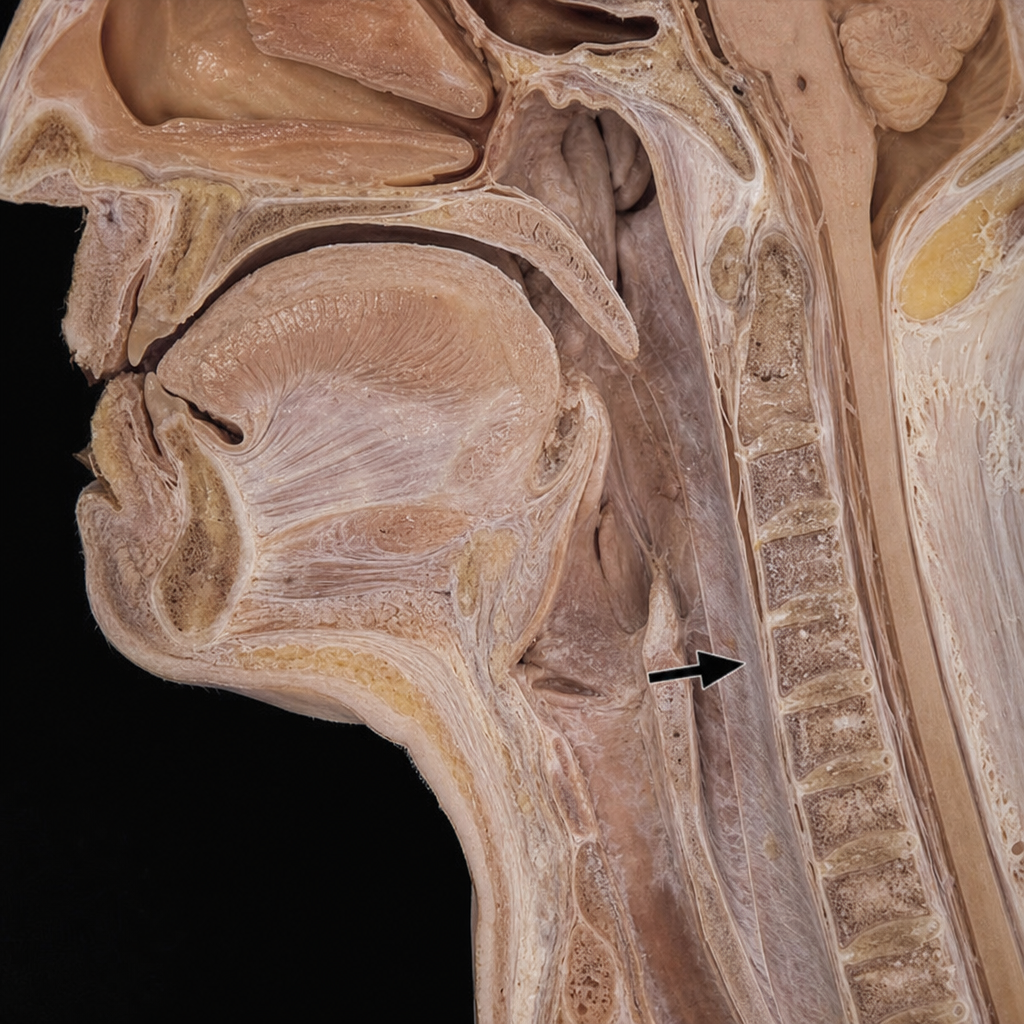
1 questionsIdentify the structure marked in the image given below.
FMGE 2025 - Anatomy FMGE Practice Questions and MCQs
Question 181: Identify the structure marked in the image given below.
- A. Buccopharyngeal fascia
- B. Superior constrictor muscle
- C. Pharyngobasilar fascia (Correct Answer)
- D. Capsule
Explanation: ***Pharyngobasilar fascia*** - The image shows the layers of the tonsillar bed. The arrow points to the **pharyngobasilar fascia**, which lies between the tonsillar capsule medially and the superior constrictor muscle laterally. - This fascia is the aponeurotic upper part of the superior constrictor muscle, attaching the pharynx to the base of the skull. *Buccopharyngeal fascia* - This fascia covers the **external surface** of the pharyngeal constrictor muscles and the buccinator muscle. - It is located more laterally than the structure indicated by the arrow, outside the superior constrictor muscle. *Capsule* - The **tonsillar capsule** is a thin, fibrous layer that directly covers the lateral surface of the palatine tonsil, separating it from the peritonsillar space. - The arrow is pointing to the layer just lateral to the tonsillar capsule, not the capsule itself. *Superior constrictor muscle* - This muscle forms the lateral wall of the tonsillar fossa and is situated laterally to the **pharyngobasilar fascia**. - The indicated structure is a fascial layer medial to this muscle.
Anesthesiology
1 questionsAccording to the American Heart Association (AHA), what is the 6th link added to the chain of survival?
FMGE 2025 - Anesthesiology FMGE Practice Questions and MCQs
Question 181: According to the American Heart Association (AHA), what is the 6th link added to the chain of survival?
- A. Recovery and rehabilitation (Correct Answer)
- B. Advanced airway management
- C. High-quality CPR
- D. Rapid defibrillation
Explanation: ***Recovery and rehabilitation*** - The American Heart Association (**AHA**) added this as the **6th link** to the chain of survival to emphasize the importance of post-event care for cardiac arrest survivors. - This link focuses on the long-term health outcomes, addressing physical, cognitive, and emotional needs to improve the survivor's **quality of life**. *Rapid defibrillation* - This is the **fourth link** in the chain of survival, often grouped with Advanced Life Support (ALS). - It is a critical intervention for shockable rhythms like **ventricular fibrillation (VF)** and **pulseless ventricular tachycardia (VT)**, but it precedes post-cardiac arrest care and recovery. *High-quality CPR* - This is the **third link** in the chain of survival, immediately following activation of the emergency response system. - Its purpose is to maintain vital organ perfusion until defibrillation or the return of spontaneous circulation is achieved. *Advanced airway management* - This is a component of **Advanced Life Support (ALS)**, which is part of the fourth link in the chain. - While crucial during the resuscitation effort, it is an acute intervention and not the distinct final step focused on long-term patient recovery.
Internal Medicine
1 questionsA patient presents with fever, neck rigidity, headache, vomiting, and petechial rashes on the lower limbs. What is the most likely causative organism?
FMGE 2025 - Internal Medicine FMGE Practice Questions and MCQs
Question 181: A patient presents with fever, neck rigidity, headache, vomiting, and petechial rashes on the lower limbs. What is the most likely causative organism?
- A. Neisseria meningitidis (Correct Answer)
- B. Cryptococcus neoformans
- C. Clostridium difficile
- D. Clostridium perfringens
Explanation: ***Neisseria meningitidis***- This gram-negative diplococcus is the most likely causative agent as it classically causes **meningococcal meningitis** combined with **meningococcemia**, which highly correlates with the presence of **petechial or purpuric rashes** on the skin.- The rash results from **endotoxin** (lipooligosaccharide) damage to the blood vessel walls, leading to **vasculitis** and hemorrhage, often progressing to severe complications like the **Waterhouse-Friderichsen syndrome**.*Clostridium perfringens*- This organism is primarily known for causing **gas gangrene** (myonecrosis) and tissue necrosis, often following severe trauma or surgery.- It is not a common cause of primary community-acquired bacterial meningitis, and its clinical presentation focuses on localized **soft tissue infection** rather than systemic meningoencephalitis.*Cryptococcus neoformans*- This is a **fungal pathogen** that causes meningitis, usually in patients with **severe immunosuppression** (e.g., uncontrolled HIV infection).- Although it causes fever and signs of meningeal irritation, the presentation is typically subacute or chronic, and a hemorrhagic rash is not a standard clinical feature.*Clostridium difficile*- This bacterium is the causative agent of **antibiotic-associated diarrhea** and **pseudomembranous colitis**.- Its effects are localized almost exclusively to the colon, and it does not cause acute bacterial meningitis with systemic rash.
Microbiology
1 questionsA person came with the H/o thorn prick a week ago. A few days later, he developed ulcers along lymphatic drainage. Choose the correct organism.
FMGE 2025 - Microbiology FMGE Practice Questions and MCQs
Question 181: A person came with the H/o thorn prick a week ago. A few days later, he developed ulcers along lymphatic drainage. Choose the correct organism.
- A. Sporothrix schenckii (Correct Answer)
- B. Trichophyton rubrum
- C. Coccidioides immitis
- D. Aspergillus flavus
Explanation: ***Sporothrix schenckii*** - This dimorphic fungus is introduced via cutaneous trauma, classically associated with exposure to vegetation (e.g., **thorn prick**, sphagnum moss), leading to the term **Gardener's disease**. - The characteristic presentation of a primary nodule followed by secondary subcutaneous nodules or ulcers tracking along the proximal lymphatic drainage is diagnostic of **lymphocutaneous sporotrichosis**. *Coccidioides immitis* - This fungus causes **Coccidioidomycosis** (Valley fever), generally acquired by inhaling arthroconidia, leading primarily to pulmonary infection. - While disseminated infection can involve the skin, it does not typically present as a localized inoculation lesion with subsequent **ascending lymphangitis** from a thorn prick. *Aspergillus flavus* - **Aspergillus** species usually cause infections in immunocompromised patients (e.g., invasive pulmonary aspergillosis) or superficial infections such as fungal keratitis. - It is not the organism characteristically associated with traumatic inoculation from plant material causing a **sporotrichoid pattern** of lymphatic spread. *Trichophyton rubrum* - This is a common **dermatophyte** that causes superficial cutaneous infections of the keratin layer, such as tinea (ringworm) of the skin, hair, or nails. - It lacks the invasive capability to establish a deep infection followed by **lymphatic involvement** and ulceration after subcutaneous inoculation.
Pediatrics
1 questionsA 3-month-old child has a respiratory rate of 56/min with no chest indrawing and no danger signs. As per IMNCI what is the most appropriate diagnosis?
FMGE 2025 - Pediatrics FMGE Practice Questions and MCQs
Question 181: A 3-month-old child has a respiratory rate of 56/min with no chest indrawing and no danger signs. As per IMNCI what is the most appropriate diagnosis?
- A. Cold and cough
- B. Pneumonia (Correct Answer)
- C. Severe Pneumonia
- D. Allergy
Explanation: ***Pneumonia***- As per IMNCI guidelines, for a child aged 2 months up to 12 months, a respiratory rate of $\geq 50$ breaths/min is classified as **fast breathing**.- Since the child has **fast breathing** (56/min) but lacks **chest indrawing** or **danger signs**, the yellow category of **Pneumonia** is diagnosed.*Cold and cough*- This classification is utilized when the child has cough or cold but shows **no fast breathing** and **no chest indrawing** (Green classification, No Pneumonia).*Severe Pneumonia*- This classification requires the presence of **chest indrawing** or any **general danger sign** (e.g., lethargy, convulsions, inability to drink) alongside fast breathing or stridor (Red classification).*Allergy*- IMNCI focuses on classifying levels of severity of common infections (like respiratory infections, diarrhea, fever) for immediate management, and **allergy** is not one of the primary classification categories.
Physiology
3 questionsWhich of the following describes the chloride ion exchange in red blood cells, where bicarbonate ions are exchanged for chloride ions to maintain electrical neutrality?
Which of the following factors causes a rightward shift in the oxygen-hemoglobin dissociation curve?
In the jugular venous pressure (JVP) waveform, the "a" wave corresponds to:
FMGE 2025 - Physiology FMGE Practice Questions and MCQs
Question 181: Which of the following describes the chloride ion exchange in red blood cells, where bicarbonate ions are exchanged for chloride ions to maintain electrical neutrality?
- A. Root effect
- B. Chloride shift (Correct Answer)
- C. Bohr effect
- D. Haldane effect
Explanation: ***Chloride shift***- This is the term for the exchange of a **bicarbonate ion** ($ ext{HCO}_3^-$) moving out of the red blood cell for a **chloride ion** ($ ext{Cl}^-$) moving into the cell to maintain **electrical neutrality**. - It is essential for the efficient transport of **carbon dioxide** ($ ext{CO}_2$) from peripheral tissues to the lungs in the form of dissolved bicarbonate. *Haldane effect* - Describes the process where the unloading of **oxygen** in peripheral tissues increases the affinity of hemoglobin for **carbon dioxide** ($ ext{CO}_2$) and $ ext{H}^+$ (and vice versa in the lungs). - It primarily relates to the interaction between $ ext{O}_2$ saturation and $ ext{CO}_2$ binding, not the ion exchange itself. *Root effect* - This effect describes the decrease in the **oxygen carrying capacity** of hemoglobin caused by a drop in pH, often seen in fish. - It is a specialized form of the **Bohr effect**, but specifically refers to the non-sigmoidal shape of the $ ext{O}_2$-Hb curve at low pH. *Bohr effect* - This phenomenon explains that an increase in $ ext{PCO}_2$ or a decrease in pH (more **acidity**) shifts the oxygen-hemoglobin dissociation curve to the **right**. - This shift promotes the release of **oxygen** from hemoglobin to active tissues where $ ext{CO}_2$ production is high.
Question 182: Which of the following factors causes a rightward shift in the oxygen-hemoglobin dissociation curve?
- A. Increase in O₂
- B. Increase in CO₂ (Correct Answer)
- C. Decrease in CO₂
- D. Decrease in temperature
Explanation: ***Increase in CO₂*** - An increase in the partial pressure of **carbon dioxide (PCO₂)** in the blood leads to a decrease in pH (increased H⁺ concentration), a phenomenon known as the **Bohr effect**. - This acidic environment stabilizes the **taut (T) state** of hemoglobin, reducing its affinity for oxygen and facilitating oxygen unloading to metabolically active tissues, thus causing a **rightward shift**. *Increase in O₂* - An increase in the partial pressure of **oxygen (PO₂)** represents a movement *along* the existing curve to the right, leading to a higher hemoglobin saturation percentage. - It does not alter the intrinsic affinity of hemoglobin for oxygen and therefore does not cause a shift of the entire curve. *Decrease in CO₂* - A decrease in **PCO₂** leads to an increase in blood pH (respiratory alkalosis), which increases hemoglobin's affinity for oxygen. - This increased affinity impairs oxygen release to tissues and causes a **leftward shift** of the curve, promoting oxygen uptake in the lungs. *Decrease in temperature* - A decrease in body **temperature** (hypothermia) increases the affinity of hemoglobin for oxygen. - This makes it more difficult for hemoglobin to release oxygen to the tissues, resulting in a **leftward shift** of the curve.
Question 183: In the jugular venous pressure (JVP) waveform, the "a" wave corresponds to:
- A. Tricuspid valve bulging into Right atria
- B. Right Atrial contraction (Correct Answer)
- C. Right Atrial relaxation
- D. Right atrial filling
Explanation: ***Right Atrial contraction*** - The **'a' wave** is the first positive deflection in the JVP waveform and is produced by the increase in right atrial pressure during **atrial systole** (contraction). - This wave occurs just before the first heart sound (S1) and is notably absent in conditions like **atrial fibrillation** where coordinated atrial contraction is lost. *Tricuspid valve bulging into Right atria* - The bulging of the closed **tricuspid valve** into the right atrium at the beginning of ventricular systole contributes to the **'c' wave**. - The 'c' wave follows the 'a' wave and also reflects the transmitted pulsation from the adjacent **carotid artery**. *Right Atrial relaxation* - Right atrial relaxation leads to a fall in pressure, which is represented by the **'x' descent**. - This descent follows the 'c' wave and is caused by both atrial relaxation and the downward pulling of the atrial floor during ventricular contraction. *Right atrial filling* - The **'v' wave** represents the rise in right atrial pressure due to passive venous filling from the vena cavae while the tricuspid valve is closed. - This wave peaks just before the tricuspid valve opens at the beginning of diastole.
Psychiatry
2 questionsA lady presents to the hospital after having a fight with her husband. She reports that she is unable to speak. However, all neurological and physical examinations are normal, and she does not seem concerned about her health status. What is the most likely diagnosis?
A 55-year-old man presents to the hospital with auditory hallucinations and inability to recognize his own family members. He reports his last alcohol intake was 48 hours ago. What is the most likely diagnosis?
FMGE 2025 - Psychiatry FMGE Practice Questions and MCQs
Question 181: A lady presents to the hospital after having a fight with her husband. She reports that she is unable to speak. However, all neurological and physical examinations are normal, and she does not seem concerned about her health status. What is the most likely diagnosis?
- A. Conversion Disorder (Correct Answer)
- B. Somatic Symptom Disorder
- C. Adjustment Disorder
- D. Malingering
Explanation: ***Correct: Conversion Disorder*** - Patient presents with **acute loss of function (mutism)** following a psychological stressor (marital conflict) - **Neurological examination is normal**, ruling out organic causes - Most characteristic feature: **La belle indifférence** - lack of appropriate concern about the disability - Conversion disorder involves neurological symptoms (paralysis, blindness, mutism, seizures) that cannot be explained by medical conditions - Symptoms are **unconscious** (not intentionally produced) and follow psychological stress *Incorrect: Somatic Symptom Disorder* - Involves **excessive thoughts, feelings, or behaviors** related to somatic symptoms - Patients show **high anxiety** and preoccupation with their symptoms (opposite of la belle indifférence) - Symptoms are persistent (>6 months), not acute - Does not typically present with complete loss of function like mutism *Incorrect: Adjustment Disorder* - Involves emotional/behavioral symptoms in response to stressor - Does NOT present with **neurological deficits** like mutism - Symptoms are mood-related (depression, anxiety) rather than functional neurological symptoms - Would not explain the dramatic presentation of complete speech loss *Incorrect: Malingering* - **Conscious, intentional** production of symptoms for secondary gain (financial, avoiding work/legal issues) - No clear secondary gain mentioned in this scenario - Malingerers typically show concern and emphasize their symptoms (not la belle indifférence) - Would be suspected if obvious external incentive present
Question 182: A 55-year-old man presents to the hospital with auditory hallucinations and inability to recognize his own family members. He reports his last alcohol intake was 48 hours ago. What is the most likely diagnosis?
- A. Schizophrenia
- B. Delirium tremens (Correct Answer)
- C. Alcoholic hallucinosis
- D. Alcohol-induced psychosis
Explanation: ***Delirium tremens***- This severe form of alcohol withdrawal typically manifests 48 to 96 hours after the last drink, aligning perfectly with the patient's 48-hour abstinence period.- The presence of **auditory hallucinations** combined with **inability to recognize family members** (indicating **delirium** or **global disorientation**) confirms the diagnosis of Delirium Tremens (DT), which also includes autonomic hyperactivity.*Alcoholic hallucinosis*- This condition is characterized primarily by **auditory hallucinations** but generally occurs earlier, typically 12 to 24 hours after cessation.- Crucially, alcoholic hallucinosis occurs with a **clear sensorium** (clear consciousness), meaning there is no significant **delirium** or global confusion, unlike the presentation described.*Alcohol-induced psychosis*- While this broad category encompasses alcohol-related psychotic symptoms, **Delirium Tremens** is the specific and most appropriate diagnosis for the severe, time-locked withdrawal syndrome involving **delirium**, hallucinations, and autonomic instability 48 hours post-cessation.- This term is less specific and fails to capture the emergent nature and associated **autonomic hyperactivity** seen in DT.*Schizophrenia*- Schizophrenia is a **primary psychotic disorder** with a typical onset in early adulthood and a chronic course; the acute onset of psychosis temporally linked to **alcohol cessation** suggests an organic etiology.- The presence of **global confusion/disorientation** (inability to recognize family) is highly indicative of **delirium** and rules out schizophrenia, which does not involve a clouding of consciousness.