A patient presents with eyelid crusting and a thready sensation between the cornea and lids. What is the most likely diagnosis?
A patient presents with proptosis that increases when bending down. What is the most likely diagnosis?
The finding seen in the image is:
A patient with pituitary adenoma compressing the optic chiasma now presents with loss of visual field. What visual field defect will be seen in the patient?
A patient presents with complaints of eye strain. The given image shows the focus of light rays in different meridians in the eye. Which refractive error is present in this patient?
A myopic patient presents with complaints of flashes and floaters. On examination, a deep anterior chamber is seen. What is the likely diagnosis?
An elderly female presents with sudden onset of pain, redness, and decreased vision. On examination, hazy cornea, fixed mid-dilated pupil, and shallow anterior chamber are noted. What is the diagnosis?
A patient presents with a painless ulcer in the eye. On examination, a long, branching ulcer with desquamated epithelium is seen on the cornea. What is the most likely diagnosis?
A 45-year-old patient with eye examination findings of a deep anterior chamber and jet-black pupil is prescribed +12D glasses. Likely diagnosis?
A patient presents with painful lid swelling. On examination, a pus point is observed at the base of an eyelash. Which of the following glands is involved?
FMGE 2025 - Ophthalmology FMGE Practice Questions and MCQs
Question 11: A patient presents with eyelid crusting and a thready sensation between the cornea and lids. What is the most likely diagnosis?
- A. Meibomian Gland Dysfunction
- B. Dry Eye Syndrome
- C. Chronic Blepharitis (Correct Answer)
- D. Conjunctivitis
Explanation: ***Chronic Blepharitis***- This condition is characterized by chronic inflammation of the eyelid margins, leading directly to the observed **eyelid crusting** and debris accumulation at the base of the eyelashes. - The **thready sensation** (often described as a foreign body sensation or stringy mucus) is classic, resulting from poor tear film stability and excessive friction between the chronically inflamed lid margin and the ocular surface.*Dry Eye Syndrome*- While it causes a foreign body sensation, primary uncomplicated dry eye syndrome is less typically associated with significant, persistent **eyelid margin crusting**.- Symptoms are primarily due to inadequate aqueous tear production or excessive evaporation, leading to ocular surface damage, often diagnosed using the **Schirmer test** or tear film breakup time.*Meibomian Gland Dysfunction*- MGD is specifically an obstruction or hypersecretion disorder of the meibomian glands, typically manifesting as poor **lipid layer quality** of the tear film.- Key clinical findings include inspissated gland orifices and telangiectasia on the lid margin, rather than the primary presenting complaint being generalized **eyelid crusting** and debris.*Conjunctivitis*- This typically involves generalized **conjunctival injection** (redness) and discharge (watery, purulent, or mucoid) affecting the entire ocular surface.- While it can cause morning crusting (matting), the chronic presentation focused on the lid margin with persistent **thready sensation** is more characteristic of blepharitis than acute or subacute conjunctival inflammation.
Question 12: A patient presents with proptosis that increases when bending down. What is the most likely diagnosis?
- A. Orbital Cellulitis
- B. Orbital Varices (Correct Answer)
- C. Cavernous Sinus Thrombosis
- D. Thyroid Eye Disease
Explanation: ***Orbital Varices***- This condition involves abnormal orbital veins that swell when orbital venous pressure increases, hence the classic finding of worsening proptosis or **intermittent proptosis** upon bending down or performing the **Valsalva maneuver**.- The proptosis is usually non-pulsatile and often unilateral, resulting from passive congestion of the venous malformation.*Thyroid Eye Disease*- Proptosis in **Thyroid Eye Disease** (**Graves' ophthalmopathy**) is typically caused by chronic inflammation and expansion of **extraocular muscles** and orbital fat, making the proptosis constant.- The severity of proptosis is usually stable and does not fluctuate rapidly or dramatically with maneuvers that increase venous pressure.*Cavernous Sinus Thrombosis*- This condition presents acutely with constant, painful, and progressive proptosis accompanied by **ophthalmoplegia** (due to multiple cranial nerve palsies) and systemic signs like high fever and severe headache.- The clinical picture is typically severe and life-threatening, involving signs of inflammation and infection, not positional congestion.*Orbital Cellulitis*- **Orbital cellulitis** is an acute infectious process characterized by constant, painful, and typically unilateral proptosis, along with severe eyelid swelling (*chemosis*) and **systemic symptoms** (fever).- Proptosis in this condition is fixed and progressive, driven by inflammation and pus formation, and not prone to intermittent worsening simply upon bending down.
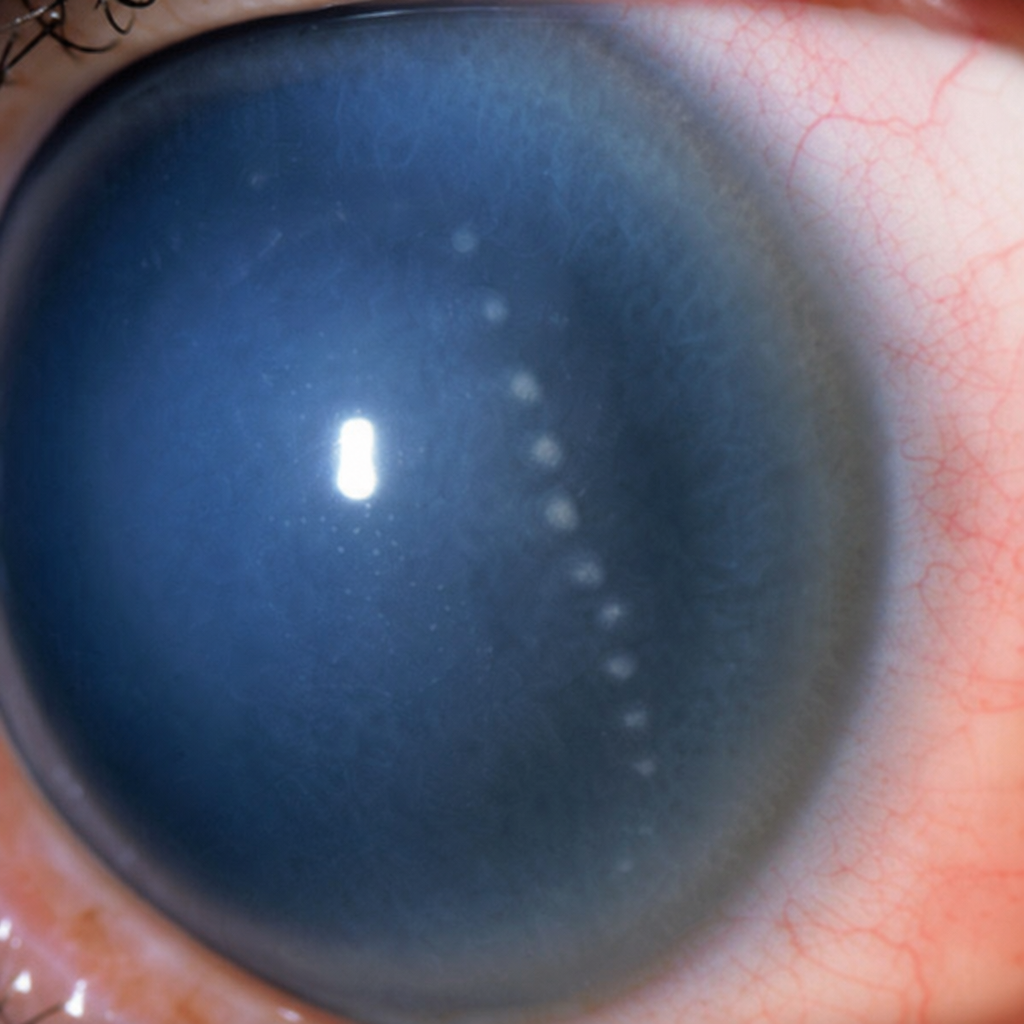
Question 13: The finding seen in the image is:
- A. Arlt's line
- B. Pannus
- C. Horner-Trantas spots
- D. Herbert's pits (Correct Answer)
Explanation: ***Herbert's pits*** - These are pathognomonic signs of **cicatricial trachoma**, representing shallow, depressed scars located at the superior corneoscleral junction (limbus). - They are formed by the resolution and scarring of **limbal follicles**, which are characteristic of the active inflammatory stage of trachoma. *Horner-Trantas spots* - These are small, white, gelatinous nodules seen at the limbus, composed of degenerated eosinophils and epithelial cells. - They are a characteristic finding in **vernal keratoconjunctivitis (VKC)**, an allergic eye condition, and are not seen in trachoma. *Pannus* - Pannus refers to the growth of fibrovascular tissue from the limbus onto the peripheral cornea. - While a **superior pannus** is a common finding in trachoma, the specific depressions shown in the image are Herbert's pits, not the pannus itself. *Arlt's line* - This is a horizontal line of scar tissue found on the **tarsal conjunctiva** of the upper eyelid. - It is another sign of cicatricial trachoma but is located on the inner surface of the eyelid, not at the limbus as seen in the image.
Question 14: A patient with pituitary adenoma compressing the optic chiasma now presents with loss of visual field. What visual field defect will be seen in the patient?
- A. Superior quadrantanopia
- B. Homonymous hemianopia
- C. Bitemporal hemianopia (Correct Answer)
- D. Homonymous anopia
Explanation: ***Bitemporal hemianopia*** - A **pituitary adenoma** most commonly compresses the **optic chiasma**, where the nasal retinal fibers from both eyes decussate (cross over). - Damage to these crossing fibers specifically leads to the loss of the **temporal visual fields** in both eyes, which is the definition of bitemporal hemianopia. *Homonymous anopia* - This is a less specific term. **Homonymous** defects refer to the loss of the same side of the visual field in both eyes (e.g., the left side in both eyes). - These types of defects are caused by lesions located **posterior** (behind) the optic chiasma, not at the chiasma itself. *Homonymous hemianopia* - This defect describes the loss of the same half (either left or right) of the visual field in both eyes. - It results from a lesion in the visual pathway **posterior** to the optic chiasma, such as in the **optic tract**, **optic radiations**, or the **visual cortex**. *Superior quadrantanopia* - This refers to the loss of vision in the upper quadrant of the visual field, often described as a "pie in the sky" defect. - This is typically caused by a lesion affecting the contralateral **temporal lobe** (damaging **Meyer's loop** of the optic radiation), not the optic chiasma.
Question 15: A patient presents with complaints of eye strain. The given image shows the focus of light rays in different meridians in the eye. Which refractive error is present in this patient?
- A. Presbyopia
- B. Astigmatism (Correct Answer)
- C. Amblyopia
- D. Hypermetropia
Explanation: ***Astigmatism*** - The image illustrates that light rays passing through different meridians (vertical and horizontal) of the eye are focused at two separate points, which is the defining feature of **astigmatism**. - This refractive error, typically caused by an irregularly shaped **cornea** or lens, results in the formation of a **conoid of Sturm** (the interval between the two focal lines), causing blurred vision and symptoms like **eye strain**. *Amblyopia* - **Amblyopia**, or lazy eye, is a neurodevelopmental condition where vision is reduced in one eye because the eye and the brain are not working together properly; it is not a refractive error itself. - It can be caused by untreated refractive errors (like severe astigmatism) or **strabismus** during early childhood, but the diagram depicts an optical-physical phenomenon, not a neurological one. *Hypermetropia* - In **hypermetropia** (farsightedness), parallel light rays from all meridians would focus at a single point **behind the retina**, not at two different points as shown. - The image's depiction of two distinct focal lines for vertical and horizontal planes is inconsistent with the uniform focusing seen in simple hypermetropia. *Presbyopia* - **Presbyopia** is the age-related loss of **accommodation**, which is the eye's ability to change focus for near objects due to hardening of the **lens**. - It does not involve different refractive powers in different meridians and therefore is not represented by the optical diagram shown.
Question 16: A myopic patient presents with complaints of flashes and floaters. On examination, a deep anterior chamber is seen. What is the likely diagnosis?
- A. Central serous retinopathy
- B. Tractional retinal detachment
- C. Exudative retinal detachment
- D. Rhegmatogenous retinal detachment (Correct Answer)
Explanation: ***Rhegmatogenous retinal detachment***- The presence of **flashes (photopsia)** and **floaters** signifies acute **vitreoretinal traction** leading to a retinal break (*rhegma*), a classic presentation of RRD, especially in a **myopic** eye.- A **deep anterior chamber** can indicate **hypotony** (low intraocular pressure), which frequently occurs in RRD due to increased uveoscleral outflow from the fluid egress through the retinal break.*Exudative retinal detachment*- This type is caused by underlying processes like inflammation or tumors and is characterized by a lack of **retinal break** and, therefore, typically does **not** cause flashes or floaters associated with vitreous traction.- The subretinal fluid in this condition classically **shifts** upon changing head position, which is a key differentiating feature.*Tractional retinal detachment*- This form is caused by the contraction of **fibrovascular membranes** on the retinal surface, most commonly seen in advanced **proliferative diabetic retinopathy**.- It is usually slowly progressive and does **not** typically present acutely with the prominent **flashes** and **floaters** that suggest a fresh retinal tear.*Central serous retinopathy*- This condition involves fluid accumulation localized beneath the macula, leading to symptoms like **metamorphopsia** and central scotoma, without involving the peripheral retina.- It does **not** cause a generalized retinal detachment, significant **flashes** and **floaters**, or changes in the **anterior chamber depth**.
Question 17: An elderly female presents with sudden onset of pain, redness, and decreased vision. On examination, hazy cornea, fixed mid-dilated pupil, and shallow anterior chamber are noted. What is the diagnosis?
- A. Central retinal artery occlusion
- B. Acute conjunctivitis
- C. Acute congestive glaucoma (Correct Answer)
- D. Acute uveitis
Explanation: ***Acute congestive glaucoma (Acute angle-closure glaucoma)*** - This presentation is **classic** for acute angle-closure glaucoma with all hallmark features present - **Sudden onset** of severe pain, redness, and decreased vision due to rapidly elevated intraocular pressure (IOP) - **Hazy/edematous cornea** results from corneal epithelial edema secondary to extremely high IOP (often >40-60 mmHg) - **Fixed mid-dilated pupil** occurs due to iris ischemia and pupillary sphincter paralysis from pressure-induced vascular compromise - **Shallow anterior chamber** is the anatomical predisposition that precipitates angle closure, more common in elderly hypermetropic individuals - This is an **ophthalmic emergency** requiring immediate IOP reduction *Acute uveitis* - Presents with pain, redness, and photophobia, but key differentiating features are absent - Typically has a **miotic (constricted) pupil** due to ciliary spasm, not a fixed mid-dilated pupil - Cornea is usually **clear** unless there is associated keratitis; hazy cornea is not a characteristic feature - Anterior chamber is **deep or normal depth**, not shallow - Classic findings include **keratic precipitates**, cells and flare in anterior chamber on slit-lamp examination *Acute conjunctivitis* - Presents with redness, discharge, and foreign body sensation - Vision is typically **preserved** or only mildly affected - **No pain** (only mild irritation), cornea remains clear, pupil is normal and reactive - Anterior chamber depth is normal - The severe pain and anterior segment findings (hazy cornea, fixed pupil, shallow AC) rule this out *Central retinal artery occlusion (CRAO)* - Presents with **sudden, painless, profound vision loss** (classically "curtain coming down") - **Anterior segment is completely normal** — no corneal haze, normal pupil reactions (may have RAPD), normal AC depth - Fundoscopy shows **cherry-red spot** at macula, pale retina, and attenuated vessels - The presence of pain and anterior segment abnormalities excludes this diagnosis
Question 18: A patient presents with a painless ulcer in the eye. On examination, a long, branching ulcer with desquamated epithelium is seen on the cornea. What is the most likely diagnosis?
- A. Bacterial corneal ulcer
- B. Neurotrophic ulcer (Correct Answer)
- C. Fungal ulcer
- D. Dendritic ulcer
Explanation: ***Neurotrophic ulcer***- The defining feature of a **neurotrophic ulcer** is the **painless** nature of the epithelial defect, resulting from damage to the **trigeminal nerve** (CN V1) leading to loss of corneal sensation.- The ulcer morphology, described as a persistent epithelial defect (ulcer) with a desquamated, **geographic** or long-branching appearance, is characteristic of the poor healing seen in the setting of chronic denervation.*Fungal ulcer*- Fungal ulcers typically cause marked pain, photophobia, and conjunctival injection, which contrasts sharply with the painless presentation in this patient.- Morphologically, they are often characterized by elevated, gray-white ulcers with **feathery borders** and commonly exhibit satellite lesions or an underlying **immune ring**.*Dendritic ulcer*- A **dendritic ulcer** is pathognomonic for **Herpes Simplex Virus (HSV) keratitis** and is usually associated with significant pain and foreign body sensation.- While it is branching, it stains vividly, and its key features are **terminal bulbs** at the ends of the branches, differentiating it from the desquamated, geographic type of defect seen in neurotrophic disease.*Bacterial corneal ulcer*- Bacterial corneal ulcers are extremely painful, rapidly progressive, and associated with profound inflammation, ciliary injection, and often significant **anterior chamber reaction (hypopyon)**.- They usually present as dense, whitish-yellow **stromal infiltrates** with an overlying epithelial defect, not a painless, superficially desquamated pattern.
Question 19: A 45-year-old patient with eye examination findings of a deep anterior chamber and jet-black pupil is prescribed +12D glasses. Likely diagnosis?
- A. Pseudophakia
- B. Hypermetropia
- C. Aphakia (Correct Answer)
- D. Myopia
Explanation: **Aphakia** - The natural lens contributes approximately +15 to +20 diopters of refractive power; its absence (aphakia) results in severe **hypermetropia**, requiring a strong convex lens, typically around **+10D to +12D**, for correction. - The clinical findings—a **deep anterior chamber** (due to the backward displacement of the iris) and a distinctive **jet-black pupil** (due to the lack of the lens obscuring the view of the retina/fundus)—are classic signs of aphakia. *Pseudophakia* - **Pseudophakia** is the state of having an **intraocular lens (IOL)**, which restores the eye's refractive power, meaning the patient typically needs minimal spectacle correction, usually < +3D, not +12D. - While the pupil might appear black, the necessary post-operative correction power rules out residual uncorrected aphakia that requires +12D. *Myopia* - **Myopia** (nearsightedness) requires **concave (minus)** lenses for correction, standing in direct contrast to the strong **convex (+12D)** lens prescribed to this patient. - Myopia is caused by excessive axial length or corneal curvature, and it does not result in a pathologically deep anterior chamber or necessitate high-plus glasses. *Hypermetropia* - Although aphakia causes hypermetropia, primary, non-aphakic **hypermetropia** is usually corrected with lenses significantly weaker than **+12D** (typically < +6D). - Primary hypermetropia is usually related to a short axial length but is not typically associated with the defining features of a **jet-black pupil** or an abnormally **deep anterior chamber**.
Question 20: A patient presents with painful lid swelling. On examination, a pus point is observed at the base of an eyelash. Which of the following glands is involved?
- A. Lacrimal gland
- B. Meibomian gland
- C. Zeis gland (Correct Answer)
- D. Moll gland
Explanation: ***Correct: Zeis gland*** - An acute pyogenic infection of the **Gland of Zeis** (a sebaceous gland associated with the eyelash follicle) is defined as an **external hordeolum** (stye). - The presence of a localized, painful swelling with a **pus point directed externally at the base of an eyelash** is the hallmark presentation of a stye. - External hordeolum classically involves the Zeis gland, though Moll glands may also be implicated. *Incorrect: Meibomian gland* - Infection of the Meibomian glands (located deep within the tarsal plate) leads to an **internal hordeolum**. - An internal hordeolum usually presents with swelling pointing *inward* toward the conjunctival surface, not externally at the lash base. *Incorrect: Lacrimal gland* - The lacrimal gland is located in the **superolateral aspect** of the orbit and is responsible for tear production. - Infection (**dacryoadenitis**) causes swelling in the upper, outer part of the eye, presenting as an **S-shaped curve** of the lid margin, distinct from a localized eyelid margin infection. *Incorrect: Moll gland* - Moll glands are modified **apocrine sweat glands** that also open near the lash follicle. - While their infection can contribute to external hordeolum, the **Zeis gland** (sebaceous) is classically cited as the primary source of acute, localized pus point at the base of the eyelash in standard teaching.