A 30-year-old man develops profuse vomiting and diarrhea within 3 hours of consuming pre-packaged salad and milk at a picnic. There is no fever. Which of the following is the most likely causative organism?
Receptor used for the entry of HIV virus into the host cell is?
Which organism is most commonly responsible for gas gangrene?
A woman was bitten by a rabid dog. The dog developed symptoms and died within a week. What is the best method for post-mortem diagnosis of rabies in the dog?
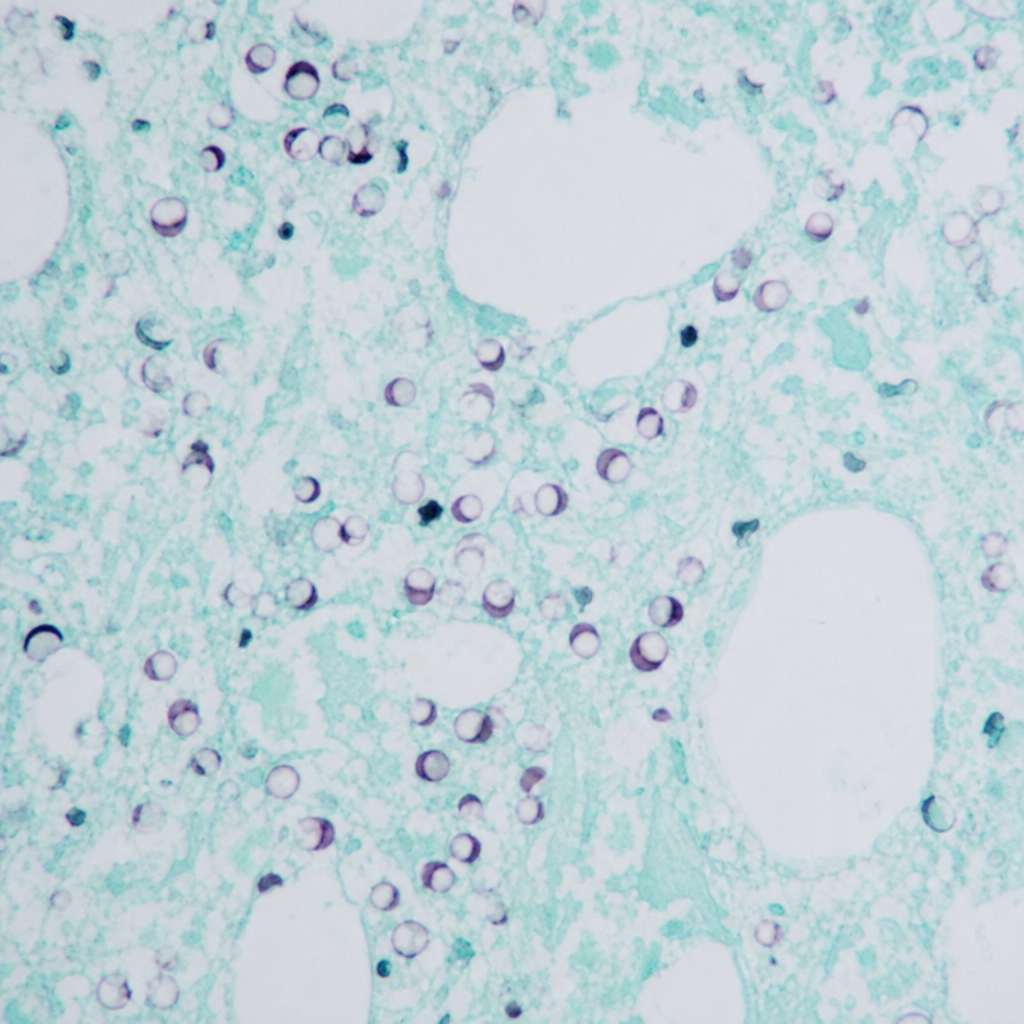
A 3-month-old child was admitted with pneumonia. The microscopy shows the following image. Choose the correct organism.
Identify the microorganism shown in the image.
FMGE 2025 - Microbiology FMGE Practice Questions and MCQs
Question 21: A 30-year-old man develops profuse vomiting and diarrhea within 3 hours of consuming pre-packaged salad and milk at a picnic. There is no fever. Which of the following is the most likely causative organism?
- A. Bacillus cereus
- B. Salmonella enterica
- C. Clostridium perfringens
- D. Staphylococcus aureus (Correct Answer)
Explanation: ***Staphylococcus aureus***- This organism produces a **heat-stable enterotoxin** that, when ingested (preformed toxin), causes rapid symptoms within 1 to 6 hours, fitting the **3-hour onset** without requiring bacterial multiplication in the host.- Symptoms are primarily profound **nausea and vomiting**, accompanied by diarrhea, and characteristically **without fever**, as this is a food intoxication rather than an invasive infection.*Clostridium perfringens*- Symptoms usually manifest after a longer incubation period of **8 to 16 hours**, as the toxin is produced *in vivo* after the bacteria are ingested.- The illness is dominated by **watery diarrhea** and abdominal cramps; vomiting is typically mild or absent.*Salmonella enterica*- This organism causes an **invasive infection** (or requires prolonged multiplication) and thus has a longer incubation period, typically **6 hours to 3 days**.- Gastroenteritis caused by *Salmonella* almost always presents with associated systemic symptoms, most notably significant **fever**.*Bacillus cereus*- *B. cereus* causes two syndromes: the **diarrheal form** (slower onset) and the **emetic form** (rapid 1–6-hour onset), which is mostly associated with contaminated **fried rice**.- While the emetic form fits the timeline, *Staphylococcus aureus* is the most common cause of rapid, non-febrile illness affecting both the stomach (vomiting) and intestines (diarrhea) related to cold, packaged foods like salads or milk.
Question 22: Receptor used for the entry of HIV virus into the host cell is?
- A. CCR5 (Correct Answer)
- B. CD8
- C. CD6
- D. CCR7
Explanation: ***CCR5*** - HIV initially binds to the **CD4** receptor on the surface of T-helper cells, which triggers a conformational change in the viral envelope protein gp120. - This change exposes a binding site for a coreceptor, which is typically the chemokine receptor **CCR5** (or **CXCR4**), facilitating the fusion of the viral envelope with the host cell membrane and allowing viral entry. *CCR7* - **CCR7** is a chemokine receptor primarily involved in the homing of lymphocytes and dendritic cells to secondary lymphoid organs like lymph nodes. - It is not utilized by HIV as a coreceptor for entry into host cells. *CD6* - **CD6** is a cell surface receptor found on T cells that functions as a costimulatory molecule in T-cell activation and adhesion. - It plays no role in the binding or entry process of the HIV virus. *CD8* - **CD8** is a coreceptor molecule that defines cytotoxic T lymphocytes, which are essential for killing virally infected cells. - HIV primarily infects **CD4+** cells, not CD8+ cells, and CD8 does not serve as a viral entry receptor.
Question 23: Which organism is most commonly responsible for gas gangrene?
- A. Clostridium difficile
- B. Clostridium perfringens (Correct Answer)
- C. Clostridium tetani
- D. Clostridium botulinum
Explanation: ***Clostridium perfringens*** - This **anaerobic, Gram-positive** rod is the most common cause of gas gangrene (or **myonecrosis**) due to its rapid production of potent toxins, especially $\alpha$-toxin (a **lecithinase**). - It is found ubiquitously in soil and the GI tract and typically infects deep penetrating wounds, leading to rapid tissue destruction and gas formation (crepitus). *Clostridium difficile* - This organism primarily causes **antibiotic-associated diarrhea** and **pseudomembranous colitis** due to the production of Toxin A (enterotoxin) and Toxin B (cytotoxin). - It is rarely involved in tissue infections or gas gangrene. *Clostridium tetani* - This bacterium is the causative agent of **tetanus**, a neurological disorder characterized by muscle spasms and locked jaw. - Tetanus symptoms are due to the production of the neurotoxin **tetanospasmin**, which blocks inhibitory neurotransmitters. *Clostridium botulinum* - This organism produces the potent **botulinum toxin**, which causes **flaccid paralysis** (botulism) by preventing the release of acetylcholine at the neuromuscular junction. - It is associated with food poisoning or infant botulism, not typically gas gangrene.
Question 24: A woman was bitten by a rabid dog. The dog developed symptoms and died within a week. What is the best method for post-mortem diagnosis of rabies in the dog?
- A. Detection of Negri bodies
- B. DFAT (Correct Answer)
- C. Brain biopsy
- D. Seller’s staining
Explanation: ***DFAT (Direct Fluorescent Antibody Test)*** - The **Direct Fluorescent Antibody Test (DFAT)** is the **gold standard** for post-mortem diagnosis of rabies in animals - It detects rabies viral antigen in **brain tissue** with high sensitivity and specificity - Provides **rapid results** (within hours) and is the WHO-recommended method for definitive diagnosis - Used worldwide as the standard confirmatory test for rabies in suspected animals *Detection of Negri bodies* - **Negri bodies** are pathognomonic eosinophilic cytoplasmic inclusions found in neurons (especially hippocampal pyramidal cells) - Detection has **low sensitivity** (only 50-80% of cases) and requires expert interpretation - While specific when present, their absence does not rule out rabies - Not reliable as the primary diagnostic method *Seller's staining* - **Seller's staining** is a classical histological technique specifically used to visualize Negri bodies - It is an **outdated method** with the same limitations as general Negri body detection - Has been largely replaced by more sensitive and specific methods like DFAT - Lower sensitivity compared to immunofluorescence techniques *Brain biopsy* - While brain tissue is the ideal specimen for rabies diagnosis, **brain biopsy** is not performed post-mortem - Post-mortem examination involves direct collection of brain tissue, not biopsy - For antemortem human diagnosis, less invasive methods (skin biopsy from nape of neck, corneal impressions) are preferred over brain biopsy
Question 25: A 3-month-old child was admitted with pneumonia. The microscopy shows the following image. Choose the correct organism.
- A. Rotavirus
- B. Hepatitis virus
- C. Respiratory syncytial virus
- D. Influenza (Correct Answer)
Explanation: ***Influenza*** - The image displays a virus with two key surface glycoproteins: **Hemagglutinin (HA)** and **Neuraminidase (NA)**. These proteins are the defining structural features of the Influenza virus and are crucial for its entry into and exit from host cells. - Influenza virus is a well-known cause of respiratory illnesses, including severe **pneumonia**, particularly in high-risk groups such as infants, the elderly, and immunocompromised individuals. *Rotavirus* - Rotavirus is the leading cause of severe **gastroenteritis** (diarrhea and vomiting) in infants and young children; it is not a primary cause of pneumonia. - It is a **non-enveloped** virus with a distinct wheel-like appearance (hence the name "rota"), which is structurally different from the enveloped virus shown in the diagram. *Hepatitis virus* - Hepatitis viruses (A, B, C, etc.) are hepatotropic, meaning they primarily infect and cause inflammation of the **liver (hepatitis)**, and are not associated with respiratory infections like pneumonia. - Their viral structures and surface antigens are different; for example, Hepatitis B virus has **HBsAg** on its surface, not HA and NA. *Respiratory syncytial virus* - While RSV is a very common cause of **pneumonia** and **bronchiolitis** in infants, its viral structure differs from the one depicted. - RSV belongs to the *Paramyxoviridae* family and has **Fusion (F)** and **Attachment (G)** proteins on its surface, not Hemagglutinin and Neuraminidase.
Question 26: Identify the microorganism shown in the image.
- A. Entamoeba histolytica (Correct Answer)
- B. Giardia lamblia
- C. Campylobacter jejuni
- D. Shigella dysenteriae
Explanation: ***Entamoeba histolytica*** - The image displays the **trophozoite** stage, characterized by a single nucleus with a central, dot-like **karyosome**. - A key diagnostic feature seen here is the presence of ingested **red blood cells** within the cytoplasm, a phenomenon known as **erythrophagocytosis**, which indicates invasive disease. *Giardia lamblia* - *Giardia* trophozoites are pear-shaped and **binucleated**, often described as having a face-like appearance, which is distinct from the single nucleus seen in the image. - They are flagellated protozoa and do not phagocytose red blood cells. *Shigella dysenteriae* - *Shigella* is a **bacterium**, not a protozoan, and would appear as a small, rod-shaped organism under a microscope. - It lacks the complex eukaryotic structures, such as a distinct nucleus and cytoplasmic inclusions, that are visible in the provided image. *Campylobacter jejuni* - This is a **bacterium** known for its characteristic curved, S-shaped, or "gull-wing" morphology. - As a prokaryote, it is much smaller and structurally simpler than the large amoeboid parasite shown.