A corneal wisp test was performed, and the corneal reflex was elicited. Which of the following nerves is responsible for the afferent limb of this reflex?
Identify the structure marked in the image given below.
Identify the marked area in the image given.
Histological section is given below. Identify the marked cell. 
Which nerve is affected in the hand deformity shown in the image at rest? 
What stage of embryonic development is shown in the following image?
Identify the structure marked as 'X' in the image below
A 45-year-old patient presents with difficulty reacting to bright light. On examination, the pupillary light reflex is absent but the near reflex is preserved. Where is the lesion likely located?
Identify the tarsal bone marked by the arrow in the given X-ray of the right foot.
Identify the bone indicated by the arrow in the image.
FMGE 2025 - Anatomy FMGE Practice Questions and MCQs
Question 11: A corneal wisp test was performed, and the corneal reflex was elicited. Which of the following nerves is responsible for the afferent limb of this reflex?
- A. Trigeminal Nerve (Correct Answer)
- B. Abducens Nerve
- C. Oculomotor Nerve
- D. Facial Nerve
Explanation: ***Trigeminal Nerve*** - The **afferent limb** (sensory input) of the corneal reflex is mediated by the **ophthalmic division (V1)** of the Trigeminal Nerve (CN V). - Sensory stimulation of the cornea sends impulses to the main sensory nucleus of CN V in the **pons**. *Facial Nerve* - The Facial Nerve (CN VII) constitutes the **efferent limb** of the corneal reflex, transmitting the motor signal. - This motor signal causes the eyelid closure reaction (blinking) by innervating the **orbicularis oculi** muscle. *Oculomotor Nerve* - The Oculomotor Nerve (CN III) is primarily responsible for most ocular movements and the **pupillary light reflex** (efferent limb), but not corneal sensation. [1] - It innervates the **levator palpebrae superioris** muscle, which controls eyelid opening, the opposite action of the reflex blink. *Abducens Nerve* - The Abducens Nerve (CN VI) is solely responsible for innervating the **lateral rectus** muscle, controlling lateral eye movement. - It plays no role in either the afferent (sensory) or efferent (motor) component of the corneal reflex pathway.
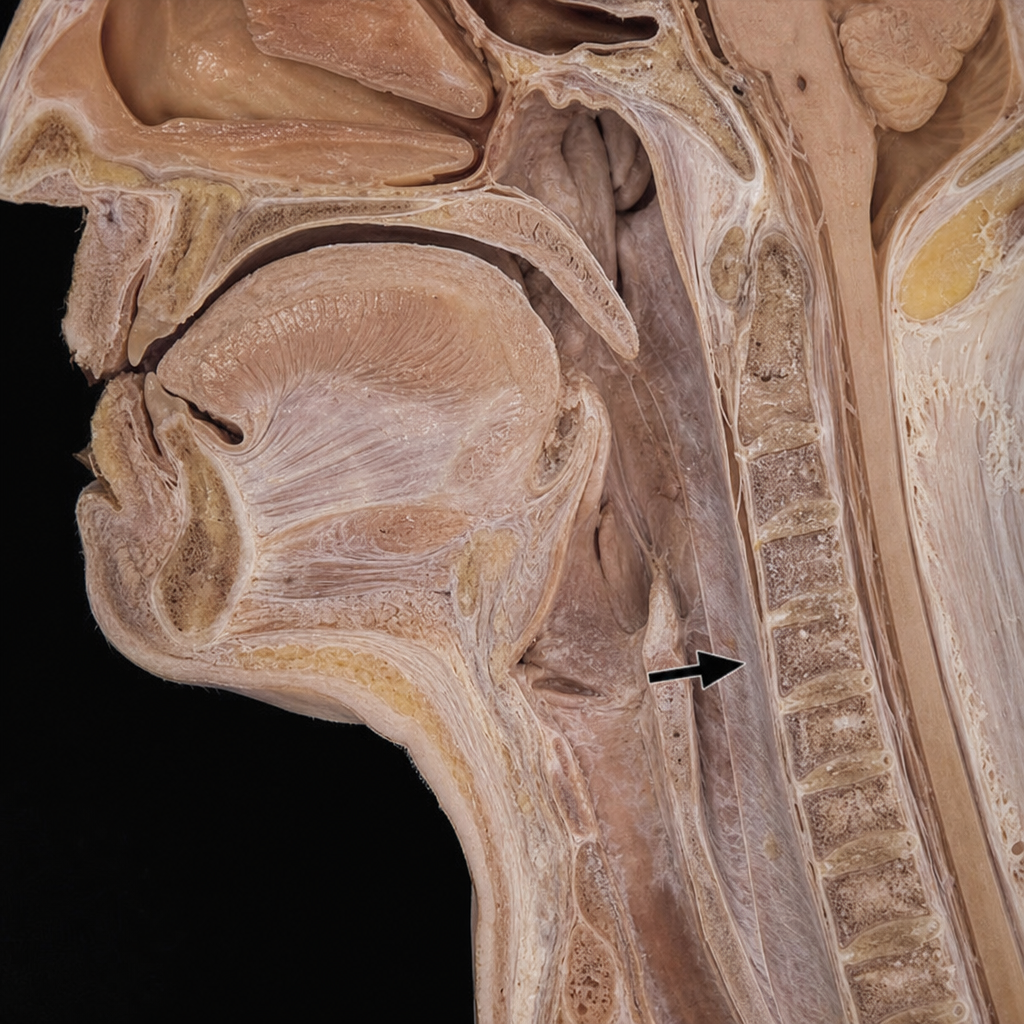
Question 12: Identify the structure marked in the image given below.
- A. Buccopharyngeal fascia
- B. Superior constrictor muscle
- C. Pharyngobasilar fascia (Correct Answer)
- D. Capsule
Explanation: ***Pharyngobasilar fascia*** - The image shows the layers of the tonsillar bed. The arrow points to the **pharyngobasilar fascia**, which lies between the tonsillar capsule medially and the superior constrictor muscle laterally. - This fascia is the aponeurotic upper part of the superior constrictor muscle, attaching the pharynx to the base of the skull. *Buccopharyngeal fascia* - This fascia covers the **external surface** of the pharyngeal constrictor muscles and the buccinator muscle. - It is located more laterally than the structure indicated by the arrow, outside the superior constrictor muscle. *Capsule* - The **tonsillar capsule** is a thin, fibrous layer that directly covers the lateral surface of the palatine tonsil, separating it from the peritonsillar space. - The arrow is pointing to the layer just lateral to the tonsillar capsule, not the capsule itself. *Superior constrictor muscle* - This muscle forms the lateral wall of the tonsillar fossa and is situated laterally to the **pharyngobasilar fascia**. - The indicated structure is a fascial layer medial to this muscle.
Question 13: Identify the marked area in the image given.
- A. Morrison's pouch
- B. Vesicouterine pouch
- C. Pouch of Douglas (Correct Answer)
- D. Ischioanal Fossa
Explanation: ***Pouch of Douglas*** - This is the **rectouterine pouch**, a peritoneal reflection between the posterior wall of the uterus and the anterior aspect of the rectum. - As the most dependent part of the female peritoneal cavity, it's a common site for fluid collection (blood, pus) and can be accessed for procedures like **culdocentesis**, as depicted by the needle. *Morrison's pouch* - Also known as the **hepatorenal pouch**, this is a potential space in the upper abdomen between the liver and the right kidney. - It is anatomically located far superior to the pelvic region shown in the image. *Vesicouterine pouch* - This is the peritoneal pouch located between the anterior surface of the uterus and the posterior surface of the urinary bladder. - The image clearly marks the space posterior to the uterus, not anterior. *Ischioanal Fossa* - This is a fat-filled space located lateral to the anal canal and inferior to the pelvic diaphragm within the perineum. - It is an extraperitoneal structure and not the intraperitoneal recess marked in the image.
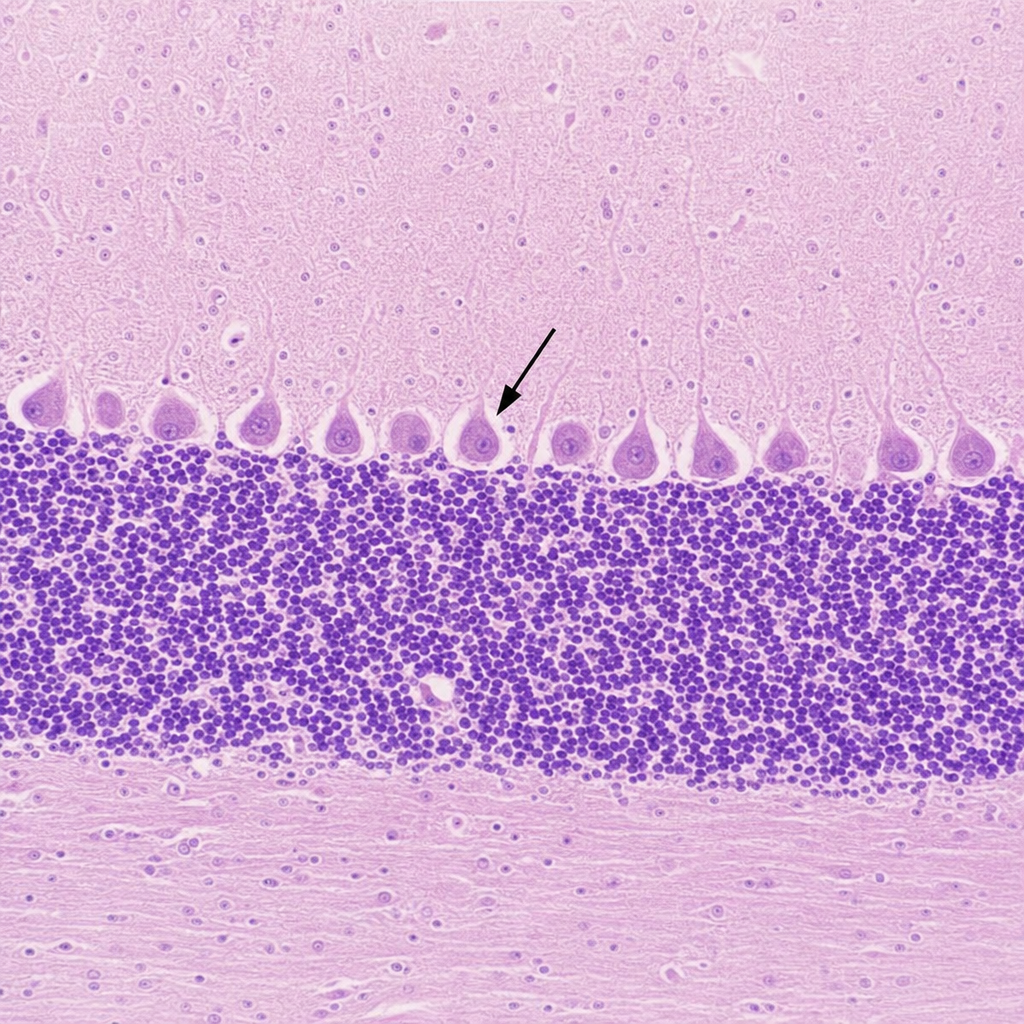
Question 14: Histological section is given below. Identify the marked cell. 
- A. Purkinje cell (Correct Answer)
- B. Granular cell
- C. Stellate cell
- D. Basket cell
Explanation: ***Purkinje cell*** - The marked cell is a **Purkinje cell**, identified by its large, **flask-shaped** (pyriform) body and its characteristic location in the cerebellar cortex. - These neurons form a distinct single layer, the **Purkinje cell layer**, situated between the outer, less cellular **molecular layer** and the inner, densely packed **granular layer**. *Stellate cell* - **Stellate cells** are small, star-shaped inhibitory interneurons located within the superficial part of the **molecular layer**; they are not the large, flask-shaped cells shown. - They are significantly smaller than Purkinje cells and do not form a distinct, single-cell-thick layer. *Basket cell* - **Basket cells** are inhibitory interneurons found in the deeper part of the **molecular layer**, close to the Purkinje cells. - Although they synapse on Purkinje cells by forming a 'basket' of fibers around the soma, the arrow is pointing to the large Purkinje cell body itself, not the smaller basket cell. *Granular cell* - **Granular cells** are the very small, densely packed neurons with dark-staining nuclei that form the **granular layer**, which is the dark purple layer at the bottom of the image. - The marked cell is clearly much larger than a granular cell and is located in the layer just above the granular layer.
Question 15: Which nerve is affected in the hand deformity shown in the image at rest? 
- A. Ulnar (Correct Answer)
- B. Median
- C. Musculocutaneous
- D. None
Explanation: ***Ulnar*** - The image displays a characteristic **claw hand** deformity, specifically affecting the 4th and 5th digits, which is a classic sign of **ulnar nerve** palsy. - This occurs due to paralysis of the ulnar-innervated muscles, primarily the **medial two lumbricals** and the **interossei**, leading to unopposed extension at the metacarpophalangeal (MCP) joints and flexion at the interphalangeal (IP) joints of the ring and little fingers. *Median* - A **median nerve** injury typically causes an **“ape hand”** deformity due to thenar muscle atrophy or a **“hand of benediction”** sign, where the patient cannot flex the 2nd and 3rd fingers when asked to make a fist. - Unlike the ulnar claw seen at rest, the hand of benediction is an **active sign** (seen on attempted action) and involves different digits. *Musculocutaneous* - The **musculocutaneous nerve** supplies the muscles in the anterior compartment of the arm, such as the **biceps brachii** and **brachialis**, which are responsible for elbow flexion. - An injury to this nerve results in a weak elbow flexion and forearm supination, but it does not cause any deformity in the hand. *None* - The deformity shown is a well-recognized clinical sign known as the **claw hand**. - This sign is specifically and directly linked to a lesion of the **ulnar nerve**, making this option incorrect.
Question 16: What stage of embryonic development is shown in the following image?
- A. Gastrula
- B. Morula
- C. Blastocyst (Correct Answer)
- D. Ova
Explanation: ***Blastocyst*** - The image shows a structure with a distinct fluid-filled cavity (the **blastocoel**, labeled X), an inner cell mass (**embryoblast**), and an outer cell layer (**trophoblast**), which are the defining features of a blastocyst. - This stage occurs around day 5 post-fertilization and is responsible for implantation into the **endometrium** of the uterine wall, which is depicted superior to the blastocyst in the illustration. *Morula* - A morula is a solid, compacted ball of 16-32 cells (**blastomeres**) that precedes the blastocyst stage; it does not have the large internal cavity shown in the image. - The morula forms around day 3-4 after fertilization, and it is the entry of fluid into the morula that transforms it into a blastocyst. *Ova* - An ovum (plural: ova) is a single, unfertilized female gamete (egg cell). - The image shows a multicellular embryo that is the result of fertilization and several rounds of cell division, not a single cell. *Gastrula* - Gastrulation is the process that follows the blastocyst stage, where the embryo organizes into three primary germ layers: **ectoderm**, **mesoderm**, and **endoderm**. - The structure shown is a pre-implantation embryo and has not yet undergone gastrulation, which is characterized by the formation of the **primitive streak**.
Question 17: Identify the structure marked as 'X' in the image below
- A. Prevertebral fascia
- B. Pharyngobasilar fascia
- C. Buccopharyngeal fascia (Correct Answer)
- D. Alar fascia
Explanation: ***Buccopharyngeal fascia*** - This fascia is a subdivision of the **pretracheal layer** of the deep cervical fascia that encloses the pharynx, esophagus, and buccinator muscle. - The pointer 'X' correctly identifies this structure, which forms the anterior boundary of the **retropharyngeal space** located immediately posterior to the pharynx. *Prevertebral fascia* - This layer of deep cervical fascia encloses the **vertebral column** and the deep muscles of the neck (e.g., longus colli, scalene muscles). - It is located posterior to the **alar fascia** and forms the floor of the posterior triangle of the neck. *Pharyngobasilar fascia* - This is a strong fibrous sheet that forms the internal framework of the **pharyngeal wall**, situated between the mucous membrane and the muscular layer. - It is an **internal** structure and is not visible on the external surface of the pharynx as indicated in the image. *Alar fascia* - This is a thin fascial layer located between the **buccopharyngeal fascia** anteriorly and the **prevertebral fascia** posteriorly. - It subdivides the space behind the pharynx into the true **retropharyngeal space** and the more posterior **danger space**.
Question 18: A 45-year-old patient presents with difficulty reacting to bright light. On examination, the pupillary light reflex is absent but the near reflex is preserved. Where is the lesion likely located?
- A. Pretectal area of the midbrain (Correct Answer)
- B. Edinger–Westphal nucleus
- C. Optic nerve
- D. Oculomotor nerve
Explanation: ***Pretectal area of the midbrain*** This clinical presentation describes **light-near dissociation** (Argyll Robertson pupil), where the pupillary light reflex is absent but the near (accommodation) reflex is preserved [2]. **Pathway Analysis:** - **Light reflex pathway**: Retina → optic nerve → optic tract → pretectal nucleus → bilateral Edinger-Westphal nuclei → pupillary constriction [1]. - **Near reflex pathway**: Visual cortex → frontal eye fields → Edinger-Westphal nucleus (bypasses pretectal area) **Why this lesion causes the finding:** A lesion in the **pretectal area** interrupts the light reflex pathway while sparing the near reflex pathway (which doesn't pass through the pretectal area), resulting in the characteristic light-near dissociation [2]. **Clinical significance:** - Classic finding in neurosyphilis (tabes dorsalis) [1] - Also seen in diabetes mellitus, multiple sclerosis, and midbrain lesions [1] - Pupils are typically small, irregular, and show poor light response *Incorrect - Edinger-Westphal nucleus* - This is the parasympathetic nucleus that provides the **final common pathway** for BOTH light and near reflexes [2] - A lesion here would abolish **both reflexes**, not cause dissociation *Incorrect - Optic nerve* - Lesion would cause an **afferent pupillary defect** (Marcus Gunn pupil) - Light reflex would be impaired in the affected eye, but near reflex would remain intact in both eyes - This doesn't explain bilateral light-near dissociation *Incorrect - Oculomotor nerve* - Carries parasympathetic fibers from Edinger-Westphal nucleus to the eye [2] - Lesion would cause **efferent defect** affecting both light AND near reflexes - Would also cause ptosis, ophthalmoplegia, and pupil dilation
Question 19: Identify the tarsal bone marked by the arrow in the given X-ray of the right foot.
- A. Cuboid
- B. Intermediate cuneiform
- C. Navicular (Correct Answer)
- D. Lateral cuneiform
Explanation: ***Navicular*** - The arrow correctly identifies the **navicular** bone, a boat-shaped tarsal bone situated on the **medial side** of the midfoot. It articulates proximally with the head of the **talus** and distally with the three **cuneiform** bones. - The navicular is a crucial component of the **medial longitudinal arch** of the foot and is a common site for avascular necrosis (**Köhler disease** in children) or stress fractures. *Cuboid* - The **cuboid** bone is located on the **lateral aspect** of the foot, articulating with the calcaneus proximally and the fourth and fifth metatarsals distally. The structure indicated by the arrow is on the medial side. - It forms the keystone of the **lateral longitudinal arch** and is not the bone indicated in the X-ray. *Intermediate cuneiform* - The **intermediate cuneiform** bone is located **distal** (further towards the toes) to the navicular bone, between the medial and lateral cuneiforms. - It articulates distally with the base of the **second metatarsal**, forming part of the **Lisfranc joint** complex. *Lateral cuneiform* - The **lateral cuneiform** is also situated **distal** to the navicular, lateral to the intermediate cuneiform, and medial to the cuboid bone. - It articulates distally with the base of the **third metatarsal** and is not the bone marked by the arrow, which is more proximal.
Question 20: Identify the bone indicated by the arrow in the image.
- A. Intermediate cuneiform
- B. Lateral cuneiform
- C. Navicular (Correct Answer)
- D. Cuboid
Explanation: ***Navicular*** - The arrow points to the navicular bone, a key tarsal bone located on the **medial side** of the foot. It articulates proximally with the **talus** and distally with the three **cuneiform** bones. - Its characteristic boat-like shape is identifiable on this AP radiograph, and it serves as the keystone of the **medial longitudinal arch** of the foot. *Cuboid* - The **cuboid** bone is located on the **lateral side** of the foot, articulating proximally with the **calcaneus** and distally with the fourth and fifth metatarsals. The indicated bone is medial. - The cuboid has a more cubical shape, which differentiates it from the scaphoid or boat-like shape of the navicular. *Intermediate cuneiform* - The **intermediate cuneiform** is located **distal** to the navicular bone and proximal to the base of the second metatarsal. The arrow points to a more proximal bone. - It is situated between the medial and lateral cuneiforms, forming part of the transverse arch of the foot. *Lateral cuneiform* - The **lateral cuneiform** is also located **distal** to the navicular, articulating with the third metatarsal. The arrow indicates the bone proximal to the cuneiform row. - It articulates with the intermediate cuneiform medially and the cuboid bone laterally, which is inconsistent with the indicated structure.