Anatomy
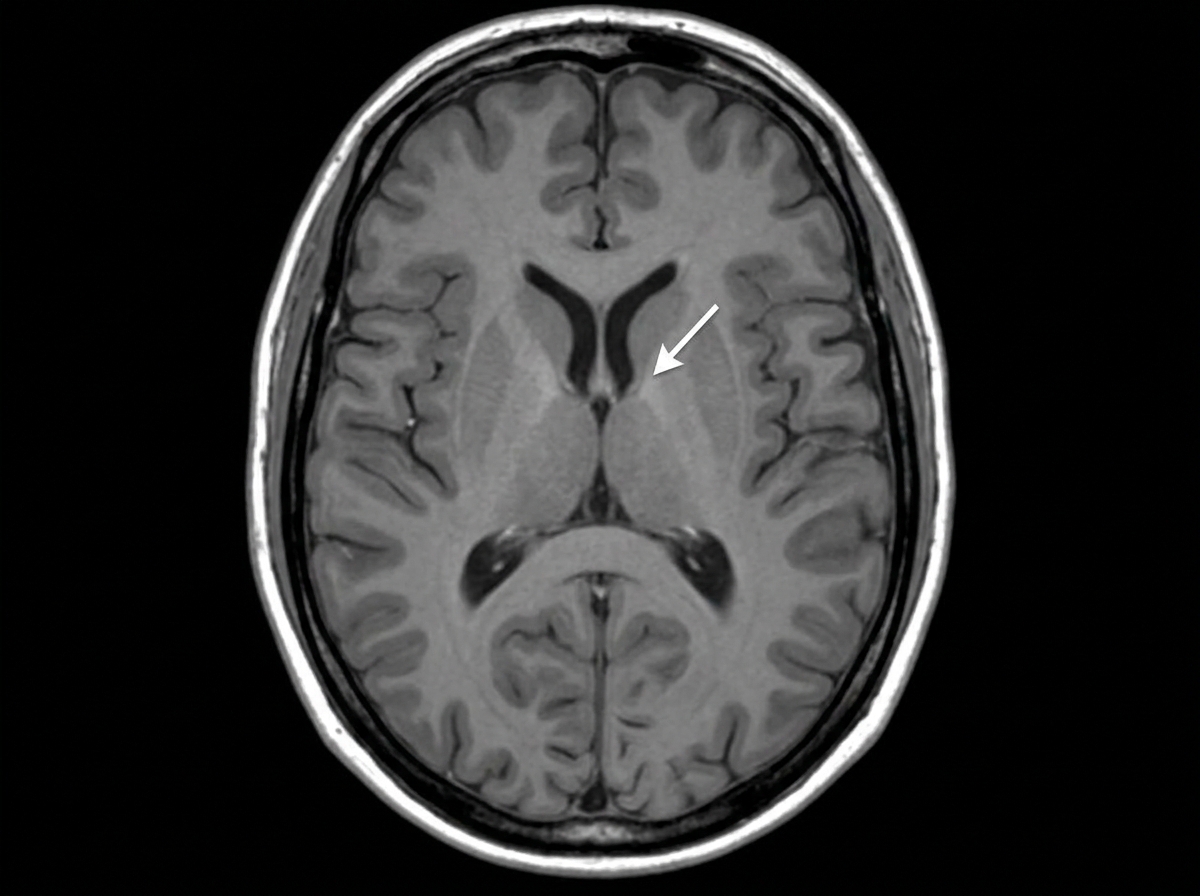
1 questionsIdentify the marked structure:
FMGE 2024 - Anatomy FMGE Practice Questions and MCQs
Question 51: Identify the marked structure:
- A. Internal capsule (Correct Answer)
- B. Lateral ventricle
- C. Body of fornix
- D. Globus pallidus
Explanation: ***Internal capsule***- This highly organized tract of **white matter** separates the **lentiform nucleus** (globus pallidus and putamen) laterally from the **caudate nucleus** and **thalamus** medially in axial/coronal brain sections.- It contains vital ascending sensory fibers and all descending **cortical efferent fibers**, including the **corticospinal tract**.*Body of fornix*- The **fornix** is an arched **white matter** tract situated inferior to the **corpus callosum** and superior to the **third ventricle** in the midline of the brain.- It connects the **hippocampi** to the **mammillary bodies** and is a critical part of the **limbic system** involved in memory.*Globus pallidus*- The **globus pallidus** is a **gray matter** structure and forms the inner, medial portion of the **lentiform nucleus**.- It is situated immediately **lateral** to the **internal capsule** and plays a crucial inhibitory role in the **basal ganglia motor circuit***Lateral ventricle*- The **lateral ventricles** are C-shaped, paired, **CSF-filled** spaces located within the cerebral hemispheres.- They are typically situated adjacent to the **caudate nucleus** head/body, appearing as **hypodense** (dark) fluid spaces on neuroimaging.
Anesthesiology
2 questionsWhich of the following inhalation agents has a blood-gas partition coefficient similar to nitrous oxide?
In epidural anesthesia, which of the following layers is least likely to be punctured during the procedure?
FMGE 2024 - Anesthesiology FMGE Practice Questions and MCQs
Question 51: Which of the following inhalation agents has a blood-gas partition coefficient similar to nitrous oxide?
- A. Desflurane (Correct Answer)
- B. Isoflurane
- C. Halothane
- D. Sevoflurane
Explanation: ***Correct: Desflurane*** - Desflurane has a **blood-gas partition coefficient** of 0.42, which is the closest value to that of **nitrous oxide (N2O)** (0.47) among the volatile agents listed. - This very low solubility in blood facilitates rapid **wash-in** and **wash-out**, translating to the fastest induction and emergence profiles among potent volatile anesthetics. *Incorrect: Isoflurane* - Isoflurane has a moderate-to-high blood-gas partition coefficient (around **1.4**), indicating high solubility compared to N2O. - Due to its high solubility, it has relatively slow **wash-in** and **wash-out** kinetics, leading to slower induction and emergence. *Incorrect: Sevoflurane* - Sevoflurane has a low blood-gas partition coefficient (around **0.65**), making its onset and offset faster than Isoflurane or Halothane. - Although it is considered a fast agent, its solubility is still higher than both **Desflurane** and **N2O**. *Incorrect: Halothane* - Halothane has the highest blood-gas partition coefficient of the agents listed (approximately **2.5**). - Its high solubility results in the slowest **induction** and **emergence** profiles because the blood must be saturated significantly before the partial pressure in the brain rises enough to cause anesthesia.
Question 52: In epidural anesthesia, which of the following layers is least likely to be punctured during the procedure?
- A. Supraspinous
- B. Arachnoid mater (Correct Answer)
- C. Ligamentum flavum
- D. Interspinous ligament
Explanation: ***Arachnoid mater*** - The **arachnoid mater** is located inside the dura mater. Puncturing it implies entering the subarachnoid (intrathecal) space, which is the goal of spinal anesthesia, not epidural. - Epidural anesthesia specifically targets the space external to the **dura mater** (the epidural space), and great care is taken to avoid puncturing the dura and the arachnoid layer beneath it. *Ligamentum flavum* - The **ligamentum flavum** is a crucial anatomical landmark that helps identify the entrance to the epidural space via the 'loss of resistance' technique. - The needle must be advanced **through** the ligamentum flavum to successfully enter the epidural space, meaning its puncture is necessary. *Supraspinous ligament* - The **supraspinous ligament** connects the tips of the spinous processes and is the most superficial central ligament encountered. - It is one of the initial layers that the needle **must penetrate** before proceeding deeper to the interspinous ligament and the ligamentum flavum. *Interspinous ligament* - The **interspinous ligament** connects adjacent spinous processes and lies between the supraspinous ligament and the ligamentum flavum. - This ligament must be traversed by the needle to reach the epidural space, and is **intentionally punctured** during the procedure.
Physiology
2 questionsWhat is the typical Glomerular Filtration Rate (GFR) in a healthy adult?
What renal function is represented by the formula UV/P?
FMGE 2024 - Physiology FMGE Practice Questions and MCQs
Question 51: What is the typical Glomerular Filtration Rate (GFR) in a healthy adult?
- A. 125 ml/min (Correct Answer)
- B. 150 ml/min
- C. 100 ml/min
- D. 200 ml/min
Explanation: **Correct: 125 ml/min** - This is the accepted average value for **Glomerular Filtration Rate (GFR)** in a standard 70 kg healthy young adult - Represents the total volume of fluid filtered from plasma into Bowman's capsule per minute - Totals approximately **180 liters per day** *Incorrect: 150 ml/min* - Higher than the established average GFR (125 ml/min) - Indicative of **renal hyperfiltration**, often an early sign preceding kidney damage - Not the normal rate for a healthy adult *Incorrect: 100 ml/min* - Within the lower limits of normal for some demographics or mild age-related decline - Not the typical average GFR used in standard physiology - GFR below 90 ml/min suggests potential **renal impairment** (Stage 2 CKD) *Incorrect: 200 ml/min* - Significantly higher than physiological GFR - Suggests **hyperfiltration**, a pathological state associated with conditions like early **diabetes mellitus** - Indicates increased pressure or permeability in glomerular capillaries
Question 52: What renal function is represented by the formula UV/P?
- A. Tubular Secretion
- B. Clearance (Correct Answer)
- C. Tubular Reabsorption
- D. Filtration
Explanation: ***Clearance*** - The formula **(U × V) / P** represents the **renal clearance** (C) of a substance, where U is the urine concentration, V is the urine flow rate, and P is the plasma concentration of that substance - Clearance measures the virtual volume of **plasma** from which a substance is completely removed by the kidney per unit of time (typically expressed in ml/min) - This is the fundamental definition and calculation of renal clearance *Filtration* - Filtration is the bulk flow of fluid and solutes from the glomerular capillaries into Bowman's capsule, quantified by the Glomerular Filtration Rate (GFR) - The net filtration rate of a substance is calculated as GFR multiplied by the plasma concentration (P), which is distinct from the clearance formula UV/P *Tubular Secretion* - Tubular secretion is the active transfer of substances from the peritubular capillaries into the tubular lumen - While UV/P is used to calculate clearance, if a substance's clearance exceeds the GFR, it indicates that net tubular secretion has occurred *Tubular Reabsorption* - Tubular reabsorption is the process where filtered solutes move from the tubular lumen back into the peritubular capillaries - If the clearance (UV/P) of a substance is significantly less than the GFR, it signifies that net reabsorption of the substance has taken place
Psychiatry
2 questionsWhat is the medical term for a person who fears seeing tall buildings and looking down from heights?
A mother presented her daughter with complaints that she has started behaving weirdly about her food habits for the last few months. She eats a lot of burgers in one go, and then she vomits it out. Her BMI is 27. What is the most probable diagnosis?
FMGE 2024 - Psychiatry FMGE Practice Questions and MCQs
Question 51: What is the medical term for a person who fears seeing tall buildings and looking down from heights?
- A. Acrophobia (Correct Answer)
- B. Nomophobia
- C. Claustrophobia
- D. Agoraphobia
Explanation: ***Acrophobia***- It is the specific phobia defined as the extreme or irrational **fear of heights** or being in high places (like a tall building or cliff). - Symptoms include anxiety, panic attacks, dizziness, and refusal to be in high places or even look down from them. *Agoraphobia* - This refers to an anxiety disorder characterized by the fear of being in places or situations from which escape might be difficult or help unavailable, such as **open spaces**, public transportation, or crowds. - It is frequently associated with a fear of having a **panic attack** and being unable to escape. *Claustrophobia* - This is the irrational fear of **confined spaces** or enclosed areas, such as elevators, small rooms, or tunnels. - It is not related to vertical distance or looking down from a height. *Nomophobia* - This is a colloquial term for the fear of being without a **mobile phone** or being unable to use it (e.g., due to loss of signal or battery). - This type of phobia involves anxiety related to technological dependence, not environmental features like height.
Question 52: A mother presented her daughter with complaints that she has started behaving weirdly about her food habits for the last few months. She eats a lot of burgers in one go, and then she vomits it out. Her BMI is 27. What is the most probable diagnosis?
- A. Bulimia nervosa (Correct Answer)
- B. Anorexia nervosa
- C. OCD
- D. Binge eating disorder
Explanation: ***Bulimia nervosa***- Involves recurrent episodes of **binge eating** followed by inappropriate **compensatory behaviors** (like self-induced **vomiting**, excessive exercise, or laxative use).- Unlike **anorexia nervosa**, patients with bulimia nervosa typically maintain a body weight that is normal or overweight (BMI $\geq$ 18.5), which aligns with the given BMI of 27.*Anorexia nervosa*- The primary criterion requires the patient to have a weight that is significantly low for their age and height (e.g., BMI $\leq$ 17.5 in adults).- This diagnosis is excluded because the patient's BMI is 27, placing her in the **overweight** category.*Binge eating disorder*- Characterized by recurrent episodes of **binge eating** without inappropriate use of **compensatory behaviors** (purging).- This patient engages in **vomiting** after eating, which is a compensatory behavior that rules out a diagnosis of simple binge eating disorder.*OCD*- Involves the presence of **obsessions** (recurrent, intrusive thoughts) and/or **compulsions** (repetitive behaviors) that cause significant distress.- While eating disorders can feature obsessive elements, the core presentation of binging followed by compensatory purging is specific to **bulimia nervosa**, not Obsessive-Compulsive Disorder.
Radiology
1 questionsGa-68 PSMA PET scan is used to diagnose which of the following conditions?
FMGE 2024 - Radiology FMGE Practice Questions and MCQs
Question 51: Ga-68 PSMA PET scan is used to diagnose which of the following conditions?
- A. Lung cancer
- B. Prostate cancer (Correct Answer)
- C. Liver cancer
- D. Colon cancer
Explanation: ***Prostate cancer***- **Ga-68 PSMA PET** scan targets **Prostate-Specific Membrane Antigen** (**PSMA**), a protein highly overexpressed on the surface of prostate cancer cells.- This scan is crucial for staging, restaging (e.g., in case of **biochemical recurrence** with rising **PSA**), and detecting metastatic foci of prostate carcinoma.*Lung cancer*- Diagnosis and staging of lung cancer primarily use **F-18 FDG PET/CT**, which identifies tumors based on high glucose uptake (the **Warburg effect**).- Lung malignancies do not typically overexpress **PSMA** to a clinically significant degree for diagnostic imaging.*Colon cancer*- Colon cancer (colorectal carcinoma) staging relies primarily on **CT** scans; **F-18 FDG PET** is used mostly for high-risk, recurrent, or metastatic disease.- **PSMA** expression is not a reliable or standard biomarker for routine clinical imaging of colon cancer.*Liver cancer*- Standard imaging for liver cancer (**Hepatocellular carcinoma**) involves dynamic contrast-enhanced **CT** or **MRI**.- While some advanced PSPCs (Prostate-Specific PET probes) might show incidental uptake, **PSMA** is not the target for diagnosing or staging primary liver malignancies.
Surgery
2 questionsA 35-year-old woman, 10 years after mastectomy, notices gradual swelling and heaviness in her right upper limb without pain. On examination, bluish nodules on the skin with no infections are noted. What is the most likely cause of her symptoms?
A patient presents with calf pain while walking a certain distance. The pain is severe enough that he must stop and rest before continuing. According to Boyd's grading, which of the following grades best describes this condition?
FMGE 2024 - Surgery FMGE Practice Questions and MCQs
Question 51: A 35-year-old woman, 10 years after mastectomy, notices gradual swelling and heaviness in her right upper limb without pain. On examination, bluish nodules on the skin with no infections are noted. What is the most likely cause of her symptoms?
- A. Recurrent breast cancer
- B. Lymphangiosarcoma (Correct Answer)
- C. Thoracic outlet syndrome
- D. Chronic venous insufficiency
Explanation: ***Lymphangiosarcoma*** - The appearance of **bluish-purple cutaneous nodules** in a limb affected by long-standing **chronic lymphedema** (secondary to mastectomy and likely axillary dissection) is the classic presentation of **Stewart-Treves syndrome**, or post-mastectomy lymphangiosarcoma. - This is a rare, highly aggressive form of **angiosarcoma** arising from lymphatic endothelial cells in chronically static fluid, which aligns perfectly with the patient's history (10 years post-mastectomy). *Thoracic outlet syndrome* - This condition typically results from compression of the neurovascular bundle, causing symptoms like pain, paresthesias, weakness, or vascular changes (e.g., *Raynaud phenomenon*). - While mild edema can occur, it does not explain the significant history of chronic post-operative lymphedema or the development of highly specific **bluish cutaneous tumor nodules**. *Chronic venous insufficiency* - CVI typically affects the **lower limbs** and is characterized by edema, **skin hyperpigmentation**, and potential venous ulceration or stasis dermatitis, rather than post-mastectomy lymphedema. - The primary pathology here is lymphatic blockage following surgery, not incompetence of the venous valves, and CVI does not lead to the formation of sarcomatous skin nodules. *Recurrent breast cancer* - While recurrence can cause new lymphedema through **lymphatic obstruction**, the appearance of aggressive, rapidly growing **bluish vascular nodules** is highly suggestive of a secondary sarcoma (lymphangiosarcoma) rather than typical epithelial recurrence. - Recurrence often presents as a firm, ill-defined mass or local inflammatory changes, unlike the descriptive appearance of an **angiomatous tumor**.
Question 52: A patient presents with calf pain while walking a certain distance. The pain is severe enough that he must stop and rest before continuing. According to Boyd's grading, which of the following grades best describes this condition?
- A. B. Grade 2
- B. C. Grade 3 (Correct Answer)
- C. D. Grade 4
- D. A. Grade 1
Explanation: ***Correct: Grade 3*** - This grade signifies that the **claudication pain is severe enough to force the patient to stop and rest**, indicating moderately severe peripheral artery disease (PAD) - The distance the patient can walk before stopping is typically **short**, distinguishing it from less severe grades - This matches the clinical scenario where the patient "must stop and rest before continuing" *Incorrect: Grade 1* - This is the mildest form, where the patient experiences **claudication pain only after long distances** of walking - The pain is typically **not severe** and does not significantly interfere with regular walking pace or necessitate stopping - Patient can complete usual walking activities without stopping *Incorrect: Grade 2* - In this stage, pain occurs after a **moderate distance**, but the patient is usually able to continue walking by **slowing their pace** without immediately having to stop - It represents a mild to moderate level of **ischemia** induced by exercise - Key difference: patient can continue walking (albeit slowly) without complete rest *Incorrect: Grade 4* - This grade represents **critical limb ischemia (CLI)**, characterized by **pain at rest** and/or the presence of **ischemic ulcers or gangrene** - It is the most severe grade of PAD, often requiring urgent revascularization - Pain occurs even without walking