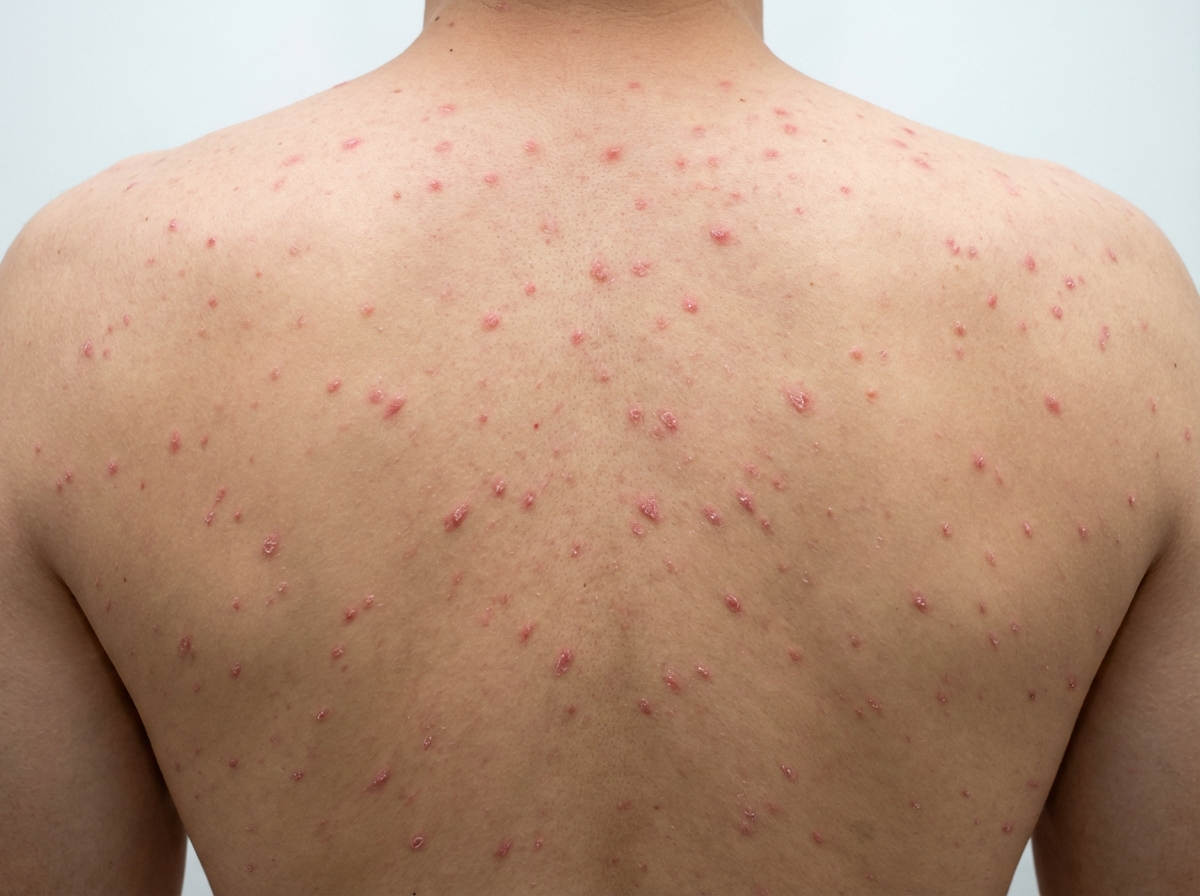
A child with a sore throat starts developing skin lesions as in the image below. Which of the following is the diagnosis?
Q2
A female patient presents to the OPD with complaints of recurrent lesions on lips, which is associated with fever. Which of the following is the characteristic feature seen in Tzanck smear?
Q3
Which of the following deficiencies causes follicular hyperkeratosis?
Q4
A 45-year-old patient presents with itchy, flat-topped, polygonal, violaceous papules on the inner wrists and flexors surfaces of the forearms. The lesions have a characteristic shiny surface and are arranged in a linear pattern. The patient denies any recent medication changes. What is the treatment?
FMGE 2024 - Dermatology FMGE Practice Questions and MCQs
Question 1: A child with a sore throat starts developing skin lesions as in the image below. Which of the following is the diagnosis?
A. Pustular psoriasis
B. Guttate psoriasis (Correct Answer)
C. Inverse psoriasis
D. Erythrodermic
Explanation: ***Guttate psoriasis***- It characteristically appears 2–3 weeks following an infection, most commonly **Streptococcal pharyngitis**, making this post-sore throat presentation highly suggestive.- The rash consists of generalized, small (2–10 mm), discrete, **"tear-drop"**-shaped papules or plaques with fine scale, often covering the trunk and extremities.*Pustular psoriasis*- This form is characterized by the presence of numerous sterile **pustules** on erythematous skin, which is a different morphology than the papular rash described.- Generalized pustular psoriasis (**von Zumbusch type**) is a severe systemic illness that is distinct from the typical post-streptococcal rash seen in children.*Erythrodermic*- This represents a severe form of psoriasis involving widespread erythema and scaling affecting **>90% of the body surface area**.- It is often associated with systemic symptoms (fever, instability) and is a medical emergency, inconsistent with the presentation following a simple sore throat.*Inverse psoriasis*- This variant exclusively affects **intertriginous areas** (skin folds) like the axilla, groin, or under the breasts.- The lesions are typically smooth, shiny, and often lack the significant scaling found in guttate or plaque psoriasis due to the moist environment.
Question 2: A female patient presents to the OPD with complaints of recurrent lesions on lips, which is associated with fever. Which of the following is the characteristic feature seen in Tzanck smear?
A. Acantholytic cells
B. Henderson-Paterson bodies
C. Multinucleated giant cells (Correct Answer)
D. Owl eye appearance
Explanation: ***Multinucleated giant cells***
- Tzanck smear is a rapid diagnostic test for vesiculobullous lesions
- In **Herpes Simplex Virus (HSV)** infection, the characteristic finding is **multinucleated giant cells** with nuclear molding (ballooning degeneration)
- The clinical presentation of recurrent lip lesions with fever is classic for HSV-1 (herpes labialis)
- Tzanck smear shows acantholysis and multinucleated keratinocytes
*Acantholytic cells*
- These are seen in **pemphigus vulgaris** (autoimmune blistering disorder)
- Not characteristic of viral infections like HSV
*Henderson-Paterson bodies*
- These are intracytoplasmic inclusion bodies seen in **molluscum contagiosum**
- Appear as eosinophilic structures (molluscum bodies)
- Not seen in HSV infection
*Owl eye appearance*
- This describes large intranuclear inclusions seen in **Cytomegalovirus (CMV)** infection
- Not characteristic of HSV infection
Question 3: Which of the following deficiencies causes follicular hyperkeratosis?
A. Vitamin C
B. Vitamin E
C. Vitamin B6
D. Vitamin A (Correct Answer)
Explanation: ***Vitamin A***- Deficiency in Vitamin A (retinol) impairs the differentiation of **keratinizing epithelia**, leading to **squamous metaplasia**.- This results in **follicular hyperkeratosis** (also known as **phrynoderma** or 'toad skin'), where keratin plugs block the hair follicles, giving the skin a rough, bumpy appearance.*Vitamin C*- Deficiency causes **scurvy**, primarily due to defective collagen synthesis, leading to fragile blood vessels.- The characteristic skin finding is **perifollicular hemorrhage** (petechiae around hair follicles) and **painless gum bleeding**, not hyperkeratosis due to keratin plugging.*Vitamin E*- This deficiency primarily acts as an **antioxidant deficiency**, leading to increased susceptibility of cell membranes to oxidative damage.- Clinical manifestations often include **hemolytic anemia** (due to erythrocyte membrane damage) and **neurological symptoms** (e.g., ataxia, peripheral neuropathy).*Vitamin B6*- Deficiency of pyridoxine is often associated with cutaneous symptoms like a **seborrheic dermatitis-like rash** and **cheilosis** (cracked lips).- It is crucial for coenzyme functions but does not directly cause the severe keratin plugging characterized by widespread follicular hyperkeratosis.
Question 4: A 45-year-old patient presents with itchy, flat-topped, polygonal, violaceous papules on the inner wrists and flexors surfaces of the forearms. The lesions have a characteristic shiny surface and are arranged in a linear pattern. The patient denies any recent medication changes. What is the treatment?
A. Anti-fungal
B. Topical steroids (Correct Answer)
C. Antibiotics
D. Immunosuppressants
Explanation: ***Topical steroids***- **Lichen planus** is an inflammatory, immune-mediated disorder, and high-potency **topical corticosteroids** are the first-line treatment for localized cutaneous disease on flexural surfaces.- They reduce the inflammation (T-cell-mediated injury to the **basal layer** of the epidermis) and effectively alleviate symptoms like intense **pruritus** (itching).*Antibiotics*- Lichen planus is a **sterile inflammatory process**, not caused by a bacterial infection, making antibiotics ineffective for treating the underlying pathology.- Antibiotics are reserved for infectious conditions like cellulitis or **secondary bacterial infection** of the lesions, which is not indicated here.*Immunosuppressants*- Systemic **immunosuppressants** (e.g., methotrexate, cyclosporine) are reserved for severe, widespread, or treatment-refractory cases, or extensive subtypes like **erosive oral lichen planus**.- For localized cutaneous disease, the risk profile of systemic immunosuppression does not justify its use over topical therapy.*Anti-fungal*- Anti-fungal agents are used to treat infections caused by fungi, such as **Tinea corporis** (ringworm), which presents with scaly, erythematous plaques, not flat-topped violaceous papules.- Lichen planus is an autoimmune/inflammatory dermatosis; therefore, anti-fungals have no role in its primary management.