Anatomy
1 questionsMiddle meningeal artery is a branch of which artery?
FMGE 2019 - Anatomy FMGE Practice Questions and MCQs
Question 71: Middle meningeal artery is a branch of which artery?
- A. Maxillary artery (Correct Answer)
- B. Superficial temporal artery
- C. Facial artery
- D. Ophthalmic artery
Explanation: ***Maxillary artery*** - The **middle meningeal artery** is a major branch of the **maxillary artery**, which itself is a terminal branch of the **external carotid artery**. - It supplies blood to the **dura mater** and cranial bones and is notably vulnerable to injury in temporal bone fractures. *Superficial temporal artery* - The **superficial temporal artery** is the other terminal branch of the **external carotid artery** (alongside the maxillary artery). - It supplies the scalp and superficial temporal region but does not give rise to the middle meningeal artery. *Facial artery* - The **facial artery** is a branch of the **external carotid artery** but primarily supplies structures of the face, such as muscles of facial expression and superficial facial tissues. - It does not give rise to the middle meningeal artery, which has an intracranial course. *Ophthalmic artery* - The **ophthalmic artery** is a branch of the **internal carotid artery** and supplies structures within the orbit, including the eye. - It does not contribute to the blood supply of the dura mater in the area supplied by the middle meningeal artery.
Anesthesiology
1 questionsSpinal anaesthesia in an adult is given at this level:
FMGE 2019 - Anesthesiology FMGE Practice Questions and MCQs
Question 71: Spinal anaesthesia in an adult is given at this level:
- A. L3-L4 (Correct Answer)
- B. T12-L1
- C. L1-L2
- D. L5-S1
Explanation: ***L3-L4*** - This intervertebral space is a **safe and common site** for spinal anaesthesia in adults because the **spinal cord typically terminates at L1-L2** in adults. - Inserting the needle at L3-L4 minimizes the risk of **spinal cord injury** while still allowing access to the cerebrospinal fluid. *T12-L1* - This level is **too high** for routine spinal anaesthesia in adults, as it is often at or very near the **conus medullaris** (the end of the spinal cord). - Puncture at this level carries a **significant risk of direct spinal cord injury**. *L1-L2* - While technically possible, this level is still considered **higher risk** as it is often the **terminal end of the spinal cord** in adults. - The **cauda equina** is present below L1-L2, but the L3-L4 space offers a greater margin of safety. *L5-S1* - This intervertebral space is generally **too low and difficult to access** for consistent and effective spinal anaesthesia. - The **iliac crests typically align with L4**, making the L3-L4 or L4-L5 spaces more accessible for spinal puncture.
Community Medicine
1 questionsContaminated tubing and catheters will be disposed in which bag according to biomedical waste management?
FMGE 2019 - Community Medicine FMGE Practice Questions and MCQs
Question 71: Contaminated tubing and catheters will be disposed in which bag according to biomedical waste management?
- A. Yellow
- B. Blue
- C. White
- D. Red (Correct Answer)
Explanation: ***Red Container*** - The **red bag** is designated for **contaminated recyclable waste** including tubing, catheters, intravenous sets, and soiled plastic items. - This waste is highly infectious and undergoes **autoclaving** or **microwaving** to disinfect it before recycling. *Yellow Container* - The **yellow bag** is used for **highly infectious waste** such as human anatomical waste, medical dressings, and microbiological waste. - This waste is typically **incinerated** or undergoes deep burial. *Blue Container* - The **blue/white puncture-proof container** is used for **sharp objects** like needles, syringes with fixed needles, and scalpel blades. - This waste is often **autoclaved** and then shredded or vitrified to prevent reuse and injury. *White Container* - In some biomedical waste management systems, a **white translucent container** is used for **glassware** that is contaminated with blood or body fluids, such as broken glass ampoules or vials. - The specific color codes can vary slightly between regions, but the red bag is consistently for contaminated plastic/tubing.
Dermatology
1 questionsWhat is the name of this appearance which is seen in pellagra?
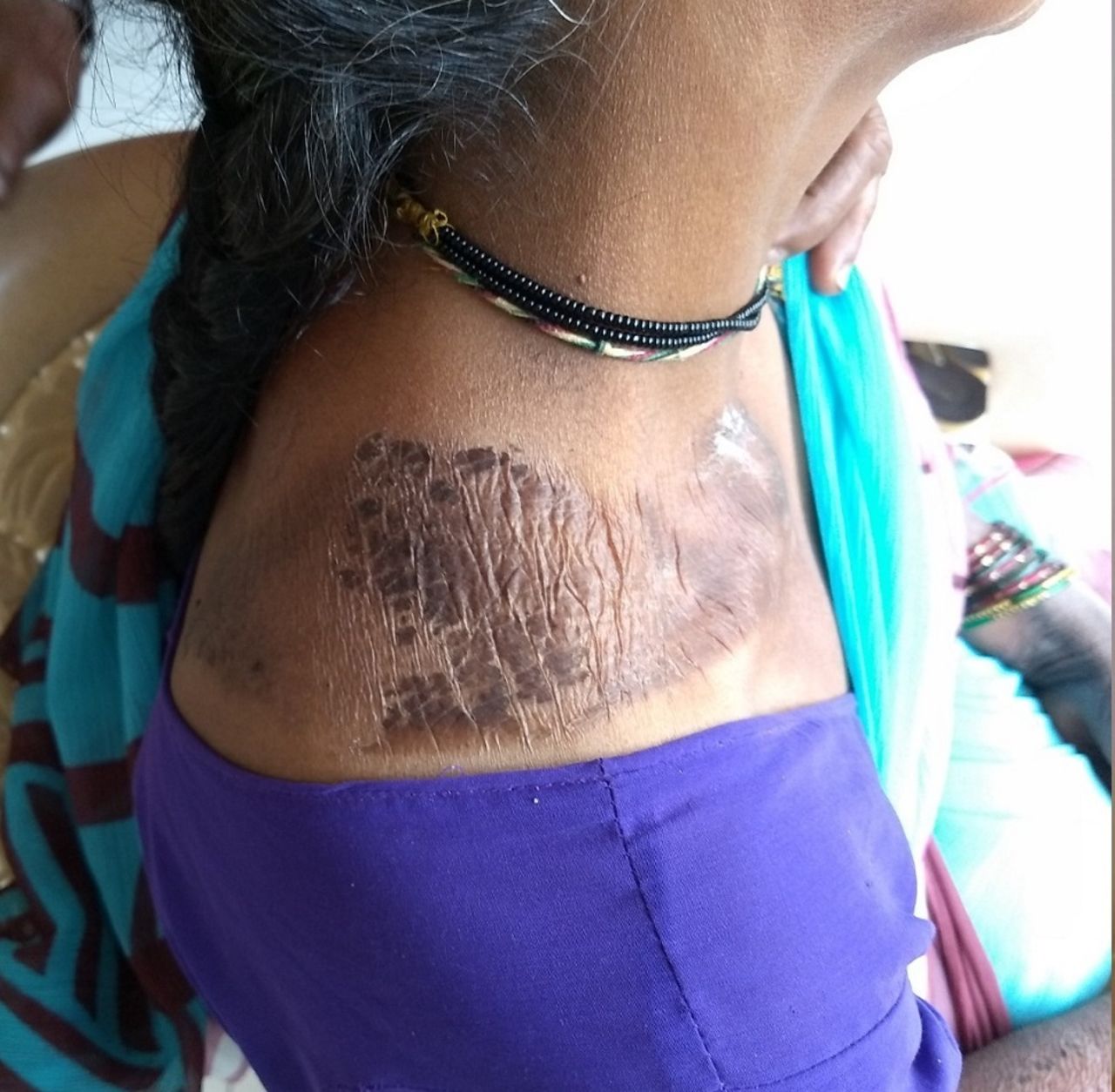
FMGE 2019 - Dermatology FMGE Practice Questions and MCQs
Question 71: What is the name of this appearance which is seen in pellagra?
- A. Shawl sign
- B. Casal's necklace (Correct Answer)
- C. Gottron's papule
- D. Burn
Explanation: ***Casal's necklace*** - Characteristic of **pellagra**, it presents as a **dermatitis** localized around the neck in a "necklace" pattern due to **niacin deficiency**. - This sign is commonly associated with other symptoms of pellagra, such as **dermatitis**, **diarrhea**, and **dementia**. *Shawl sign* - This sign typically refers to **lupus erythematosus** and involves a **rash** on the shoulders, not associated with pellagra. - It is characterized by an **erythematous rash** in sun-exposed areas, distinct from the features of **pellagra**. *Gottron's papule* - These are **papules** seen in **dermatomyositis**, characterized by violaceous lesions on the fingers, not related to pellagra. - Their appearance is associated with **muscle weakness** and other features of dermatomyositis, rather than **niacin deficiency**. *Burn* - Refers to an injury from thermal exposure and does not relate to the **dermatological signs** of pellagra. - It is not a clinical feature and does not reflect the **nutritional deficiency** seen in this condition.
Internal Medicine
2 questionsProstatic cancer mostly seen in
Abdominal pain, fever and jaundice. This triad is known as;
FMGE 2019 - Internal Medicine FMGE Practice Questions and MCQs
Question 71: Prostatic cancer mostly seen in
- A. Posterior (Correct Answer)
- B. Lateral
- C. Anterior
- D. Medial
Explanation: ***Posterior*** - The **peripheral zone** of the prostate, which is located posteriorly, is the most common site for the development of **prostatic adenocarcinoma**. - This anatomical location is why a **digital rectal exam (DRE)** is an important screening tool, as palpable nodules can be detected [1]. *Lateral* - While prostatic tissue extends laterally, this region is not the predominant site for cancer development. - Cancers originating here are less common than those in the posterior peripheral zone. *Anterior* - The **anterior fibromuscular stroma** and the anterior portion of the prostate are rarely the primary sites for prostate cancer. - Tumors found here are often extensions from more posteriorly located cancers. *Medial* - The **transition zone**, which is located medially and surrounds the urethra, is the most common site for **benign prostatic hyperplasia (BPH)**, not prostate cancer. - While cancer can occur in this zone, it is less frequent than in the peripheral zone.
Question 72: Abdominal pain, fever and jaundice. This triad is known as;
- A. Renault's triad
- B. Charcot's triad (Correct Answer)
- C. Virchow triad
- D. Saint's triad
Explanation: ***Charcot's triad*** - **Charcot's triad** consists of **abdominal pain**, **fever**, and **jaundice**, indicating **acute cholangitis** [1]. - This triad is a hallmark of **biliary tract obstruction** with concurrent infection [1]. *Renault's triad* - This is a **distractor** name; there is no recognized medical triad called "Renault's triad." - It does not describe any specific clinical presentation or set of symptoms. *Virchow triad* - **Virchow triad** describes factors that predispose to **thrombus formation**: **endothelial injury**, **stasis**, and **hypercoagulability**. - It is associated with conditions like **deep vein thrombosis (DVT)** and **pulmonary embolism**, not cholangitis. *Saint's triad* - **Saint's triad** refers to the co-occurrence of **gallstones**, **hiatal hernia**, and **diverticulosis**. - This triad describes three unrelated gastrointestinal conditions and is distinct from the symptoms of cholangitis.
Microbiology
1 questionsAntemortem diagnosis of rabies is made with:
FMGE 2019 - Microbiology FMGE Practice Questions and MCQs
Question 71: Antemortem diagnosis of rabies is made with:
- A. Inoculation in culture media
- B. Negri bodies in hippocampus
- C. Corneal impression smear (Correct Answer)
- D. Rabies virus specific antibodies
Explanation: ***Corneal impression smear*** - A **corneal impression smear** can detect viral antigens in the cornea using fluorescent antibody staining, a method that can be performed on living patients. - This technique provides a relatively rapid and non-invasive way to diagnose rabies **antemortem**. *Inoculation in culture media* - Rabies virus is notoriously difficult to culture in standard cell culture media, making this method impractical and unreliable for **antemortem diagnosis**. - While viral isolation is possible in specialized research settings, it is not a routine diagnostic tool for rabies in living patients. *Negri bodies in hippocampus* - **Negri bodies** are eosinophilic inclusions found in the cytoplasm of neurons, particularly in the hippocampus, which are pathognomonic for rabies. - However, their detection requires **postmortem brain tissue biopsy**, making this a **postmortem diagnostic** method, not antemortem. *Rabies virus specific antibodies* - While the presence of **rabies virus-specific antibodies** (particularly in CSF) can indicate exposure and infection, they often appear late in the disease course. - The detection of antibodies may not be reliable for early **antemortem diagnosis**, especially in naive individuals whose immune response has not yet fully developed.
Obstetrics and Gynecology
2 questionsWhich of the following can be a cause of Oligohydramnios?
Absolute contraindication of IUCD is?
FMGE 2019 - Obstetrics and Gynecology FMGE Practice Questions and MCQs
Question 71: Which of the following can be a cause of Oligohydramnios?
- A. Macrosomia
- B. Multiparity
- C. Renal agenesis (Correct Answer)
- D. Twins
Explanation: ***Renal agenesis*** - **Fetal urine production** is the primary source of **amniotic fluid** in the latter half of pregnancy, so **bilateral renal agenesis** prevents this production. - Oligohydramnios due to renal agenesis is often associated with **Potter sequence**, characterized by facial anomalies, limb deformities, and pulmonary hypoplasia due to prolonged severe oligohydramnios. *Macrosomia* - **Macrosomia** (large baby) is not a cause of oligohydramnios; a larger fetus does not directly reduce amniotic fluid volume. - In fact, conditions like **gestational diabetes** which can cause macrosomia, are often associated with **polyhydramnios** (excess amniotic fluid) due to increased fetal urination. *Multiparity* - **Multiparity** (having had multiple previous pregnancies) is not directly associated with oligohydramnios. - While it can be a risk factor for certain pregnancy complications, it does not physiologically lead to reduced amniotic fluid. *Twins* - A multifetal pregnancy, such as **twins**, can sometimes be associated with complications like **twin-to-twin transfusion syndrome**, where one twin might develop oligohydramnios and the other polyhydramnios. - However, the presence of twins itself does not intrinsically cause oligohydramnios; it is a potential complication of specific twin types or their pathologies rather than a direct cause.
Question 72: Absolute contraindication of IUCD is?
- A. Previous history of abortion
- B. Acute PID (Correct Answer)
- C. Breast cancer
- D. PCOD
Explanation: ***Acute PID*** - **Acute pelvic inflammatory disease (PID)** is an absolute contraindication for IUCD insertion because the device can potentially worsen the existing infection or spread it further into the uterus and fallopian tubes. - Inserting an IUCD in the presence of acute PID significantly increases the risk of serious complications, including **sepsis** and **infertility**. *Previous history of abortion* - A **previous history of abortion** is generally not an absolute contraindication for IUCD insertion; rather, it may be a relative contraindication depending on factors such as the recency of the abortion or presence of infection risks. - IUCDs can be safely inserted after an abortion if there are no signs of infection and the uterus has involuted sufficiently. *Breast cancer* - **Breast cancer** is primarily a contraindication for **hormonal contraceptives** (like hormonal IUCDs) due to the potential estrogen or progestin sensitivity of certain cancers. - However, **copper IUCDs** (which are non-hormonal) are generally safe to use in patients with a history of breast cancer. *PCOD* - **Polycystic ovary syndrome (PCOS)** is not a contraindication for IUCD insertion; in fact, hormonal IUCDs can sometimes be beneficial in managing symptoms like heavy menstrual bleeding associated with PCOS. - IUCDs do not interfere with the underlying pathophysiology of PCOS.
Pharmacology
1 questionsHydrochlorothiazide works by inhibiting
FMGE 2019 - Pharmacology FMGE Practice Questions and MCQs
Question 71: Hydrochlorothiazide works by inhibiting
- A. Na+ Cl pump in late DCT
- B. Na+ K+ 2Cl pump in descending limb of loop of Henle
- C. Na+ K+ 2Cl pump in ascending limb of loop of Henle
- D. Na+ Cl pump in early DCT (Correct Answer)
Explanation: ***Na+ Cl pump in early DCT*** - **Hydrochlorothiazide** is a **thiazide diuretic** that acts primarily on the **early distal convoluted tubule (DCT)**. - It inhibits the **sodium-chloride cotransporter (NCC)**, leading to increased excretion of sodium, chloride, and water. *Na+ Cl pump in late DCT* - The **late DCT** and collecting duct are primarily involved in fine-tuning sodium reabsorption, influenced by **aldosterone**, not the primary site of action for thiazides. - The **epithelial sodium channel (ENaC)** and Na+/K+-ATPase are more prominent here. *Na+ K+ 2Cl pump in descending limb of loop of Henle* - The **descending limb of the loop of Henle** is primarily permeable to water, with no active ion pumps like **Na+ K+ 2Cl pump**. - Its main function is to concentrate the urine by allowing water to move out. *Na+ K+ 2Cl pump in ascending limb of loop of Henle* - **Furosemide** and other **loop diuretics** act on the **Na+ K+ 2Cl cotransporter (NKCC2)** in the **thick ascending limb of the loop of Henle**, not hydrochlorothiazide. - Inhibition here prevents significant reabsorption of sodium, potassium, and chloride, leading to potent diuresis.