

Muscle Fibers - Slow vs. Fast Twitch
📌 Mnemonic: "1 slow red ox" → Type 1 fibers are slow-twitch, red (↑ myoglobin/mitochondria), and use oxidative phosphorylation.
| Feature | Type I (Slow-Twitch) | Type II (Fast-Twitch) |
|---|---|---|
| Action | Sustained (Endurance) | Rapid, forceful (Sprints) |
| Contraction Speed | Slow | Fast |
| Myoglobin Content | High (Red muscle) | Low (White muscle) |
| Mitochondria | ↑ Numerous | ↓ Fewer |
| Metabolism | Aerobic (Oxidative) | Anaerobic (Glycolytic) |
| Fatigability | Fatigue-resistant | Easily fatigued |
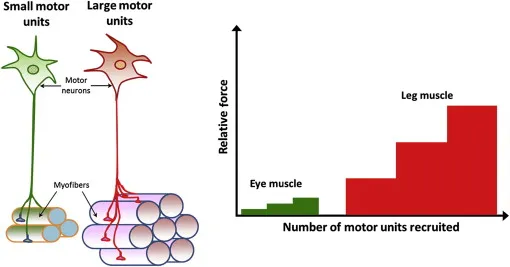
⭐ Size Principle of Recruitment: Motor units are recruited from smallest to largest. Smaller, low-threshold motor units innervate slow-twitch (Type I) fibers, so they are recruited first for most movements. Larger, high-threshold units innervating fast-twitch (Type II) fibers are recruited later for more forceful contractions.
Recruitment Rules - The Size Principle
- Principle: Motor units are recruited in order of size, from smallest (Type I) to largest (Type IIx), as the required force of contraction increases.
- Recruitment Order & Rationale (Henneman's Size Principle):
- Small Motor Neurons (Type I fibers):
- Have ↑ input resistance & lower activation thresholds.
- A given synaptic current generates a larger voltage potential ($V=IR$), reaching threshold first.
- Recruited for light, sustained efforts (e.g., posture).
- Large Motor Neurons (Type II fibers):
- Have ↓ input resistance & higher activation thresholds.
- Recruited progressively for powerful, forceful contractions.
- Small Motor Neurons (Type I fibers):
⭐ Asynchronous recruitment of motor units during submaximal contractions helps delay fatigue by allowing some units to rest while others are active. This is critical for endurance.
Training Adaptations - Use It or Lose It
-
Endurance (Aerobic) Training:
- ↑ Mitochondrial density & oxidative enzymes.
- ↑ Capillary supply & myoglobin content.
- Enhances fatigue resistance.
- Fiber type shift: Type IIx → Type IIa.
-
Resistance (Anaerobic) Training:
- ↑ Muscle fiber diameter (hypertrophy), especially Type II.
- ↑ Glycolytic enzyme activity & glycogen stores.
- ↑ Contractile proteins (actin, myosin) → ↑ strength.
-
Detraining (Immobilization):
- Muscle atrophy (↓ size); Type I fibers affected most in early stages.
- Rapid loss of mitochondrial and strength gains.
⭐ Initial strength gains in resistance training (first 2-4 weeks) are primarily due to improved neuromuscular coordination, not hypertrophy.
High‑Yield Points - ⚡ Biggest Takeaways
- Type I fibers (slow-twitch, red) are for endurance (e.g., posture); they rely on oxidative phosphorylation.
- Type II fibers (fast-twitch, white) are for power and sprints; they rely on anaerobic glycolysis.
- Muscle fiber recruitment follows the size principle: Type I → Type IIa → Type IIx.
- Marathoners show a predominance of Type I fibers.
- Sprinters and weightlifters have more Type II fibers.
- Weight training can induce hypertrophy, primarily in Type II fibers.
Continue reading on Oncourse
Sign up for free to access the full lesson, plus unlimited questions, flashcards, AI-powered notes, and more.
CONTINUE READING — FREEor get the app
