

Benign vs Malignant - The Great Divide
- Benign: Well-differentiated, slow-growing, encapsulated, and non-invasive. No metastatic potential.
- Malignant: Poorly differentiated (anaplastic), erratic growth, locally invasive, and capable of metastasis.
| Feature | Benign | Malignant |
|---|---|---|
| Differentiation | Well-differentiated | Poor to anaplastic |
| Growth Rate | Slow, few mitoses | Rapid, many atypical mitoses |
| Local Invasion | Cohesive, encapsulated | Infiltrative, non-encapsulated |
| Metastasis | Absent | Present (definitive sign) |
⭐ Anaplasia, the lack of differentiation, is a hallmark of malignancy. However, the most reliable feature distinguishing malignant from benign tumors is metastasis.
Key Characteristics - A Tale of Two Tumors
| Feature | Benign Tumors | Malignant Tumors (Cancer) |
|---|---|---|
| Differentiation | Well-differentiated; resembles parent tissue. | Poorly differentiated (anaplastic); atypical structure. |
| Rate of Growth | Slow, progressive expansion; may stop or regress. Mitotic figures are rare. | Rapid, erratic growth; numerous, atypical mitotic figures. |
| Local Invasion | Cohesive growth; often encapsulated with a fibrous rim. Does not invade surrounding tissue. | Infiltrative growth; invades and destroys adjacent tissues. Poorly demarcated. |
| Metastasis | Absent. | Frequent; the definitive hallmark of malignancy. |
⭐ Anaplasia (lack of differentiation) is the most reliable indicator of malignancy. Key features include pleomorphism (variation in cell size/shape), hyperchromatic nuclei, high nuclear-to-cytoplasmic ratio (N/C ratio), and loss of polarity.
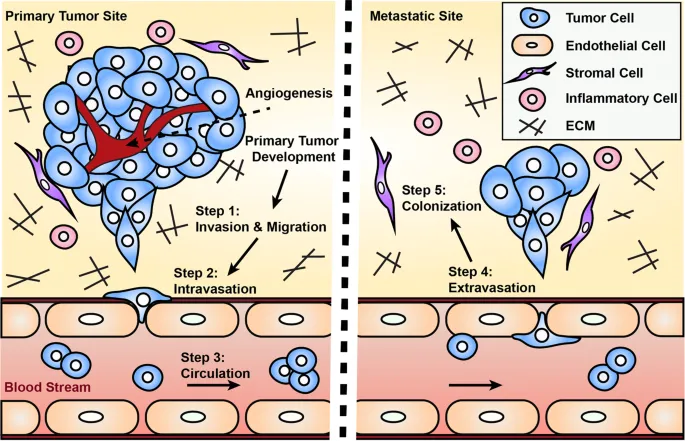
Metastasis - The Great Escape
Metastasis is the single most important feature distinguishing malignant from benign tumors. It is the primary cause of cancer-related death.
-
Pathways of Spread:
- Seeding of Body Cavities: Peritoneal spread of ovarian cancer.
- Lymphatic Spread: The most common pathway for initial dissemination of carcinomas (e.g., breast cancer).
- Hematogenous Spread: Favored by sarcomas, but also used by carcinomas. Liver and lungs are the most frequently involved secondary sites.
-
The Metastatic Cascade:
⭐ The sentinel lymph node is the first regional lymph node that receives lymph flow from a primary tumor. Its biopsy is critical for staging and determining treatment for melanoma and breast cancer.
High‑Yield Points - ⚡ Biggest Takeaways
- Metastasis is the single most reliable feature of malignancy.
- Benign tumors are typically well-differentiated, slow-growing, and encapsulated.
- Malignant tumors are poorly-differentiated (anaplastic), grow rapidly, and invade local tissues.
- Anaplasia implies a loss of structural and functional differentiation in malignant cells.
- Malignant cells exhibit pleomorphism, hyperchromatic nuclei, and a high N:C ratio.
- Atypical mitotic figures and high mitotic activity are hallmarks of malignancy.
Unlock the full lesson and continue reading
Signup to continue reading this lesson and unlimited access questions, flashcards, AI notes, and more
