

Mitochondrial Inheritance - It's All From Mom
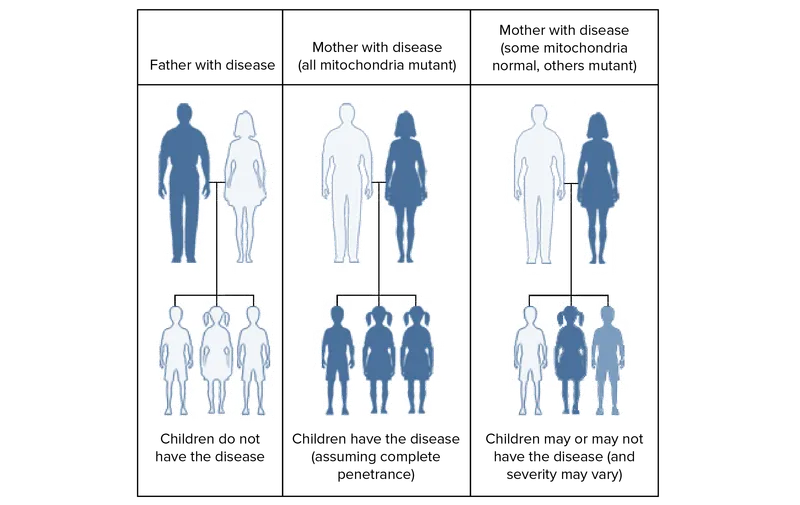
- Transmitted exclusively through the mother, as mitochondria are inherited from the ovum. All offspring of an affected female inherit the mutation.
- Key Concepts:
- Heteroplasmy: A mixture of normal and mutated mtDNA in cells, leading to...
- Variable Expressivity: ...a wide range of clinical severity among affected family members.
- Classic Syndromes:
- Leber hereditary optic neuropathy (LHON): Acute central vision loss.
- MERRF: Myoclonic epilepsy with ragged-red fibers.
- MELAS: Mitochondrial encephalomyopathy, lactic acidosis, stroke-like episodes.
⭐ Muscle biopsy often shows "ragged red fibers" with Gomori trichrome stain, representing accumulations of abnormal mitochondria.
Genomic Imprinting - The Silencing Game
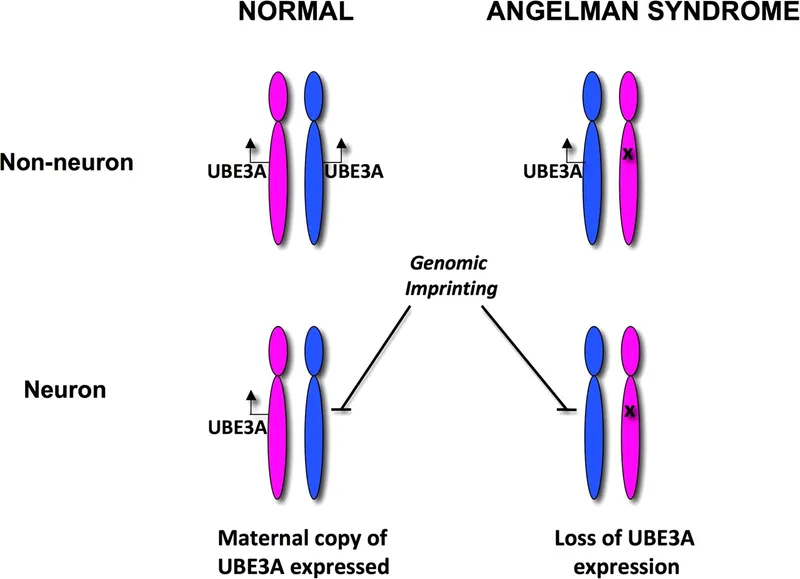
Genomic imprinting silences genes based on parent of origin, typically via DNA methylation. If the expressed allele is deleted, disease occurs. This affects gene clusters, most notably on chromosome 15.
| Syndrome | Locus | Deletion Origin | Key Features |
|---|---|---|---|
| Prader-Willi | 15q11-q13 | Paternal | Hyperphagia, hypotonia, obesity. |
| Angelman | 15q11-q13 | Maternal | Inappropriate laughter, seizures, ataxia. |
⭐ Uniparental disomy (inheriting both chromosome copies from one parent) is another key cause for these syndromes.
Trinucleotide Repeats - Genetic Stutters
- Dynamic mutations: Unstable repeats that can expand in number between generations. This leads to anticipation-earlier onset and increased severity in successive generations.
📌 Mnemonic: The Crazy Giants Hunt For Gummies (CTG, CGG, CAG, GAA).
| Disorder | Repeat | Inheritance | Key Feature |
|---|---|---|---|
| Huntington's Disease | CAG | AD | Chorea, dementia, caudate atrophy |
| Myotonic Dystrophy | CTG | AD | Myotonia, cataracts, toupee (frontal balding) |
| Fragile X Syndrome | CGG | X-linked | Large jaw, large ears, large testes |
| Friedreich's Ataxia | GAA | AR | Ataxia, hypertrophic cardiomyopathy |
Other Patterns - Genetic Curveballs
- Codominance: Both alleles in a heterozygote are fully expressed.
- Example: ABO blood groups (A and B alleles are codominant).
- Incomplete Dominance: Heterozygous phenotype is a blend of the two homozygous phenotypes.
- Example: Familial hypercholesterolemia; heterozygotes have LDL levels intermediate between normal and homozygous individuals.
- Mosaicism: Presence of genetically distinct cell lines in an individual.
- Somatic: Mutation arises after fertilization. Example: McCune-Albright syndrome.
- Germline: Mutation is confined to egg or sperm cells.
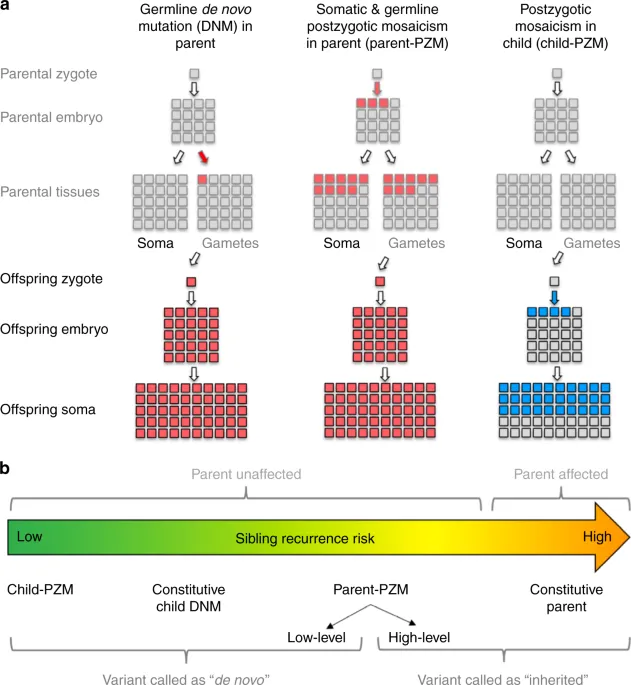
⭐ Germline mosaicism is an important consideration when counseling parents who are phenotypically normal but have a child with an autosomal dominant condition.
High‑Yield Points - ⚡ Biggest Takeaways
- Mitochondrial inheritance is transmitted exclusively from the mother; all offspring can be affected, often with variable expressivity due to heteroplasmy.
- Genomic imprinting is parent-of-origin-specific gene silencing via methylation, underlying syndromes like Prader-Willi and Angelman.
- Anticipation describes how trinucleotide repeat disorders (e.g., Huntington's) worsen through generations.
- Germline mosaicism can lead to disease in offspring from a phenotypically normal parent.
- Uniparental disomy is inheriting two copies of a chromosome from one parent.
Continue reading on Oncourse
Sign up for free to access the full lesson, plus unlimited questions, flashcards, AI-powered notes, and more.
CONTINUE READING — FREEor get the app
