

DKA & Potassium - The Great K+ Shift
-
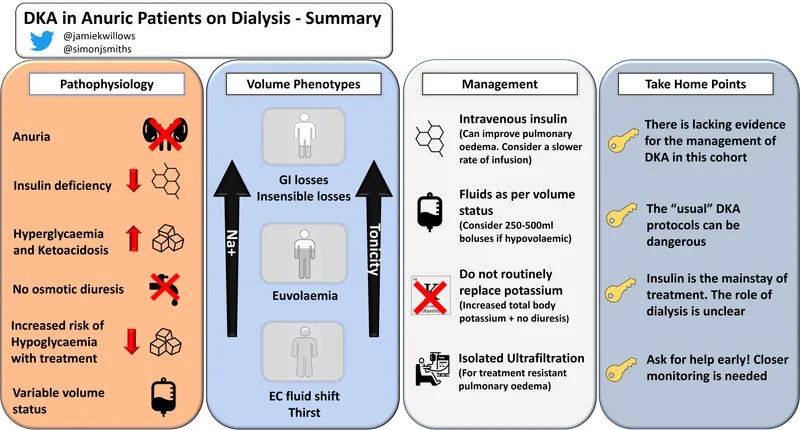
Paradox: Patients have a total body K+ deficit (due to osmotic diuresis) but often present with normal or high serum K+ ($hyperkalemia$). This is a critical extracellular shift.
-
Core Pathophysiology: Two main drivers pull K+ out of cells:
- Insulin Deficiency: Insulin normally stimulates the $Na^+/K^+$-ATPase pump, pushing K+ intracellularly. Its absence traps K+ in the serum.
- Acidosis: Excess serum $H^+$ ions are exchanged for intracellular K+ via the $H^+/K^+$ anti-porter to buffer the acid, further raising serum K+.
⭐ For every 0.1 unit decrease in blood pH, serum potassium is expected to increase by approximately 0.6 mEq/L.
Potassium Triage - The Crucial First Look
Insulin drives potassium into cells, which can dangerously worsen hypokalemia. Always check serum potassium before starting insulin therapy. The initial K+ level dictates the first step in management.
⭐ Total Body Potassium Depletion: Despite normal or even high initial serum K+ levels, all patients with DKA have a significant total body potassium deficit due to urinary losses from osmotic diuresis.
Repletion Roadmap - The K+ Correction Plan
- Goal: Maintain serum K+ in the target range of 4.0-5.0 mEq/L. Insulin drives K+ intracellularly, so proactive repletion is key.
- If Serum K+ > 5.2 mEq/L:
- Start insulin; do not give K+ initially.
- Recheck serum K+ every 2 hours.
- If Serum K+ is 3.3-5.2 mEq/L:
- Start insulin and K+ repletion together.
- Add 20-40 mEq of K+ (e.g., KCl) to each liter of IV fluid.
- Monitor serum K+ every 2-4 hours.
- If Serum K+ < 3.3 mEq/L:
- ⚠️ Hold insulin.
- Aggressively replete K+ first.
- Begin insulin only once K+ is > 3.3 mEq/L.
⭐ Patients in DKA have a large total-body K+ deficit (3-5 mEq/kg), even with normal or high initial serum levels, due to osmotic diuresis.
High‑Yield Points - ⚡ Biggest Takeaways
- DKA leads to a total-body potassium deficit, even with normal or high serum levels due to extracellular shifts.
- Insulin therapy is the main driver of potassium's intracellular shift, which can cause severe hypokalemia.
- Always check potassium before starting insulin. If K+ is < 3.3 mEq/L, replete potassium first.
- If initial K+ is > 5.2 mEq/L, begin insulin and monitor closely.
- For K+ between 3.3-5.2 mEq/L, give IV potassium with the insulin infusion.
Unlock the full lesson and continue reading
Signup to continue reading this lesson and unlimited access questions, flashcards, AI notes, and more
