

Cell Cycle Phases - The Cell's Day Planner
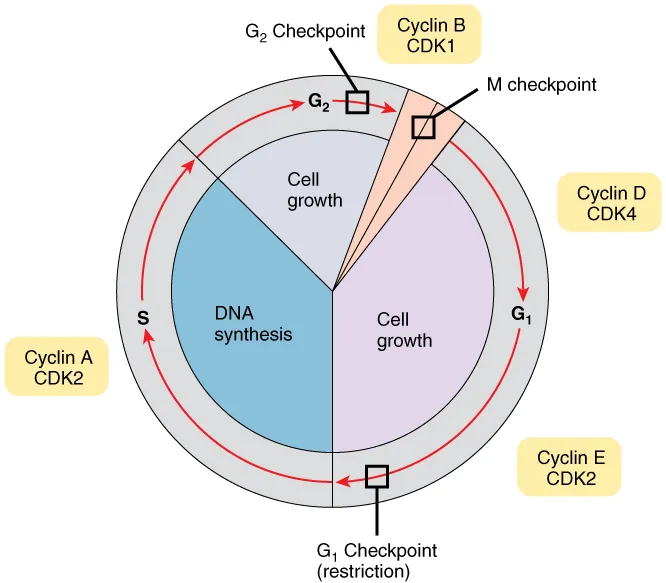
- Interphase (G1, S, G2): Longest phase, focused on growth and DNA replication.
- G1 (Gap 1): Cell growth, protein synthesis. DNA content: $2n$. Most variable phase.
- S (Synthesis): DNA replication occurs. DNA content: $2n \rightarrow 4n$.
- G2 (Gap 2): Growth, organelle duplication, and DNA proofreading. DNA content: $4n$.
- M (Mitosis): Division of the nucleus.
- G0 (Quiescence): Non-dividing state. Permanent cells (neurons, cardiac muscle) remain here; stable cells (hepatocytes) can re-enter the cycle.
⭐ The G1/S checkpoint (Restriction Point) is a critical, rate-limiting step. It's regulated by tumor suppressors like Rb and p53 to prevent uncontrolled proliferation.
📌 Go Sally Go, Make Children! (G1, S, G2, M, Cytokinesis)
Cell Cycle Regulation - Cyclin' Thru Checkpoints
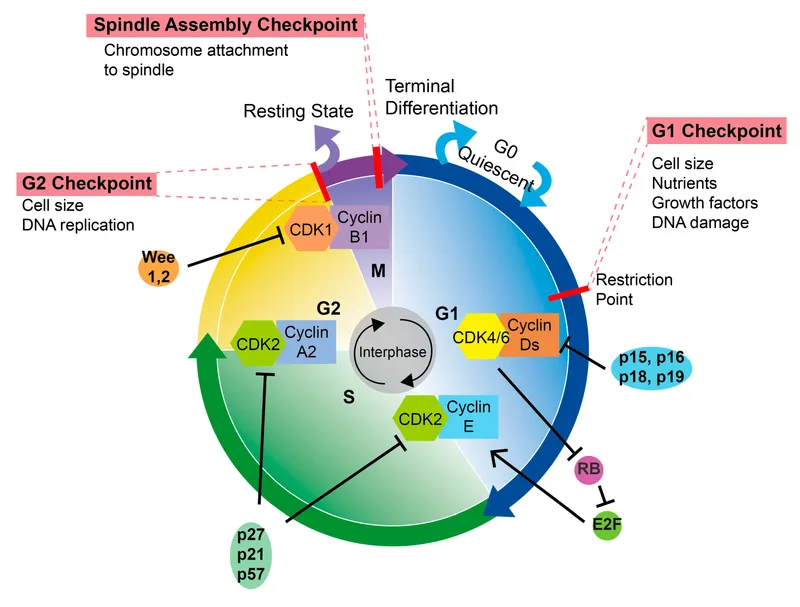
- Core Engine: Progression is driven by Cyclin-Dependent Kinases (CDKs), which are activated by binding to cyclins. Cyclin levels oscillate, driving the cycle forward.
- Key Checkpoints:
- G1 → S (Restriction Point): The primary decision point. Checks for DNA damage before replication.
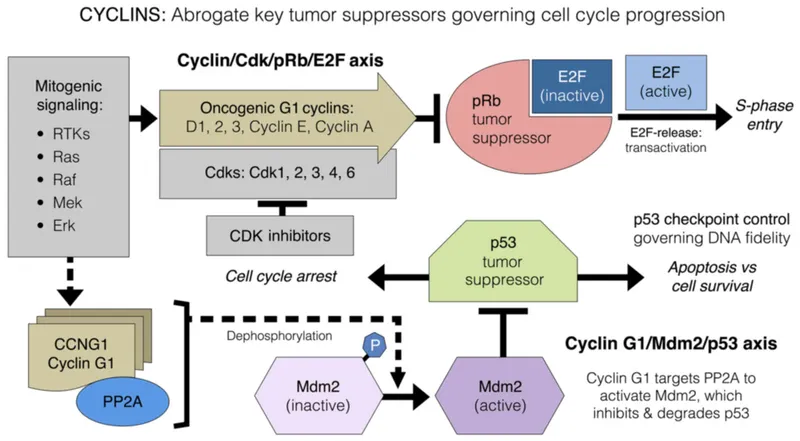
- Rb Pathway: Growth factors ↑ Cyclin D/CDK4 → phosphorylates (inactivates) Rb protein → releases E2F transcription factor → S-phase gene expression.
- p53 Pathway: DNA damage ↑ p53 → ↑ p21 (a CDK inhibitor) → hypophosphorylated Rb stays active → cell cycle arrest.
- G2 → M: Ensures DNA replication is complete and accurate before cell division.
- G1 → S (Restriction Point): The primary decision point. Checks for DNA damage before replication.
⭐ Li-Fraumeni syndrome, from a germline TP53 mutation, confers a high lifetime risk of various cancers (sarcomas, breast, brain, adrenal).
Mitosis Stages - The Great Cellular Divide
- Goal: To produce two genetically identical daughter cells from one parent cell.
- Maintains ploidy (e.g., diploid 2n → 2n).
- 📌 Mnemonic: Pass Me A Tissue (or PMAT)
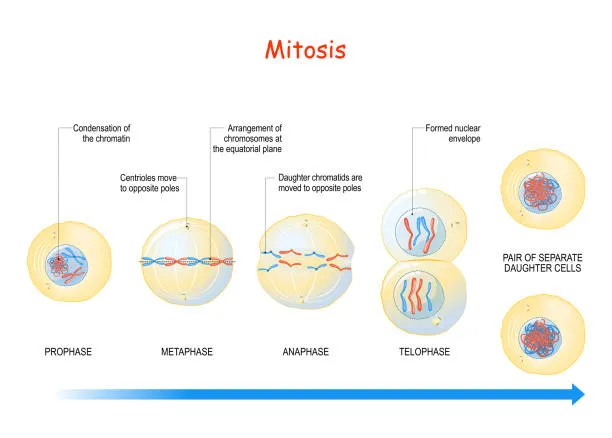
- Prophase: Chromatin condenses into visible chromosomes (2 sister chromatids). Nuclear envelope dissolves. Spindle fibers form.
- Metaphase: Chromosomes align at the Metaphase plate.
- Anaphase: Sister chromatids separate and move to opposite poles.
- Telophase: Chromosomes decondense. Nuclear envelope reforms.
⭐ Exam Favorite: Microtubule inhibitors disrupt mitosis. Colchicine prevents microtubule polymerization, arresting cells in metaphase. This is useful for karyotyping.
Clinical Correlations - When Good Cells Go Bad
Uncontrolled cell division, the hallmark of cancer, arises from mutations in key cell cycle regulators.
- Tumor Suppressor Genes (Two-Hit Hypothesis)
- p53 (Guardian of the Genome): Halts G1/S progression if DNA damage is detected. Mutated in >50% of human cancers.
- Rb (Retinoblastoma): Inhibits E2F; blocks G1 → S transition.
- Proto-Oncogenes (One-Hit Hypothesis)
- Cyclins & CDKs: Overactivation promotes cell proliferation.
⭐> Li-Fraumeni syndrome, an autosomal dominant condition, results from a germline TP53 mutation, leading to a lifetime risk of various cancers.
- Cyclin-dependent kinases (CDKs) are constitutively expressed but are activated by cyclins, which are phase-specific.
- The primary cell cycle checkpoints are at the G1/S transition (Restriction Point) and the G2/M transition.
- Key tumor suppressors p53 and retinoblastoma (Rb) protein halt the cycle at the G1/S checkpoint.
- Hypophosphorylated Rb is active and inhibits E2F, preventing S phase entry.
- S phase is for DNA synthesis; M phase is for mitosis.
- Permanent cells like neurons and cardiac muscle remain in G0.
Unlock the full lesson and continue reading
Signup to continue reading this lesson and unlimited access questions, flashcards, AI notes, and more
