Head and Neck Cancer Indian Medical PG Practice Questions and MCQs
Practice Indian Medical PG questions for Head and Neck Cancer. These multiple choice questions (MCQs) cover important concepts and help you prepare for your exams.
Head and Neck Cancer Indian Medical PG Question 1: All of the following are true about carcinoma of the hard palate except:
- A. Lymphatic metastasis is uncommon
- B. Larger tumors require maxillectomy
- C. Associated with reverse smoking
- D. Most cancers are poorly differentiated and of ulcerative variety (Correct Answer)
Head and Neck Cancer Explanation: ***Most cancers are poorly differentiated and of ulcerative variety***
- The majority of **hard palate carcinomas** are well to moderately differentiated squamous cell carcinomas, rather than poorly differentiated.
- While some may ulcerate, the presentation is not predominantly of an **ulcerative variety**; they can also present as exophytic or endophytic masses.
*Lymphatic metastasis is uncommon*
- **Lymphatic metastasis** to regional lymph nodes (submandibular and deep cervical) is indeed uncommon in early-stage hard palate cancers due to the relatively dense bony barrier.
- However, as the tumor size increases or if there is extensive soft tissue involvement, the risk of **nodal metastasis** significantly rises.
*Larger tumors require maxillectomy*
- For larger or deeply invasive carcinomas of the hard palate, **maxillectomy** (surgical removal of part or all of the maxilla) is often necessary to achieve adequate surgical margins.
- This extensive surgical approach is crucial for local disease control and to prevent recurrence, especially when the tumor extends into the bone or adjacent structures.
*Associated with reverse smoking*
- **Reverse smoking**, a practice where the lit end of a cigarette is placed inside the mouth, generates higher heat and carcinogen exposure to the palate.
- This habit is strongly linked to an increased incidence of **squamous cell carcinoma** of the hard palate, particularly in certain geographic regions.
Head and Neck Cancer Indian Medical PG Question 2: What is the most significant factor associated with the causation of head and neck carcinoma?
- A. Intravenous drug abuse
- B. Exposure to nickel
- C. History of syphilis
- D. Tobacco use (Correct Answer)
Head and Neck Cancer Explanation: ***Tobacco use*** [1]
- Tobacco use is the most significant risk factor for head and neck carcinomas, with strong evidence linking it to both oral and pharyngeal cancers. [1]
- It promotes carcinogenic changes in the mucosal lining of the head and neck, significantly increasing the risk of malignancy. [1]
*History of syphilis*
- While syphilis has been linked to oropharyngeal squamous cell carcinoma, its role is less significant than tobacco.
- Other factors, such as HPV infection, are more clinically relevant for head and neck cancers associated with syphilis. [1]
*Exposure to nickel*
- Nickel exposure is primarily associated with respiratory cancers, particularly lung cancer, rather than head and neck cancers.
- The connection to head and neck carcinoma is not well established, making it a minor risk factor compared to tobacco.
*Intravenous drug abuse*
- Although intravenous drug abuse may lead to other health complications, it is not a direct significant risk factor for head and neck carcinoma.
- Other lifestyle choices and exposures, particularly tobacco, play a much larger role in the development of these cancers.
Head and Neck Cancer Indian Medical PG Question 3: N3a TNM staging of head and neck tumors (AJCC 8th edition) shows:
- A. Metastasis in a lymph node >6 cm (Correct Answer)
- B. Metastasis in lymph nodes >2 cm
- C. Metastasis in lymph nodes >5 cm
- D. None of the options
Head and Neck Cancer Explanation: ***Metastasis in a lymph node >6 cm***
- **N3a disease** in head and neck cancer staging (AJCC 8th edition) specifically refers to metastasis in a single lymph node larger than 6 cm in greatest dimension **without extranodal extension (ENE)**.
- This applies to oral cavity, oropharynx (HPV-negative), hypopharynx, and larynx cancers.
- **Note:** N3 staging also includes **N3b** (metastasis in any node with clinically overt ENE), but this question specifically asks about N3a criteria.
*Metastasis in lymph nodes >2 cm*
- Lymph nodes in the 2-3 cm range typically fall within **N1 or N2a categories**, depending on laterality and number of involved nodes.
- **N3a disease** requires a single lymph node to exceed 6 cm in greatest dimension without ENE.
*Metastasis in lymph nodes >5 cm*
- A lymph node between 3-6 cm is usually classified as **N2 disease** (N2a if single ipsilateral ≤6 cm, N2b if multiple ipsilateral ≤6 cm, N2c if bilateral or contralateral ≤6 cm).
- To be classified as **N3a**, the lymph node must be **>6 cm** without extranodal extension.
*None of the options*
- This option is incorrect because the first option accurately describes the size criterion for **N3a TNM staging** in head and neck tumors according to AJCC 8th edition guidelines.
- While N3 staging has two subcategories (N3a and N3b), the size criterion of >6 cm correctly defines N3a disease.
Head and Neck Cancer Indian Medical PG Question 4: Field carcinogenesis theory is commonly seen in
- A. Head and neck cancer (Correct Answer)
- B. Cervical cancer
- C. Prostate cancer
- D. Breast cancer
Head and Neck Cancer Explanation: ***Head and neck cancer***
- **Field carcinogenesis** refers to the concept that a large area of tissue is exposed to carcinogens, leading to multiple primary tumors or recurrences [1].
- In **head and neck squamous cell carcinoma**, extensive exposure of the mucosal lining to tobacco and alcohol promotes widespread genetic alterations [1].
*Cervical cancer*
- Primarily linked to **human papillomavirus (HPV) infection**, which causes localized lesions that may progress [2].
- While different areas of the cervix can be affected, the underlying mechanism is more focal infection rather than diffuse field exposure.
*Prostate cancer*
- Development is often associated with **age**, **genetics**, and **hormonal factors** (androgens).
- It typically arises from a single or a few distinct foci within the prostate gland, not pervasive field change [3].
*Breast cancer*
- Characterized by distinct lesions originating from ductal or lobular epithelium and influenced by **hormones** and **genetics** [4].
- While multifocal breast cancer can occur, it is generally considered the result of multiple independent events or spread from an initial lesion, not a widespread "field" of precancerous tissue in the same way as head and neck.
**References:**
[1] Kumar V, Abbas AK, et al.. Robbins and Cotran Pathologic Basis of Disease. 9th ed. The Lung, pp. 738-739.
[2] Cross SS. Underwood's Pathology: A Clinical Approach. 6th ed. (Basic Pathology) introduces the student to key general principles of pathology, both as a medical science and as a clinical activity with a vital role in patient care. Part 2 (Disease Mechanisms) provides fundamental knowledge about the cellular and molecular processes involved in diseases, providing the rationale for their treatment. Part 3 (Systematic Pathology) deals in detail with specific diseases, with emphasis on the clinically important aspects., pp. 222-223.
[3] Kumar V, Abbas AK, et al.. Robbins and Cotran Pathologic Basis of Disease. 9th ed. The Lower Urinary Tract and Male Genital System, pp. 993-994.
[4] Kumar V, Abbas AK, et al.. Robbins and Cotran Pathologic Basis of Disease. 9th ed. The Breast, pp. 1059-1060.
Head and Neck Cancer Indian Medical PG Question 5: A 26-year-old male presents to the outpatient department with a discrete thyroid swelling. On neck ultrasound, an isolated cystic swelling of the gland is seen. What is the risk of malignancy associated with this finding?
- A. 48%
- B. 12%
- C. 24%
- D. 3% (Correct Answer)
Head and Neck Cancer Explanation: ***3%***
- **Purely cystic thyroid nodules** (as described in this case with "isolated cystic swelling") have a **very low risk of malignancy**, typically **2-3%** or less.
- According to **ATA guidelines** and **TIRADS classification**, purely cystic nodules are considered **low suspicion** lesions.
- The cystic nature suggests a **benign process** such as a degenerated adenoma, colloid cyst, or simple cyst.
- **Fine needle aspiration (FNA)** may still be considered if the nodule is >2 cm or has any suspicious solid components, but is often not required for purely cystic lesions.
*48%*
- This percentage is **significantly higher** than the actual malignancy risk for a purely cystic thyroid swelling.
- Such a **high risk** would typically be associated with **solid nodules** exhibiting highly suspicious ultrasound features such as:
- Microcalcifications
- Irregular or spiculated margins
- Taller-than-wide shape
- Marked hypoechogenicity
- Extrathyroidal extension
*24%*
- This percentage represents a **moderate to high risk** of malignancy, which is **not characteristic** of an isolated purely cystic thyroid swelling.
- A risk in this range might be seen with:
- **Mixed solid-cystic nodules** with predominantly solid components
- Solid nodules with **intermediate suspicious features** on ultrasound
*12%*
- While lower than 24% or 48%, 12% is still **considerably higher** than the generally accepted malignancy risk for purely cystic thyroid nodules.
- This risk level could be plausible for:
- **Predominantly cystic nodules** with some eccentric solid components
- Solid nodules with **mildly suspicious** features on ultrasound
Head and Neck Cancer Indian Medical PG Question 6: A person presents with neck node and B type tympanogram. What is the most likely diagnosis?
- A. Acoustic neuroma
- B. Nasopharyngeal CA (Correct Answer)
- C. None of the options
- D. Angiofibroma
Head and Neck Cancer Explanation: ***Nasopharyngeal CA***
- A **neck node** can be a presenting symptom of **nasopharyngeal carcinoma (NPC)** due to metastatic spread to cervical lymph nodes, often as the first presenting feature in ~75% of cases.
- A **Type B tympanogram** indicates reduced compliance of the tympanic membrane, often due to **otitis media with effusion (OME)**, which can be caused by Eustachian tube obstruction from a nasopharyngeal mass like NPC.
- This is the **classic presentation** combining lymphadenopathy with conductive hearing loss/middle ear effusion.
*Acoustic neuroma*
- An **acoustic neuroma** (vestibular schwannoma) typically presents with **unilateral sensorineural hearing loss**, tinnitus, and balance issues.
- It does not directly cause an obstructive process leading to a Type B tympanogram or cervical lymphadenopathy.
- Metastasis from acoustic neuroma is extremely rare.
*Angiofibroma*
- **Angiofibroma** is a benign, highly vascular tumor typically found in the **nasopharynx**, primarily affecting adolescent males.
- While it can cause **nasal obstruction** and epistaxis, leading to Eustachian tube dysfunction and a Type B tympanogram, it is **benign and does not metastasize** to neck nodes.
- This is a key differentiating feature from nasopharyngeal carcinoma.
Head and Neck Cancer Indian Medical PG Question 7: Treatment of resectable T4N0M0 stage of head and neck carcinoma is?
- A. Radiotherapy alone
- B. Surgery and Radiotherapy (Correct Answer)
- C. Chemoradiation
- D. Surgery alone
Head and Neck Cancer Explanation: ***Surgery and Radiotherapy***
- For **resectable T4N0M0 head and neck carcinoma**, the standard treatment is **surgical resection** of the primary tumor followed by **adjuvant radiotherapy**.
- This approach achieves optimal **local control** for advanced primary tumors without nodal involvement.
- **Adjuvant radiotherapy** is essential for T4 tumors due to high risk of microscopic residual disease and local recurrence.
- Surgery allows for complete tumor removal with negative margins, while radiotherapy addresses subclinical disease.
*Radiotherapy alone*
- Radiotherapy alone is **insufficient as monotherapy** for T4 tumors due to the large tumor burden and extensive local invasion.
- Single modality radiation cannot reliably achieve adequate tumor control for advanced primary lesions.
- Generally reserved for early-stage disease or patients unfit for surgery.
*Chemoradiation*
- **Definitive chemoradiation** is an alternative for **unresectable T4 tumors** or when organ preservation is desired (e.g., laryngeal cancer).
- For **resectable** T4N0M0 disease, surgery with adjuvant RT is preferred as it provides better local control and allows pathological staging.
- Chemoradiation may be used postoperatively if high-risk features are found (positive margins, perineural invasion, extranodal extension).
- In this **N0 case with resectable tumor**, upfront surgery is the preferred initial approach.
*Surgery alone*
- While surgical resection is crucial for T4 tumors, **surgery alone is inadequate** due to high risk of locoregional recurrence.
- T4 classification indicates extensive local invasion, necessitating **adjuvant radiotherapy** to eradicate microscopic disease.
- Combined modality treatment (surgery + RT) significantly improves local control and survival compared to surgery alone.
Head and Neck Cancer Indian Medical PG Question 8: What is the staging system used for the condition seen in the patient after a history of intubation, as shown in the image?
- A. Cormack and Lehane (Correct Answer)
- B. AJCC
- C. TNM
- D. Radkowski
Head and Neck Cancer Explanation: ***Cormack and Lehane***
- The **Cormack and Lehane classification** system is used to grade the view of the **larynx** during **direct laryngoscopy** for intubation.
- Given the history of intubation and the image showing the laryngeal view, this system is the most appropriate for staging the visual difficulty or success of intubation.
*AJCC*
- The **American Joint Committee on Cancer (AJCC) staging system** is primarily used for **oncological staging**, classifying the extent of cancer.
- It is not relevant for assessing the view of the larynx during intubation.
*TNM*
- **TNM staging** (Tumor, Node, Metastasis) is a widely used system for classifying the **progression of cancer**.
- This system is specific to cancer staging and is not applicable to the assessment of airways for intubation.
*Radkowski*
- The **Radkowski staging system** is used to classify **pediatric subglottic stenosis**, a narrowing of the airway below the vocal cords.
- While it deals with airway issues, the question focuses on the view during intubation, not the severity of subglottic stenosis, and the image does not specifically point to this condition.
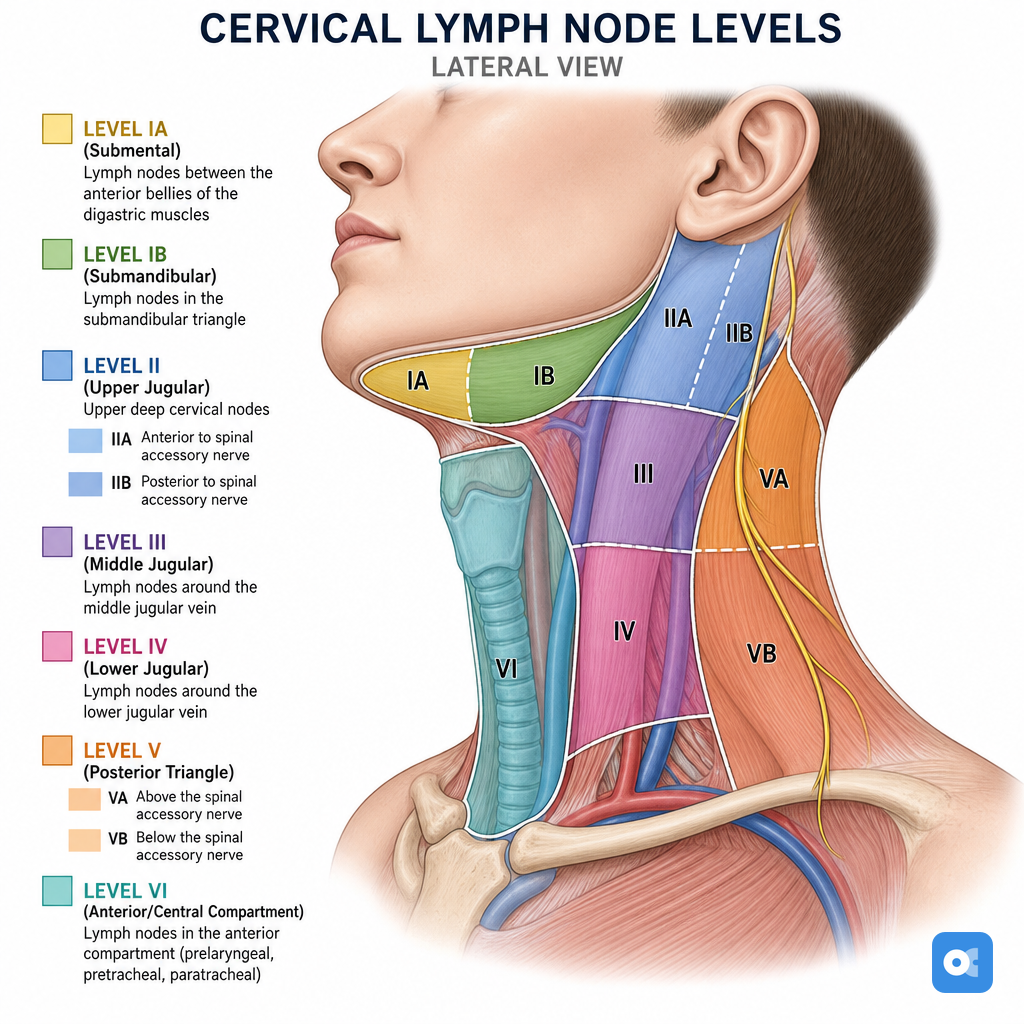
Head and Neck Cancer Indian Medical PG Question 9: Supraomohyoid dissection is a type of?
- A. Selective neck dissection (Correct Answer)
- B. Modified radical neck dissection
- C. Radical neck dissection
- D. Posterolateral dissection
Head and Neck Cancer Explanation: ***Selective neck dissection***
- **Supraomohyoid dissection** specifically refers to a type of selective neck dissection, characterized by the removal of lymph node levels **I, II, and III**.
- This procedure is commonly performed for early-stage oral cavity cancers due to their typical lymphatic spread patterns.
*Modified radical neck dissection*
- This dissection preserves one or more **non-lymphatic structures** (e.g., sternocleidomastoid muscle, internal jugular vein, spinal accessory nerve) that are typically removed in a radical neck dissection.
- It involves a broader range of lymph node levels (typically **I-V**) compared to a supraomohyoid dissection.
*Radical neck dissection*
- This is a more extensive procedure involving the removal of all lymph node groups (levels **I-V**), along with the **sternocleidomastoid muscle**, **internal jugular vein**, and **spinal accessory nerve**.
- It is reserved for advanced neck disease due to its significant morbidity.
*Posterolateral dissection*
- **Posterolateral neck dissection** is a term not commonly used within the standard classification of neck dissections (radical, modified radical, selective).
- Lymphatic dissection is typically categorized based on anatomical levels rather than a general directional term like posterolateral.
Head and Neck Cancer Indian Medical PG Question 10: Second primary tumor of head and neck is most commonly seen in malignancy of:
- A. Paranasal sinuses
- B. Hypopharynx
- C. Larynx
- D. Oral cavity (Correct Answer)
Head and Neck Cancer Explanation: ***Oral cavity***
- Patients with **oral cavity squamous cell carcinoma** (OCSCC) have the highest incidence of developing **second primary tumors** (SPTs) in the head and neck region, often due to shared risk factors like tobacco and alcohol use.
- The concept of "**field cancerization**" explains this phenomenon, where prolonged exposure to carcinogens leads to widespread genetic alterations in the mucosal lining, predisposing multiple sites to develop independent primary cancers.
*Paranasal sinuses*
- While paranasal sinus cancers can be aggressive, they are less commonly associated with the development of **second primary tumors** within the head and neck compared to oral cavity cancers.
- The etiology of paranasal sinus cancers is often linked to specific exposures like wood dust or nickel, which are less broadly distributed across the upper aerodigestive tract compared to tobacco and alcohol.
*Hypopharynx*
- Hypopharyngeal cancers do carry a significant risk of developing **second primary tumors**, particularly in the esophagus and lungs, but the overall incidence of head and neck SPTs is generally considered lower than that for oral cavity cancers.
- The anatomical location and typical lymphatic drainage patterns of hypopharyngeal cancers might direct SPTs to different sites compared to oral cavity cancers.
*Larynx*
- Laryngeal cancers, especially those of the **glottis**, are also strongly associated with tobacco and alcohol. However, the incidence of **second primary tumors** in other head and neck sites is typically reported to be lower than in oral cavity cancer patients.
- While laryngeal cancer patients are at risk for SPTs in the lung and esophagus, the synchronous or metachronous development of another primary tumor *within* the head and neck region is more prevalent in oral cavity cases.
More Head and Neck Cancer Indian Medical PG questions available in the OnCourse app. Practice MCQs, flashcards, and get detailed explanations.