Colorectal Anatomy and Physiology Indian Medical PG Practice Questions and MCQs
Practice Indian Medical PG questions for Colorectal Anatomy and Physiology. These multiple choice questions (MCQs) cover important concepts and help you prepare for your exams.
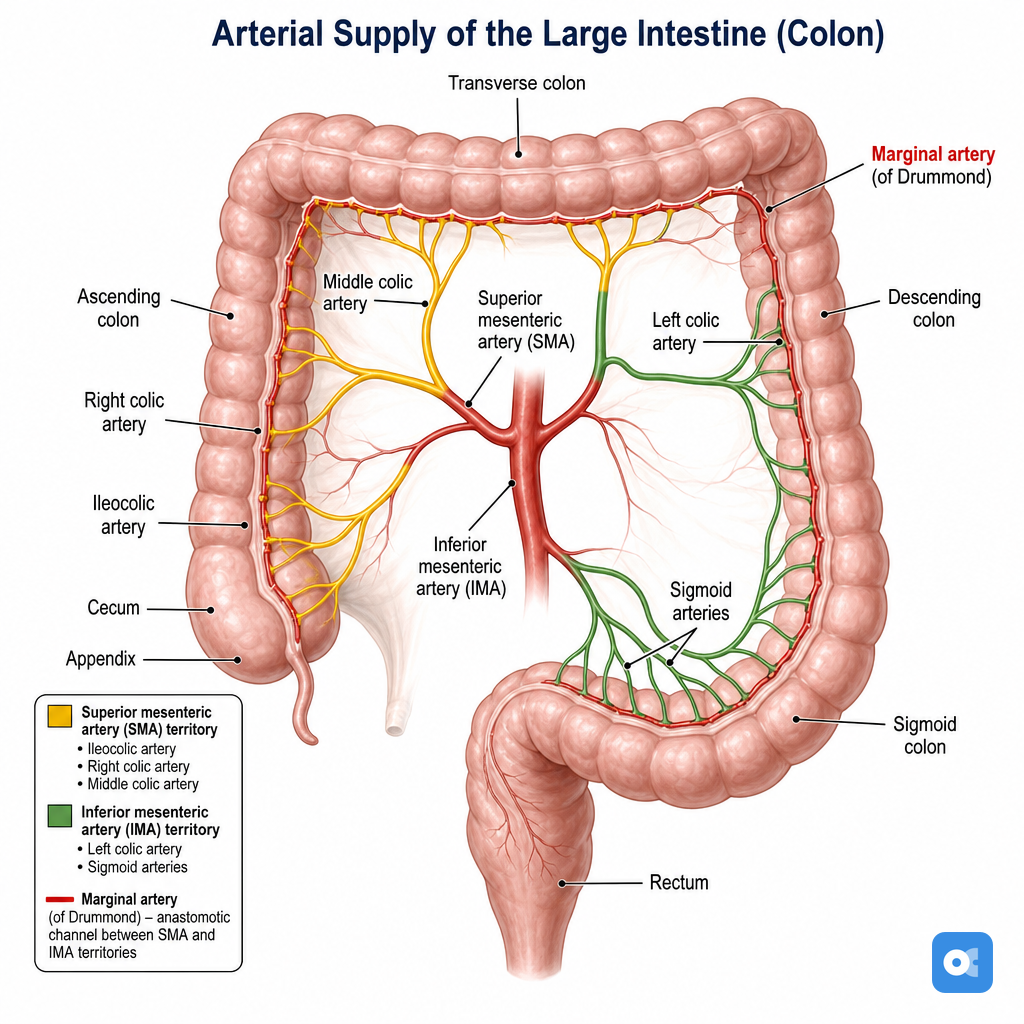
Colorectal Anatomy and Physiology Indian Medical PG Question 1: Which of the following is not a branch of the inferior mesenteric artery?
- A. Left colic
- B. Middle rectal (Correct Answer)
- C. Superior rectal
- D. Sigmoidal artery
Colorectal Anatomy and Physiology Explanation: ***Middle rectal artery***
- The **middle rectal artery** [2] is typically a branch of the **internal iliac artery** [2], supplying the middle part of the rectum.
- It is not a direct branch of the inferior mesenteric artery.
*Left colic artery*
- The left colic artery is a direct branch of the **inferior mesenteric artery** [1], supplying the distal transverse colon and descending colon.
- It forms an important anastomosis with the middle colic artery [1].
*Superior rectal artery*
- The **superior rectal artery** is the terminal branch of the **inferior mesenteric artery**, supplying the upper rectum.
- This artery provides the primary arterial supply to the proximal large intestine structures.
*Sigmoidal artery*
- The **sigmoidal arteries** are typically 2-4 branches arising from the **inferior mesenteric artery**, supplying the sigmoid colon.
- These arteries anastomose with branches of the superior rectal and left colic arteries.
Colorectal Anatomy and Physiology Indian Medical PG Question 2: During incision and drainage of ischiorectal abscess, which nerve is most likely to be injured?
- A. Superior rectal nerve
- B. Inferior rectal nerve (Correct Answer)
- C. Superior gluteal nerve
- D. Inferior gluteal nerve
Colorectal Anatomy and Physiology Explanation: ***Inferior rectal nerve***
- The **inferior rectal nerve** innervates the **external anal sphincter** and the skin around the anus, making it vulnerable during an incision and drainage of an **ischiorectal abscess** due to its anatomical proximity.
- Injury to this nerve can lead to **fecal incontinence** or altered sensation in the perianal region.
*Superior rectal nerve*
- The **superior rectal nerve** is primarily involved in the innervation of the **rectum** and is not directly located in the area of an **ischiorectal abscess**.
- This nerve supplies the smooth muscle of the rectum and is not anatomically vulnerable during incision and drainage of an abscess in the ischiorectal fossa.
*Superior gluteal nerve*
- The **superior gluteal nerve** supplies the **gluteus medius**, **gluteus minimus**, and **tensor fasciae latae muscles**, which are typically located much more superior and lateral to an **ischiorectal abscess**.
- Damage to this nerve causes a characteristic **Trendelenburg gait**, which is unrelated to perianal surgery.
*Inferior gluteal nerve*
- The **inferior gluteal nerve** innervates the **gluteus maximus muscle**, which is also located more superiorly and laterally relative to the **ischiorectal fossa**.
- Injury to this nerve would primarily affect hip extension and is not a common complication of **ischiorectal abscess** drainage.
Colorectal Anatomy and Physiology Indian Medical PG Question 3: Episotomy extended posteriorly beyond perineal body injuring structure posterior to it, which structure is injured?
- A. Urethral sphincter
- B. Ischiocavernosus
- C. External anal sphincter (Correct Answer)
- D. Bulbospongiosus
Colorectal Anatomy and Physiology Explanation: ***External anal sphincter***
- An episiotomy extending posteriorly beyond the **perineal body** (the central tendon of the perineum) is likely to involve the **external anal sphincter (EAS)**, which lies immediately posterior to the perineal body.
- Injury to the EAS can lead to **fecal incontinence** due to its role in voluntary control of defecation.
*Urethral sphincter*
- The **urethral sphincter** is located anterior to the vaginal introitus and is not typically affected by a posterior extension of an episiotomy.
- Damage to the urethral sphincter would lead to **urinary incontinence**, not directly related to posterior perineal injury.
*Ischiocavernosus*
- The **ischiocavernosus muscle** covers the crus of the clitoris (or penis in males) and is located more laterally and anteriorly in the perineum.
- Its primary role is in **clitoral (or penile) erection**, and it is generally not injured by an episiotomy, especially one extending posteriorly.
*Bulbospongiosus*
- The **bulbospongiosus muscle** surrounds the vaginal opening and bulb of the vestibule, lying superficial to the perineal membrane.
- While an episiotomy cuts through this muscle, a posterior extension *beyond* the perineal body would primarily involve structures further back, such as the **external anal sphincter**, not just the bulbospongiosus.
Colorectal Anatomy and Physiology Indian Medical PG Question 4: The following statements concerning the abdominal part of the sympathetic trunk are not true EXCEPT:
- A. All the ganglia receive white rami communicantes
- B. It enters the abdomen behind the lateral arcuate ligament
- C. The trunk passes in 6 segmentally arranged ganglia
- D. Gray rami communicantes are given off to the lumbar spinal nerves (Correct Answer)
Colorectal Anatomy and Physiology Explanation: ***Gray rami communicantes are given off to the lumbar spinal nerves***
- All **sympathetic ganglia**, including those in the abdominal sympathetic trunk, give off **gray rami communicantes** to their corresponding spinal nerves.
- These gray rami carry **postganglionic sympathetic fibers** to the spinal nerves for distribution to peripheral structures such as blood vessels, sweat glands, and piloerector muscles.
*All the ganglia receive white rami communicantes*
- **White rami communicantes** carry **preganglionic sympathetic fibers** from the spinal cord to the sympathetic trunk.
- These are typically only found at the **thoracolumbar levels** (T1-L2), corresponding to the origin of the sympathetic outflow, meaning not all abdominal ganglia receive them.
*It enters the abdomen behind the lateral arcuate ligament*
- The sympathetic trunk enters the abdomen by passing **behind the medial arcuate ligament** (or crus of the diaphragm), not the lateral arcuate ligament.
- The **lateral arcuate ligament** typically bridges over the quadratus lumborum muscle.
*The trunk passes in 6 segmentally arranged ganglia*
- The abdominal part of the sympathetic trunk usually consists of **4 lumbar ganglia**, rather than 6.
- These ganglia are segmentally arranged in relation to the lumbar vertebrae.
Colorectal Anatomy and Physiology Indian Medical PG Question 5: Which of the following is the terminal group of lymph nodes for the colon?
- A. Paracolic
- B. Epicolic
- C. Preaortic (Correct Answer)
- D. Ileocolic
Colorectal Anatomy and Physiology Explanation: ***Preaortic***
- Lymph from the **colon** eventually drains into the preaortic lymph nodes, which are the **terminal group** for the lymphatic drainage of the large intestine. [1]
- These nodes are located along the **aorta** and receive lymphatic flow from various regional lymph node groups of the colon.
*Paracolic*
- **Paracolic lymph nodes** are located along the mesenteric border of the colon, adjacent to the bowel wall.
- They are considered a **regional group** that drains directly from the colon, but they are not the terminal group.
*Epicolic*
- **Epicolic lymph nodes** are the lymph nodes located on the **surface or within the wall of the colon**.
- They represent the **first echelon** of lymphatic drainage but are not the terminal group.
*Ileocolic*
- **Ileocolic lymph nodes** are specific to the region around the **ileocecal junction**.
- While they drain part of the colon (ascending colon and cecum), they are a **regional group** and not the ultimate terminal lymphatic drainage for the entire colon.
Colorectal Anatomy and Physiology Indian Medical PG Question 6: Which of the following is least important in the maintenance of normal fecal continence?
- A. Anorectal angulation
- B. Rectal innervation
- C. Internal sphincter
- D. Haustral valve (Correct Answer)
Colorectal Anatomy and Physiology Explanation: **Haustral valve**
- The **haustral valve** (or redundant mucosal folds within the haustra) primarily functions to *increase surface area* for water absorption and slow the passage of contents through the colon.
- While critical for digestive function, it plays a *negligible direct role* in the mechanisms preventing involuntary stool leakage.
*Anorectal angulation*
- The **anorectal angle**, formed by the pull of the **puborectalis muscle**, creates a sharp bend that acts as a flap valve, significantly contributing to continence.
- Loss of this angle (e.g., due to injury or structural changes) substantially impairs continence.
*Rectal innervation*
- **Intact innervation** of the rectum provides crucial sensory feedback regarding rectal distension and stool consistency, allowing for conscious control of defecation.
- It also mediates the **rectoanal inhibitory reflex** and the ability to voluntarily contract external anal sphincters, both vital for continence.
*Internal sphincter*
- The **internal anal sphincter** is an *involuntary smooth muscle* responsible for approximately 70-80% of the resting anal tone, providing continuous passive continence.
- Damage to this sphincter leads to substantial impairment in continence, particularly against flatus and liquid stool.
Colorectal Anatomy and Physiology Indian Medical PG Question 7: A patient presents with abdominal distension. Based on the X-ray, which of the following bowel loops are dilated?
- A. Jejunum (Correct Answer)
- B. Duodenum
- C. Transverse colon
- D. Ileum
Colorectal Anatomy and Physiology Explanation: ***Jejunum***
- The image shows dilated small bowel loops with prominent **valvulae conniventes** (also known as plicae circulares), which are characteristic of the jejunum.
- These folds are typically closely spaced and extend across the entire lumen, giving a "coiled spring" or "stack of coins" appearance on plain radiographs when dilated.
*Duodenum*
- While the duodenum is part of the small bowel, it is the most proximal segment and typically not as diffusely involved in generalized small bowel dilation as the jejunum and ileum unless the obstruction is very high.
- The valvulae conniventes in the duodenum are less prominent and more sparsely distributed compared to the jejunum.
*Transverse colon*
- The transverse colon is part of the large intestine and would show **haustra**, which are sacculations that do not extend across the entire lumen and are typically more widely spaced than valvulae conniventes.
- The dilated loops in the image clearly show mucosal folds that span the entire width of the bowel.
*Ileum*
- The ileum also has valvulae conniventes, but they are less prominent and more sparsely distributed than in the jejunum.
- In cases of small bowel obstruction or dilation, the jejunum characteristically shows more distinct and closely packed valvulae conniventes, making it the most identifiable segment in this image.
Colorectal Anatomy and Physiology Indian Medical PG Question 8: External hemorrhoids are innervated by:
- A. Lumbar Nerves
- B. Pudendal Nerve (Correct Answer)
- C. Obturator Nerve
- D. Gluteal Nerves
Colorectal Anatomy and Physiology Explanation: ***Pudendal Nerve***
- **External hemorrhoids** develop below the **dentate line** in the anal canal, a region supplied by somatic innervation.
- The **inferior rectal nerve**, a branch of the pudendal nerve, provides sensory and motor innervation to the external anal sphincter and the perianal skin, including external hemorrhoids, making them sensitive to pain.
*Lumbar Nerves*
- The **lumbar plexus** primarily innervates the lower limbs and parts of the abdominal wall.
- They do not directly supply the anal canal or perianal region.
*Obturator Nerve*
- The **obturator nerve** originates from the lumbar plexus and primarily innervates the **adductor muscles of the thigh** and sensory input from the medial thigh.
- It has no role in the innervation of the anal canal.
*Gluteal Nerves*
- The **superior and inferior gluteal nerves** are responsible for innervating the **gluteal muscles** (buttocks).
- They do not contribute to the innervation of the perianal region or hemorrhoids.
Colorectal Anatomy and Physiology Indian Medical PG Question 9: Which artery supplies the ductus deferens?
- A. Deferential artery (Correct Answer)
- B. Cremasteric artery
- C. Inferior epigastric artery
- D. Vesical artery
Colorectal Anatomy and Physiology Explanation: ***Deferential artery***
- The **deferential artery** is the primary blood supply to the **ductus deferens**. It typically originates from the **superior or inferior vesical artery**.
- This artery runs alongside the ductus deferens within the **spermatic cord**, providing arterial branches throughout its length.
*Cremasteric artery*
- The **cremasteric artery** primarily supplies the **cremaster muscle** and the fascial coverings of the spermatic cord [1].
- While it traverses the spermatic cord, it does not directly supply the ductus deferens itself.
*Inferior epigastric artery*
- The **inferior epigastric artery** supplies the **anterior abdominal wall muscles** and skin [1].
- It does not directly supply the ductus deferens but gives rise to the **cremasteric artery** as one of its branches [1].
*Vesical artery*
- The **vesical arteries** (superior and inferior) primarily supply the **urinary bladder**.
- While the deferential artery often originates from a vesical artery, "vesical artery" itself is not the direct and specific supply to the ductus deferens.
Colorectal Anatomy and Physiology Indian Medical PG Question 10: A patient with a non-obstructing carcinoma of the sigmoid colon is being prepared for elective resection. To minimize the risk of postoperative infectious complications, what should be included in your planning?
- A. Postoperative administration for 5 to 7 days of parenteral antibiotics effective against aerobes and anaerobes
- B. A single preoperative parenteral dose of antibiotic effective against aerobes and anaerobes may provide initial coverage. (Correct Answer)
- C. Postoperative administration for 2 to 4 days of parenteral antibiotics effective against aerobes and anaerobes
- D. Avoidance of oral antibiotics to prevent emergence of Clostridioides difficile
Colorectal Anatomy and Physiology Explanation: ***Single preoperative parenteral dose of antibiotic effective against aerobes and anaerobes***
- For **elective colorectal surgery**, a single dose of a **broad-spectrum parenteral antibiotic** administered within 60 minutes prior to incision is the standard of care to reduce surgical site infections.
- This approach ensures adequate drug levels in the tissues during the period of potential bacterial contamination and is a cornerstone of modern surgical prophylaxis.
- Current guidelines (WHO, SCIP) recommend a single preoperative dose, which may be redosed intraoperatively if the procedure is prolonged beyond 3-4 hours.
*Avoidance of oral antibiotics to prevent emergence of Clostridioides difficile*
- This is **incorrect**. **Oral antibiotics** (such as neomycin and metronidazole) are routinely used preoperatively in conjunction with mechanical bowel preparation for colorectal surgery to reduce intraluminal bacterial load.
- The concern for *Clostridioides difficile* infection is generally low with short-term, targeted prophylactic antibiotic regimens compared to broad-spectrum, prolonged use.
- The combination of oral and parenteral antibiotics has been shown to further reduce surgical site infections.
*Postoperative administration for 5 to 7 days of parenteral antibiotics*
- **Prolonged postoperative antibiotic administration** beyond 24 hours in uncomplicated cases is not recommended as it increases the risk of **antibiotic resistance**, *C. difficile* infection, and adverse drug reactions without additional benefit.
- The goal of prophylactic antibiotics is to cover the period of contamination during surgery, not to treat presumed ongoing infection postoperatively.
*Postoperative administration for 2 to 4 days of parenteral antibiotics*
- While administration for up to 24 hours post-operatively may be considered in some high-risk cases, routine **prolonged postoperative antibiotics** (2-4 days) are unnecessary for most elective colorectal resections.
- Evidence suggests that continuing antibiotics beyond the immediate perioperative period does not further reduce the incidence of **surgical site infections** in clean-contaminated surgeries.
More Colorectal Anatomy and Physiology Indian Medical PG questions available in the OnCourse app. Practice MCQs, flashcards, and get detailed explanations.