Diffusion and Perfusion Imaging Indian Medical PG Practice Questions and MCQs
Practice Indian Medical PG questions for Diffusion and Perfusion Imaging. These multiple choice questions (MCQs) cover important concepts and help you prepare for your exams.
Diffusion and Perfusion Imaging Indian Medical PG Question 1: Which of the following is not a differential diagnosis of non-accidental injury?
- A. Osteogenesis imperfecta
- B. Scurvy
- C. Caffey's disease
- D. Osteopetrosis (Correct Answer)
Diffusion and Perfusion Imaging Explanation: ***Correct: Osteopetrosis***
- Osteopetrosis is a rare genetic disorder characterized by **increased bone density** due to defective osteoclast function
- While it causes bones to be brittle and prone to fracture, it has **distinctive radiological features** including diffuse sclerosis and "bone-within-bone" appearance
- The **increased bone density on X-ray** is pathognomonic and readily distinguishes it from NAI, making it **less likely to be confused** with non-accidental injury in clinical practice
- Fractures occur but the radiological pattern is diagnostic of the underlying metabolic bone disease
*Incorrect: Osteogenesis imperfecta*
- This is a **classic differential** for NAI causing **multiple brittle bone fractures** that can be mistaken for abuse
- Features include **blue sclera**, **dentinogenesis imperfecta**, **wormian bones**, and **family history**
- Often presents with multiple fractures at different stages of healing, mimicking the pattern seen in NAI
*Incorrect: Scurvy*
- Caused by **vitamin C deficiency**, leads to defective collagen synthesis
- Results in **subperiosteal hemorrhages**, **metaphyseal fractures**, and **periosteal elevation** that closely mimic NAI
- Additional features include **gingival bleeding**, **petechiae**, **follicular hyperkeratosis**, and **poor wound healing**
*Incorrect: Caffey's disease*
- Also known as **infantile cortical hyperostosis**, presents in infants under 6 months
- Causes **periosteal reactions**, **bone thickening**, and **soft tissue swelling** in long bones, ribs, and mandible
- The periosteal new bone formation can be mistaken for healing fractures from NAI, making it an important differential
Diffusion and Perfusion Imaging Indian Medical PG Question 2: Which of the following appears the same on both T1 and T2 weighted MRI sequences?
- A. Gall bladder
- B. Fat (Correct Answer)
- C. Kidney
- D. CSF
Diffusion and Perfusion Imaging Explanation: ***Fat***
- On both T1 and T2 weighted MRI sequences, fat appears **bright** (high signal intensity).
- This consistent bright signal makes fat a useful internal reference point for signal interpretation.
*Gall bladder*
- The gall bladder is filled with **bile**, which appears bright on T2-weighted images due to its high water content, but can be variable on T1.
- Bile does not maintain consistently the **same signal intensity** as fat on both sequences.
*Kidney*
- The renal parenchyma typically has **intermediate signal intensity** on both T1 and T2, but its signal characteristics are different from the consistently bright signal of fat.
- The signal can vary depending on the specific sequence parameters and hydration status, unlike fat.
*CSF*
- **Cerebrospinal fluid (CSF)** appears dark (low signal) on T1-weighted images and bright (high signal) on T2-weighted images due to its high water content.
- This distinct signal intensity difference between T1 and T2 is contrary to the shared bright appearance of fat on both sequences.
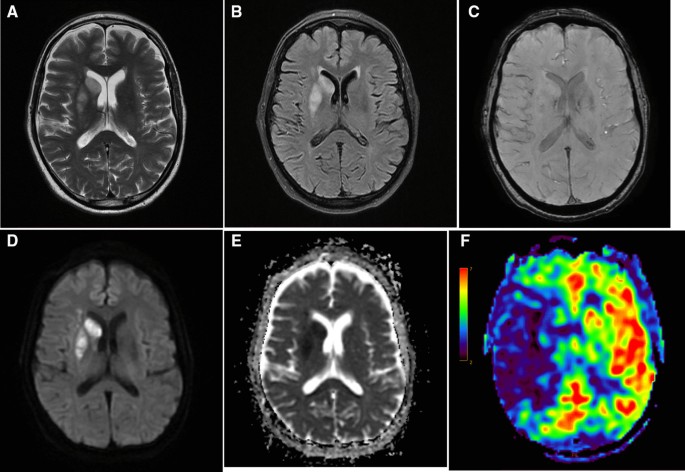
Diffusion and Perfusion Imaging Indian Medical PG Question 3: A 65-year-old male presents with acute onset of right-sided weakness and facial droop. CT shows no hemorrhage, but MRI with DWI reveals hyperintense lesions in the left MCA territory. What is the next best step?
- A. Cerebral angiography
- B. Anticoagulation
- C. IV thrombolysis (Correct Answer)
- D. CT perfusion
Diffusion and Perfusion Imaging Explanation: ***IV thrombolysis***
- The patient presents with **acute onset symptoms** consistent with an **ischemic stroke** (right-sided weakness, facial droop). [1]
- The **CT scan ruling out hemorrhage** and **MRI with DWI** showing hyperintense lesions in the left MCA territory confirm an acute ischemic stroke, making the patient a candidate for **thrombolytic therapy** if within the therapeutic window. [1]
*Cerebral angiography*
- While it can identify vascular lesions, it is an **invasive procedure** and not the immediate next best step for acute stroke management. [1]
- It's typically reserved for cases where **endovascular thrombectomy** is considered after IV thrombolysis has been evaluated or is contraindicated.
*Anticoagulation*
- **Anticoagulation** is generally used for **secondary stroke prevention**, especially in cases of cardioembolic stroke (e.g., atrial fibrillation), and is not the immediate treatment for acute ischemic stroke.
- Initiating anticoagulation acutely without first attempting thrombolysis or thrombectomy can **delay definitive reperfusion therapy**.
*CT perfusion*
- **CT perfusion** provides information about the **ischemic penumbra** and can help guide decisions regarding thrombectomy, especially in extended time windows.
- However, in cases of clear acute ischemic stroke confirmed by DWI with no hemorrhage, **IV thrombolysis** is the priority within the therapeutic window, and CT perfusion is not mandatory for this initial decision.
Diffusion and Perfusion Imaging Indian Medical PG Question 4: False regarding Alzheimer's disease (AD) is:
- A. Number of neurofibrillary tangles is associated with the severity of dementia
- B. Number of senile (neuritic) plaques correlates (increases) with age
- C. Presence of tau protein suggest neurodegeneration
- D. Extracellular inclusion (lesion) can occur in the absence of intracellular inclusions to make pathological diagnosis of AD (Correct Answer)
Diffusion and Perfusion Imaging Explanation: ***Extracellular inclusion (lesion) can occur in the absence of intracellular inclusions to make pathological diagnosis of AD***
- A definitive pathological diagnosis of **Alzheimer's disease** requires both the presence of **extracellular amyloid plaques** and **intracellular neurofibrillary tangles** [1].
- Neither inclusion type alone is sufficient for the diagnosis, as amyloid plaques can be found in non-demented elderly individuals [1].
*Number of neurofibrillary tangles is associated with the severity of dementia*
- The **density and distribution of neurofibrillary tangles** (NFTs) directly correlate with the severity of cognitive impairment and **dementia** in AD [1].
- Tangles are composed of hyperphosphorylated **tau protein** and disrupt neuronal function, leading to neurodegeneration [2].
*Number of senile (neuritic) plaques correlates (increases) with age*
- The accumulation of **senile (neuritic) plaques**, composed primarily of **beta-amyloid protein**, generally increases with age, even in cognitively normal individuals [1].
- While plaques are a hallmark of AD, their mere presence is not always diagnostic of clinical dementia [1].
*Presence of tau protein suggest neurodegeneration*
- The presence of **hyperphosphorylated tau protein**, especially when forming **neurofibrillary tangles**, is a strong indicator of **neurodegeneration** [2].
- **Tauopathy** is a key pathological feature in AD and other neurodegenerative diseases [1].
**References:**
[1] Kumar V, Abbas AK, et al.. Robbins and Cotran Pathologic Basis of Disease. 9th ed. The Central Nervous System, pp. 1292-1294.
[2] Cross SS. Underwood's Pathology: A Clinical Approach. 6th ed. Common Clinical Manifestations Of Central And Peripheral Nervous System Disease, pp. 721-722.
Diffusion and Perfusion Imaging Indian Medical PG Question 5: In Spot Map, what do dots of different colors typically represent?
- A. Different diseases (Correct Answer)
- B. Different age groups
- C. Different time periods
- D. Different outcomes
Diffusion and Perfusion Imaging Explanation: ***Different diseases***
- In a **spot map**, the use of **different colors for dots** is a common visualization technique to differentiate between various categories or types of data
- When applied to public health or epidemiology, these distinct colors frequently represent different diseases or health conditions, allowing for easy visual comparison of their geographical distribution.
*Different age groups*
- While age groups can be represented on a map, it is usually done using **different symbols**, sizes of dots, or by creating separate maps for each age group, not typically by just different dot colors within the same map for distinct diseases.
- Using color for age groups could lead to confusion when multiple diseases are being mapped simultaneously.
*Different time periods*
- To show different time periods, maps often use **animation**, a series of maps over time, or sometimes different shades of the same color, but not usually distinct colors for each time period on a single static spot map when the primary differentiation is disease type.
- Superimposing different time periods with different colors on a single map would make it difficult to discern disease distribution.
*Different outcomes*
- Different outcomes might be represented by **varying dot sizes**, shading, or specific symbols to indicate severity or type of outcome, rather than just different colors that are primarily used to distinguish between different diseases themselves.
- While outcomes could be layered, the fundamental role of distinct dot colors on a spot map is often to categorize the core subject being mapped, such as different types of diseases.
Diffusion and Perfusion Imaging Indian Medical PG Question 6: A polytrauma patient's CT brain shows a crescent-shaped extra-axial collection with a concave inner margin. What is the most likely diagnosis?
- A. EDH
- B. SDH (Correct Answer)
- C. Contusion
- D. Diffuse axonal injury
Diffusion and Perfusion Imaging Explanation: ***SDH***
- The image shows a **crescent-shaped collection** of hemorrhage with a concave inner margin, consistent with a **subdural hematoma** (SDH).
- SDHs result from the tearing of **bridging veins** and typically conform to the brain's surface, crossing suture lines but not limited by bony sutures.
*EDH*
- An **epidural hematoma (EDH)** characteristically appears as a **lenticular** or **biconvex** shape on CT, not crescent-shaped.
- EDHs are typically caused by arterial bleeding, often from the **middle meningeal artery**, and are limited by cranial sutures.
*Contusion*
- A **contusion** is brain tissue bruising that appears as **heterogeneous areas** of hemorrhage and edema within the brain parenchyma itself.
- It would not manifest as a distinct extra-axial collection with a smooth, concave margin.
*Diffuse axonal injury*
- **Diffuse axonal injury (DAI)** involves widespread microscopic damage to axons, often at the gray-white matter junction.
- It may appear as *punctate hemorrhages* or **small lesions** at these junctions on CT, but often the CT can be normal, and it would not present as a large extra-axial collection.
Diffusion and Perfusion Imaging Indian Medical PG Question 7: MUGA scan is not useful in:
- A. Stroke volume
- B. Regional wall perfusion (Correct Answer)
- C. Left ventricular ejection fraction
- D. Regional wall motion
Diffusion and Perfusion Imaging Explanation: ***Regional wall perfusion***
- A MUGA scan assesses **ventricular function** through blood pool imaging, evaluating wall motion and ejection fraction.
- It does not directly visualize or quantify myocardial perfusion, which is the flow of blood through the coronary arteries to the heart muscle.
*Stroke volume*
- A MUGA scan accurately measures **end-diastolic volume** and **end-systolic volume**, from which stroke volume (EDV – ESV) can be calculated.
- This parameter directly reflects the amount of blood pumped out by the ventricle with each beat.
*Left ventricular ejection fraction*
- The MUGA scan is considered a gold standard for calculating **left ventricular ejection fraction** (LVEF), a key indicator of cardiac pump function.
- It uses a count-based method from gated blood pool images to determine the percentage of blood ejected from the left ventricle.
*Regional wall motion*
- MUGA scans are highly effective in assessing **regional wall motion abnormalities**, identifying areas of **hypokinesis**, **akinesis**, or **dyskinesis**.
- This is crucial for diagnosing and monitoring conditions like myocardial ischemia or infarction, and is a primary utility of the scan.
Diffusion and Perfusion Imaging Indian Medical PG Question 8: In a child, non-functioning kidney is best diagnosed by:
- A. Ultrasonography
- B. IVU
- C. Creatinine clearance
- D. DTPA renogram (Correct Answer)
Diffusion and Perfusion Imaging Explanation: ***DTPA renogram***
- A **DTPA (diethylenetriamine pentaacetic acid) renogram** is a nuclear medicine study that assesses **renal blood flow**, **glomerular filtration**, and urinary drainage. It directly measures the function of each kidney by quantifying tracer uptake and excretion, making it ideal for diagnosing a non-functioning kidney in a child.
- The test provides information on the **relative function** of each kidney and outflow obstruction, which is crucial for determining if a kidney is truly non-functioning rather than just poorly visualized.
*Ultrasonography*
- While ultrasound can visualize the **anatomy** of the kidney (size, shape, presence of hydronephrosis), it does not directly assess renal function.
- It may show a small, atrophic, or poorly developed kidney, but cannot definitively determine if it is non-functioning without functional studies.
*IVU (Intravenous Urogram)*
- An **IVU** relies on the kidneys' ability to excrete contrast material, which is visualized by X-ray. If a kidney is non-functioning, it will not excrete the contrast, leading to non-visualization.
- However, IVU exposes the child to **radiation** and **iodinated contrast**, and newer, safer, and more precise functional studies like renograms are preferred, especially in pediatric cases where radiation exposure should be minimized.
*Creatinine clearance*
- **Creatinine clearance** is a measure of overall **glomerular filtration rate (GFR)** for both kidneys combined.
- It does not provide information on the individual function of each kidney, so it cannot diagnose a non-functioning unilateral kidney.
Diffusion and Perfusion Imaging Indian Medical PG Question 9: A 48-year-old woman presents with suspected myocardial ischemia. Pharmacologic stress myocardial perfusion SPECT with Tc-99m sestamibi shows reversible perfusion defect in the inferior wall. Evaluate the optimal management approach based on this functional imaging finding.
- A. Reassure patient as findings represent artifact
- B. Start medical management without further investigation
- C. Recommend coronary angiography for further evaluation and potential revascularization (Correct Answer)
- D. Proceed directly to coronary artery bypass grafting
Diffusion and Perfusion Imaging Explanation: ***Recommend coronary angiography for further evaluation and potential revascularization***
- A **reversible perfusion defect** on SPECT denotes **stress-induced ischemia** with viable myocardium, characterized by reduced tracer uptake during stress that normalizes at rest.
- This finding indicates significant **coronary artery stenosis** (often >70%) and requires **coronary angiography** to define the anatomy and plan possible **percutaneous coronary intervention (PCI)**.
*Reassure patient as findings represent artifact*
- While **diaphragmatic attenuation** can cause inferior wall artifacts, a truly **reversible defect** (normal rest scan) is diagnostic of ischemia rather than a permanent artifact.
- Attenuation artifacts typically present as **fixed defects** or are clarified using **ECG-gated SPECT** to check for normal wall motion.
*Start medical management without further investigation*
- Although medical therapy is a pillar of CAD treatment, a documented **reversible defect** in a symptomatic patient warrants anatomical assessment to evaluate the risk of **major adverse cardiovascular events (MACE)**.
- Management solely with drugs is insufficient for patients with high-risk ischemia patterns on **functional imaging** who may benefit from revascularization.
*Proceed directly to coronary artery bypass grafting*
- **Coronary artery bypass grafting (CABG)** is a surgical intervention that requires prior visualization of coronary anatomy via angiography to determine the extent of disease (e.g., **triple-vessel** or **left main disease**).
- It is premature to provide surgical referral before confirming the **syntax score** or the suitability of the lesions for less invasive procedures like **angioplasty**.
Diffusion and Perfusion Imaging Indian Medical PG Question 10: A 70-year-old male with recurrent prostate cancer post-prostatectomy has rising PSA (4.2 ng/mL) but negative conventional imaging. Which functional imaging modality would provide the highest detection rate for disease localization in this clinical scenario?
- A. 68Ga-PSMA PET-CT (Correct Answer)
- B. In-111 Capromab pendetide scan
- C. 18F-FDG PET-CT
- D. Tc-99m MDP bone scan
Diffusion and Perfusion Imaging Explanation: ***68Ga-PSMA PET-CT***
- **68Ga-PSMA PET-CT** is currently the gold standard for detecting **biochemical recurrence** of prostate cancer, showing a detection rate of over 90% when PSA levels are >2 ng/mL.
- It targets the **Prostate-Specific Membrane Antigen**, which is significantly overexpressed in prostate cancer cells, allowing for precise localization of both local recurrence and **distant metastases**.
*In-111 Capromab pendetide scan*
- This older imaging modality (ProstaScint) targets an **intracellular epitope** of PSMA, which is less accessible in viable, non-necrotic cells compared to the extracellular targets of modern tracers.
- It has a much lower **sensitivity and specificity** compared to 68Ga-PSMA PET-CT and is rarely used in contemporary clinical practice.
*18F-FDG PET-CT*
- **18F-FDG** is generally not useful for prostate cancer because these tumors are typically slow-growing and have **low glucose metabolism** (low glycolytic rate).
- It is primarily reserved for **aggressive, high-grade**, or neuroendocrine-differentiated prostate cancers that have lost the ability to express PSMA.
*Tc-99m MDP bone scan*
- This is a conventional imaging modality that detects **osteoblastic activity** rather than the cancer cells themselves, often resulting in low sensitivity at low PSA levels.
- It is specifically limited to detecting **bone metastases** and cannot identify soft tissue recurrence or lymph node involvement in the pelvis.
More Diffusion and Perfusion Imaging Indian Medical PG questions available in the OnCourse app. Practice MCQs, flashcards, and get detailed explanations.