

Hypothalamic Centers - Brain's AC Unit
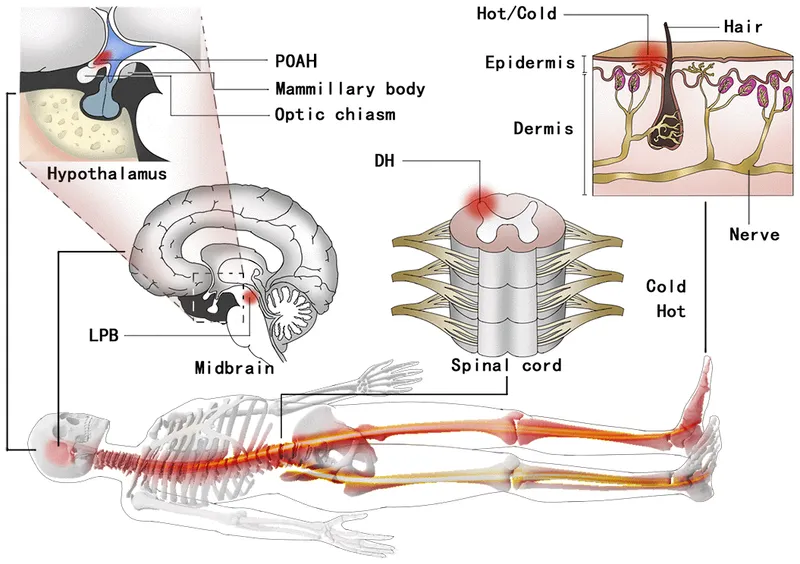
- Anterior Hypothalamus (Preoptic Area - POA):
- "Heat Loss Center" - senses ↑ core body temperature.
- Initiates cooling mechanisms: sweating, vasodilation.
- 📌 Mnemonic: Anterior = Avoids heat.
- Posterior Hypothalamus:
- "Heat Gain Center" - senses ↓ core body temperature.
- Initiates heat production/conservation: shivering, vasoconstriction, thyroxine release.
- Integrates signals from POA & peripheral cold receptors.
⭐ Lesions in the anterior hypothalamus can cause central hyperthermia, while posterior hypothalamic lesions can lead to poikilothermia (inability to regulate body temperature).
Thermosensing - Temp Detectives
- Central Thermoreceptors:
- Mainly in Preoptic Area (POA) & Anterior Hypothalamus (AH).
- Contain warm-sensitive neurons (↑ firing with ↑ temp) & cold-sensitive neurons (↑ firing with ↓ temp).
- Peripheral Thermoreceptors:
- Located in skin, spinal cord, & deep tissues.
- Detect environmental & core temperature changes.
- Signals via Aδ (cold) & C fibers (warm) through spinothalamic tract to hypothalamus.
⭐ POA/AH neurons show a sharp increase in firing rate when brain temperature rises above 37°C.
oka
Response to Cold - Shiver & Shield
- Posterior Hypothalamus: Primary center for cold defense, orchestrates responses.
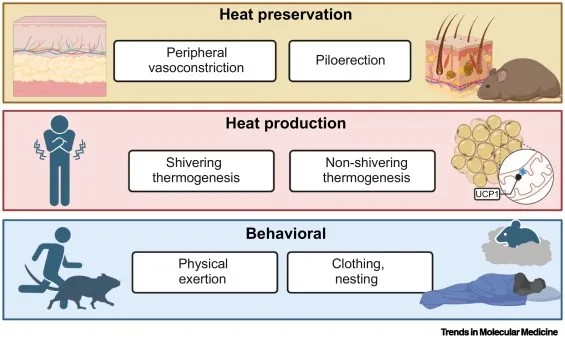
- Heat Conservation ("Shield"):
- Sympathetic drive:
- Peripheral vasoconstriction (α1 receptors) → ↓ skin blood flow → ↓ heat loss.
- Piloerection.
- Behavioral: e.g., seeking warmth, adding clothing.
- Sympathetic drive:
- Heat Production ("Shiver & More"):
- Shivering: Involuntary muscle contractions → ↑ heat.
- Non-Shivering Thermogenesis (NST):
- ↑ Sympathetic activity → ↑ metabolic rate.
- ↑ Thyroxine secretion (TRH→TSH→Thyroxine) → ↑ BMR (slower onset).
- Brown Adipose Tissue (BAT): UCP1 (thermogenin) uncouples oxidative phosphorylation → heat.
⭐ The posterior hypothalamus acts as the primary thermostat initiating responses to cold.
Response to Heat - Sweat & Spread
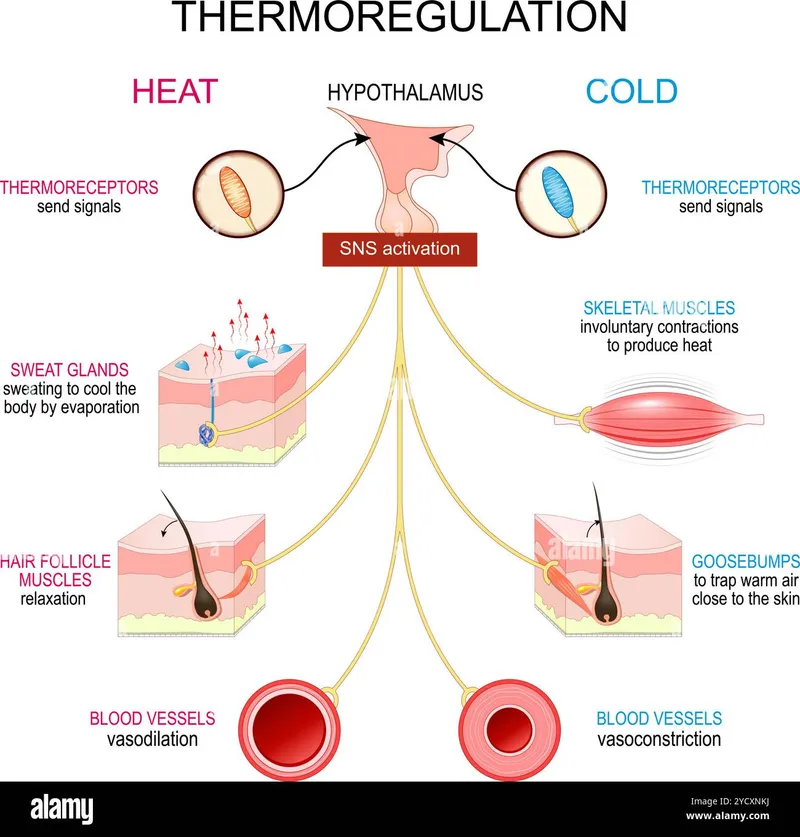
- Stimulus: ↑ Core body temp → anterior hypothalamus (preoptic area).
- Action: Activates heat dissipation.
- Mechanisms:
- Sweating (Evaporation):
- Sympathetic cholinergic stimulation of eccrine glands.
- Crucial if ambient temp > skin temp.
- 📌 Neurotransmitter: Acetylcholine.
- Vasodilation (Radiation/Convection - "Spread"):
- ↓ Sympathetic vasoconstrictor tone to skin vessels.
- ↑ Skin blood flow → ↑ heat loss.
- Behavioral: ↓ activity, seek cool.
- Sweating (Evaporation):
⭐ Unacclimatized individuals lose ~1L sweat/hr; after 4-6 weeks acclimatization, sweat rate can ↑ to 2-3 L/hr with significantly ↓ [NaCl] due to increased aldosterone action on sweat ducts.
Fever Pathogenesis - Pyrogen Party
- Pyrogens: Agents causing fever.
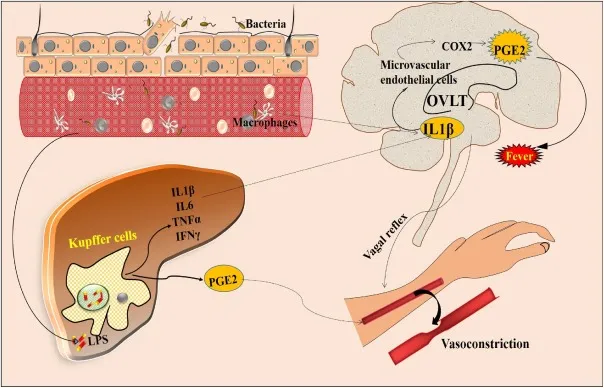
- Exogenous: Microbial products (e.g., Lipopolysaccharide - LPS).
- Endogenous: Cytokines (e.g., IL-1, IL-6, TNF-α) released by host immune cells.
- Mechanism:
- Exogenous pyrogens stimulate immune cells to release endogenous pyrogens.
- Endogenous pyrogens act on Organum Vasculosum of Lamina Terminalis (OVLT) in hypothalamus.
- In OVLT: ↑ Cyclooxygenase-2 (COX-2) activity → ↑ Prostaglandin E2 ($PGE_2$) synthesis.
- $PGE_2$ acts on Preoptic Area (POA) of hypothalamus.
- Result: ↑ Hypothalamic thermoregulatory set-point → Fever (chills, vasoconstriction).
⭐ The elevation of the hypothalamic set-point in fever is primarily mediated by Prostaglandin E2 acting on the preoptic area; this is the target for antipyretics like NSAIDs which inhibit COX enzymes.
High‑Yield Points - ⚡ Biggest Takeaways
- Hypothalamus: Primary thermoregulatory center.
- Anterior hypothalamus (preoptic area): Governs heat loss (sweating, vasodilation). Lesions → hyperthermia.
- Posterior hypothalamus: Manages heat production & conservation (shivering, vasoconstriction). Lesions → poikilothermia.
- Set-point temperature: Maintained around 37°C (98.6°F).
- Fever: Caused by pyrogens (e.g., IL-1, PGE2) elevating the hypothalamic set-point.
- Aspirin: Reduces fever by inhibiting cyclooxygenase (COX) and thus PGE2 synthesis.
- Peripheral and central thermoreceptors provide input to the hypothalamus for feedback control.
Unlock the full lesson and continue reading
Signup to continue reading this lesson and unlimited access questions, flashcards, AI notes, and more
