

Sensory Receptors & Coding - The Body's Detectives
- Receptors: Specialized transducers converting stimuli to electrical signals.
- Types: (📌 Mnemonic: Many Tall Nurses Prefer Coffee)
- Mechanoreceptors (touch, pressure)
- Thermoreceptors (temperature)
- Nociceptors (pain)
- Photoreceptors (light)
- Chemoreceptors (taste, smell, $O_2$, $CO_2$)
- Receptor Potential: Graded, local electrical response; if threshold met → AP.
- Sensory Coding:
- Modality: Labeled Line Principle.
- Intensity: AP frequency & # active receptors. Weber-Fechner Law: $S = K \log R$.
- Duration: Receptor adaptation (phasic/tonic).
- Location: Receptive fields; lateral inhibition (sharpens contrast).
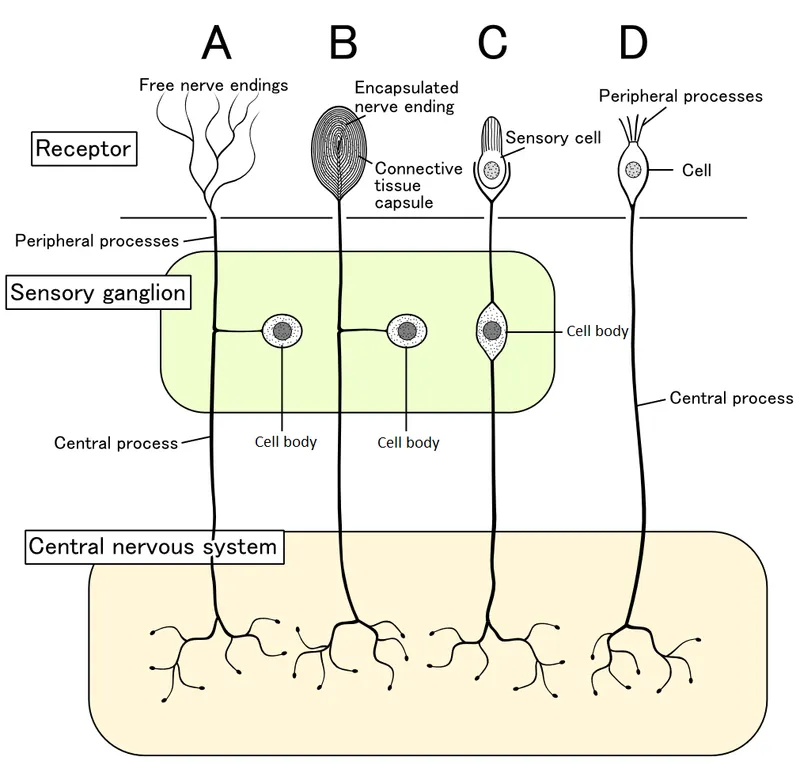
⭐ Muller's Law (Law of Specific Nerve Energies): Sensation depends on pathway activated, not stimulus type.
Somatosensory Pathways - Touch, Pain & Position
- Dorsal Column-Medial Lemniscus (DCML): Fine touch, vibration, proprioception.
- 1° Neuron: Enters SC, ascends ipsilaterally (Fasciculus Gracilis - lower limb; Cuneatus - upper limb). Synapse: N. Gracilis/Cuneatus (Medulla).
- 2° Neuron: Decussates in medulla (internal arcuate fibers) → Medial Lemniscus. Synapse: VPL (Thalamus).
- 3° Neuron: VPL → Primary Somatosensory Cortex.
- Anterolateral System (ALS) / Spinothalamic: Pain, temperature, crude touch.
- 1° Neuron: Synapse in Dorsal Horn (e.g., Substantia Gelatinosa).
- 2° Neuron: Decussates in SC (Anterior White Commissure) → Spinothalamic Tract. Synapse: VPL (Thalamus).
- 3° Neuron: VPL → Primary Somatosensory Cortex.
- Spinocerebellar Tracts: Unconscious proprioception to cerebellum.
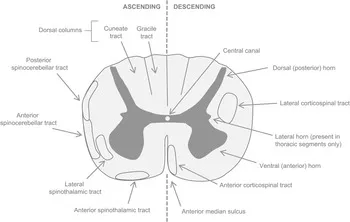
⭐ Brown-Séquard Syndrome: Spinal cord hemisection. Ipsilateral loss of fine touch/proprioception, contralateral loss of pain/temperature below lesion level.
Special Senses I - Vision & Hearing Hits
- Vision
- Photoreceptors: Rods (scotopic, rhodopsin, night vision), Cones (photopic, iodopsin, color, fovea).
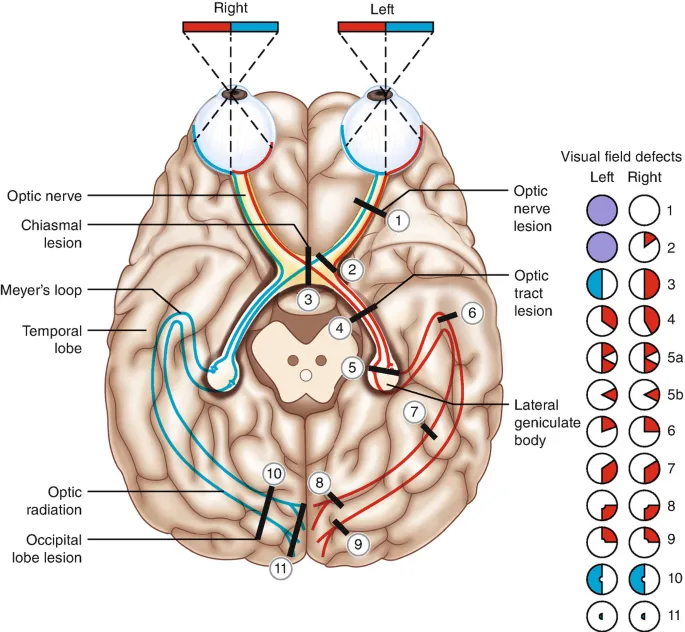
- Pathway: Retina → Optic N. (CN II) → Chiasm (nasal decussation) → Optic Tract → LGN (Thalamus) → Optic Radiation → Visual Cortex (Occipital). 📌 LGN for Light.
*   Pupillary light reflex: Afferent **CN II**, Efferent **CN III**.
*   Accommodation: Ciliary muscle contraction (**CN III**), ↑lens convexity, miosis.
*   Refractive errors: Myopia (concave lens), Hyperopia (convex lens).
- Hearing
- Organ of Corti: Hair cells (mechanoreceptors).
- Pathway: Cochlear N. (CN VIII) → Cochlear Nuclei → Superior Olivary Complex (sound localization) → Lateral Lemniscus → Inferior Colliculus → MGN (Thalamus) → Auditory Cortex (Temporal). 📌 MGN for Music.
- Middle Ear Ossicles: Malleus, Incus, Stapes (amplification).
- Tests: Rinne/Weber differentiate conductive vs. sensorineural hearing loss.
⭐ Meyer's loop (inferior optic radiation) lesion causes contralateral superior homonymous quadrantanopia ("pie in the sky").
Special Senses II - Chemical Senses & Balance Beats
- Olfaction (Smell):
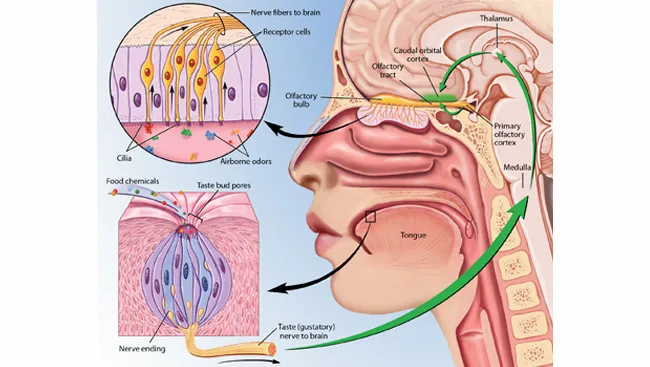
- Receptors: Olfactory receptor cells (CN I) in olfactory epithelium; GPCRs.
- Pathway: Olfactory bulb → piriform cortex, amygdala.
- 📌 Unique: Neurons regenerate.
- Gustation (Taste):
- Receptors: Taste buds (gustatory cells) on papillae.
- Tastes: Sweet, Sour, Salty, Bitter, Umami (GPCRs for Sweet, Bitter, Umami).
- Nerves: CN VII, IX, X → solitary nucleus → VPM thalamus → insula.
- Vestibular System (Balance):
- Organs: Utricle & Saccule (linear acceleration; otoliths); Semicircular canals (angular acceleration; cupula).
- Receptors: Hair cells.
- Key: Vestibulo-ocular reflex (VOR) for gaze stability.
⭐ Olfactory receptor neurons are unique as they are replaced throughout life (neurogenesis).
High‑Yield Points - ⚡ Biggest Takeaways
- Receptor potentials are graded; summation leads to action potentials.
- Phasic receptors (e.g., Pacinian) adapt rapidly; tonic receptors (e.g., Ruffini) adapt slowly.
- DCML pathway: fine touch, vibration, proprioception. ALS pathway: pain, temperature, crude touch.
- Thalamus (VPL/VPM) is the key sensory relay (except olfaction).
- Somatosensory cortex (postcentral gyrus) has somatotopic organization (homunculus).
- Lateral inhibition sharpens sensory discrimination and contrast.
- Labeled line principle: specific pathways for specific modalities.
Unlock the full lesson and continue reading
Signup to continue reading this lesson and unlimited access questions, flashcards, AI notes, and more
