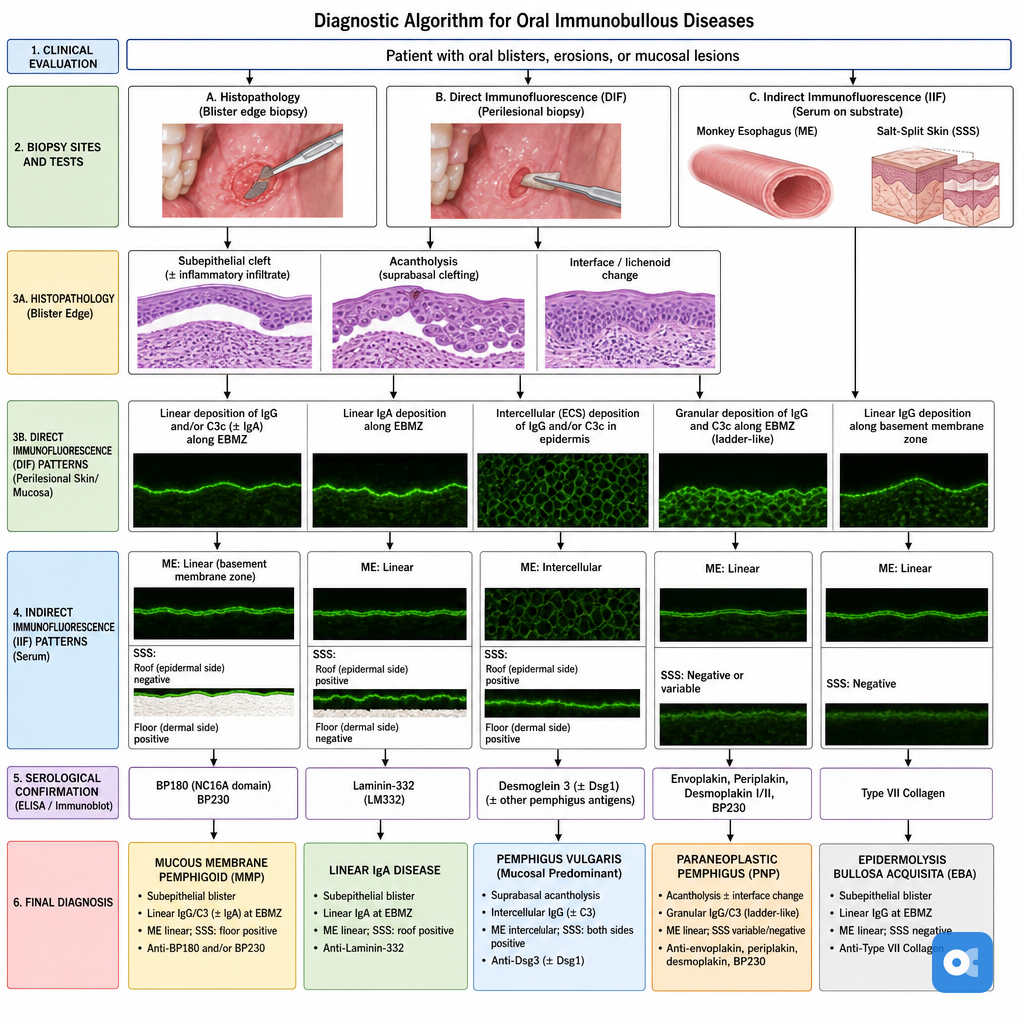
Blistering Diseases Indian Medical PG Practice Questions and MCQs
Practice Indian Medical PG questions for Blistering Diseases. These multiple choice questions (MCQs) cover important concepts and help you prepare for your exams.
Blistering Diseases Indian Medical PG Question 1: A 85-year-old female developed multiple blisters on the trunk and thighs. Nikolsky's sign is negative. The lesions came on and off. The most probable diagnosis is
- A. Pemphigus vulgaris
- B. Bullous pemphigoid (Correct Answer)
- C. Lepra reaction
- D. Lichen planus
Blistering Diseases Explanation: ***Bullous pemphigoid***
- The presence of **multiple tense blisters** on the trunk and thighs in an 85-year-old female, coupled with a **negative Nikolsky's sign**, is highly characteristic of bullous pemphigoid.
- This condition tends to wax and wane, causing the lesions to "come on and off," and is more common in the **elderly**.
*Lichen planus*
- This condition presents with **pruritic, polygonal, purple, planar papules and plaques**, not blisters.
- It does not typically involve the formation of **blisters** as the primary lesion nor does it involve a negative Nikolsky's sign.
*Pemphigus vulgaris*
- Characterized by **flaccid blisters** that rupture easily, leading to erosions, and a **positive Nikolsky's sign**.
- This is in contrast to the **tense blisters** and **negative Nikolsky's sign** described in the patient.
*Lepra reaction*
- Refers to **acute inflammatory episodes** occurring in patients with leprosy, often presenting as **erythematous nodules** or plaques.
- It does not typically involve the formation of **blisters** on the trunk and thighs in an elderly patient without a prior diagnosis of leprosy.
Blistering Diseases Indian Medical PG Question 2: A patient presents with itchy skin lesions with blistering along with gastrointestinal issues. Which of the following is the most specific serological test for this condition?
- A. Anti-TTG antibody
- B. Anti-nuclear antibody
- C. Anti-endomysial antibody (Correct Answer)
- D. IgA deposits at the dermoepidermal junction
- E. Anti-desmoglein antibody
Blistering Diseases Explanation: ***Anti-endomysial antibody***
- The combination of **itchy, blistering skin lesions** and **gastrointestinal issues** is highly suggestive of **Dermatitis Herpetiformis**, which is the cutaneous manifestation of **celiac disease**.
- **Anti-endomysial antibody (EMA)**, particularly IgA, is highly specific (nearly 100%) for **celiac disease** and thus for Dermatitis Herpetiformis, especially when tested on primate esophagus.
*Anti-TTG antibody*
- **Anti-tissue transglutaminase (tTG) antibody** (IgA) is a sensitive and specific serological marker for **celiac disease** and is often the first-line test.
- While highly indicative, **EMA** is generally considered to have slightly higher specificity than tTG for celiac disease, particularly in predicting intestinal villous atrophy.
*Anti-nuclear antibody*
- **Anti-nuclear antibodies (ANA)** are primarily associated with **systemic autoimmune diseases** like Systemic Lupus Erythematosus.
- They are not specific for **celiac disease** or **Dermatitis Herpetiformis**.
*Anti-desmoglein antibody*
- **Anti-desmoglein antibodies** (anti-Dsg1 and anti-Dsg3) are specific for **pemphigus vulgaris** and **pemphigus foliaceus**, which are autoimmune blistering disorders.
- While these conditions present with blistering, they typically lack the gastrointestinal symptoms and the specific pruritic, grouped vesicular pattern seen in **Dermatitis Herpetiformis**.
- This is not the appropriate serological test for DH/celiac disease.
*IgA deposits at the dermoepidermal junction*
- The presence of **granular IgA deposits at the dermoepidermal junction** (dermal papillae) is the **gold standard for diagnosing Dermatitis Herpetiformis** through **direct immunofluorescence** of a skin biopsy.
- However, this is a **histopathological finding**, not a serological test, and therefore does not fit the question's criteria for a "serological test."
Blistering Diseases Indian Medical PG Question 3: A 85-year-old woman has large blistering lesions on the abdomen and thighs that come and go without therapy, and Nikolsky sign is negative. Which of the following is the most likely diagnosis?
- A. pemphigus vulgaris
- B. dermatitis herpetiformis
- C. bullous pemphigoid (Correct Answer)
- D. herpes gestationis
Blistering Diseases Explanation: ***Bullous pemphigoid***
- This condition typically affects **elderly individuals** with large, tense bullae that often resolve spontaneously and a negative **Nikolsky sign**.
- **Immunofluorescence** shows IgG and C3 deposits along the **dermal-epidermal junction**.
*Pemphigus vulgaris*
- Characterized by **flaccid bullae** that rupture easily and a **positive Nikolsky sign**, which is not seen here.
- Patients are usually younger and involvement of **mucous membranes** is common.
*Dermatitis herpetiformis*
- This condition presents with **pruritic papulovesicular lesions** arranged in a herpetiform pattern.
- It is associated with **celiac disease** and responds to a gluten-free diet.
*Herpes gestationis*
- Also known as **pemphigoid gestationis**, this rare autoimmune blistering disease occurs during **pregnancy or postpartum**.
- It presents with **urticarial plaques and bullae**, primarily on the abdomen and extremities, but is not relevant to an 85-year-old woman.
Blistering Diseases Indian Medical PG Question 4: Statement 1 - A 59-year-old patient presents with flaccid bullae. Histopathology shows a suprabasal acantholytic split.
Statement 2 - The row of tombstones appearance is diagnostic of Pemphigus vulgaris.
- A. Statements 1 & 2 are correct, 2 is not explaining 1 (Correct Answer)
- B. Statements 1 and 2 are correct and 2 is the correct explanation for 1
- C. Statements 1 and 2 are incorrect
- D. Statement 1 is incorrect
Blistering Diseases Explanation: ***Correct: Statements 1 & 2 are correct, 2 is not explaining 1***
**Analysis of Statement 1:**
- A 59-year-old patient with **flaccid bullae** and **suprabasal acantholytic split** on histopathology is the classic presentation of **Pemphigus vulgaris**
- The flaccid (easily ruptured) nature of bullae distinguishes it from tense bullae seen in bullous pemphigoid
- The suprabasal location of the split (just above the basal layer) with acantholysis (loss of cell-to-cell adhesion) is pathognomonic
- **Statement 1 is CORRECT** ✓
**Analysis of Statement 2:**
- The **"row of tombstones" or "tombstone appearance"** is indeed a diagnostic histopathological feature of Pemphigus vulgaris
- This appearance results from basal keratinocytes remaining attached to the basement membrane while suprabasal cells separate due to acantholysis
- The intact basal cells standing upright resemble a row of tombstones
- **Statement 2 is CORRECT** ✓
**Does Statement 2 explain Statement 1?**
- Statement 2 describes a **histopathological appearance** (tombstone pattern) that is a **consequence** of the suprabasal split
- However, it does NOT explain the **underlying cause** of the flaccid bullae or the suprabasal split
- The true explanation involves **IgG autoantibodies against desmoglein 3 (and desmoglein 1)**, which attack intercellular adhesion structures (desmosomes), causing **acantholysis**
- Therefore, **Statement 2 does NOT explain Statement 1** ✗
*Incorrect: Statement 2 is the correct explanation for Statement 1*
- While both statements describe features of Pemphigus vulgaris, the tombstone appearance is a descriptive finding, not an explanatory mechanism
*Incorrect: Statements 1 and 2 are incorrect*
- Both statements are medically accurate descriptions of Pemphigus vulgaris features
*Incorrect: Statement 1 is incorrect*
- Statement 1 correctly describes the cardinal clinical and histopathological features of Pemphigus vulgaris
Blistering Diseases Indian Medical PG Question 5: Which histological finding is most specific for pemphigus vulgaris?
- A. Basement membrane thickening
- B. Granular IgA deposits
- C. Row of tombstones (Correct Answer)
- D. IgG linear deposits
Blistering Diseases Explanation: ***Row of tombstones***
- This characteristic histological finding in **pemphigus vulgaris** refers to the appearance of a single layer of basal cells still attached to the basement membrane, resembling a **row of tombstones**, after the detachment of suprabasal epidermal cells.
- It signifies **acantholysis** (loss of cell-to-cell adhesion) occurring just above the basal layer.
*Basement membrane thickening*
- This finding is more characteristic of conditions like **lichen sclerosus** or some chronic inflammatory dermatoses, and is not specific for pemphigus vulgaris.
- It does not directly reflect the underlying immune-mediated acantholysis seen in pemphigus.
*Granular IgA deposits*
- **Granular IgA deposits** along the dermal-epidermal junction are the hallmark of **dermatitis herpetiformis**.
- Pemphigus vulgaris is characterized by IgG autoantibodies, not IgA, targeting desmogleins.
*IgG linear deposits*
- **Linear IgG deposits** along the dermal-epidermal junction are characteristic of **bullous pemphigoid**, not pemphigus vulgaris.
- In pemphigus vulgaris, IgG deposits are typically found in a **chicken-wire pattern** intercellularly within the epidermis.
Blistering Diseases Indian Medical PG Question 6: A female presents with persistent painful oral lesions, with acantholytic cells. The most likely diagnosis is?
- A. Pemphigus vulgaris (Correct Answer)
- B. Dermatitis herpetiformis
- C. Epidermolysis bullosa
- D. Bullous pemphigoid
Blistering Diseases Explanation: ***Pemphigus vulgaris***
- **Pemphigus vulgaris** is characterized by **painful oral lesions** that precede cutaneous lesions in many cases.
- The presence of **acantholytic cells** (separated keratinocytes) on a Tzanck smear or biopsy is a diagnostic hallmark, indicating loss of adhesion between epidermal cells.
*Dermatitis herpetiformis*
- This condition typically presents with **pruritic, vesicular lesions** on extensor surfaces, not usually painful persistent oral lesions as the primary concern.
- Histologically, it shows **subepidermal blisters** with neutrophil accumulation in dermal papillae, and **IgA deposits** in the dermal papillae are characteristic, not acantholysis.
*Epidermolysis bullosa*
- This is a group of **genetic disorders** characterized by extreme skin fragility and blistering upon minimal trauma, often presenting at birth or early childhood.
- While oral lesions can occur, the primary feature is **mechanical fragility** and not typically associated with acantholytic cells in the way pemphigus vulgaris is.
*Bullous pemphigoid*
- **Bullous pemphigoid** presents with **tense blisters** on erythematous or normal skin, primarily affecting the elderly, and oral involvement is less common and usually milder.
- Histology shows a **subepidermal bulla** with inflammatory cells, and **IgG and C3 deposits** along the basement membrane zone, with the absence of acantholysis.
Blistering Diseases Indian Medical PG Question 7: Acantholytic cells in pemphigus are derived from:
- A. Stratum spinosum (Correct Answer)
- B. Stratum basale
- C. Stratum granulosum
- D. Langerhans cells
Blistering Diseases Explanation: Acantholytic cells in pemphigus are keratinocytes that have lost their desmosomal attachments due to autoimmune destruction, primarily affecting the integrity of the stratum spinosum [1]. This layer is characterized by abundant desmosomes, and their disruption leads to the characteristic intraepidermal blistering seen in pemphigus [2]. While pemphigus can affect the basal layer in some forms (like pemphigus vegetans), the primary acantholytic process occurs above this layer, leading to suprabasal cleavage [1]. The stratum granulosum lies above the stratum spinosum and contains keratohyalin granules and lamellar granules, which are essential for skin barrier function. While cells from all epidermal layers can eventually slough off, acantholysis itself primarily originates from the more adhesive cells of the stratum spinosum. Langerhans cells are dendritic antigen-presenting cells found predominantly in the stratum spinosum but are not keratinocytes. While they play a role in immune surveillance, they are not the cells that undergo acantholysis or form the bulk of the epidermal layers [3].
**References:**
[1] Kumar V, Abbas AK, et al.. Robbins and Cotran Pathologic Basis of Disease. 9th ed. The Skin, pp. 1170-1172.
[2] Cross SS. Underwood's Pathology: A Clinical Approach. 6th ed. Disorders Involving Inflammatory And Haemopoietic Cells, pp. 645-646.
[3] Kumar V, Abbas AK, et al.. Robbins and Cotran Pathologic Basis of Disease. 9th ed. The Skin, p. 1144.
Blistering Diseases Indian Medical PG Question 8: Which histological finding is most specific for pemphigus vulgaris?
- A. IgG linear deposits
- B. Basement membrane thickening
- C. Row of tombstones (Correct Answer)
- D. Granular IgA deposits
Blistering Diseases Explanation: ***Row of tombstones***
- This characteristic histological finding in pemphigus vulgaris is due to the **acantholysis** (loss of cell-to-cell adhesion) occurring just above the **basal layer** of keratinocytes [1].
- The intact basal cells remain attached to the basement membrane, resembling a "row of tombstones" when viewed microscopically [1].
*IgG linear deposits*
- **Linear IgG deposits** along the dermoepidermal junction are characteristic of **bullous pemphigoid**, not pemphigus vulgaris [1].
- These deposits target components of the **hemidesmosomes**, leading to subepidermal blistering [1].
*Basement membrane thickening*
- While basement membrane thickening can be seen in various chronic skin conditions and some autoimmune disorders, it is **not specific** for pemphigus vulgaris.
- It can be a feature of conditions like **lichen planus** or discoid lupus erythematosus.
*Granular IgA deposits*
- **Granular IgA deposits** in the dermal papillae are the hallmark of **dermatitis herpetiformis**, a pruritic papulovesicular disease associated with celiac disease.
- This finding is unrelated to the pathophysiology of pemphigus vulgaris.
**References:**
[1] Kumar V, Abbas AK, et al.. Robbins and Cotran Pathologic Basis of Disease. 9th ed. The Skin, pp. 1170-1172.
Blistering Diseases Indian Medical PG Question 9: A 74-year-old woman has noted increasing size and number of darker brown patches on the dorsum of each hand for the past 15 years. They do not change with sun exposure, are nonpruritic, and non-tender. On examination, these 0.5- to 1-cm lightly pigmented lesions are flat. Which of the following is the most likely microscopic finding in these lesions?
- A. Basal melanocytic hyperplasia (Correct Answer)
- B. Dermal nevus cells
- C. Loss of melanin in surrounding skin
- D. Mast cell proliferation
Blistering Diseases Explanation: **Explanation:**
The clinical presentation describes **Solar Lentigo** (also known as "liver spots" or "senile lentigo"). These are common, benign, pigmented macules occurring in elderly individuals on sun-exposed areas like the dorsum of the hands and face.
**1. Why "Basal Melanocytic Hyperplasia" is correct:**
The hallmark of solar lentigo is a **linear (non-nested) hyperplasia of melanocytes** along the basal layer of the epidermis [1]. This is often accompanied by "dirty socks" appearance—elongated, club-shaped rete ridges with increased melanin pigmentation in the basal keratinocytes [1]. Unlike freckles (ephelides), where the number of melanocytes is normal but melanin production is increased, lentigines show a true increase in the number of melanocytes.
**2. Why other options are incorrect:**
* **Dermal nevus cells:** This describes a **Dermal Melanocytic Nevus** [3]. These are typically raised (papular) lesions [2], whereas the question describes flat (macular) lesions [2].
* **Loss of melanin:** This is characteristic of **Vitiligo** or **Pityriasis alba**, which present as hypopigmented or depigmented patches, not dark brown lesions.
* **Mast cell proliferation:** This is the feature of **Urticaria Pigmentosa** (Mastocytosis). These lesions typically exhibit "Darier’s sign" (wheal formation upon stroking), which is absent here.
**High-Yield Clinical Pearls for NEET-PG:**
* **Lentigo vs. Ephelis (Freckle):** Lentigines do *not* darken with sun exposure and have increased melanocyte counts [1]. Ephelides *do* darken with sun exposure and have a normal melanocyte count but increased melanosomes.
* **Lentigo Maligna:** A subtype of melanoma in situ found on sun-damaged skin; it shows atypical melanocytes, unlike the benign hyperplasia seen in solar lentigo.
* **Key Histology:** Look for "club-shaped" or "bud-like" extensions of the rete ridges in solar lentigo [1].
**References:**
[1] Kumar V, Abbas AK, et al.. Robbins and Cotran Pathologic Basis of Disease. 9th ed. The Skin, pp. 1148-1150.
[2] Cross SS. Underwood's Pathology: A Clinical Approach. 6th ed. Common Clinical Problems From Blood And Bone Marrow Disease, pp. 631-633.
[3] Kumar V, Abbas AK, et al.. Robbins and Cotran Pathologic Basis of Disease. 9th ed. The Skin, pp. 1146-1148.
Blistering Diseases Indian Medical PG Question 10: Which of the following is NOT true about dysplastic nevus syndrome?
- A. It is inherited in an autosomal recessive pattern. (Correct Answer)
- B. Approximately half of such patients develop melanoma by age 60.
- C. It is associated with mutations in BRAF and NRAS.
- D. It is a disorder characterized by numerous dysplastic nevi.
Blistering Diseases Explanation: **Explanation:**
**Dysplastic Nevus Syndrome (DNS)**, also known as Familial Atypical Multiple Mole Melanoma (FAMMM) syndrome, is a critical topic in dermatopathology due to its high association with malignancy.
**1. Why Option A is the Correct Answer (The False Statement):**
Dysplastic Nevus Syndrome is inherited in an **autosomal dominant** pattern, not recessive [1]. It is primarily associated with germline mutations in the **CDKN2A gene** (located on chromosome 9p21), which encodes for p16/INK4a, a potent tumor suppressor that regulates the cell cycle [2].
**2. Analysis of Other Options:**
* **Option B:** Patients with DNS have a significantly elevated lifetime risk of developing cutaneous melanoma. In familial cases, the penetrance is high, with approximately **50% to nearly 100%** of affected individuals developing melanoma by age 60 [1].
* **Option C:** While CDKN2A is the germline driver, the progression of these nevi to melanoma often involves acquired somatic mutations in the **MAPK pathway**, specifically **BRAF** (V600E) and **NRAS** mutations [2].
* **Option D:** Clinically, the syndrome is defined by the presence of **numerous (often >50-100)** atypical nevi [3]. These moles are typically larger (>6mm), have variegated colors, and irregular borders [3].
**Clinical Pearls for NEET-PG:**
* **Histology:** Look for "bridging" of nests (fusion of adjacent rete ridges), **lamellar fibroplasia** (concentric fibrosis around rete ridges), and subepidermal lymphocytic infiltration.
* **ABCDE Rule:** Used for clinical screening (Asymmetry, Border irregularity, Color variegation, Diameter >6mm, Evolving).
* **Syndromic Association:** CDKN2A mutations are also linked to an increased risk of **pancreatic cancer**.
**References:**
[1] Kumar V, Abbas AK, et al.. Robbins and Cotran Pathologic Basis of Disease. 9th ed. The Skin, p. 1148.
[2] Kumar V, Abbas AK, et al.. Robbins and Cotran Pathologic Basis of Disease. 9th ed. The Skin, pp. 1150-1151.
[3] Kumar V, Abbas AK, et al.. Robbins and Cotran Pathologic Basis of Disease. 9th ed. The Skin, pp. 1148-1150.
More Blistering Diseases Indian Medical PG questions available in the OnCourse app. Practice MCQs, flashcards, and get detailed explanations.