Congenital Heart Disease Indian Medical PG Practice Questions and MCQs
Practice Indian Medical PG questions for Congenital Heart Disease. These multiple choice questions (MCQs) cover important concepts and help you prepare for your exams.
Congenital Heart Disease Indian Medical PG Question 1: Coarctation of aorta is most commonly associated with?
- A. PDA
- B. Bicuspid aortic valve (Correct Answer)
- C. VSD
- D. ASD
Congenital Heart Disease Explanation: ***Bicuspid aortic valve***
- A **bicuspid aortic valve** is found in 50-80% of patients with coarctation of the aorta [1].
- This association is due to shared developmental pathways during embryogenesis.
*PDA*
- A patent ductus arteriosus (PDA) can coexist with coarctation, but it is not the most common associated anomaly.
- PDA allows for shunting of blood, which can sometimes mask the severity of coarctation in neonates.
*VSD*
- A ventricular septal defect (VSD) is a common congenital heart defect but is less frequently associated with coarctation of the aorta compared to a bicuspid aortic valve.
- While VSDs can occur with various congenital heart conditions, the embryological link is not as strong.
*ASD*
- An atrial septal defect (ASD) is a common congenital heart anomaly but is not the most common defect associated with coarctation of the aorta [1].
- ASDs are more often found in isolation or with other shunting lesions.
Congenital Heart Disease Indian Medical PG Question 2: All of the following are acyanotic congenital heart diseases except _________
- A. PDA
- B. VSD
- C. ASD
- D. Tetralogy of fallot (Correct Answer)
Congenital Heart Disease Explanation: ***Tetralogy of Fallot***
- This is a **cyanotic heart disease** due to the combination of four heart defects, leading to a **right-to-left shunt** and deoxygenated blood entering the systemic circulation [1].
- The four defects include a large **ventricular septal defect (VSD)**, **pulmonary stenosis**, an **overriding aorta**, and **right ventricular hypertrophy** [1].
*PDA*
- A **patent ductus arteriosus (PDA)** allows blood to flow from the aorta to the pulmonary artery, creating a **left-to-right shunt**, which typically results in an acyanotic condition [3].
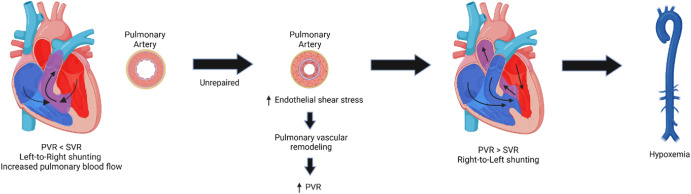
- While it can lead to complications like pulmonary hypertension, it does not usually cause cyanosis unless severe pulmonary hypertension develops (Eisenmenger syndrome).
*VSD*
- A **ventricular septal defect (VSD)** involves an opening between the ventricles, typically causing **left-to-right shunting** [2].
- This increased blood flow to the lungs defines it as an **acyanotic** condition because oxygenated blood from the left side is rerouted to the lungs.
*ASD*
- An **atrial septal defect (ASD)** is a hole in the septum separating the atria, usually leading to a **left-to-right shunt** from the left atrium to the right atrium [4].
- The increased blood flow to the right side of the heart and lungs makes it an **acyanotic** condition, as oxygenated blood continues to be delivered systemically.
Congenital Heart Disease Indian Medical PG Question 3: Which congenital heart disease is most common in Down syndrome?
- A. Patent ductus arteriosus
- B. Atrial septal defect
- C. AV septal defect (Correct Answer)
- D. Ventricular septal defect
Congenital Heart Disease Explanation: ***AV septal defect***
- **Atrioventricular septal defect (AVSD)**, also known as endocardial cushion defect, is the most common congenital heart disease in individuals with Down syndrome, occurring in approximately 40-50% of affected infants.
- This defect involves a **malformation of the septa** separating all four chambers of the heart, often leading to a common atrioventricular valve and large shunts.
*Patent ductus arteriosus*
- While PDA can occur in infants with Down syndrome, its prevalence is lower than that of AVSD, and it is more generally associated with **prematurity**.
- It involves the **failure of closure of the ductus arteriosus** after birth, leading to left-to-right shunting.
*Atrial septal defect*
- ASDs are common congenital heart defects, but a simple atrial septal defect is less prevalent in Down syndrome compared to the more complex AVSD.
- **ASD** involves an opening in the atrial septum, allowing blood to flow between the atria.
*Ventricular septal defect*
- **Ventricular septal defects (VSDs)** are among the most common congenital heart defects overall, but in Down syndrome, they are less frequent than AVSDs.
- A **VSD** is an opening in the ventricular septum, causing blood to shunt between the ventricles.
Congenital Heart Disease Indian Medical PG Question 4: Eisenmenger complex is common in adult in –
- A. Cushion defect
- B. ASD
- C. PDA
- D. VSD (Correct Answer)
Congenital Heart Disease Explanation: ***VSD***
- A large, uncorrected **ventricular septal defect (VSD)** is the most common congenital heart defect to progress to **Eisenmenger syndrome** in adults. [1]
- The bidirectional or right-to-left shunting through the VSD eventually leads to **pulmonary hypertension** and and systemic cyanosis. [1]
*Cushion defect*
- While **atrioventricular septal defects (AVSDs)**, or cushion defects, can lead to pulmonary hypertension, they are less common causes of Eisenmenger syndrome than VSDs in adults. [1]
- They involve defects in both atrial and ventricular septa, often seen in individuals with **Down syndrome**. [1]
*ASD*
- **Atrial septal defects (ASDs)** typically involve left-to-right shunting, and while they can cause pulmonary hypertension over many decades, they rarely progress to full Eisenmenger syndrome due to the lower pressure differential between the atria. [1]
- The elevated pulmonary pressures with ASD tend to be less severe and slower in onset compared to VSDs or PDAs. [1]
*PDA*
- A **patent ductus arteriosus (PDA)** can lead to Eisenmenger syndrome, but it is less common in adults than VSDs because PDAs are often recognized and closed earlier in life. [1]
- An uncorrected large PDA results in chronic left-to-right shunting, leading to increased pulmonary blood flow and subsequent **pulmonary vascular disease**. [1]
Congenital Heart Disease Indian Medical PG Question 5: Commonest congenital heart disease is:
- A. Patent ductus arteriosus
- B. Atrial septal defect
- C. Ventricular septal defect (Correct Answer)
- D. Mitral valve prolapse
Congenital Heart Disease Explanation: ***Ventricular septal defect***
- A **ventricular septal defect (VSD)** is the most frequently observed type of congenital heart disease, accounting for approximately 25-30% of all congenital heart lesions.
- It involves an opening in the **interventricular septum**, allowing blood to shunt between the left and right ventricles.
*Persistent ductus arteriosus*
- While common, **patent ductus arteriosus (PDA)** is not as prevalent as VSDs overall.
- PDA is more frequently seen in **premature infants**, but VSDs are the most common in the general population of live births with congenital heart disease.
*Atrial septal defect*
- **Atrial septal defect (ASD)** is a common congenital heart defect, but its incidence is lower than that of VSDs.
- ASDs involve a hole in the **interatrial septum**, leading to shunting of blood between the atria.
*Mitral valve prolapse*
- **Mitral valve prolapse (MVP)** is a relatively common valvular anomaly but is generally considered a minor congenital heart abnormality or sometimes an acquired condition, not typically classified as the most common "congenital heart disease" in the same category as septal defects.
- It involves the leaflets of the **mitral valve bulging into the left atrium** during systole.
Congenital Heart Disease Indian Medical PG Question 6: A 2-week-old girl is found to have a harsh murmur along the left sternal border. The parents report that the baby gets "bluish" when she cries or drinks from her bottle. Echocardiogram reveals a congenital heart defect associated with pulmonary stenosis, ventricular septal defect, dextroposition of the aorta, and right ventricular hypertrophy. What is the appropriate diagnosis?
- A. Atrial septal defect
- B. Tetralogy of Fallot (Correct Answer)
- C. Coarctation of aorta, postductal
- D. Coarctation of aorta, preductal
Congenital Heart Disease Explanation: ***Tetralogy of Fallot***
- The combination of **pulmonary stenosis**, **ventricular septal defect**, **dextroposition of the aorta** (overriding aorta), and **right ventricular hypertrophy** is the classic definition of Tetralogy of Fallot.
- The "bluish" episodes (cyanosis) when crying or feeding are characteristic of **tet spells**, indicating right-to-left shunting and reduced pulmonary blood flow, exacerbated by activity.
*Atrial septal defect*
- An ASD primarily involves a **left-to-right shunt** and typically presents with a **fixed, split S2** and a **pulmonic flow murmur**, usually without cyanosis in infancy.
- It does not involve the characteristic four defects seen in this patient, particularly the significant pulmonary stenosis and cyanosis.
*Coarctation of aorta, postductal*
- **Postductal coarctation** typically presents in older children or adults with **hypertension in the upper extremities** and **diminished or absent femoral pulses**, often without cyanosis.
- This condition is a narrowing of the aorta **distal to the ductus arteriosus** and does not involve the four specific intracardiac defects described.
*Coarctation of aorta, preductal*
- **Preductal coarctation** can present in neonates with **heart failure** and **differential cyanosis** (upper body pink, lower body blue), or signs of shock if the ductus arteriosus closes.
- This condition involves a narrowing of the aorta **proximal to the ductus arteriosus** and is not characterized by the four specific tetralogy defects.
Congenital Heart Disease Indian Medical PG Question 7: A child presented at 10 weeks with recurrent episode of pneumonia and failure to thrive. X-ray shows cardiomegaly & pulmonary plethora. What is the diagnosis?
- A. VSD (Correct Answer)
- B. TOF
- C. Patent foramen ovale
- D. ASD
Congenital Heart Disease Explanation: ***VSD***
- **Ventricular septal defect (VSD)** is the most common cause of this presentation in early infancy (symptoms typically appear at **6-10 weeks** of age).
- Large VSDs cause significant **left-to-right shunt** leading to pulmonary overcirculation, resulting in **recurrent pneumonia** and **failure to thrive**.
- **Cardiomegaly** (due to volume overload of left atrium and ventricle) and **pulmonary plethora** (increased pulmonary vascular markings) on X-ray are classic findings.
- The infant may also present with tachypnea, feeding difficulties, and poor weight gain.
*TOF*
- **Tetralogy of Fallot (TOF)** is a **cyanotic heart defect** with right-to-left shunt, presenting with cyanosis and hypoxic spells, not recurrent pneumonia.
- X-ray shows **boot-shaped heart** and **pulmonary oligemia** (decreased pulmonary vascular markings), not pulmonary plethora.
- Does not typically cause failure to thrive in the same manner as acyanotic left-to-right shunt lesions.
*Patent foramen ovale*
- A **patent foramen ovale (PFO)** is a normal variant in infants and typically remains **asymptomatic**.
- Does not cause significant hemodynamic shunting in the absence of elevated right atrial pressure.
- Does not cause **cardiomegaly**, **pulmonary plethora**, recurrent pneumonia, or failure to thrive.
*ASD*
- An **atrial septal defect (ASD)** also causes left-to-right shunt with pulmonary plethora, but the shunt develops **gradually** over time.
- ASD typically presents **later in childhood or adulthood** with milder symptoms (fatigue, exercise intolerance) due to lower pressure gradient across atria.
- **Recurrent pneumonia and failure to thrive at 10 weeks** are uncommon with isolated ASD, as the hemodynamic changes are less pronounced in early infancy compared to VSD.
- When symptomatic in infancy, large ASDs present later (around 6 months to 1 year) rather than at 10 weeks.
Congenital Heart Disease Indian Medical PG Question 8: Which of the following cyanotic heart diseases cause increased pulmonary blood flow?
1. Ebstein anomaly
2. Tetralogy of Fallot
3. Transposition of the great arteries (TGA)
4. Total anomalous pulmonary venous communication (TAPVC)
Select the correct combination:
- A. 3,4 (Correct Answer)
- B. 1,2
- C. 2,4
- D. 1,4
Congenital Heart Disease Explanation: ***3,4 (TGA and TAPVC)***
- **Transposition of the great arteries (TGA)** involves two parallel circulations with the aorta arising from the right ventricle and pulmonary artery from the left ventricle. Mixing occurs through defects (ASD, VSD, or PDA), leading to **pulmonary overcirculation** as oxygenated blood recirculates through the lungs.
- **Total anomalous pulmonary venous connection (TAPVC)** results in all pulmonary veins draining into the systemic venous circulation (typically right atrium). This causes **increased volume load on the right heart** and subsequently increased pulmonary blood flow, with obligatory mixing at the atrial level.
*1,2 (Ebstein and ToF)*
- Both conditions cause **decreased pulmonary blood flow**.
- **Ebstein anomaly** involves apical displacement of the tricuspid valve with "atrialization" of the right ventricle, causing tricuspid regurgitation and right-to-left shunting through an ASD/PFO.
- **Tetralogy of Fallot** features right ventricular outflow tract obstruction (pulmonary stenosis) as its defining feature, causing reduced pulmonary blood flow.
*2,4*
- Incorrect combination: **Tetralogy of Fallot causes decreased pulmonary blood flow** due to RVOT obstruction, not increased.
*1,4*
- Incorrect combination: **Ebstein anomaly causes decreased pulmonary blood flow**, not increased.
Congenital Heart Disease Indian Medical PG Question 9: A 50-year-old male presented with signs and symptoms of restrictive heart disease. A right ventricular endomyocardial biopsy revealed deposition of extracellular eosinophilic hyaline material. On transmission electron microscopy, what is the most likely finding in this material?
- A. Weber Palade bodies
- B. Concentric whorls of lamellar structures
- C. Non-branching filaments of indefinite length (Correct Answer)
- D. Cross banded fibres with 67 nm periodicity
Congenital Heart Disease Explanation: ***Non branching filaments of indefinite length***
- The presence of **eosinophilic hyaline material** in restrictive heart disease suggests the deposition of **amyloid** [1][2], which is characterized by long, **non-branching filaments** [4].
- Transmission electron microscopy typically reveals **randomly oriented filaments** [3], confirming the diagnosis of amyloidosis.
*Concentric whorls of lamellar structures*
- Concentric whorls are more characteristic of **myxomatous degeneration** or **lipofuscin deposits**, not amyloid deposition.
- This finding does not correlate with the **eosinophilic hyaline material** seen in the biopsy [2].
*Weber Palade bodies*
- Weber Palade bodies are **granules found in endothelial cells**, related to the storage of von Willebrand factor, not heart tissue pathology.
- Their presence does not explain the findings seen in **restrictive heart disease** or the specific biopsy results.
*Cross banded fibres with 67 m periodicity*
- Cross banded fibers are indicative of **collagen** or **muscle striations**, rather than amyloid.
- Such fibers do not relate to the **eosinophilic hyaline material** revealed in this context [2].
**References:**
[1] Kumar V, Abbas AK, et al.. Robbins and Cotran Pathologic Basis of Disease. 9th ed. Diseases of the Immune System, pp. 264-266.
[2] Kumar V, Abbas AK, et al.. Robbins and Cotran Pathologic Basis of Disease. 9th ed. The Heart, pp. 580-581.
[3] Kumar V, Abbas AK, et al.. Robbins and Cotran Pathologic Basis of Disease. 9th ed. Diseases of the Immune System, pp. 268-269.
[4] Cross SS. Underwood's Pathology: A Clinical Approach. 6th ed. (Basic Pathology) introduces the student to key general principles of pathology, both as a medical science and as a clinical activity with a vital role in patient care. Part 2 (Disease Mechanisms) provides fundamental knowledge about the cellular and molecular processes involved in diseases, providing the rationale for their treatment. Part 3 (Systematic Pathology) deals in detail with specific diseases, with emphasis on the clinically important aspects., pp. 135-136.
Congenital Heart Disease Indian Medical PG Question 10: Which of the following has the most friable vegetations:
- A. SLE
- B. Rheumatic heart disease
- C. Libman Sack's endocarditis
- D. Infective endocarditis (Correct Answer)
Congenital Heart Disease Explanation: ***Infective endocarditis***
- The vegetations in infective endocarditis are composed of **fibrin**, **platelets**, and **microorganisms**, making them typically very **friable** and prone to embolization [1].
- This friability is a key factor in the pathogenesis of **septic emboli**, which can lead to complications such as stroke, organ infarction, and systemic infections [1].
*Libman Sack's endocarditis*
- Characterized by sterile vegetations, predominantly on the **mitral and aortic valves**, in patients with **Systemic Lupus Erythematosus (SLE)** [1].
- While these vegetations can be a source of emboli, they are generally **less friable** than those seen in infective endocarditis, as they lack the aggressive bacterial component.
*SLE*
- SLE itself is a **systemic autoimmune disease** that can cause various cardiac manifestations, including pericarditis, myocarditis, and endocarditis (Libman-Sacks).
- The term "SLE" refers to the underlying disease, not directly to the friability of vegetations, though it is associated with Libman-Sacks endocarditis which has relatively less friable vegetations.
*Rheumatic heart disease*
- Results from **acute rheumatic fever**, leading to chronic valvular damage, most commonly affecting the **mitral valve** [2].
- The vegetations, when present during acute rheumatic fever, are small, sterile, and composed primarily of **fibrin and platelets**, making them generally **less friable** and less likely to embolize compared to infective endocarditis [1].
**References:**
[1] Kumar V, Abbas AK, et al.. Robbins and Cotran Pathologic Basis of Disease. 9th ed. The Heart, pp. 568-570.
[2] Kumar V, Abbas AK, et al.. Robbins and Cotran Pathologic Basis of Disease. 9th ed. The Heart, p. 566.
More Congenital Heart Disease Indian Medical PG questions available in the OnCourse app. Practice MCQs, flashcards, and get detailed explanations.