

Aqueous Dynamics - Eye's Inner River
- Production: Ciliary body (epithelium) via active secretion (e.g., Na+/K+ ATPase, carbonic anhydrase) & ultrafiltration.
- Circulation: Posterior chamber → pupil → anterior chamber.
- Drainage: Two main pathways at the iridocorneal angle:
- Trabecular Meshwork (TM): ~80-90% outflow; pressure-dependent.
- Uveoscleral Pathway (US): ~10-20% outflow; largely pressure-independent.
- 📌 Mnemonic: Trabecular Takes Time (majority), UveoScleral is Unconventional & Speedy (alternative).
- Intraocular Pressure (IOP): Normal range 10-21 mmHg. Maintained by production/outflow balance. Factors: diurnal variation (↑AM), age, arterial BP, pulse.
Loading diagram…

⭐ Uveoscleral outflow accounts for 10-20% of aqueous drainage and is largely pressure-independent; prostaglandins ↑ this outflow significantly, forming a basis for glaucoma treatment.
Corneal Physiology - Window Wonders
- Transparency Factors: Avascularity, deturgescence (stromal hydration ~78%), regular collagen fibril lattice (Maurice's theory).
- Metabolism:
- Epithelium & Endothelium: Aerobic (glucose from aqueous humor, O₂ from tears/aqueous).
- Stroma: Anaerobic glycolysis.
- Hydration (Deturgescence): Maintained by:
- Endothelial pump ($Na^+/K^+$ ATPase) & barrier function.
- Epithelial barrier.
- Endothelial cell count: Healthy >2000 cells/mm²; edema risk <500-700 cells/mm².
- Innervation: Trigeminal nerve (V1) → Nasociliary nerve → long ciliary nerves.
- 📌 Mnemonic (Layers): 'ABCDE' - Anterior Epithelium, Bowman's layer, Central Stroma, Descemet's membrane, Endothelium.
⭐ The corneal endothelium has minimal regenerative capacity; cell loss is primarily compensated by cell enlargement (polymegathism) and migration, not mitosis. Critical density for clarity is ~500 cells/mm².
Lens & Accommodation - Focus Flex
-
Transparency: Maintained by soluble crystallins, avascularity, and intact capsular barrier. Lens power approx. +20D.
-
Metabolism: Primarily anaerobic glycolysis. Hyperglycemia activates sorbitol pathway (aldose reductase) → osmotic stress → diabetic cataract.
-
Accommodation:
- Mechanism: Ciliary muscle contraction (parasympathetic, CN III) → zonular fiber relaxation → ↑lens anterior curvature & dioptric power.
- 📌 Ciliary Contracts, Zonules Zlack for Close vision.
-
Presbyopia: Age-related loss of accommodation (lens hardening, ↓elasticity).
⭐ Cataracts are lens opacities, commonly from aggregated crystallin proteins, leading to progressive vision loss.
Retinal Physiology - Light to Sight
| Feature | Rods | Cones |
|---|---|---|
| Vision | Scotopic (night) | Photopic (day) |
| Location | Peripheral retina | Central retina (fovea) |
| Sensitivity | High (low light) | Low (bright light) |
| Acuity | Low | High |
| Color | No | Yes (3 types: S, M, L) |
| Pigment | Rhodopsin | Iodopsins |
Phototransduction Cascade:
- Visual Pigments: Rods: Rhodopsin. Cones: Iodopsins (S, M, L types for blue, green, red sensitivity).
- Adaptation: Dark adaptation (slow, ↑sensitivity); Light adaptation (fast, ↓sensitivity).
- ERG (Electroretinogram): Assesses retinal electrical activity.
- a-wave: Photoreceptors (initial negative).
- b-wave: Bipolar & Müller cells (positive).
- c-wave: Retinal Pigment Epithelium (RPE).
- 📌 Mnemonic: 'Photoreceptors Act (a-wave), Bipolar/Muller Boost (b-wave)'.
- EOG (Electrooculogram): Assesses RPE health. Arden ratio: Light peak / Dark trough; Normal >1.85.
⭐ In the dark, photoreceptors are depolarized and continuously release glutamate. Light causes hyperpolarization, reducing glutamate release, which is the signal for vision.
Tears & Vitreous - Protective Coats
- Tear Film (3 Layers):
- Lipid: Meibomian glands; outer, prevents evaporation.
- Aqueous: Lacrimal glands; middle, nutrients, antibacterial (lysozyme). Schirmer I: >10-15mm/5min.
- Mucin: Goblet cells; inner, adherence to cornea, lubrication.
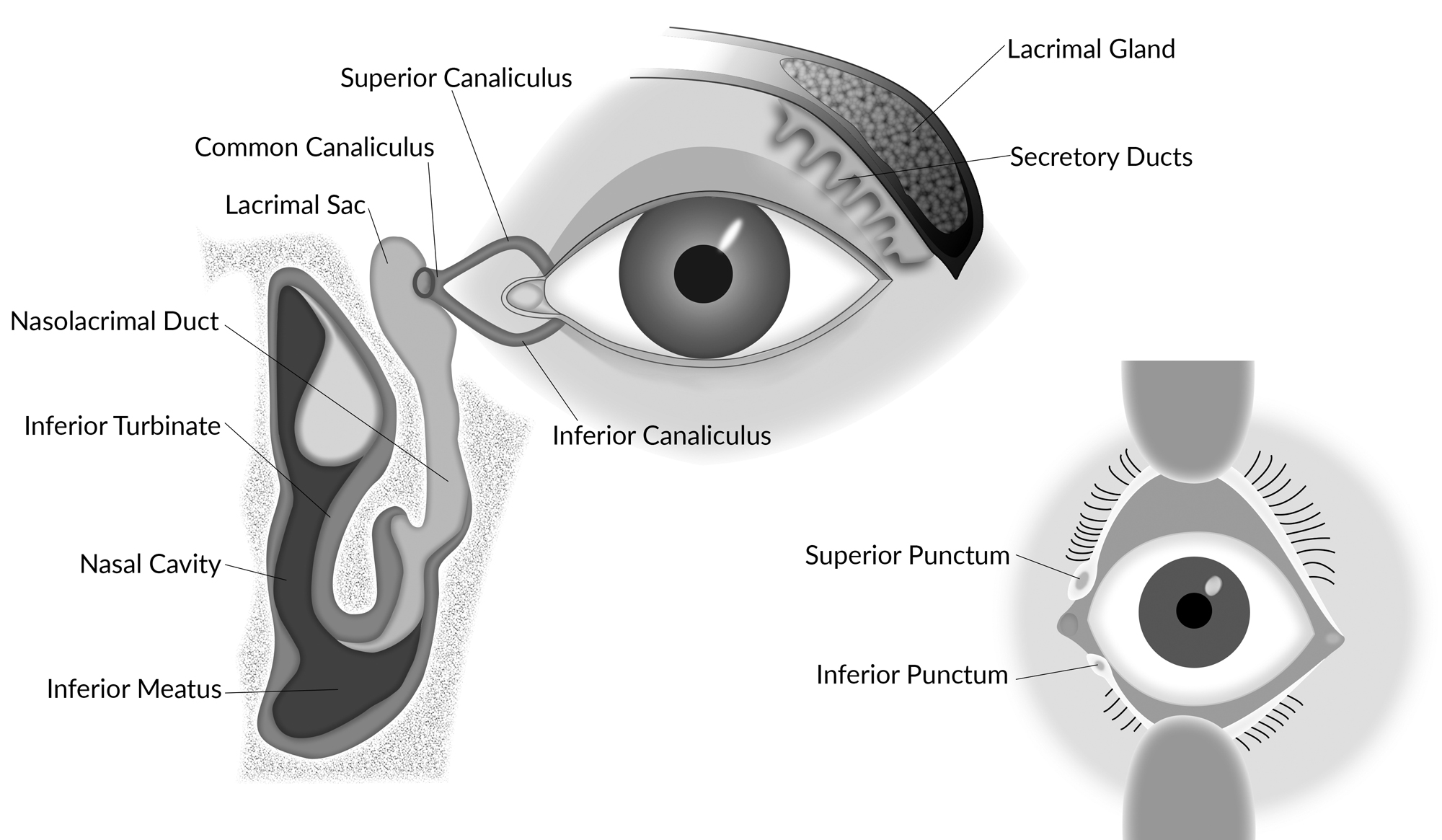
- Tear Drainage: Puncta → Canaliculi → Lacrimal Sac → Nasolacrimal Duct → Nose.
- 📌 Mnemonic: 'P Crying Little Nasty Drops'.
-
Loading diagram…
%%{init: {'flowchart': {'htmlLabels': true}}}%% flowchart TD
Puncta["💧 Puncta
• Tear entry point• Eyelid opening"]
Canaliculi["🛤️ Canaliculi
• Small channels• Medial drainage"]
LacrimalSac["👜 Lacrimal Sac
• Tear reservoir• Lacrimal fossa"]
NasolacrimDuct["👃 Nasolacrim Duct
• Bony canal link• Distal pathway"]
NoseMeatus["🎭 Nose Inf Meatus
• Final drainage• Nasal cavity"]
Puncta --> Canaliculi Canaliculi --> LacrimalSac LacrimalSac --> NasolacrimDuct NasolacrimDuct --> NoseMeatus
style Puncta fill:#F7F5FD, stroke:#F0EDFA, stroke-width:1.5px, rx:12, ry:12, color:#6B21A8 style Canaliculi fill:#F7F5FD, stroke:#F0EDFA, stroke-width:1.5px, rx:12, ry:12, color:#6B21A8 style LacrimalSac fill:#F7F5FD, stroke:#F0EDFA, stroke-width:1.5px, rx:12, ry:12, color:#6B21A8 style NasolacrimDuct fill:#F7F5FD, stroke:#F0EDFA, stroke-width:1.5px, rx:12, ry:12, color:#6B21A8 style NoseMeatus fill:#F6F5F5, stroke:#E7E6E6, stroke-width:1.5px, rx:12, ry:12, color:#525252
- 
* **Vitreous Humor:**
- Composition: **~99%** water, collagen (Type II), hyaluronic acid.
- Functions: Maintains globe shape, shock absorption, optical transparency.
- Age changes: Liquefaction (syneresis), Posterior Vitreous Detachment (PVD).
> ⭐ The mucin layer of the tear film, produced by conjunctival goblet cells, is crucial for converting the hydrophobic corneal epithelium into a hydrophilic surface, ensuring tear film stability.
## High‑Yield Points - ⚡ Biggest Takeaways
>
> * **Aqueous humor**, produced by the **ciliary body**, primarily drains via the **trabecular meshwork** and secondarily via the **uveoscleral pathway**.
> * Normal **Intraocular Pressure (IOP)** is **10-21 mmHg**, maintained by the balance of aqueous production and outflow.
> * **Corneal transparency** depends on its **avascularity**, regular collagen arrangement, and **endothelial pump** maintaining deturgescence.
> * **Accommodation** for near vision involves **ciliary muscle contraction**, leading to zonular relaxation and increased lens convexity.
> * **Phototransduction**: Light absorption by photoreceptors causes **hyperpolarization** due to ↓**cGMP** and closure of **Na+ channels**.
> * The **blood-aqueous barrier** and **blood-retinal barrier** are crucial for maintaining the eye's immune privilege and internal environment.
Unlock the full lesson and continue reading
Signup to continue reading this lesson and unlimited access questions, flashcards, AI notes, and more
