

Occupational Hazards Intro - Workplace Perils Primer
- Hazard Types:
- Physical (noise, radiation)
- Chemical (solvents, dusts)
- Biological (bacteria, viruses)
- Ergonomic (poor posture, repetitive tasks)
- Psychosocial (stress, violence)
- Routes of Entry: Inhalation (main), Ingestion, Skin absorption.
- Core Concept: Dose-response relationship (↑dose = ↑effect).
- Hierarchy of Controls (📌 ESEAP: Every Student Enjoys A Pizza): Ranked system for hazard control.
Loading diagram…
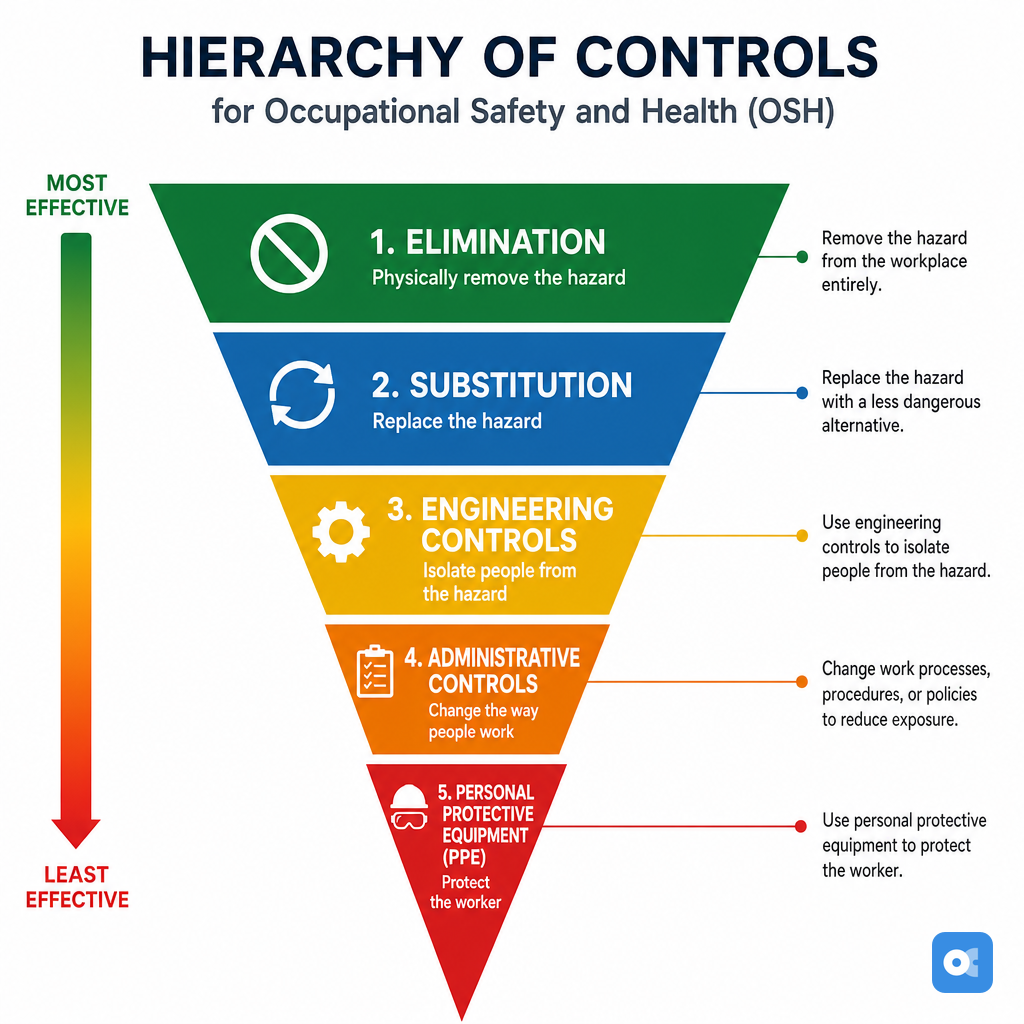
> ⭐ The most effective level in the hierarchy of controls is **Elimination** of the hazard.
Pneumoconioses - Dust Devastation
Prolonged inhalation of specific occupational dusts leads to a group of irreversible, fibrotic lung diseases termed pneumoconioses. Key examples include:
| Disease | Exposure Source | Key X-ray/Pathology Findings | Complications/Associations |
|---|---|---|---|
| Silicosis | Sand, quartz (mining, stone cutting) | 'Egg-shell' calcification (hilar nodes), Progressive Massive Fibrosis (PMF), upper lobe predominance | ↑TB risk |
| CWP | Coal dust | Simple: coal macules/nodules (upper lobes). Complicated: Progressive Massive Fibrosis (PMF). | Caplan's syndrome (RA + pneumoconiotic nodules) |
| Asbestosis | Shipbuilding, insulation, construction | Ferruginous bodies, pleural plaques (lower lobes, parietal), bibasilar fine end-inspiratory crackles. Fiber: $L >\textbf{5µm}$, $D <\textbf{3µm}$, $AR >\textbf{3:1}$ | ↑Lung cancer (esp. smokers), Mesothelioma |
| Berylliosis | Aerospace, electronics | Acute chemical pneumonitis or chronic non-caseating granulomas (sarcoid-like, hilar lymphadenopathy) | Chronic Beryllium Disease (CBD) |

⭐ Asbestos exposure is the single most important risk factor for malignant mesothelioma.
Toxic Agents - Metals & Cancer Culprits
Heavy Metals
| Metal | Sources | Clinical Features | Diagnostics | Chelators |
|---|---|---|---|---|
| Lead | Battery, paint, smelting | Burton's line (gums), wrist/foot drop, abdominal colic, microcytic anemia (basophilic stippling), encephalopathy. 📌 LEAD: Lead lines, Encephalopathy, Anemia/Abdominal colic, Drop (wrist/foot). BLL >5 µg/dL (child), >10 µg/dL (adult) | Blood Lead Level | CaNa2EDTA, DMSA, BAL |
| Mercury | Thermometers, batteries, dental amalgam | Tremor, erethism, gingivostomatitis, nephrotic syndrome. Minamata disease (organic Hg) | Urine/blood mercury | DMSA, BAL |
| Arsenic | Pesticides, semiconductors, wood preservative | Garlic breath, Mees' lines, skin hyperkeratosis/pigmentation, peripheral neuropathy, cancers (lung, skin, bladder) | Urine arsenic, Mees' lines on nails | BAL, DMSA |
Occupational Cancers
- Lung: Asbestos, Radon, Arsenic, Chromium, Nickel, Polycyclic Aromatic Hydrocarbons (PAHs).
- Bladder: Aromatic amines (e.g., Benzidine, 2-Naphthylamine - dye/rubber industry).
- Leukemia (AML): Benzene.
⭐ Benzene exposure is a well-established cause of Acute Myeloid Leukemia (AML).
- Angiosarcoma (liver): Vinyl chloride (plastics industry).
- Skin: PAHs, Arsenic, UV radiation.
Other Hazards - Asthma to ZZZ-Be-Gone (Noise)
-
OA: Most common. Sensitizer (latency, prior exposure) vs. Irritant (no latency, high exposure).
- Agents: Isocyanates, flour, wood dust, dander.
- Dx: PFTs, IgE, PEFR (work/home).
-
Dermatitis: ICD vs. ACD.
- Agents: Solvents, nickel, wet work.
- Dx: Patch test (ACD).
-
NIHL: Sensorineural, bilateral. Notch: 4000 Hz.
⭐ The hallmark of Noise-Induced Hearing Loss on an audiogram is a characteristic notch (dip in hearing threshold) at 4000 Hz.
- OSHA: 85 dBA TWA. Prevention key.
-
Pesticide Poisoning:
- Organophosphates (OPs): Cholinesterase inhibitors. 📌 SLUDGE/DUMBELS mnemonic for muscarinic effects: Salivation, Lacrimation, Urination, Defecation, GI upset, Emesis / Diarrhea, Urination, Miosis, Bronchospasm, Emesis, Lacrimation, Salivation. Rx: Atropine + Pralidoxime.
- Carbamates: Like OPs, reversible. Pralidoxime not usually needed.
- Organochlorines (DDT): CNS stimulation.
High‑Yield Points - ⚡ Biggest Takeaways
- Silicosis: Eggshell calcification, ↑ TB risk. Asbestosis: Lower lobes, pleural plaques, mesothelioma.
- Lead poisoning: Basophilic stippling, wrist drop. Arsenic: Aldrich-Mees lines, skin cancer.
- Benzene → Leukemia. Vinyl chloride → Hepatic angiosarcoma. Aromatic amines → Bladder cancer.
- Byssinosis: "Monday fever" in cotton workers.
- Noise-Induced Hearing Loss: Notch at 4000 Hz.
- Bagassosis: Hypersensitivity pneumonitis from moldy sugarcane.
- Irritant contact dermatitis: Most common occupational dermatitis.
Unlock the full lesson and continue reading
Signup to continue reading this lesson and unlimited access questions, flashcards, AI notes, and more
