Sterilization Monitoring Indian Medical PG Practice Questions and MCQs
Practice Indian Medical PG questions for Sterilization Monitoring. These multiple choice questions (MCQs) cover important concepts and help you prepare for your exams.
Sterilization Monitoring Indian Medical PG Question 1: What is the preferred method for sterilizing disposable syringes?
- A. Gas sterilization (Ethylene oxide) (Correct Answer)
- B. Steam sterilization (Autoclave)
- C. Chemical sterilization (Cidex)
- D. Dry heat sterilization (Hot air oven)
Sterilization Monitoring Explanation: ***Steam sterilization (Autoclave)***
- While generally effective, **disposable syringes** are typically **pre-sterilized** by the manufacturer using methods like radiation or ethylene oxide and are not meant for resterilization.
- Reusing and resterilizing disposable syringes, even with an autoclave, is **not recommended** due to potential material degradation and safety concerns.
*Chemical sterilization (Cidex)*
- **Cidex (glutaraldehyde)** is a high-level disinfectant primarily used for **heat-sensitive instruments** that cannot withstand high temperatures, such as endoscopes.
- It involves **immersion** and is not suitable for the rapid, high-volume sterilization of plastic disposable syringes due to potential residue and material incompatibility.
*Dry heat sterilization (Hot air oven)*
- Requires **prolonged exposure** to high temperatures and is suitable for **glassware** and **oil-based substances**.
- **Plastic disposable syringes** would melt or degrade at the required temperatures (160-170°C) for effective dry heat sterilization.
*Gas sterilization (Ethylene oxide)*
- **Ethylene oxide (EtO)** is the **preferred industrial method** for sterilizing heat-sensitive and moisture-sensitive medical devices, including **disposable plastic syringes**, by manufacturers.
- It penetrates packaging effectively and sterilizes without damaging plastic, but requires specialized equipment and extensive aeration due to its **toxic and flammable nature**, making it impractical for point-of-use sterilization.
Sterilization Monitoring Indian Medical PG Question 2: All are methods of sterilization except.
- A. Filtration
- B. Heat
- C. Gases
- D. Sunlight (Correct Answer)
Sterilization Monitoring Explanation: ***Sunlight***
- While sunlight has some **disinfectant** properties due to its **UV radiation**, it is not considered a reliable method of **sterilization** because it cannot kill all forms of microbial life, including bacterial spores.
- Sterilization requires the **complete elimination of all viable microorganisms**, which sunlight cannot consistently achieve.
*Gases*
- Certain gases, such as **ethylene oxide** and **hydrogen peroxide vapor**, are effective **sterilizing agents** used for heat-sensitive materials and medical devices.
- These gases penetrate packaging and kill microorganisms by **alkylating proteins** and **nucleic acids**.
*Filtration*
- **Filtration** is a method of **sterilization** for liquids and gases that cannot withstand heat, by physically removing microorganisms.
- Filters with very small pore sizes (e.g., **0.22 micrometers**) can retain bacteria and fungi, even though they do not kill them.
*Heat*
- **Heat** is one of the most common and effective methods of sterilization, used in various forms like **dry heat** (e.g., sterilization ovens) and **moist heat** (e.g., autoclaving).
- **Autoclaving** with **saturated steam under pressure** is particularly effective as it rapidly coagulates and denatures microbial proteins.
Sterilization Monitoring Indian Medical PG Question 3: Endoscope is sterilized by:
- A. Glutaraldehyde (Correct Answer)
- B. Formalin
- C. Autoclaving
- D. Boiling
Sterilization Monitoring Explanation: **Glutaraldehyde**
- **Glutaraldehyde** is a high-level disinfectant used for sterilizing heat-sensitive instruments like endoscopes, as it effectively kills bacteria, viruses, fungi, and spores without damaging the instruments.
- Endoscopes cannot withstand the high temperatures of autoclaving, making chemical disinfection with agents like **glutaraldehyde** the preferred method.
*Formalin*
- **Formalin** (formaldehyde solution) is a strong disinfectant and sterilant, but it is highly toxic, irritating, and has a strong pungent odor, making it less suitable for routine clinical sterilization of endoscopes compared to glutaraldehyde.
- While effective, its safety profile and handling difficulties mean it is not the primary choice for endoscope reprocessing in most healthcare settings.
*Autoclaving*
- **Autoclaving** uses high-pressure steam and high temperatures to sterilize instruments, which would damage the delicate optical fibers, electronics, and heat-sensitive plastics of endoscopes.
- For this reason, endoscopes are considered **heat-labile** and cannot be sterilized using an autoclave.
*Boiling*
- **Boiling** is a low-level disinfection method that is insufficient to achieve sterilization as it does not kill bacterial spores and some viruses.
- While it can disinfect some instruments, it is inadequate for complex medical devices like endoscopes that require high-level disinfection or sterilization.
Sterilization Monitoring Indian Medical PG Question 4: Which item cannot be effectively sterilized using a hot air oven?
- A. Liquid paraffin
- B. Instruments
- C. Culture media (Correct Answer)
- D. Needles
Sterilization Monitoring Explanation: ***Culture media***
- Heat sterilization in a hot air oven would cause **dehydration** and **degradation of nutrients** in most culture media, rendering them unusable for microbial growth.
- Many components of culture media, such as **sugars** and **proteins**, are heat-sensitive and will break down at the high temperatures required for sterilization in a hot air oven.
*Liquid paraffin*
- **Oils** and **greases** can be effectively sterilized by a hot air oven because they are unable to be sterilized by steam due to its inability to penetrate oil-based substances.
- The dry heat effectively kills microorganisms by causing **oxidative damage** to cellular components without causing unwanted chemical reactions.
*Instruments*
- **Surgical instruments** made of metal are ideal for sterilization in a hot air oven as dry heat can penetrate their surfaces and kill microorganisms without causing corrosion common with moist heat.
- This method is effective for instruments that can withstand high temperatures and are sensitive to moisture.
*Needles*
- **Metal needles** can be safely sterilized in a hot air oven, as it effectively destroys all microbial life including spores, and prevents **rusting** or **dulling** often caused by steam sterilization.
- The dry heat ensures that instruments remain sharp and undamaged after sterilization.
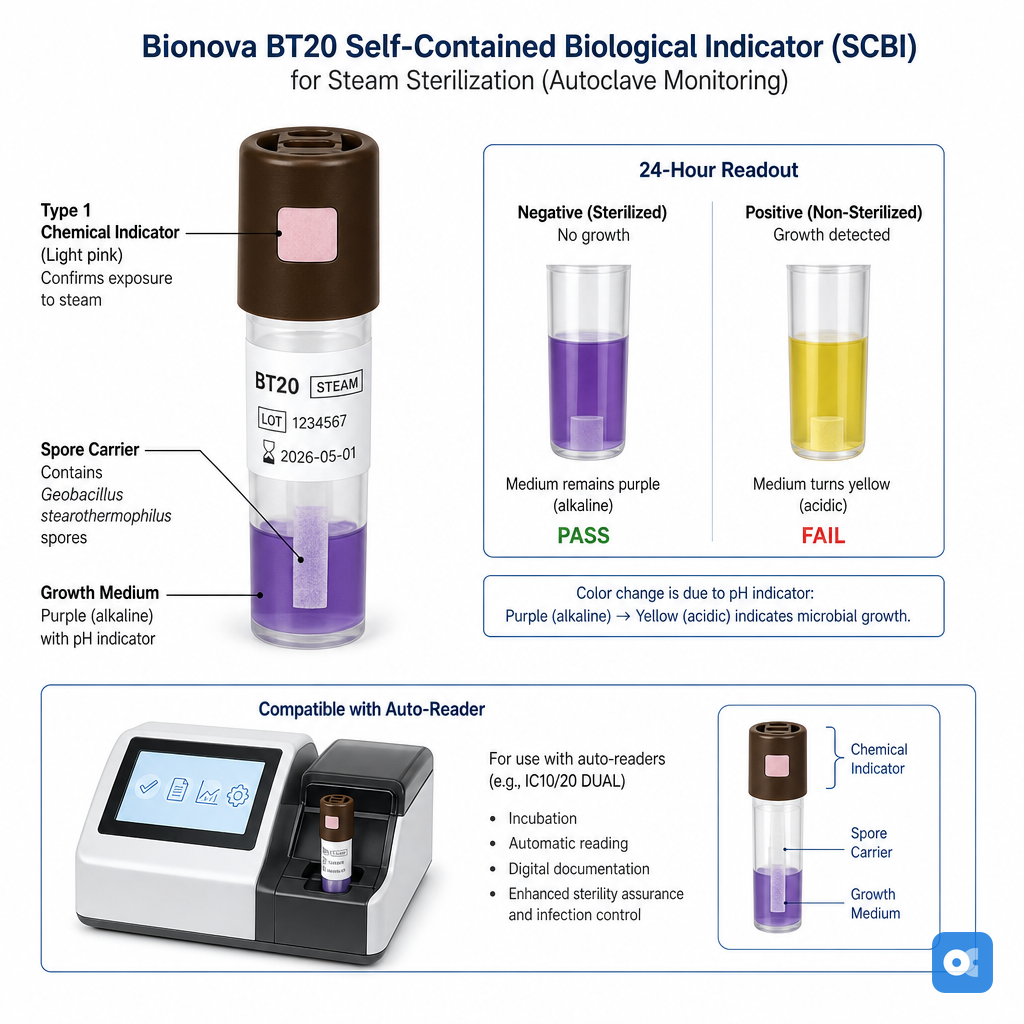
Sterilization Monitoring Indian Medical PG Question 5: Biological indicator for determining efficacy of autoclaving is
- A. Bacillus stearothermophilus (Correct Answer)
- B. Pseudomonas aeruginosa
- C. Clostridium perfringens
- D. Salmonella typhi
Sterilization Monitoring Explanation: ***Bacillus stearothermophilus***
- *Bacillus stearothermophilus* (now *Geobacillus stearothermophilus*) is a **thermoduric spore-forming bacterium** used as a biological indicator for **autoclave efficacy**.
- Its spores are highly **resistant to heat**, making them ideal for challenging the sterilization process.
*Pseudomonas aeruginosa*
- *Pseudomonas aeruginosa* is a **Gram-negative bacterium** known for causing hospital-acquired infections, but it is **not used as a biological indicator** for autoclaving.
- It is **less resistant to heat** and sterilization methods compared to bacterial spores.
*Clostridium perfringens*
- *Clostridium perfringens* is a **spore-forming anaerobic bacterium** associated with gas gangrene and food poisoning.
- While it forms spores, its **heat resistance profile is different** from that of *Bacillus stearothermophilus*, and it is not the standard biological indicator for autoclaving.
*Salmonella typhi*
- *Salmonella typhi* is a **Gram-negative bacterium** that causes typhoid fever.
- It is a **pathogen but not a spore-former**, and therefore, it is easily killed by autoclaving and not suitable as a biological indicator for monitoring sterilization effectiveness.
Sterilization Monitoring Indian Medical PG Question 6: Which spores are used to test the efficacy of moist heat sterilization?
- A. Bacillus stearothermophilus (Correct Answer)
- B. Clostridium tetani
- C. Bacillus subtilis
- D. Clostridium botulinum
Sterilization Monitoring Explanation: ***Bacillus stearothermophilus***
- The spores of **Bacillus stearothermophilus** (now referred to as **Geobacillus stearothermophilus**) are highly resistant to heat.
- Due to their heat resistance, they are used as the **standard biological indicator** for monitoring the efficacy of **moist heat sterilization** (autoclaving) processes.
- These spores can survive temperatures up to 121°C, making them ideal for testing autoclave effectiveness.
*Clostridium tetani*
- While **Clostridium tetani** forms highly resistant spores, it is **not used as a biological indicator** for sterilization processes.
- This organism is clinically significant as the causative agent of tetanus, not as a sterilization test organism.
- Standard biological indicators are specially selected *Bacillus* and *Geobacillus* species with known resistance characteristics.
*Bacillus subtilis*
- **Bacillus subtilis** (and **Bacillus atrophaeus**) spores are used as biological indicators for **dry heat sterilization** and **ethylene oxide gas sterilization**.
- Their spores are **less resistant to moist heat** compared to *Bacillus stearothermophilus*, making them unsuitable for testing autoclaves.
- They have different resistance profiles better suited to testing other sterilization methods.
*Clostridium botulinum*
- **Clostridium botulinum** spores are known for producing a potent neurotoxin and are important in food safety and canning industry sterilization standards.
- However, they are **not used as biological indicators** for routine laboratory or hospital sterilization monitoring.
- Their primary relevance is in food preservation where their spore destruction is the target endpoint.
Sterilization Monitoring Indian Medical PG Question 7: Irradiation can be used to sterilize which of the following items?
- A. Bone graft
- B. Suture
- C. Artificial tissue graft
- D. Bronchoscope (Correct Answer)
Sterilization Monitoring Explanation: ### Explanation
**Correct Answer: D. Bronchoscope**
**Underlying Medical Concept:**
Sterilization by irradiation (specifically **Ionizing Radiation** like Gamma rays or Electron beams) is a "cold sterilization" method. It is preferred for heat-sensitive items. While traditionally used for disposable medical supplies (syringes, catheters), modern high-level disinfection and sterilization protocols for flexible endoscopes, such as **bronchoscopes**, often utilize specialized irradiation or low-temperature chemical sterilization to prevent damage to delicate fiber-optics and rubber components that would be destroyed in an autoclave.
**Analysis of Options:**
* **A. Bone graft & C. Artificial tissue graft:** These are typically sterilized using **Ethylene Oxide (EtO)** or specific chemical sterilants. While gamma radiation is sometimes used for bone banks, it can alter the structural integrity and osteoinductive properties of the graft, making it less ideal than chemical methods in many clinical settings.
* **B. Suture:** Most synthetic sutures are sterilized using **Ethylene Oxide (EtO)**. While some are gamma-irradiated, EtO is the industry standard to maintain the tensile strength of the material.
* **D. Bronchoscope:** Because bronchoscopes are heat-labile and contain fragile optical fibers, they cannot be autoclaved. Irradiation (or more commonly, Glutaraldehyde/Cidex) is the method of choice to ensure sterility without thermal damage.
**High-Yield Clinical Pearls for NEET-PG:**
* **Cold Sterilization:** Refers to Gamma radiation or chemicals (like Glutaraldehyde) used for heat-sensitive materials.
* **Gamma Radiation:** Source is typically **Cobalt-60**. It has high penetrative power.
* **Disposable Items:** Items like plastic syringes, swabs, and catheters are commercially sterilized using Gamma radiation (often called "Industrial Sterilization").
* **Monitoring:** The efficacy of radiation sterilization is monitored using *Bacillus pumilus*.
Sterilization Monitoring Indian Medical PG Question 8: The Phenol test or Rideal-Walker test is done to determine:
- A. Hardness of water
- B. Chlorine demand
- C. Quality of a disinfectant
- D. Efficacy of a disinfectant (Correct Answer)
Sterilization Monitoring Explanation: ### Explanation
**Correct Answer: D. Efficacy of a disinfectant**
The **Rideal-Walker (RW) test** is a standardized laboratory method used to evaluate the **efficacy** of a disinfectant by comparing its germicidal power to that of pure phenol.
The underlying concept is the **Phenol Coefficient**. In this test, a specific test organism (usually *Salmonella typhi*) is exposed to varying dilutions of the disinfectant and phenol under controlled conditions. The phenol coefficient is calculated by dividing the highest dilution of the disinfectant that kills the organism in 10 minutes (but not 5) by the corresponding dilution of phenol. A coefficient >1 indicates the disinfectant is more effective than phenol.
**Why other options are incorrect:**
* **A. Hardness of water:** This is measured by EDTA titration or soap titration methods to determine the concentration of calcium and magnesium ions.
* **B. Chlorine demand:** This refers to the difference between the amount of chlorine added to water and the amount of residual chlorine remaining after a specific contact period. It is measured using Horrocks' apparatus.
* **C. Quality of a disinfectant:** While "quality" is a broad term, the RW test specifically measures "efficacy" (potency/killing power). Quality control involves broader parameters including stability and toxicity.
**High-Yield Clinical Pearls for NEET-PG:**
* **Chick-Martin Test:** A modification of the phenol coefficient test that uses organic matter (like dried yeast or feces) to simulate real-world conditions, making it more realistic than the RW test.
* **In-use Test (Kelsey-Maurer Test):** Used to determine if a disinfectant solution currently in use in a hospital ward or operating theater has become contaminated or ineffective.
* **Test Organisms:** *Salmonella typhi*, *Staphylococcus aureus*, and *Pseudomonas aeruginosa* are the standard organisms used in these evaluations.
Sterilization Monitoring Indian Medical PG Question 9: What does disinfection free the surface from?
- A. Vegetative forms (Correct Answer)
- B. Spore forms
- C. Both vegetative and spore forms
- D. None of the above
Sterilization Monitoring Explanation: ### Explanation
The core concept in microbiology for sterilization and disinfection lies in the **degree of microbial destruction**.
**1. Why Option A is Correct:**
**Disinfection** is defined as the process of eliminating or reducing most pathogenic microorganisms, specifically in their **vegetative state** (active, growing cells), from inanimate objects. Disinfectants (like phenols or hypochlorites) lack the penetrative power or chemical intensity required to breach the highly resistant, dormant protein coats of bacterial spores.
**2. Why Other Options are Incorrect:**
* **Option B & C:** Destruction of **spores** is the hallmark of **Sterilization**, not disinfection. Sterilization (e.g., autoclaving, hot air oven) ensures the absolute destruction of all forms of microbial life, including highly resistant spores like *Bacillus* and *Clostridium*.
* **Option D:** This is incorrect as disinfection effectively targets vegetative bacteria, fungi, and most viruses.
**3. High-Yield Clinical Pearls for NEET-PG:**
* **Levels of Disinfection:**
* *High-level:* Kills all except high loads of spores (e.g., Glutaraldehyde 2%).
* *Intermediate-level:* Kills mycobacteria and most viruses (e.g., Isopropyl alcohol).
* *Low-level:* Kills most vegetative bacteria (e.g., Quaternary ammonium compounds).
* **Spore Check:** The standard biological indicator for successful sterilization (spore kill) in an autoclave is *Geobacillus stearothermophilus*.
* **Antisepsis vs. Disinfection:** Disinfectants are used on **inanimate objects**, while Antiseptics are applied to **living tissue**. Some agents (like alcohols) can function as both depending on concentration and application.
Sterilization Monitoring Indian Medical PG Question 10: What is the biological indicator used for sterilization control in membrane filters?
- A. Bacillus pumilis
- B. Bacillus stearothermophilus
- C. Clostridium tetani
- D. Brevundimonas diminuta (Correct Answer)
Sterilization Monitoring Explanation: ### Explanation
**Correct Answer: D. Brevundimonas diminuta**
**Concept:**
Sterilization by filtration is used for heat-sensitive liquids (e.g., sera, antibiotics, vaccines). Unlike heat or chemical sterilization, filtration works by physical exclusion based on pore size. The standard pore size for "sterilizing grade" filters is **0.22 μm**. To validate these filters, a biological challenge is required using an organism small enough to test the filter's integrity. **_Brevundimonas diminuta_** (formerly *Pseudomonas diminuta*) is the organism of choice because it is a small, Gram-negative rod (approx. 0.3 μm in diameter) that can reliably penetrate filters with defects or larger-than-rated pores.
**Analysis of Incorrect Options:**
* **A. Bacillus pumilus:** This is the biological indicator used for **Ionizing Radiation** (Gamma rays).
* **B. Bacillus stearothermophilus:** This is the most common indicator for **Autoclaving** (Moist heat) and Plasma sterilization, as its spores are highly heat-resistant.
* **C. Clostridium tetani:** While it forms spores, it is not used as a standardized biological indicator for any sterilization process.
**High-Yield Clinical Pearls for NEET-PG:**
* **Ethylene Oxide (ETO):** Biological indicator is *Bacillus atrophaeus* (formerly *B. subtilis var. niger*).
* **Dry Heat (Hot Air Oven):** Biological indicator is *Bacillus atrophaeus* (formerly *B. subtilis var. globigii*).
* **HEPA Filters:** Efficiency is tested using the **DOP (Dioctyl Phthalate) test**, which uses particles of 0.3 μm.
* **Filtration types:** Seitz filters (asbestos), Chamberland/Pasteur filters (porcelain), and Membrane filters (cellulose acetate/nitrate).
More Sterilization Monitoring Indian Medical PG questions available in the OnCourse app. Practice MCQs, flashcards, and get detailed explanations.