

Bacterial Physiology and Metabolism - Fueling the Minions
- Growth Essentials:
- Nutrients: Macronutrients (📌 CHONPS: C, H, O, N, P, S), Micronutrients (Fe, Zn, Mn).
- Growth Factors: Vitamins, amino acids (e.g., Haemophilus needs X & V factors).
- Environment:
- Temperature: Psychrophiles (<20°C), Mesophiles (20-40°C), Thermophiles (>45°C).
- pH: Acidophiles, Neutrophiles, Alkaliphiles.
- Oxygen: Aerobes (need $O_2$), Anaerobes ($O_2$ toxic), Facultative (flexible), Microaerophilic (low $O_2$).
- Bacterial Growth Curve:
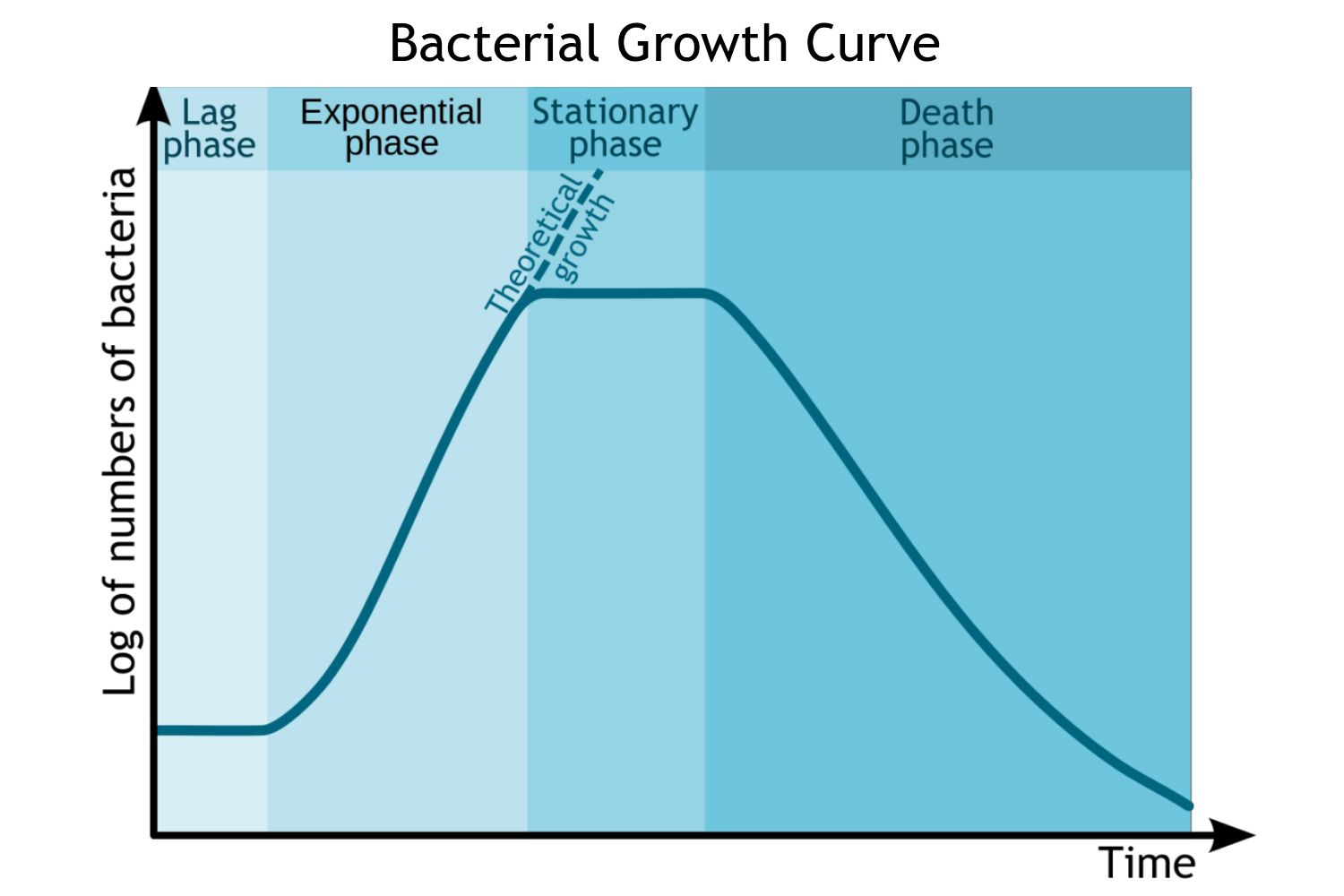
⭐ The four phases of a typical bacterial growth curve are lag, log (exponential), stationary, and death phase; generation time is shortest in the log phase.
Loading diagram…
- Metabolism & Energy:
- Catabolism: Breakdown for energy (ATP). Pathways: Glycolysis, Kreb's cycle (TCA), Oxidative phosphorylation (aerobes).
- Anabolism: Biosynthesis using energy.
- Fermentation: Anaerobic ATP generation, organic end products (e.g., lactate, ethanol).
Bacterial Physiology and Metabolism - Gateway Guardians
- Nutrient Uptake Mechanisms: Crucial for bacterial survival and growth.
- Passive Transport: No energy required.
- Simple Diffusion: Movement of small molecules (e.g., $O_2$, $CO_2$) down concentration gradient.
- Facilitated Diffusion: Carrier protein mediated (e.g., glycerol transport); no metabolic energy.
- Active Transport: Energy-dependent; moves solutes against gradient.
- Primary Active Transport: Uses ATP directly (e.g., ABC transporters).
- Secondary Active Transport: Uses ion gradients (e.g., symport, antiport).
- Group Translocation: Substrate is chemically modified during transport.
⭐ The phosphotransferase system (PTS) is a unique group translocation mechanism in many bacteria, which chemically modifies the substrate (e.g., glucose by phosphorylation) as it is transported across the cell membrane.
- Passive Transport: No energy required.

Loading diagram…
- Key Metabolic Pathways: Glycolysis, TCA cycle, Oxidative phosphorylation (brief overview).
Bacterial Physiology and Metabolism - Powerhouse Pathways
- Primary Goal: Efficient ATP synthesis via nutrient catabolism.
- Aerobic Respiration: Key pathway for maximal energy extraction.
- 1. Glycolysis (EMP pathway): Glucose breakdown to Pyruvate.
- Location: Cytoplasm.
- Net yield: 2 ATP, 2 NADH.
- 2. Pyruvate Decarboxylation (Link Reaction): Pyruvate to Acetyl-CoA.
- Yields: NADH, CO₂.
- 3. TCA Cycle (Krebs Cycle): Acetyl-CoA fully oxidized to CO₂.
- Location: Cytoplasm (prokaryotes).
- Generates: ATP (as GTP), multiple NADH, FADH₂.
- 4. Oxidative Phosphorylation:
⭐ In prokaryotes, the Electron Transport Chain (ETC) and ATP synthesis are coupled on the cytoplasmic membrane, generating a Proton Motive Force (PMF). This differs from eukaryotes (mitochondria).
- Electrons from NADH/FADH₂ pass through ETC; O₂ is terminal acceptor.
- PMF powers ATP synthase, producing ~30-32 ATP per glucose.
- 1. Glycolysis (EMP pathway): Glucose breakdown to Pyruvate.
Loading diagram…
Bacterial Physiology and Metabolism - Life Without Air
-
Anaerobic Respiration:
- Final electron acceptor: Inorganic molecules ($NO_3^-$, $SO_4^{2-}$, $CO_2$), not $O_2$.
- ATP yield: > Fermentation, < Aerobic.
-
Fermentation:
- No ETC; ATP via substrate-level phosphorylation.
- Low ATP yield (e.g., 2 ATP/glucose).
- Regenerates $NAD^+$ from $NADH$ for glycolysis.
- End products: Acids (lactic), alcohols (ethanol), gases.
⭐ Fermentation regenerates $NAD^+$, enabling glycolysis without $O_2$, yielding minimal ATP (typically 2 ATP/glucose).
-
Oxygen Tolerance:
- Obligate Anaerobes: $O_2$ toxic (e.g., Clostridium). Lack catalase, SOD. (📌 ABC: Actinomyces, Bacteroides, Clostridium)
- Aerotolerant: Tolerate $O_2$, don't use it.
- Facultative: Switch metabolisms (e.g., E. coli).
Loading diagram…
High‑Yield Points - ⚡ Biggest Takeaways
- Growth curve: Lag, Log, Stationary, Death phases.
- Obligate aerobes (e.g., M. tb) need O2; Obligate anaerobes (e.g., Clostridium) killed by O2.
- Facultative anaerobes (e.g., E. coli) prefer O2, can grow without. Aerotolerant ignore O2.
- ATP generation: Substrate-level phosphorylation and oxidative phosphorylation are key.
- Fermentation: Anaerobic, regenerates NAD+, yields diverse organic end products.
- Bacterial spores (Bacillus, Clostridium): Dormant, highly resistant, contain calcium dipicolinate.
- Nutrient transport: Includes active transport, passive/facilitated diffusion, and group translocation (e.g., PTS).
Unlock the full lesson and continue reading
Signup to continue reading this lesson and unlimited access questions, flashcards, AI notes, and more
