Cancer Biology and Carcinogenesis Indian Medical PG Practice Questions and MCQs
Practice Indian Medical PG questions for Cancer Biology and Carcinogenesis. These multiple choice questions (MCQs) cover important concepts and help you prepare for your exams.
Cancer Biology and Carcinogenesis Indian Medical PG Question 1: Gastric carcinoma is associated with all of the following EXCEPT:
- A. Over expression of C-met
- B. Inactivation of p53
- C. Over expression of C-erb
- D. Activation of RAS (Correct Answer)
Cancer Biology and Carcinogenesis Explanation: ***Activation of RAS***
- **RAS mutations** are relatively uncommon in gastric carcinoma compared to other gastrointestinal malignancies. While KRAS mutations can occur in approximately 10-15% of gastric cancers (particularly intestinal type), they are **far less frequent** than in **pancreatic adenocarcinoma** (~90%) or **colorectal carcinoma** (~40%).
- In the context of gastric carcinoma, RAS pathway alterations are **not considered a major oncogenic driver** compared to the other molecular changes listed, making this the **LEAST characteristically associated** alteration.
*Inactivation of p53*
- **Inactivation of the p53 tumor suppressor gene** is one of the most frequent molecular events in gastric carcinoma, occurring in approximately **50-60% of cases**.
- Loss of p53 function leads to genomic instability, uncontrolled cell proliferation, and resistance to apoptosis, contributing significantly to **tumorigenesis** and **poor prognosis**.
*Over expression of C-met*
- **Overexpression of C-MET**, a receptor tyrosine kinase for hepatocyte growth factor (HGF), is commonly observed in gastric carcinoma (30-40% of cases) and is strongly linked to **tumor growth**, **invasion**, and **metastasis**.
- C-MET amplification and overexpression promote cell proliferation, survival, migration, and angiogenesis, making it an important **therapeutic target** in advanced gastric cancer.
*Over expression of C-erb*
- **Overexpression of C-erbB-2 (HER2/neu)** is found in approximately **10-20% of gastric adenocarcinomas**, particularly the intestinal type.
- HER2 amplification or overexpression is a significant **prognostic and predictive biomarker**, and is specifically targeted by **trastuzumab** (Herceptin) therapy in HER2-positive advanced gastric cancer, improving survival outcomes.
Cancer Biology and Carcinogenesis Indian Medical PG Question 2: Cancer cells preferentially utilize glycolysis for energy production even in the presence of adequate oxygen. What is this phenomenon called?
- A. Warburg effect (Correct Answer)
- B. Hypoxic adaptation
- C. Anoxic survival
- D. Oxygen-independent metabolism
Cancer Biology and Carcinogenesis Explanation: ***Warburg***
- The **Warburg effect** describes how cancer cells preferentially use glycolysis for energy production even in the presence of oxygen, allowing them to thrive in **hypoxic conditions** [1].
- This metabolic adaptation supports **cell proliferation** and survival in tumor microenvironments where oxygen is limited [1][3].
- Cancer cells upregulate glucose uptake and express specific metabolic enzymes like the M2 isoform of pyruvate kinase that facilitate this altered metabolism [2][4].
*Wanton*
- This term typically refers to recklessness or extravagance and is not used in the context of cancer metabolism or hypoxia.
- There are no associations with **cancer cell adaptation** under adverse environmental conditions.
*Wormian*
- **Wormian bones** are extra bone pieces within sutures of the skull, unrelated to cancer cell metabolism or survival mechanisms.
- This term does not connect to **hypoxia** or metabolic adaptations in cancer biology.
*Wolf*
- "Wolf" has no recognized connection to cancer cell biology, particularly regarding metabolic adaptations under **hypoxic stress**.
- It does not imply any concept associated with how cancer cells cope with adverse conditions.
**References:**
[1] Kumar V, Abbas AK, et al.. Robbins and Cotran Pathologic Basis of Disease. 9th ed. Neoplasia, pp. 307-308.
[2] Kumar V, Abbas AK, et al.. Robbins and Cotran Pathologic Basis of Disease. 9th ed. Neoplasia, pp. 308-310.
[3] Kumar V, Abbas AK, et al.. Robbins and Cotran Pathologic Basis of Disease. 9th ed. Neoplasia, pp. 290-291.
[4] Kumar V, Abbas AK, et al.. Robbins and Cotran Pathologic Basis of Disease. 9th ed. With Illustrations By, pp. 26-27.
Cancer Biology and Carcinogenesis Indian Medical PG Question 3: A researcher is studying the interactions between foreign antigens and human immune cells. She has isolated a line of lymphocytes that is known to bind antigen-presenting cells. From this cell line, she has isolated a cell surface protein that binds to class I major histocompatibility complex molecules. The continued activation, proliferation and survival of this specific cell line requires which of the following signaling molecules?
- A. Interleukin 1
- B. Interleukin 4
- C. Interleukin 2 (Correct Answer)
- D. Interleukin 8
- E. Interleukin 6
Cancer Biology and Carcinogenesis Explanation: ***Interleukin 2***
- The description of the lymphocyte binding the **constant portion of MHC class I** and requiring a signaling molecule for activation, proliferation, and survival points to a **T cell**.
- **Interleukin-2 (IL-2)** is a crucial cytokine for the proliferation, differentiation, and survival of T lymphocytes, acting in an autocrine or paracrine fashion after T cell activation.
*Interleukin 1*
- **Interleukin-1 (IL-1)** is primarily involved in inflammation and fever, produced by macrophages and other innate immune cells.
- While it can act as a costimulator for T cells, it is not the primary cytokine required for their sustained proliferation and survival after initial activation.
*Interleukin 4*
- **Interleukin-4 (IL-4)** is a key cytokine in humoral immunity, promoting B cell proliferation and differentiation, and inducing IgE class switching.
- It also plays a role in the differentiation of naive T cells into **Th2 cells**, but it is not the main cytokine for general T cell proliferation and survival.
*Interleukin 8*
- **Interleukin-8 (IL-8)**, also known as CXCL8, is a chemokine primarily responsible for attracting and activating neutrophils to sites of infection or inflammation.
- It does not have a direct role in the sustained proliferation and survival of activated lymphocytes.
*Interleukin 6*
- **Interleukin-6 (IL-6)** is a pleiotropic cytokine involved in acute phase reactions, hematopoiesis, and the immune response, particularly B cell differentiation and antibody production.
- Although it can influence T cell responses, it is not the primary growth factor for activated T lymphocytes as IL-2 is.
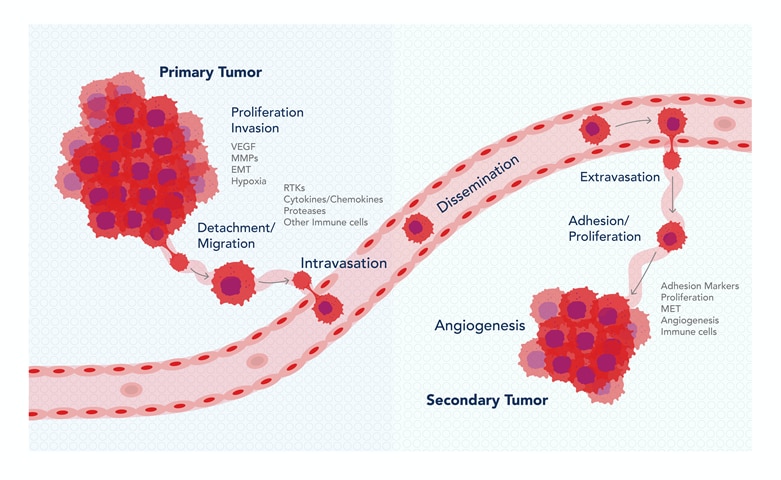
Cancer Biology and Carcinogenesis Indian Medical PG Question 4: Which of the following is the most critical factor in the tumor metastasis cascade?
- A. E-Cadherin (Correct Answer)
- B. Type IV collagenase
- C. Tyrosine kinase
- D. Fibronectin
Cancer Biology and Carcinogenesis Explanation: ***E-Cadherin***
- E-Cadherin plays a crucial role in **cell-cell adhesion**, maintaining the integrity of epithelial tissues, and is notably downregulated during epithelial-mesenchymal transition (EMT) in tumor metastasis [1][3].
- Loss of E-Cadherin promotes **invasiveness** and the ability of cancer cells to enter the bloodstream for metastasis [1][3].
*Fibronectin*
- While involved in the **extracellular matrix**, it mainly supports cell adhesion and migration but is not specifically tied to the cascade of tumor metastasis [2].
- It does not directly influence the **cellular changes** needed for metastasis like EMT does.
*Type IV collagenase*
- Type IV collagenase is important for **degrading basement membranes**, but is not as directly involved in the initial stages of **tumor cell dissemination** as E-Cadherin [2][3].
- Its role is more supportive in the context of **tissue remodeling** rather than in the metastatic cascade itself [2].
*Tyrosine kinase*
- Tyrosine kinases are involved in **signal transduction** and cellular communication but are not a structural component in the metastasis cascade [2].
- While they may modulate pathways that affect metastasis, they do not directly facilitate cell adhesion or detachment processes essential for initial metastasis [3].
**References:**
[1] Kumar V, Abbas AK, et al.. Robbins and Cotran Pathologic Basis of Disease. 9th ed. Neoplasia, pp. 317-318.
[2] Cross SS. Underwood's Pathology: A Clinical Approach. 6th ed. (Basic Pathology) introduces the student to key general principles of pathology, both as a medical science and as a clinical activity with a vital role in patient care. Part 2 (Disease Mechanisms) provides fundamental knowledge about the cellular and molecular processes involved in diseases, providing the rationale for their treatment. Part 3 (Systematic Pathology) deals in detail with specific diseases, with emphasis on the clinically important aspects., pp. 233-234.
[3] Kumar V, Abbas AK, et al.. Robbins and Cotran Pathologic Basis of Disease. 9th ed. Neoplasia, pp. 314-316.
Cancer Biology and Carcinogenesis Indian Medical PG Question 5: The carcinogenic chemical that has a very long latent period is –
- A. Benzopyrene
- B. Asbestos (Correct Answer)
- C. Vinyl chloride
- D. Estrogens
Cancer Biology and Carcinogenesis Explanation: ***Asbestos***
- Asbestos exposure is famously associated with a **very long latent period** (often 20-50 years) before the development of cancers like **mesothelioma** and lung cancer.
- This characteristic makes it challenging to link past exposure directly to current disease, leading to significant public health and legal implications.
*Benzopyrene*
- Benzopyrene (a polycyclic aromatic hydrocarbon found in cigarette smoke and industrial emissions) is a potent carcinogen, but its latency period, while significant, is generally shorter than that of asbestos.
- It is primarily associated with **lung cancer** and other cancers related to direct exposure.
*Vinyl chloride*
- Vinyl chloride is a well-known carcinogen, primarily implicated in **hepatic angiosarcoma**; however, its latent period is typically shorter than that observed with asbestos exposure.
- Exposure is usually occupational, and the associated cancers often manifest within 10-20 years.
*Estrogens*
- Estrogens, particularly prolonged or unopposed exposure (e.g., in some hormone replacement therapies or conditions like obesity), are linked to an increased risk of **endometrial** and **breast cancers**.
- While these cancers have latent periods, they are generally not as exceptionally long as those associated with asbestos.
Cancer Biology and Carcinogenesis Indian Medical PG Question 6: Identify the gene commonly involved in the condition shown in the image?
- A. RAS
- B. RET
- C. BRAF V600E (Correct Answer)
- D. P53
Cancer Biology and Carcinogenesis Explanation: ***BRAF V600E***
- The image displays cells with **Langerhans cell morphology**, including folded nuclei and abundant pale cytoplasm, which are characteristic of **Langerhans cell histiocytosis (LCH)** [1].
- The **BRAF V600E mutation** is the most common genetic alteration found in LCH, present in about 50-60% of cases and activating the MAPK pathway [1].
*RAS*
- **RAS mutations** are frequently seen in various cancers, including colorectal adenocarcinoma, pancreatic adenocarcinoma, and non-small cell lung cancer.
- While RAS pathway activation can occur in LCH, a direct RAS mutation is not the most common genetic driver; rather, downstream effectors like BRAF V600E are more prominent [1].
*RET*
- **RET mutations** are primarily associated with **medullary thyroid carcinoma** (in both sporadic and inherited forms like MEN 2A and MEN 2B) and can also be found in certain types of lung cancer.
- They are not a characteristic genetic alteration for Langerhans cell histiocytosis.
*P53*
- The **TP53 gene** encodes the tumor suppressor protein p53, and mutations in this gene are among the most frequent genetic alterations across a wide spectrum of human cancers.
- Although p53 plays a critical role in cell cycle regulation and apoptosis, it is not a primary or common driver mutation specifically associated with Langerhans cell histiocytosis [1].
**References:**
[1] Kumar V, Abbas AK, et al.. Robbins and Cotran Pathologic Basis of Disease. 9th ed. Diseases of White Blood Cells, Lymph Nodes, Spleen, and Thymus, pp. 629-630.
Cancer Biology and Carcinogenesis Indian Medical PG Question 7: The strongest occupational risk factor for hematological carcinoma is
- A. Benzene (Correct Answer)
- B. Lithium
- C. Radiation exposure
- D. Cigarette smoke
Cancer Biology and Carcinogenesis Explanation: ***Benzene***
- Benzene exposure is recognized as a potent **carcinogen** linked to various hematological malignancies, including **leukemia** [1].
- It affects the **bone marrow**, leading to dysplastic changes and ultimately malignancy.
*Nicotine*
- Although nicotine is associated with **smoking-related cancers**, it is not directly linked to **hematological carcinomas**.
- Its primary role is in causing **lung cancer**, rather than blood cancers.
*Lithium*
- Lithium is primarily used for **bipolar disorder** and does not have a known link to causing hematological malignancies.
- Side effects are more related to **nephrotoxicity** rather than carcinogenic effects.
*Alcohol*
- Alcohol consumption is primarily associated with **liver cancers** and not specifically linked to hematological carcinomas [2].
- It can contribute to general malignancy development but is not a direct cause of blood cancers.
**References:**
[1] Kumar V, Abbas AK, et al.. Robbins and Cotran Pathologic Basis of Disease. 9th ed. Neoplasia, p. 286.
[2] Cross SS. Underwood's Pathology: A Clinical Approach. 6th ed. (Basic Pathology) introduces the student to key general principles of pathology, both as a medical science and as a clinical activity with a vital role in patient care. Part 2 (Disease Mechanisms) provides fundamental knowledge about the cellular and molecular processes involved in diseases, providing the rationale for their treatment. Part 3 (Systematic Pathology) deals in detail with specific diseases, with emphasis on the clinically important aspects., pp. 217-218.
Cancer Biology and Carcinogenesis Indian Medical PG Question 8: Which of the following is an oncogene?
- A. WT-1
- B. Rb
- C. p53
- D. RAS (Correct Answer)
Cancer Biology and Carcinogenesis Explanation: ***RAS***
- RAS is an **oncogene**, not a tumor suppressor gene; it promotes cell proliferation and survival [1].
- Mutations in RAS lead to uncontrolled cell division, contributing to various cancers.
*p53*
- p53 is a crucial **tumor suppressor gene** responsible for regulating the cell cycle and preventing tumor formation [1,2].
- It functions by inducing apoptosis in cells with damaged DNA, preventing their proliferation [2].
*WT-1*
- WT-1 is a **tumor suppressor gene** associated with Wilms' tumor and regulates kidney and gonadal development.
- It plays a role in cell growth and differentiation, preventing tumorigenesis when functioning correctly.
*Rb*
- The Rb gene encodes the **retinoblastoma protein**, a key tumor suppressor that regulates the cell cycle by inhibiting cell division [1,2].
- Loss of Rb function is primarily associated with retinoblastoma and other cancers, indicating its critical role in tumor suppression [1,2].
**References:**
[1] Kumar V, Abbas AK, et al.. Robbins and Cotran Pathologic Basis of Disease. 9th ed. Neoplasia, pp. 297-301.
[2] Cross SS. Underwood's Pathology: A Clinical Approach. 6th ed. (Basic Pathology) introduces the student to key general principles of pathology, both as a medical science and as a clinical activity with a vital role in patient care. Part 2 (Disease Mechanisms) provides fundamental knowledge about the cellular and molecular processes involved in diseases, providing the rationale for their treatment. Part 3 (Systematic Pathology) deals in detail with specific diseases, with emphasis on the clinically important aspects., pp. 227-228.
Cancer Biology and Carcinogenesis Indian Medical PG Question 9: Transition from G2 to M phase of the cell cycle is controlled by which?
- A. Retinoblastoma gene product
- B. p53 protein
- C. Cyclin E
- D. Cyclin B (Correct Answer)
Cancer Biology and Carcinogenesis Explanation: ***Cyclin B***
- The transition from G2 to M phase is primarily controlled by the **maturation-promoting factor (MPF)**, which is a complex of **cyclin B** and **CDK1 (cyclin-dependent kinase 1)**.
- **Cyclin B** levels rise during G2 and peak at M phase, activating CDK1 to initiate mitosis.
*Retinoblastoma gene product*
- The **retinoblastoma (Rb) protein** primarily regulates the G1/S transition by inhibiting the E2F transcription factor.
- It acts as a **tumor suppressor**, preventing uncontrolled cell proliferation.
*p53 protein*
- The **p53 protein** is a critical **tumor suppressor** that monitors DNA integrity at various cell cycle checkpoints, particularly G1/S and G2/M.
- If DNA damage is detected, p53 can induce cell cycle arrest and/or apoptosis, but it is not directly responsible for initiating M phase.
*Cyclin E*
- **Cyclin E** is essential for the **G1/S transition**, forming a complex with CDK2 to initiate DNA replication.
- Its activity peaks during late G1 and early S phase, not during the G2/M transition.
Cancer Biology and Carcinogenesis Indian Medical PG Question 10: Metastases from follicular carcinoma should be treated by:
- A. Radioiodine (Correct Answer)
- B. Surgery
- C. Thyroxine
- D. Observation
Cancer Biology and Carcinogenesis Explanation: ***Radioiodine***
- **Differentiated thyroid cancers**, including **follicular carcinoma**, retain the ability to uptake iodine, making **radioiodine (I-131) therapy** highly effective for treating metastases [1].
- This therapy targets and destroys thyroid cancer cells wherever they are located in the body, including distant metastatic sites.
*Surgery*
- While surgery (e.g., **thyroidectomy**) is the primary treatment for localized thyroid cancer and can be used to resect some metastases, it is **not always feasible** for all metastatic sites, especially widely disseminated disease.
- Surgery for widespread metastases carries significant risks and may not be curative if all tumor burden cannot be removed.
*Thyroxine*
- **Thyroxine (T4)** replacement therapy is crucial after thyroidectomy to replace missing hormones and to **suppress TSH** production, which can stimulate residual cancer growth [1].
- However, thyroxine itself does **not directly destroy** existing metastases; it's a supportive and suppressive therapy, not a primary treatment for metastases.
*Observation*
- **Observation** is generally not appropriate for treating metastases from **follicular carcinoma**, as these metastases have the potential to grow and lead to significant morbidity and mortality if left untreated.
- Active treatment is usually indicated to improve prognosis and quality of life.
More Cancer Biology and Carcinogenesis Indian Medical PG questions available in the OnCourse app. Practice MCQs, flashcards, and get detailed explanations.