Liver Diseases and Cirrhosis Indian Medical PG Practice Questions and MCQs
Practice Indian Medical PG questions for Liver Diseases and Cirrhosis. These multiple choice questions (MCQs) cover important concepts and help you prepare for your exams.
Liver Diseases and Cirrhosis Indian Medical PG Question 1: A 55-year-old man with cirrhosis develops ascites. Which of the following is a poor prognostic indicator in this patient?
- A. Serum sodium <130 mEq/L (Correct Answer)
- B. Elevated AST and ALT
- C. Serum albumin >3 g/dL
- D. Mild hepatic encephalopathy
Liver Diseases and Cirrhosis Explanation: ***Serum sodium <130 mEq/L***
- **Hyponatremia** (serum sodium <130 mEq/L) in cirrhosis is a strong independent predictor of **poor prognosis** and is associated with increased mortality due to its reflection of severe liver dysfunction and fluid retention [1].
- It often indicates **dilutional hyponatremia** due to impaired free water excretion and high levels of ADH, contributing to increased risk of complications like **hepatic encephalopathy** and **hepatorenal syndrome** [1].
*Elevated AST and ALT*
- While elevated **AST** (aspartate aminotransferase) and **ALT** (alanine aminotransferase) indicate **hepatocellular injury**, their prognostic value in advanced cirrhosis with ascites is often limited as they may normalize or even decrease with severe liver failure due to fewer viable hepatocytes [1].
- In end-stage liver disease, these enzymes are not as reliable as synthetic function tests (e.g., INR, albumin) or other markers of liver decompensation for assessing prognosis [1].
*Serum albumin >3 g/dL*
- A serum albumin greater than 3 g/dL generally indicates **better preserved liver synthetic function** compared to lower levels, which is considered a relatively good prognostic sign, not a poor one.
- Low albumin is a hallmark of **decompensated cirrhosis** and is typically associated with worse outcomes, including increased risk of ascites, edema, and mortality [1].
*Mild hepatic encephalopathy*
- While hepatic encephalopathy is a complication of cirrhosis, **mild hepatic encephalopathy** (e.g., Grade 1 or 2, which are often reversible with treatment) is generally not considered as poor a prognostic indicator as severe hyponatremia [1].
- Although it points to liver dysfunction, its impact on immediate mortality is less direct compared to severe systemic complications like profound dilutional hyponatremia [1].
Liver Diseases and Cirrhosis Indian Medical PG Question 2: Which of the following conditions is a known precipitating factor for hepatic encephalopathy?
- A. Increased potassium
- B. Constipation
- C. Dehydration
- D. Gastrointestinal bleeding (Correct Answer)
Liver Diseases and Cirrhosis Explanation: **Gastrointestinal bleeding**
- **Gastrointestinal bleeding** leads to an increased protein load in the intestines (from blood), which is then broken down by bacteria into **ammonia** [1].
- This elevated ammonia level overwhelms the liver's capacity to detoxify it, leading to its accumulation in the systemic circulation and subsequent entry into the brain, causing **hepatic encephalopathy** [1].
*Increased potassium*
- While electrolyte imbalances can affect neurological function, **hyperkalemia** (increased potassium) is not a direct or prominent precipitating factor for hepatic encephalopathy.
- Hyperkalemia primarily affects **cardiac and neuromuscular excitability**, rather than ammonia metabolism.
*Constipation*
- **Constipation** prolongs the transit time of stool in the colon, allowing more time for gut bacteria to produce **ammonia** from protein breakdown [1].
- This increased production of ammonia contributes to its accumulation and can precipitate or worsen hepatic encephalopathy, but it is not the most significant factor like GI bleeding. (The question is which of the following is THE precipitating factor for HE, not the other way around)
*Dehydration*
- **Dehydration** can lead to **prerenal azotemia** and hemoconcentration, which may increase the blood urea nitrogen (BUN) and worsen renal function.
- While dehydration can indirectly affect the body's ability to clear toxins, it is not a direct precipitating factor for hepatic encephalopathy in the same way as increased ammonia production or reduced effective circulating volume.
Liver Diseases and Cirrhosis Indian Medical PG Question 3: How does liver cirrhosis contribute to the development of edema?
- A. Increased capillary permeability
- B. Increased salt intake
- C. Increased cardiac output
- D. Decreased albumin production (Correct Answer)
Liver Diseases and Cirrhosis Explanation: ***Decreased albumin production***
- The **liver** is the primary site of **albumin synthesis** [2]. In cirrhosis, liver damage impairs this synthetic function, leading to **hypoalbuminemia** (low serum albumin).
- Albumin is a major contributor to **plasma oncotic pressure**. Reduced oncotic pressure causes fluid to shift from the intravascular space into the interstitial space, resulting in **edema and ascites** [1].
*Increased capillary permeability*
- While increased capillary permeability can cause edema, it is **not the primary mechanism** by which liver cirrhosis leads to edema.
- Conditions like severe inflammation or sepsis are more commonly associated with widespread increases in capillary permeability.
*Increased salt intake*
- Although excessive **sodium intake** can worsen edema in patients with cirrhosis, it is **not the fundamental cause** of edema related to the underlying liver disease.
- The edema in cirrhosis is primarily due to fluid retention mechanisms driven by liver dysfunction, rather than mere dietary intake.
*Increased cardiac output*
- In advanced cirrhosis, patients often develop a **hyperdynamic circulatory state** characterized by increased cardiac output and systemic vasodilation.
- While this circulatory dysfunction contributes to fluid retention through activation of neurohormonal systems, it is **not the direct cause** of edema as a primary mechanism of fluid extravasation, which is largely driven by decreased oncotic pressure and portal hypertension [3].
Liver Diseases and Cirrhosis Indian Medical PG Question 4: All of the following are complications of cirrhosis, EXCEPT:
- A. Spontaneous bacterial peritonitis
- B. Portal hypertension
- C. Hepatic encephalopathy
- D. Hypercalcemia (Correct Answer)
Liver Diseases and Cirrhosis Explanation: ***Hypercalcemia***
- While liver disease can lead to **metabolic derangements**, severe hypercalcemia is not a direct or typical complication of **cirrhosis** itself.
- Causes of hypercalcemia are usually related to **parathyroid dysfunction**, **malignancy**, or specific drug effects.
*Spontaneous bacterial peritonitis*
- This is a common and serious infection of the **ascitic fluid** that occurs in patients with cirrhosis, often without an obvious source of infection.
- It is a direct consequence of impaired immune function and bacterial translocation in **advanced liver disease**.
*Portal hypertension*
- This condition is a hallmark of cirrhosis, resulting from increased resistance to blood flow through the fibrotic liver [1].
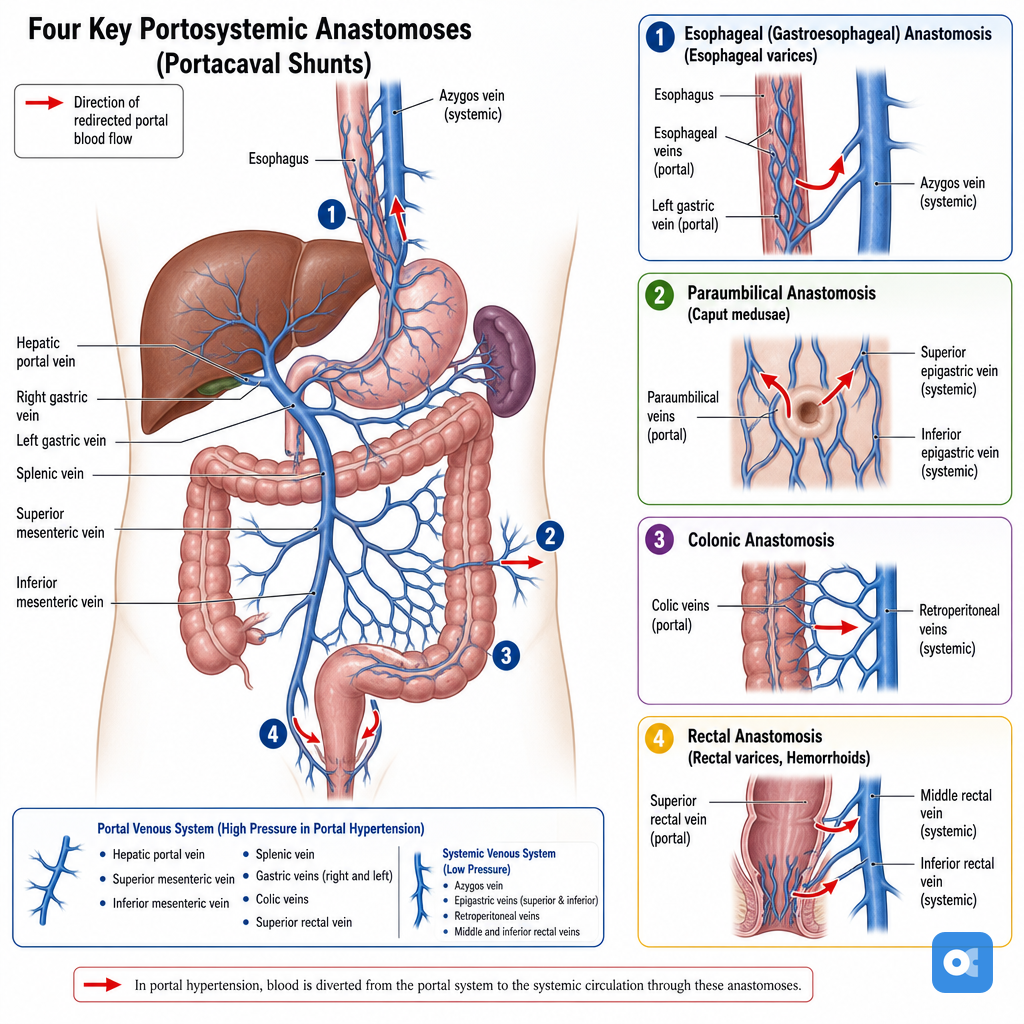
- It leads to many other complications such as **ascites**, **esophageal varices**, and **splenomegaly** [1].
*Hepatic encephalopathy*
- This is a neuropsychiatric syndrome caused by the accumulation of toxins normally cleared by the liver, such as **ammonia**, in the systemic circulation [1].
- It is a significant complication of **cirrhosis** and often indicates advanced liver failure [1].
Liver Diseases and Cirrhosis Indian Medical PG Question 5: Use of spironolactone in liver cirrhosis is
- A. Decrease edema (Correct Answer)
- B. May improve liver function indirectly
- C. May decrease afterload
- D. May decrease intravascular volume
Liver Diseases and Cirrhosis Explanation: ***Decrease edema***
- Spironolactone is an **aldosterone antagonist** that blocks the effects of aldosterone, which is often elevated in liver cirrhosis.
- By antagonizing aldosterone, spironolactone promotes **sodium and water excretion**, directly leading to a reduction in **ascites and peripheral edema** [1].
*May improve liver function indirectly*
- While spironolactone manages complications of liver cirrhosis, it does **not directly improve liver function** or reverse liver damage.
- Its primary role is in **symptom management**, particularly fluid retention, not in healing the underlying liver disease.
*May decrease afterload*
- Spironolactone's primary action is on the **kidneys** to promote diuresis; it is **not a vasodilator** and therefore does not directly decrease cardiac afterload.
- Any effect on systemic vascular resistance would be minimal and secondary to volume changes rather than a direct vasodilatory property.
*May decrease intravascular volume*
- Spironolactone **decreases total body sodium and water**, leading to a reduction in extravascular fluid (edema and ascites) [1].
- While it decreases the total amount of fluid in the body, its main effect is on **extravascular volume**, and it's chosen over loop diuretics in cirrhosis to prevent **excessive intravascular depletion** which can worsen renal function.
Liver Diseases and Cirrhosis Indian Medical PG Question 6: A patient with known cirrhosis presents with jaundice and abdominal distention. Ultrasound reveals ascites and splenomegaly. What is the most likely cause of his ascites?
- A. Portal hypertension (Correct Answer)
- B. Peritoneal carcinomatosis
- C. Nephrotic syndrome
- D. Congestive heart failure
Liver Diseases and Cirrhosis Explanation: ***Portal hypertension***
- In cirrhosis, **fibrosis** and **regenerative nodules** increase resistance to blood flow through the liver, leading to **portal hypertension** [1].
- This increased pressure in the portal venous system, combined with **splanchnic vasodilation** and **renal sodium retention**, drives the transudation of fluid into the peritoneal cavity, forming ascites [1].
*Peritoneal carcinomatosis*
- This would typically result in **exudative ascites**, often with a high protein content and positive cytology for malignant cells [1].
- While it can cause abdominal distention, it is not directly linked to the pathology of **cirrhosis** and **splenomegaly** as the primary cause of ascites in this context.
*Nephrotic syndrome*
- Characterized by **massive proteinuria**, **hypoalbuminemia**, and **generalized edema**, including ascites.
- While it causes fluid retention, the clinical picture of **jaundice** and **splenomegaly** strongly points to liver pathology rather than primary renal disease [1].
*Congestive heart failure*
- Can cause **dependent edema** and ascites due to elevated systemic venous pressures, but typically presents with other signs like **dyspnea**, orthopnea, and pulmonary edema [1].
- The patient's history of **cirrhosis** and the presence of **splenomegaly** make portal hypertension a significantly more likely cause of ascites [1].
Liver Diseases and Cirrhosis Indian Medical PG Question 7: Plasma cholinesterase levels are affected by various conditions. Which of the following conditions does not typically reduce plasma cholinesterase levels?
- A. Pregnancy
- B. Liver disease
- C. Malnutrition
- D. Chronic renal failure (Correct Answer)
Liver Diseases and Cirrhosis Explanation: ***Chronic renal failure***
- While chronic renal failure can cause various metabolic derangements, it does not typically lead to a significant **reduction in plasma cholinesterase levels**.
- Plasma cholinesterase is primarily synthesized in the liver, and its levels are more directly impacted by conditions affecting **liver function** or **protein synthesis** [1].
*Pregnancy*
- **Plasma cholinesterase levels** are known to decrease during normal pregnancy, particularly in the third trimester.
- This reduction is thought to be due to **hormonal changes** and possibly increased plasma volume.
*Liver disease*
- Since plasma cholinesterase is synthesized in the **liver**, severe **liver disease** (e.g., cirrhosis, acute hepatitis) significantly impairs its production [1].
- This leads to a marked **reduction in circulating enzyme levels**, which can affect drug metabolism [1].
*Malnutrition*
- **Severe malnutrition**, especially protein-calorie malnutrition, can lead to decreased synthesis of many proteins, including plasma cholinesterase.
- This is because the body lacks the necessary **amino acids** for enzyme production.
Liver Diseases and Cirrhosis Indian Medical PG Question 8: To differentiate pancreatic ascites from ascites secondary to cirrhosis of the liver, the most important test is :
- A. Abdominal ultrasound
- B. Endoscopic retrograde cholangio pancreatography (ERCP)
- C. Computed tomogram (CT) scan
- D. Abdominal paracentesis (Correct Answer)
Liver Diseases and Cirrhosis Explanation: ***Abdominal paracentesis***
- This procedure involves analyzing the **ascitic fluid**, which is crucial for distinguishing between pancreatic ascites and cirrhosis-related ascites [1].
- In **pancreatic ascites**, the fluid will have a very high **amylase** content and often a high protein level (>2.5 g/dL), whereas in **cirrhosis**, the amylase is typically normal and the protein is usually low (<2.5 g/dL) [1].
*Abdominal ultrasound*
- While useful for detecting ascites and underlying liver disease (cirrhosis), it cannot definitively determine the **cause of ascites** or the specific content of the ascitic fluid [2].
- Ultrasound can visualize the pancreas but cannot reliably differentiate pancreatic ascites from other causes without **fluid analysis**.
*Endoscopic retrograde cholangiopancreatography (ERCP)*
- This is an **invasive procedure** primarily used for diagnosing and treating disorders of the bile ducts and pancreatic duct, such as strictures or stones.
- It is not the most important or initial test for differentiating the cause of ascites, as its main role is in identifying **ductal leaks** that might lead to pancreatic ascites, rather than direct fluid analysis.
*Computed tomogram (CT) scan*
- CT can confirm the presence of ascites, evaluate the **pancreas** for inflammation or pseudocysts, and assess the **liver** for signs of cirrhosis [2].
- However, like ultrasound, a CT scan cannot provide the definitive **biochemical analysis** of the ascitic fluid that is necessary to distinguish pancreatic ascites from other causes.
Liver Diseases and Cirrhosis Indian Medical PG Question 9: A gentleman of 48 years was being worked up for hepatocellular function. He had no history or signs of encephalopathy. His serum bilirubin was 5 mg%, serum albumin was 3.9 gm%, International normalized ratio was 1.6. On ultrasound no free fluid was detected inside abdomen. As per Child-Turcotte-Pugh (CTP) classification, he was in:
- A. CTP–D
- B. CTP–A
- C. CTP–B (Correct Answer)
- D. CTP–C
Liver Diseases and Cirrhosis Explanation: CTP–B
- This patient scores 2 points for bilirubin (3.5-5 mg%), 1 point for albumin (>3.5 gm%), 2 points for INR (1.7-2.3), 1 point for no encephalopathy, and 1 point for no ascites. This sums to **7 points**, which falls into the **CTP Class B** range (7-9 points).
- The CTP classification is used to assess the prognosis of **chronic liver disease**, primarily **cirrhosis**, based on five clinical and laboratory criteria [1].
CTP–D
- The CTP classification only includes A, B, and C; there is no CTP–D class.
- This option is incorrect as it represents a classification that does not exist within the CTP scoring system.
CTP–A
- CTP Class A requires a total score of 5-6 points, indicating **mild liver dysfunction**.
- This patient's calculated score of 7 points places him beyond the Class A category.
CTP–C
- CTP Class C requires a total score of 10-15 points, indicating **severe liver dysfunction**.
- This patient's score of 7 points is considerably lower than the range for Class C.
Liver Diseases and Cirrhosis Indian Medical PG Question 10: Match List-I with List-II and select the correct answer using the code given below the Lists:
- A. A→1 B→3 C→2 D→4 (Correct Answer)
- B. A→1 B→2 C→3 D→4
- C. A→3 B→2 C→4 D→1
- D. A→4 B→3 C→2 D→1
Liver Diseases and Cirrhosis Explanation: ***A→1 B→3 C→2 D→4***
- Caroli's disease is characterized by **dilatation of intrahepatic bile ducts**, predisposing to **bile stasis**, stone formation, and recurrent **biliary sepsis** with associated abdominal pain.
- Budd-Chiari Syndrome is defined by **hepatic venous outflow obstruction**, leading to symptoms like **ascites**, hepatomegaly, and abdominal pain.
- Polycystic Liver Disease involves the presence of **multiple cysts in the liver**, which can cause **hepatomegaly** and **pain** due to the size and mass effect of the cysts.
- Primary sclerosing cholangitis (PSC) is a **cholestatic liver disease** causing inflammation and fibrosis of the bile ducts, leading to **abnormal liver function tests** (elevated alkaline phosphatase and bilirubin) and often presenting with **jaundice**.
*A→1 B→2 C→3 D→4*
- This option incorrectly matches Budd-Chiari Syndrome with Hepatomegaly, Pain and Polycystic Liver Disease with Ascites.
- The hallmark of Budd-Chiari is venous outflow obstruction leading to **ascites**, while **hepatomegaly and pain** are more characteristic symptoms of Polycystic Liver Disease due to the expanding cysts.
*A→3 B→2 C→4 D→1*
- This option incorrectly associates Caroli's disease with ascites and Primary Sclerosing Cholangitis with Abdominal pain, Biliary sepsis.
- Caroli's disease is primarily characterized by **biliary complications** like cholangitis, not ascites, and ascites is a key feature of Budd-Chiari, not Polycystic Liver Disease.
*A→4 B→3 C→2 D→1*
- This option incorrectly links Caroli's disease with Abnormal LFT/jaundice generally and Primary Sclerosing Cholangitis with Abdominal pain, Biliary sepsis.
- While Caroli's can cause abnormal LFTs and jaundice secondarily to cholangitis, its primary specific presentation involves **recurrent infection (biliary sepsis)**. Primary Sclerosing Cholangitis directly causes **abnormal LFTs and jaundice** due to cholestasis, but it is not commonly associated with abdominal pain and biliary sepsis.
More Liver Diseases and Cirrhosis Indian Medical PG questions available in the OnCourse app. Practice MCQs, flashcards, and get detailed explanations.