

Intro & Classification - Hand's First Drafts
- Embryology: Hand development spans 4th-8th weeks.
- Limb bud appears (4th wk).
- Apical Ectodermal Ridge (AER) for proximo-distal growth.
- Zone of Polarizing Activity (ZPA) for radio-ulnar axis.
- Hand plate forms (5th wk); digital rays separate via apoptosis (6th-8th wk).
- Classification (Modified Swanson/IFSSH):
- I: Failure of Formation (Arrest; e.g., transverse, longitudinal - radial/ulnar clubhand)
- II: Failure of Differentiation (Separation; e.g., syndactyly, camptodactyly, clinodactyly)
- III: Duplication (Polydactyly; preaxial, postaxial, central)
- IV: Overgrowth (Macrodactyly)
- V: Undergrowth (Hypoplasia; e.g., brachydactyly)
- VI: Congenital Constriction Band Syndrome (Amniotic band syndrome)
- VII: Generalized Skeletal Abnormalities/Syndromes

Loading diagram…
⭐ Syndactyly is the most common congenital hand anomaly, most frequently involving the 3rd web space (middle-ring finger).
Formation Failures - Building Blocks Gone Astray
- Arrest in limb development; parts are absent or deficient.
- Transverse Arrests (Congenital Amputations):
- Complete arrest of development beyond a point.
- E.g., Acheiria (hand), Adactyly (digits).
- Often unilateral; resembles amputation stump.
- Cause: Vascular events, teratogens.
⭐ Most common congenital upper limb deficiency: Transverse arrest (below elbow).
- Longitudinal Arrests: Segmental absence along the longitudinal axis.
- Radial Deficiency (Radial Clubhand):
- Partial/complete absence of radius; hand deviates radially.
- Thumb hypoplasia/aplasia frequent.
- Syndromes: VACTERL, Holt-Oram, TAR.
- Ulnar Deficiency (Ulnar Clubhand):
- Partial/complete absence of ulna; ulnar deviation.
- Rarer than radial deficiency.
- Central Deficiency (Cleft Hand/Ectrodactyly):
- Typical 'lobster claw' appearance; absent 3rd ray common.
- Often AD inheritance.
- Radial Deficiency (Radial Clubhand):
Separation & Shape Issues - Fingers Fused & Funky
-
Syndactyly: Most common hand anomaly; failure of interdigital apoptosis.
- Types: Simple (skin), Complex (bone/nail), Complicated (e.g., Apert). 3rd web (Middle-Ring Finger) most common.
- Surgery: Border digits (thumb/index, ring/little) at 6 months; others 18-24 months. Z-plasty, Full-Thickness Skin Grafts (FTSG). ⭐ > Apert syndrome: often complex syndactyly ("mitten hand").
-
Clinodactyly: Radioulnar finger curve, usually 5th finger (radial deviation). Cause: Delta phalanx.
- Assoc: Down syndrome.
- Rx: Observation; osteotomy if >30° & functional issues.
-
Camptodactyly: PIP joint flexion contracture, usually 5th finger.
- Types: Infantile (often bilateral), Adolescent.
- Rx: Splinting, stretching. Surgery (Flexor Digitorum Superficialis release) if refractory.
-
Kirner's Deformity: Palmar/radial curve of 5th finger's distal phalanx.
- Onset ~12 years, often bilateral.
- Rx: Usually none; corrective osteotomy if symptomatic/severe progressive deformity.
Extra Parts & Odd Sizes - More or Mighty Digits
- Polydactyly (Extra Digits)
- Presence of supernumerary digits.
- Classification:
- Preaxial (Radial/Thumb): Wassel Classification (Types I-VII) guides treatment. Most common is Type IV.
- Central (Index, Middle, Ring fingers): Rarest form.
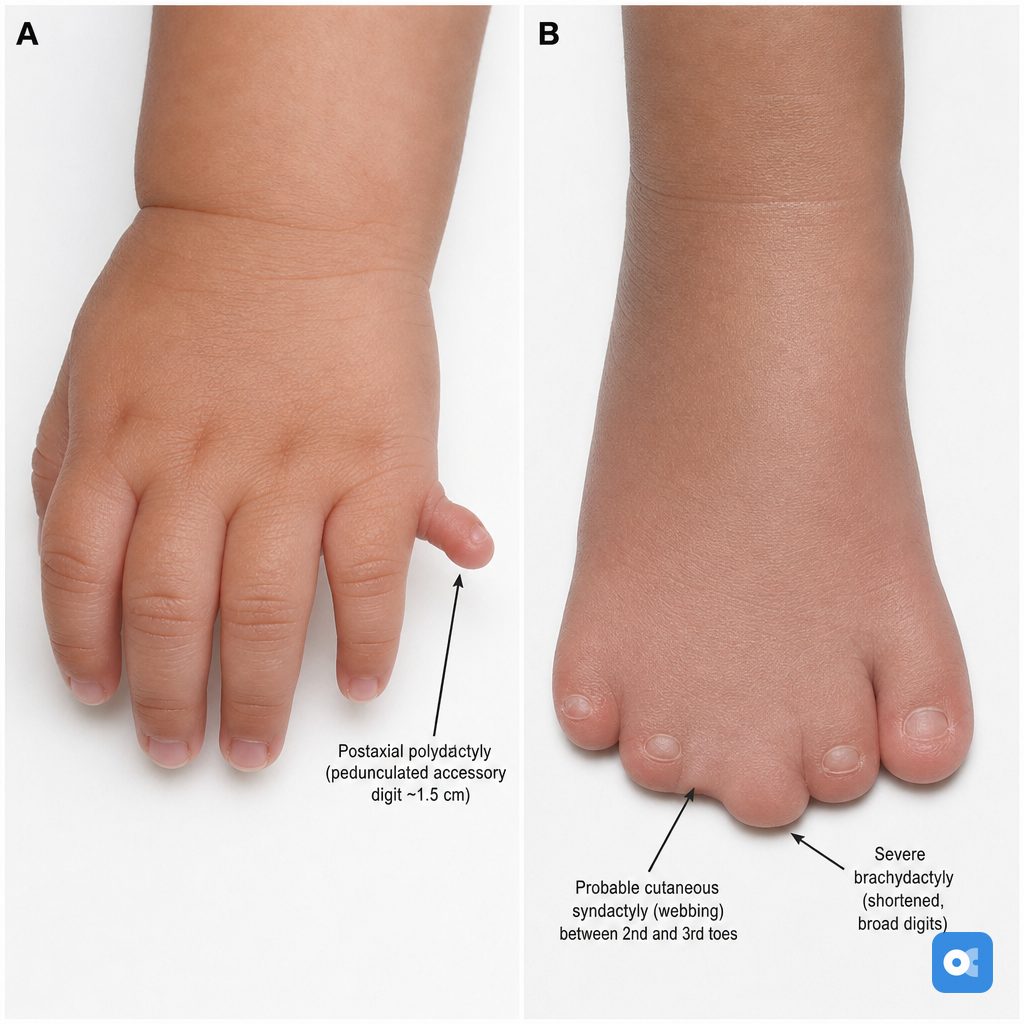
- Postaxial (Ulnar/Little Finger): Most common overall. Simple excision for Type B (pedunculated).
- Surgical timing: Typically 6-18 months.
Loading diagram…
- Macrodactyly (Mighty Digits)
- Non-hereditary congenital gigantism of digit(s); often unilateral.
- Types: Static (proportional growth) vs. Progressive (disproportionate, rapid growth).
- Often involves nerve territory (e.g., median nerve in macrodystrophia lipomatosa).
- Treatment: Challenging; includes debulking, epiphysiodesis, ray amputation.
- Constriction Ring Syndrome (Amniotic Band Syndrome)
- Cause: Intrauterine amniotic bands.
- Features: Circumferential grooves, distal lymphedema/necrosis, acrosyndactyly (fusion of distal digits), intrauterine amputations. Patterson classification used.
- Treatment: Surgical release of constricting bands (e.g., Z-plasty).
⭐ Wassel Type IV is the most common type of preaxial (thumb) polydactyly, representing a duplicated proximal phalanx with a common metacarpal head or a bifid metacarpal head for the two thumbs.
High‑Yield Points - ⚡ Biggest Takeaways
- Syndactyly is the most common congenital hand anomaly; surgical separation indicated.
- Polydactyly is second most common; postaxial (ulnar) more frequent than preaxial.
- Thumb hypoplasia often linked to Holt-Oram syndrome (cardiac) & VACTERL.
- Madelung deformity: Volar carpal subluxation from distal radial tilt.
- Kirner deformity: Palmar/radial bowing of little finger's distal phalanx.
- Camptodactyly: PIP joint flexion contracture, typically little finger.
- Clinodactyly: Coronal plane deviation of digit, often little finger.
Unlock the full lesson and continue reading
Signup to continue reading this lesson and unlimited access questions, flashcards, AI notes, and more
