

Enzyme-Linked Receptors - Cell's Smart Sensors
Cell surface receptors with intracellular domains possessing enzymatic activity or directly associating with an enzyme.
- Basic Structure:
- Extracellular: Ligand-binding domain.
- Transmembrane: Typically a single-pass α-helix.
- Intracellular: Catalytic domain or enzyme-association site.
- General Mechanism: Ligand binding → Receptor conformational change (often dimerization) → Intrinsic/associated enzyme activation (e.g., autophosphorylation for RTKs) → Downstream signal cascade.
- Major Classes:
- Receptor Tyrosine Kinases (RTKs) e.g., Insulin R.
- Tyrosine Kinase-Associated Receptors (TKARs) e.g., Cytokine R. (JAK-STAT).
- Receptor Serine/Threonine Kinases e.g., TGF-β R.
- Receptor Guanylyl Cyclases e.g., ANP R.
- Receptor Tyrosine Phosphatases e.g., CD45.
⭐ Most enzyme-linked receptors are single-pass transmembrane proteins.
Receptor Tyrosine Kinases - Dimerize & Dominate
- Largest family of enzyme-linked receptors; possess intrinsic tyrosine kinase activity.
- Structure: Extracellular ligand-binding domain, transmembrane helix, intracellular domain with tyrosine kinase activity.
- Mechanism:
- Ligand binding induces receptor dimerization.
- Dimerization activates kinase domains, leading to autophosphorylation of tyrosine residues on the cytoplasmic tail.
- Phosphorylated tyrosines create docking sites for SH2 (Src Homology 2) or PTB (Phosphotyrosine-Binding) domain-containing proteins (e.g., Grb2, PLCγ, PI3K).
- Key Examples:
- Insulin Receptor (unique: pre-formed dimer)
- EGFR (Epidermal Growth Factor Receptor)
- PDGFR (Platelet-Derived Growth Factor Receptor)
- VEGFR (Vascular Endothelial Growth Factor Receptor)
- FGFR (Fibroblast Growth Factor Receptor)
- Major Signaling Pathways:
- MAPK Pathway (Ras-Raf-MEK-ERK): Cell proliferation, differentiation.
- PI3K-Akt Pathway: Cell survival, growth, metabolism.
⭐ The Insulin Receptor is an RTK that exists as a pre-formed dimer.

Loading diagram…
JAK-STAT & Other Kinases - Signal Relayers Inc.
- Tyrosine Kinase-Associated Receptors (TKARs): No intrinsic kinase; use cytoplasmic JAKs.
- Example: Cytokine receptors (Interferons, Interleukins, GH, Prolactin).
- JAK-STAT Pathway: Cytokine → Receptor dimerization → JAK activation & phosphorylation → STAT recruitment & phosphorylation → STAT dimerization → Nucleus → Gene transcription.
- 📌 JAK-STAT: Just Activate Kinases, Signal Transducers And Transcription.
Loading diagram…
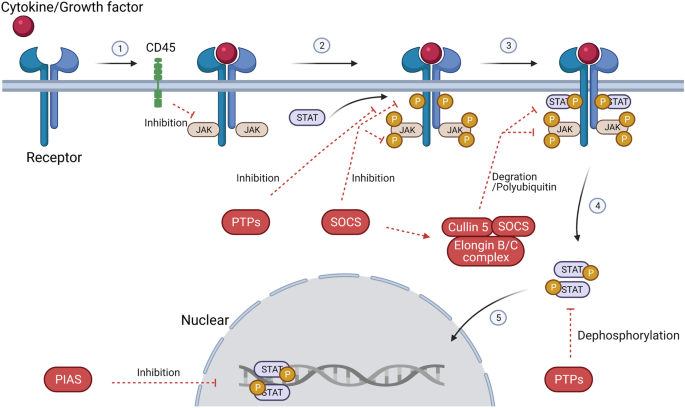
- Receptor Serine/Threonine Kinases: Intrinsic Ser/Thr kinase.
- Example: TGF-β receptors (Type I & Type II).
- Mechanism: TGF-β binds Type II → phosphorylates Type I → Type I phosphorylates Smads → Smads complex to nucleus → Gene transcription.
- Receptor Guanylyl Cyclases: Ligand activates guanylyl cyclase.
- Example: ANP receptor.
- Converts $GTP \rightarrow cGMP$.
⭐ The JAK-STAT pathway is critical for immune responses and hematopoiesis.
ELR Clinical Significance - Targets & Troubles
- Dysregulation of ELR signaling pathways is implicated in numerous diseases.
- Cancer:
- Overexpression/mutation of RTKs (e.g., EGFR in lung cancer, HER2 in breast cancer) leads to uncontrolled cell proliferation and survival.
- Therapeutic strategies:
- Monoclonal antibodies: Trastuzumab (anti-HER2), Cetuximab (anti-EGFR).
- Tyrosine Kinase Inhibitors (TKIs): Imatinib (BCR-ABL), Erlotinib (EGFR).
- Inflammatory/Autoimmune diseases:
- JAK inhibitors (e.g., Tofacitinib) target dysregulated cytokine receptor signaling in conditions like rheumatoid arthritis.
- Developmental disorders:
- Mutations in FGFRs (e.g., Achondroplasia due to FGFR3 mutation) cause skeletal dysplasias.
⭐ Imatinib, a TKI, revolutionized Chronic Myeloid Leukemia (CML) treatment by targeting the BCR-ABL fusion protein.
High‑Yield Points - ⚡ Biggest Takeaways
- Receptor Tyrosine Kinases (RTKs): Largest class; ligand binding induces dimerization and autophosphorylation.
- Insulin Receptor: A crucial RTK activating PI3K/Akt and MAPK pathways.
- JAK-STAT Pathway: Utilized by cytokine receptors, involving associated Janus kinases.
- Ras Protein: A key small G-protein linking RTK activation to the MAPK cascade.
- Growth Factors: Such as EGF and PDGF, typically signal through RTKs.
- Cancer: Dysregulated RTK signaling (e.g., HER2) is frequently implicated in various malignancies.
- Serine/Threonine Kinase Receptors: Another class, e.g., TGF-β receptors, phosphorylating SMAD proteins.
Unlock the full lesson and continue reading
Signup to continue reading this lesson and unlimited access questions, flashcards, AI notes, and more
