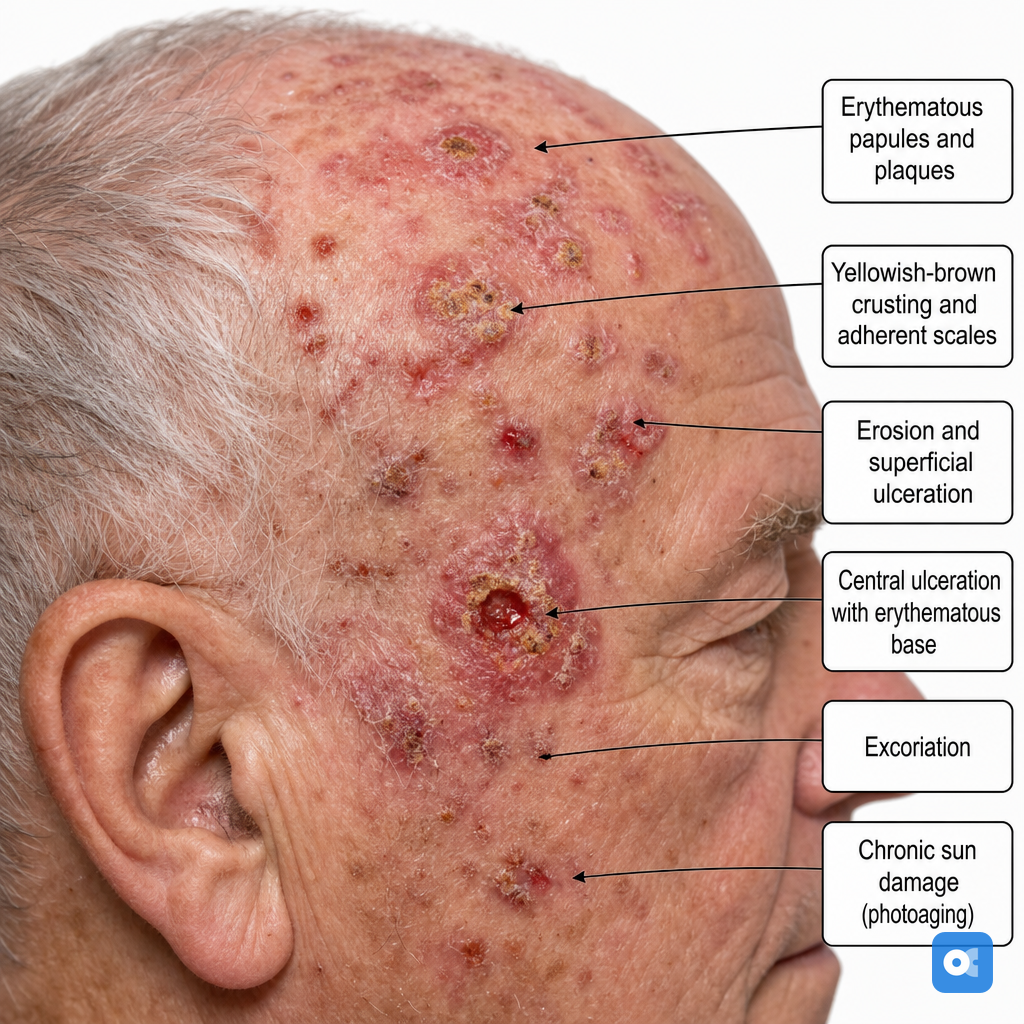
Premalignant Epidermal Tumors Indian Medical PG Practice Questions and MCQs
Practice Indian Medical PG questions for Premalignant Epidermal Tumors. These multiple choice questions (MCQs) cover important concepts and help you prepare for your exams.
Premalignant Epidermal Tumors Indian Medical PG Question 1: A patient consults a dermatologist about a skin lesion on her neck. Examination reveals a 1-cm diameter, red, scaly plaque with a rough texture and irregular margins. Biopsy demonstrates epidermal cells with large, pleomorphic, hyperchromatic nuclei. What is the most likely diagnosis?
- A. Dermal nevus
- B. Actinic keratosis (Correct Answer)
- C. Junctional nevus
- D. Compound nevus
Premalignant Epidermal Tumors Explanation: ***Actinic keratosis***
- This diagnosis aligns with the description of a **red, scaly plaque** with a **rough texture** and **irregular margins**, which are classic clinical features of actinic keratosis.
- The biopsy findings of epidermal and dermal cells with **large, pleomorphic, hyperchromatic nuclei** are consistent with **atypical keratinocytes**, a hallmark of actinic keratosis, indicating **premalignant change**.
*Dermal nevus*
- A dermal nevus is a **benign melanocytic lesion** that typically presents as a smooth, flesh-colored to light brown papule or nodule, not a scaly or rough plaque.
- Histologically, it would show nests of nevus cells primarily in the **dermis** without the significant cellular atypia described.
*Junctional nevus*
- A junctional nevus is a **benign melanocytic lesion** characterized by nests of nevus cells located at the **dermoepidermal junction**.
- Clinically, it appears as a flat or slightly raised, well-demarcated macule or papule, usually uniform in color, lacking the scaly, rough, and irregular features of the presented lesion.
*Compound nevus*
- A compound nevus is a **benign melanocytic lesion** with nevus cell nests present at both the **dermoepidermal junction** and within the dermis.
- It typically presents as a raised, pigmented papule or nodule with a smooth or slightly warty surface, not a scaly plaque with irregular margins.
Premalignant Epidermal Tumors Indian Medical PG Question 2: Which of the following is not a premalignant condition for oral cancer?
- A. Leukoplakia
- B. Erythroplakia
- C. Systemic Sclerosis (Correct Answer)
- D. Oral submucous fibrosis
Premalignant Epidermal Tumors Explanation: ***Systemic Sclerosis***
- Systemic sclerosis is primarily an **autoimmune disease** affecting connective tissue and does not have a direct association with the development of oral cancer.
- Although oral manifestations can occur, systemic sclerosis is **not classified** as a premalignant condition for oral malignancies.
*Leukoplakia*
- Leukoplakia is characterized by **white patches** in the oral cavity and is considered a potentially **premalignant** lesion [1].
- It has a known association with the development of **squamous cell carcinoma** in the oral region [1].
*Erythroplakia*
- Erythroplakia presents as **red lesions** in the oral cavity and has a higher risk of **malignant transformation** compared to leukoplakia.
- It is regarded as a significant **premalignant condition** for oral cancer.
*Oral submucous fibrosis*
- This condition involves **fibrosis** of the oral mucosa and is recognized as a **premalignant condition** due to its association with increased cancer risk.
- It often develops in individuals with a history of **betel quid** or areca nut use, contributing to cancer risk in the oral cavity [2].
**References:**
[1] Cross SS. Underwood's Pathology: A Clinical Approach. 6th ed. Common Clinical Problems From Alimentary System Disease, pp. 344-345.
[2] Kumar V, Abbas AK, et al.. Robbins and Cotran Pathologic Basis of Disease. 9th ed. The Lung, pp. 738-739.
Premalignant Epidermal Tumors Indian Medical PG Question 3: Which of the following statements about actinic lichen planus is false?
- A. Associated with severe pruritus (Correct Answer)
- B. Violaceous brown papules
- C. Usually affects exposed areas of body
- D. Autoimmune etiology
Premalignant Epidermal Tumors Explanation: ***Associated with severe pruritus***
- While other forms of lichen planus, especially the typical cutaneous type, are often associated with **severe pruritus**, actinic lichen planus is typically characterized by **mild or absent pruritus**.
- Its presentation is often more focused on pigmentary changes and papules in sun-exposed areas rather than intense itching.
*Autoimmune etiology*
- **Lichen planus**, including its actinic variant, is recognized as an **autoimmune disease**.
- It involves a **T-cell-mediated immune response** against basal keratinocytes.
*Violaceous brown papules*
- Actinic lichen planus commonly presents with **violaceous, brown, or hyperpigmented papules and plaques**.
- These lesions often exhibit a subtle **annular or reticulated pattern**.
*Usually affects exposed areas of body*
- As its name suggests ("actinic" referring to light), this variant of lichen planus preferentially affects **sun-exposed areas** such as the face, neck, and dorsal hands.
- This distribution distinguishes it from classic lichen planus, which can occur anywhere but often affects the flexor surfaces of the wrists, ankles, and oral mucosa.
Premalignant Epidermal Tumors Indian Medical PG Question 4: A 24-year-old male presents with asymptomatic scaly lesions over the body as shown in the image below. What is the likely diagnosis?
- A. Atopic Dermatitis
- B. Lichen planus
- C. Seborrheic Dermatitis
- D. Pityriasis Rosea (Correct Answer)
Premalignant Epidermal Tumors Explanation: ***Pityriasis Rosea***
- The image shows numerous **scaly, erythematous plaques** distributed over the trunk, with a characteristic "Christmas tree" pattern often observed in Pityriasis Rosea.
- The lesions are described as **asymptomatic**, which is consistent with Pityriasis Rosea, although mild pruritus can occur.
*Atopic Dermatitis*
- Typically presents with **intensely pruritic, erythematous, and eczematous lesions** often found in flexural areas (e.g., antecubital and popliteal fossae).
- While it can be widespread, the morphology of the lesions (eczematous vs. scaly plaques) and the absence of pruritus make this less likely.
*Lichen planus*
- Characterized by **pruritic, violaceous, polygonal papules** and plaques, often appearing on the flexor surfaces of wrists, ankles, and oral mucosa.
- The appearance of the lesions in the image does not match the typical morphology of lichen planus.
*Seborrheic Dermatitis*
- Primarily affects areas with a high density of sebaceous glands, such as the **scalp, face (nasolabial folds, eyebrows), and chest**.
- Presents with **greasy, yellowish scales** on an erythematous base, which is distinct from the dry, scaly plaques seen in the image.
Premalignant Epidermal Tumors Indian Medical PG Question 5: For the treatment of basal cell carcinoma, what is the popular surgery that is carried out?
- A. Mohs surgery (Correct Answer)
- B. Superficial laser surgery
- C. Curettage and electrodesiccation
- D. Wide local excision
Premalignant Epidermal Tumors Explanation: ***Mohs surgery***
- **Mohs micrographic surgery** is the most popular and highly effective procedure specifically designed for **basal cell carcinoma (BCC)**, especially on the face and other cosmetically sensitive areas.
- It involves the **progressive removal** of thin layers of skin, which are immediately examined under a microscope, allowing for complete tumor removal while preserving maximum healthy tissue.
- Mohs surgery has the **highest cure rate** (95-99%) for BCC and is particularly preferred for high-risk locations, recurrent tumors, and poorly defined borders.
*Superficial laser surgery*
- While lasers can sometimes be used for very superficial skin lesions, **superficial laser surgery** is generally not the primary treatment for established **BCC** due to the risk of incomplete removal and recurrence.
- It lacks the **histological margin control** provided by Mohs surgery, which is crucial for ensuring complete eradication of BCC.
*Curettage and electrodesiccation*
- **Curettage and electrodesiccation** is an alternative surgical treatment for small, low-risk BCCs in non-critical areas.
- However, it has **lower cure rates** (85-95%) compared to Mohs surgery and does not provide histological margin assessment.
- It is less preferred for facial BCCs where cosmetic outcome and complete removal are critical.
*Wide local excision*
- **Wide local excision** is a standard surgical approach that removes the tumor with predetermined margins (typically 4-5 mm for BCC).
- While effective, it requires **larger tissue removal** compared to Mohs surgery and lacks the real-time microscopic margin control.
- Mohs surgery remains more popular due to its tissue-sparing nature and higher cure rates, especially in cosmetically sensitive areas.
Premalignant Epidermal Tumors Indian Medical PG Question 6: Mycosis fungoides primarily involves which type of immune cell?
- A. NK cells
- B. B lymphocytes
- C. Plasma cells
- D. T lymphocytes (Correct Answer)
Premalignant Epidermal Tumors Explanation: ***CD4+ T Cells***
- Mycosis fungoides is a type of **cutaneous T-cell lymphoma**, primarily involving **CD4+ T cells** which infiltrate the skin [1][2].
- The disease is characterized by **pleomorphic** skin lesions caused by **malignant T-cell proliferation** [3].
*K Cells (not primarily involved in mycosis fungoides)*
- K Cells are involved in **immunological responses** but are not specifically linked to mycosis fungoides.
- They do not play a primary role in **cutaneous lymphoproliferative disorders**.
*B Cells (involved in humoral immunity)*
- B Cells are mainly responsible for **antibody production**, which is not the primary mechanism in mycosis fungoides.
- The condition involves **T cell malignancy**, rather than abnormalities in B cell function.
*NK Cells (part of innate immunity)*
- NK Cells are important for **innate immunity** and target viral and tumor cells but are not primarily involved in this lymphoma.
- Mycosis fungoides is characterized by **T cell-mediated responses**, not NK cell activity.
**References:**
[1] Kumar V, Abbas AK, et al.. Robbins and Cotran Pathologic Basis of Disease. 9th ed. Diseases of White Blood Cells, Lymph Nodes, Spleen, and Thymus, pp. 613-614.
[2] Kumar V, Abbas AK, et al.. Robbins and Cotran Pathologic Basis of Disease. 9th ed. The Skin, p. 1162.
[3] Cross SS. Underwood's Pathology: A Clinical Approach. 6th ed. Common Clinical Problems From Diseases Of The Urinary And Male Genital Tracts, pp. 564-565.
Premalignant Epidermal Tumors Indian Medical PG Question 7: All of the following are growth promoting proto-oncogenes except?
- A. Fibroblast Growth Factor (FGF)
- B. TGF alpha
- C. TGF beta (Correct Answer)
- D. Platelet-Derived Growth Factor (PDGF)
Premalignant Epidermal Tumors Explanation: ***TGF beta***
- **TGF-β (Transforming Growth Factor-beta)** is primarily a **growth inhibitory cytokine** and a **tumor suppressor**, rather than a growth-promoting proto-oncogene [3].
- While it can have complex roles, its main function in the context of cancer is to **inhibit cell proliferation** and promote differentiation or apoptosis, unless its signaling pathway is disrupted.
*Fibroblast Growth Factor (FGF)*
- **FGFs** are a family of **growth factors** that play crucial roles in cell proliferation, differentiation, and tissue repair [1].
- **Overexpression** or aberrant signaling of FGF receptors can lead to uncontrolled cell growth and is associated with various cancers, making them **growth-promoting proto-oncogenes** [1].
*TGF alpha*
- **TGF-α (Transforming Growth Factor-alpha)** is a **growth factor** that binds to the **epidermal growth factor receptor (EGFR)**, stimulating cell proliferation and differentiation [1].
- Its mechanism of action is distinctly different from TGF-β, and its involvement in **promoting cell growth** classifies it as a growth-promoting proto-oncogene [1].
*Platelet-Derived Growth Factor (PDGF)*
- **PDGF** is a potent **mitogen** that stimulates cell division in various cell types, particularly fibroblasts and smooth muscle cells [2].
- **Dysregulation** of PDGF signaling can contribute to tumor growth and angiogenesis, confirming its role as a **growth-promoting proto-oncogene** [1], [2].
**References:**
[1] Kumar V, Abbas AK, et al.. Robbins and Cotran Pathologic Basis of Disease. 9th ed. Neoplasia, p. 292.
[2] Kumar V, Abbas AK, et al.. Robbins and Cotran Pathologic Basis of Disease. 9th ed. With Illustrations By, pp. 31-32.
[3] Kumar V, Abbas AK, et al.. Robbins and Cotran Pathologic Basis of Disease. 9th ed. The Lung, pp. 706-707.
Premalignant Epidermal Tumors Indian Medical PG Question 8: Comment on the image shown:
- A. Corn
- B. Callosity (Correct Answer)
- C. Warts
- D. Cutaneous horn
Premalignant Epidermal Tumors Explanation: ***Callosity***
- The image displays several **thickened, hyperkeratotic patches** on the palm, characteristic of callosities.
- Callosities are caused by repeated friction and pressure, leading to **diffuse epidermal thickening** without a central core.
*Corn*
- A **corn** is a small, well-demarcated lesion with a **central core** that causes localized pain, unlike the diffuse thickening seen here.
- They typically occur over bony prominences and are less spread out than the lesions in the image.
*Warts*
- **Warts** are caused by the **human papillomavirus (HPV)** and present as rough, elevated lesions with characteristic **black puncta** (thrombosed capillaries) upon paring, which are not visible in the image.
- They often have a **papillomatous** or verrucous surface, different from the relatively smooth, thickened appearance here.
*Cutaneous horn*
- A **cutaneous horn** is a conical projection of **hyperkeratotic material** resembling an animal horn, typically developing on sun-exposed areas.
- It is usually a solitary lesion and has a different morphology than the multiple, flat, thickened lesions shown.
Premalignant Epidermal Tumors Indian Medical PG Question 9: A 22-year-old woman presents with multiple tender, erythematous nodules on her shins that developed over the past week. She reports having a sore throat 2 weeks ago. She also complains of joint pain and fatigue. Physical examination reveals raised, red, tender nodules on the anterior surface of both legs. Her temperature is 38.2°C. Which of the following is the most likely diagnosis?
- A. Cellulitis
- B. Erythema nodosum (Correct Answer)
- C. Sweet syndrome
- D. Superficial thrombophlebitis
Premalignant Epidermal Tumors Explanation: ***Erythema nodosum***
- The presentation of **tender, erythematous nodules on the shins**, following a preceding **sore throat**, with associated **joint pain and fatigue**, is highly characteristic of **erythema nodosum**.
- It is a form of **panniculitis** typically triggered by infections (e.g., streptococcal pharyngitis), medications, or systemic diseases.
*Cellulitis*
- Characterized by a **warm, erythematous, swollen area** with poorly defined borders, often accompanied by pain and fever, but typically presents as a diffuse skin infection rather than distinct nodules.
- While fever is present, the **nodular nature** of the lesions and their bilateral, symmetrical distribution are less consistent with cellulitis.
*Sweet syndrome*
- Also known as acute febrile neutrophilic dermatosis, it presents with **tender erythematous plaques or nodules** and **fever**, but typically has a more prominent **neutrophilic infiltrate** histologically.
- Lesions of Sweet syndrome often appear on the **upper extremities, face, or neck**, and while it can affect the shins, the clinical picture here is more classic for erythema nodosum, especially given the history of sore throat.
*Superficial thrombophlebitis*
- Presents as a **palpable, tender, erythematous cord** along the course of a superficial vein, often with localized swelling and warmth.
- The lesions are typically **linear or cord-like**, not discrete nodules scattered over the shins, and are directly related to a thrombosed vein.
Premalignant Epidermal Tumors Indian Medical PG Question 10: A 40 year old man presented with a flat 1x1cm scaly, itchy black mole on the front of thigh. Examination did not reveal any inguinal lymphodenopathy. The best course of management would be:
- A. FNAC of lesion
- B. Incision biopsy
- C. Wide excision with inguinal lymphadenectomy
- D. Excision biopsy (Correct Answer)
Premalignant Epidermal Tumors Explanation: ***Excision biopsy***
- A **flat, scaly, itchy, black mole** is highly suspicious for **melanoma**, and an excision biopsy provides the most accurate histopathological diagnosis and depth assessment.
- This procedure removes the entire lesion with a narrow margin of normal-appearing skin, allowing for comprehensive evaluation of its nature and determining further management.
*FNAC of lesion*
- **Fine needle aspiration cytology (FNAC)** is generally used for evaluating palpable masses or lymph nodes, not primary skin lesions like a suspicious mole.
- It provides only cellular samples, making it difficult to assess architectural features, depth of invasion, or determine definitive malignancy in skin lesions.
*Incision biopsy*
- An **incision biopsy** involves removing only a partial sample of the lesion, which can lead to sampling error and an inaccurate diagnosis if the most aggressive part is missed.
- For suspected melanoma, an incomplete biopsy can compromise subsequent staging and definitive treatment planning.
*Wide excision with inguinal lymphadenectomy*
- This is an **overly aggressive initial approach** before a definitive diagnosis of melanoma and its stage has been established.
- **Wide excision** is typically performed after an excision biopsy confirms melanoma and determines its depth, while **lymphadenectomy** is indicated for confirmed lymph node involvement.
More Premalignant Epidermal Tumors Indian Medical PG questions available in the OnCourse app. Practice MCQs, flashcards, and get detailed explanations.