Mutations and DNA Repair Indian Medical PG Practice Questions and MCQs
Practice Indian Medical PG questions for Mutations and DNA Repair. These multiple choice questions (MCQs) cover important concepts and help you prepare for your exams.
Mutations and DNA Repair Indian Medical PG Question 1: Which of the following statements is true about silent mutations in a gene?
- A. No change in Amino acid sequence in protein (Correct Answer)
- B. No change in mRNA sequence
- C. No change in protein expression
- D. None of the above
Mutations and DNA Repair Explanation: ***No change in Amino acid sequence in protein***
- A **silent mutation** is a type of point mutation that results in a **substituted nucleotide** but does not alter the **amino acid sequence** of the protein.
- This occurs due to the **redundancy (degeneracy) of the genetic code**, where multiple codons can specify the same amino acid.
- Example: UUA → UUG both code for Leucine, making this a silent mutation.
*No change in mRNA sequence*
- A silent mutation *does* involve a **change in the DNA sequence**, which consequently leads to a **change in the mRNA sequence** (a different nucleotide at the mutation site).
- The change in mRNA sequence is at the nucleotide level, but the amino acid encoded remains the same.
*No change in protein expression*
- While a silent mutation does not change the amino acid sequence, it *can* affect **protein expression** through several mechanisms:
- **Codon usage bias**: Different codons are translated at different rates
- **mRNA stability**: Sequence changes may affect secondary structure
- **Translation efficiency**: Some synonymous codons are translated faster than others
- Therefore, this statement is incorrect as silent mutations can affect protein expression levels.
*None of the above*
- This option is incorrect because there is one correct statement among the choices provided.
Mutations and DNA Repair Indian Medical PG Question 2: Which of the following is true about ataxia telangiectasia?
- A. There is absence of amphicytes in different organs
- B. It is an autosomal recessive disease (Correct Answer)
- C. It is associated with normal immune function
- D. Serum levels of IgA are increased
- E. Serum alpha-fetoprotein levels are decreased
Mutations and DNA Repair Explanation: ***It is an autosomal recessive disease***
- Ataxia telangiectasia is caused by mutations in the **ATM gene**, which is inherited in an **autosomal recessive** pattern.
- This genetic defect leads to a deficiency in a protein crucial for DNA repair, causing systemic effects.
*There is absence of amphicytes in different organs*
- This statement is incorrect; **ataxia telangiectasia** is not characterized by an absence of amphicytes.
- The term "amphicytes" is not typically associated with the defining pathological features of ataxia telangiectasia.
*It is associated with normal immune function*
- Ataxia telangiectasia is associated with **immunodeficiency**, particularly affecting T- and B-cell function.
- Patients often experience recurrent infections due to impaired adaptive immunity, which is not a characteristic of normal immune function.
*Serum levels of IgA are increased*
- Patients with ataxia telangiectasia typically have **decreased serum levels of IgA**, and often IgG and IgE, leading to immunodeficiency.
- Increased IgA levels are characteristic of other conditions and not ataxia telangiectasia.
*Serum alpha-fetoprotein levels are decreased*
- In ataxia telangiectasia, serum **alpha-fetoprotein (AFP) levels are characteristically elevated**, not decreased.
- Elevated AFP is a useful diagnostic marker for this condition.
Mutations and DNA Repair Indian Medical PG Question 3: Which of the following techniques can be used to detect single base pair substitutions?
- A. FISH
- B. Southern blot
- C. PCR (Correct Answer)
- D. Restriction Fragment Length Polymorphism (RFLP)
Mutations and DNA Repair Explanation: ***PCR (with sequencing or allele-specific methods)***
- **PCR-based techniques** are the most versatile methods for detecting single base pair substitutions (point mutations)
- **Allele-specific PCR** can directly detect known point mutations by using primers specific to mutant or wild-type alleles
- **PCR followed by Sanger sequencing** is the gold standard for identifying any single base pair substitution
- **High-resolution melting (HRM) analysis** after PCR can detect mutations based on melting curve differences
- PCR amplification is the foundation that enables these detection methods
*FISH (Fluorescence in situ hybridization)*
- FISH detects **large chromosomal abnormalities** such as aneuploidy, translocations, large deletions, and duplications
- It visualizes chromosomal-level changes using fluorescent probes
- **Not sensitive enough** to detect single base pair changes, as these are too small to visualize cytogenetically
*Southern blot*
- Southern blot detects **large DNA rearrangements**, insertions, deletions, or copy number variations
- Analyzes restriction enzyme fragments separated by gel electrophoresis
- **Generally cannot detect** single base pair substitutions unless they create or abolish a restriction enzyme recognition site
- Even when applicable, PCR-based methods are more efficient and sensitive
*Restriction Fragment Length Polymorphism (RFLP)*
- RFLP can detect single base pair substitutions **only if** they create or abolish a **restriction enzyme recognition site**
- Classic example: **Sickle cell mutation** (GAG→GTG in β-globin gene) abolishes an MstII restriction site
- **Limited applicability** - can only detect the subset of point mutations that affect restriction sites
- PCR-based methods are preferred as they can detect **any** single base pair substitution, not just those affecting restriction sites
Mutations and DNA Repair Indian Medical PG Question 4: Even conventional radiological procedures are contraindicated in which neurological disease?
- A. Cockayne Syndrome
- B. Gorlin Syndrome
- C. Ataxia telangiectasia (Correct Answer)
- D. All of the options
Mutations and DNA Repair Explanation: ***Ataxia telangiectasia***
- Patients with **ataxia telangiectasia** have a defect in the **ATM gene**, leading to extreme sensitivity to **ionizing radiation**, making conventional radiological procedures unsafe.
- This increased radiosensitivity can result in severe adverse reactions, including increased risk of **malignancy** and neurological damage if exposed to routine diagnostic radiation.
*Cockayne Syndrome*
- **Cockayne Syndrome** is characterized by a defect in **DNA repair**, specifically **transcription-coupled repair**, leading to pronounced sun sensitivity and premature aging.
- While these patients are sensitive to UV radiation, they do not have the profound hypersensitivity to **ionizing radiation** that contraindicates conventional X-ray imaging, distinguishing them from ataxia telangiectasia.
*Gorlin Syndrome*
- **Gorlin Syndrome** (Nevoid Basal Cell Carcinoma Syndrome) is associated with an increased risk of developing various cancers, including **basal cell carcinomas**, and is linked to the **PTCH1 gene**.
- Although individuals with Gorlin Syndrome have an increased lifetime risk of developing tumors with **ionizing radiation exposure**, it does not typically contraindicate conventional diagnostic imaging, unlike the extreme radiosensitivity seen in ataxia telangiectasia.
*All of the options*
- This option is incorrect because while Cockayne Syndrome and Gorlin Syndrome involve heightened cancer risks or sensitivities, only **ataxia telangiectasia** presents a direct and severe contraindication to conventional radiological procedures due to extreme **radiosensitivity**.
Mutations and DNA Repair Indian Medical PG Question 5: Best method for the detection of mutations with low allele frequency is:
- A. FISH
- B. Droplet digital PCR (Correct Answer)
- C. Sanger sequencing
- D. Nested PCR
Mutations and DNA Repair Explanation: ***Droplet digital PCR***
- **Droplet digital PCR (ddPCR)** offers superior sensitivity for detecting **low allele frequency mutations** by partitioning the sample into thousands of individual reactions.
- This compartmentalization allows for the direct quantification of target DNA molecules without relying on a standard curve, making it highly accurate for rare mutation detection.
*FISH*
- **Fluorescence in situ hybridization (FISH)** primarily detects **chromosomal abnormalities** like translocations, deletions, or amplifications, rather than single-nucleotide variants or small indels with low allele frequencies [2].
- It visualizes genetic changes at a **cytogenetic level** on an intracellular basis, not typically for quantifying rare DNA mutations in a heterogeneous sample.
*Sanger sequencing*
- **Sanger sequencing** is the gold standard for **sequencing individual DNA fragments** but has a detection limit of around 15-20% for allele frequency, making it unsuitable for very low allele frequency mutations [1].
- It struggles to reliably detect minor alleles when they are present in a small proportion of the total DNA pool.
*Nested PCR*
- **Nested PCR** increases the sensitivity and specificity of amplification by using two sets of primers in a sequential manner but does not inherently provide the **quantification capability** or the same level of **low allele frequency detection** as ddPCR processes.
- While sensitive for detecting target sequences, it is not designed for precise quantification of rare mutations in a background of wild-type sequences.
**References:**
[1] Kumar V, Abbas AK, et al.. Robbins and Cotran Pathologic Basis of Disease. 9th ed. Genetic Disorders, p. 185.
[2] Kumar V, Abbas AK, et al.. Robbins and Cotran Pathologic Basis of Disease. 9th ed. Genetic Disorders, pp. 185-186.
Mutations and DNA Repair Indian Medical PG Question 6: Mutations are due to changes in:
- A. DNA nucleotide sequence (Correct Answer)
- B. RNA nucleotide sequence
- C. Amino acid sequence of ribonuclease
- D. Cell membrane
Mutations and DNA Repair Explanation: ***DNA nucleotide sequence***
- **Mutations** are defined as changes in the **genetic material**, which is primarily composed of **DNA**.
- These changes in the **nucleotide sequence** of DNA can alter the genetic code, leading to changes in **protein structure and function**.
*RNA nucleotide sequence*
- While RNA can have its nucleotide sequence altered, these changes are generally not considered true **mutations** in the heritable sense for most organisms.
- RNA is typically a temporary molecule, and changes to its sequence are usually not passed down to subsequent generations.
*Amino acid sequence of ribonuclease*
- An altered **amino acid sequence** in a protein like ribonuclease is a consequence of a **mutation in the DNA**, not the mutation itself.
- **Ribonucleases** are enzymes that catalyze the degradation of RNA, and their structure is determined by the **DNA sequence**.
*Cell membrane*
- The cell membrane is a **lipid bilayer** with embedded proteins that regulates cellular transport and communication.
- While its components can be affected by genetic mutations, alterations in the cell membrane itself do not constitute the primary definition of a **mutation**.
Mutations and DNA Repair Indian Medical PG Question 7: Sun damage causes malignant transformation of the skin by:
- A. Direct DNA damage
- B. Free radical formation
- C. Induction of pyrimidine dimers (Correct Answer)
- D. Mutation of p53 due to UV exposure
Mutations and DNA Repair Explanation: ***Induction of pyrimidine dimers***
- **Ultraviolet (UV) radiation** from the sun causes the formation of **covalent bonds between adjacent pyrimidine bases** (thymine or cytosine) on the same DNA strand, creating pyrimidine dimers [1].
- These dimers lead to **DNA distortion**, interfering with DNA replication and transcription, and if not repaired, can result in **mutations** that contribute to carcinogenesis [2].
*Free radical formation*
- While UV radiation can induce **reactive oxygen species** (free radicals) that cause DNA damage, the primary mechanism of malignant transformation leading to skin cancer is the direct formation of pyrimidine dimers.
- Free radicals cause a variety of oxidative damage to DNA, proteins, and lipids, but **pyrimidine dimers are unique to UV exposure** and are the main initiators of UV-induced skin cancer.
*Direct DNA damage*
- This option is too broad; while pyrimidine dimer formation is a form of direct DNA damage, it is the **most specific and significant mechanism** of malignant transformation due to sun exposure [3].
- Non-specific direct DNA damage can also occur from other sources, but the hallmark of UV-induced damage is the creation of **photoproducts like pyrimidine dimers**.
*Mutation of p53 due to UV exposure*
- **p53 gene mutations** are frequently found in skin cancers, particularly **squamous cell carcinoma**, and are indeed induced by UV radiation.
- However, the mutation of p53 is a **consequence** of the initial DNA damage (specifically pyrimidine dimers not being repaired), not the primary mechanism by which sun damage *causes* malignant transformation [2]. The induction of pyrimidine dimers *leads* to these mutations.
**References:**
[1] Kumar V, Abbas AK, et al.. Robbins and Cotran Pathologic Basis of Disease. 9th ed. Neoplasia, pp. 322-323.
[2] Kumar V, Abbas AK, et al.. Robbins and Cotran Pathologic Basis of Disease. 9th ed. Neoplasia, pp. 332-333.
[3] Cross SS. Underwood's Pathology: A Clinical Approach. 6th ed. (Basic Pathology) introduces the student to key general principles of pathology, both as a medical science and as a clinical activity with a vital role in patient care. Part 2 (Disease Mechanisms) provides fundamental knowledge about the cellular and molecular processes involved in diseases, providing the rationale for their treatment. Part 3 (Systematic Pathology) deals in detail with specific diseases, with emphasis on the clinically important aspects., pp. 220-221.
Mutations and DNA Repair Indian Medical PG Question 8: A patient presents with a skin rash that is exaggerated on sun exposure. What is the repair mechanism involved in this condition?
- A. Nucleotide excision repair (Correct Answer)
- B. Base excision repair
- C. Mismatch repair
- D. Double stranded DNA break repair
Mutations and DNA Repair Explanation: ***Nucleotide excision repair***
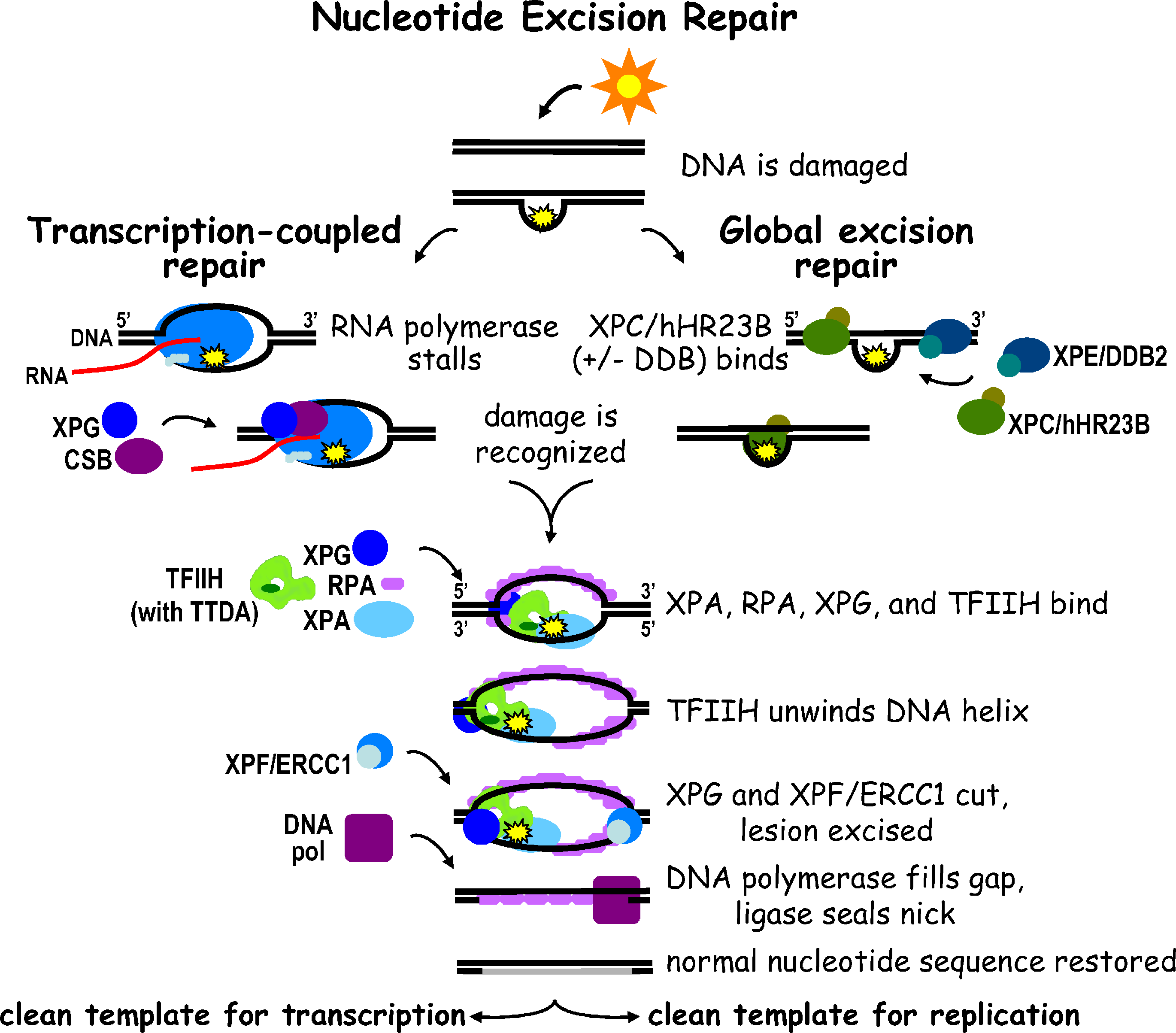
- This mechanism is responsible for repairing **bulky lesions** in DNA, such as **pyrimidine dimers** caused by **UV radiation** from sun exposure.
- Patients with defects in nucleotide excision repair (e.g., **xeroderma pigmentosum**) are highly sensitive to sunlight and develop skin rashes, pigment changes, and skin cancers.
*Base excision repair*
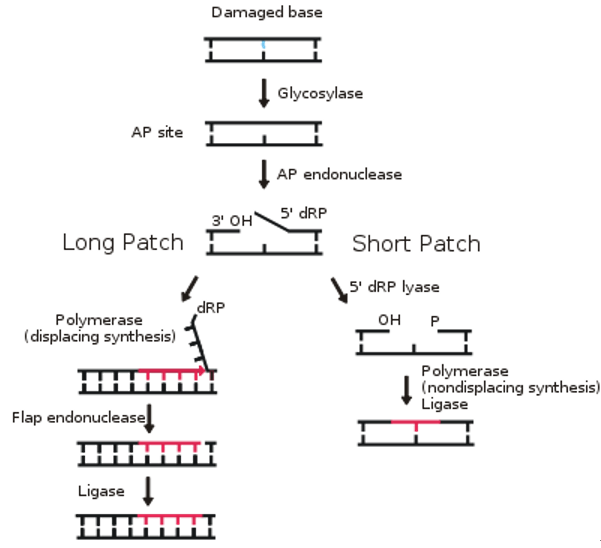
- This pathway primarily corrects **small damaged bases** that do not cause significant distortion of the DNA helix, such as deaminated, oxidized, or alkylated bases.
- It does not primarily address the bulky lesions induced by UV light that cause exaggerated sun sensitivity.
*Mismatch repair*
- This system corrects errors, like **mismatched base pairs**, that are incorporated during DNA replication.
- It is not directly involved in repairing DNA damage caused by environmental factors like UV radiation.
*Double stranded DNA break repair*
- This mechanism repairs **double-strand breaks** in DNA, which are highly deleterious lesions caused by ionizing radiation or oxidative stress.
- While critical for genome stability, it is not the primary repair pathway for UV-induced DNA lesions or the direct cause of sun sensitivity.
Mutations and DNA Repair Indian Medical PG Question 9: DNA Methylation is not related to?
- A. DNA Replication
- B. Gene silencing
- C. Capping (Correct Answer)
- D. Mismatch repair
Mutations and DNA Repair Explanation: ***Capping***
- **Capping** is a modification of messenger RNA (mRNA) that occurs during **mRNA processing** in eukaryotes, involving the addition of a 7-methylguanosine cap to the 5' end of the mRNA molecule.
- This process is crucial for mRNA stability, translation initiation, and nuclear export, and is entirely **independent of DNA modifications** like DNA methylation.
*DNA Replication*
- DNA methylation plays a role in **DNA replication** to distinguish newly synthesized strands from parental strands during **DNA repair**.
- In bacteria, methylation at specific sites (**Dam methylase**) helps in **mismatch repair** by identifying the parental strand.
*Gene silencing*
- **DNA methylation** of CpG islands in promoter regions is a well-established mechanism for **gene silencing** by altering chromatin structure and preventing transcription factor binding.
- This epigenetic modification leads to stable transcriptional repression and is critical for processes like X-chromosome inactivation and genomic imprinting.
*Mismatch repair*
- In prokaryotes, **DNA methylation** marks the parental strand, which is used by the **mismatch repair system** to correct errors on the newly synthesized, unmethylated strand.
- In eukaryotes, while not directly marking strands, DNA methylation can influence the efficiency of mismatch repair pathways by altering chromatin accessibility.
Mutations and DNA Repair Indian Medical PG Question 10: Which of the following statements regarding mitochondrial DNA is FALSE?
- A. Double stranded
- B. Inherited from mother
- C. High mutation rate
- D. All respiratory proteins are synthesized within the mitochondria (Correct Answer)
Mutations and DNA Repair Explanation: ***All respiratory proteins are synthesized within the mitochondria.***
- While mitochondrial DNA (mtDNA) encodes some proteins essential for the **electron transport chain** (respiratory proteins), not all respiratory proteins are synthesized within the mitochondria.
- Many crucial respiratory proteins are encoded by **nuclear DNA** and imported into the mitochondria from the cytoplasm.
*Double stranded*
- **Mitochondrial DNA (mtDNA)** is a **double-stranded**, circular molecule, similar to bacterial chromosomes.
- This structure provides stability and allows for efficient replication within the organelle.
*Inherited from mother*
- Mitochondria and their DNA are exclusively inherited from the **mother** during fertilization, as sperm primarily contributes nuclear DNA.
- This **maternal inheritance pattern** is a key feature of mtDNA and is used in tracing ancestry.
*High mutation rate*
- mtDNA has a significantly **higher mutation rate** compared to nuclear DNA due to several factors, including lack of robust repair mechanisms and exposure to reactive oxygen species.
- This contributes to the rapid evolution of mtDNA and its use in **population genetics** studies.
More Mutations and DNA Repair Indian Medical PG questions available in the OnCourse app. Practice MCQs, flashcards, and get detailed explanations.