Fatty Acid Oxidation Indian Medical PG Practice Questions and MCQs
Practice Indian Medical PG questions for Fatty Acid Oxidation. These multiple choice questions (MCQs) cover important concepts and help you prepare for your exams.
Fatty Acid Oxidation Indian Medical PG Question 1: Which of the following helps in the transport of fatty acids across the inner mitochondrial membrane?
- A. Acyl carrier protein
- B. Carnitine (Correct Answer)
- C. Lecithin-cholesterol acyltransferase
- D. Carnitine and albumin
Fatty Acid Oxidation Explanation: ***Carnitine***
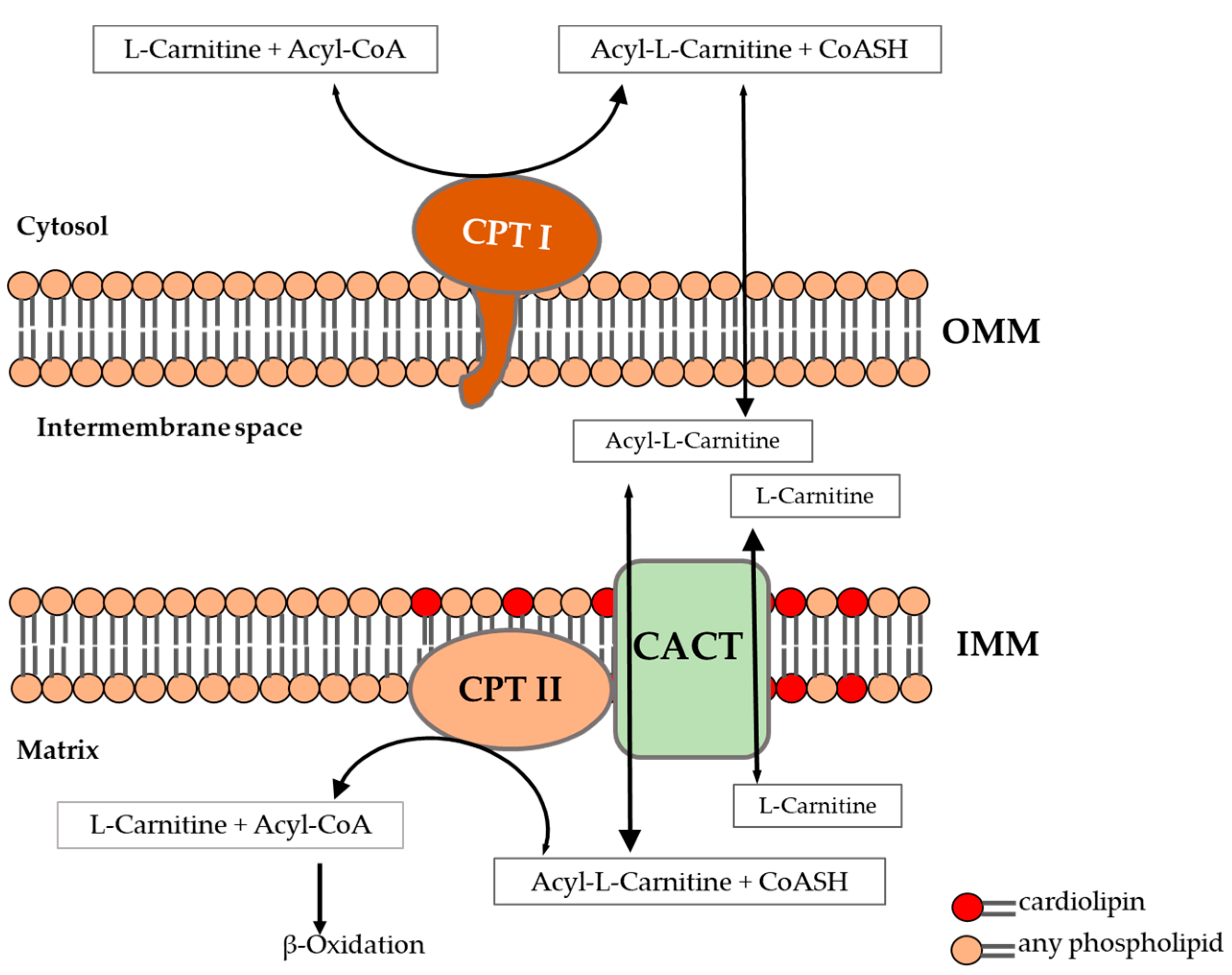
- **Carnitine** plays a crucial role in transporting long-chain fatty acids from the **cytosol** into the **mitochondrial matrix** for beta-oxidation.
- It acts as a shuttling molecule, forming **acylcarnitine** which can cross the inner mitochondrial membrane via the **carnitine-acylcarnitine translocase**.
*Acyl carrier protein*
- **Acyl carrier protein (ACP)** is primarily involved in **fatty acid synthesis** in the cytoplasm, not in the transport of fatty acids into mitochondria for degradation.
- It carries acyl groups during the elongation reactions of fatty acid synthesis.
*Lecithin-cholesterol acyltransferase*
- **Lecithin-cholesterol acyltransferase (LCAT)** is an enzyme found in plasma that catalyzes the formation of **cholesterol esters**, which are then transported by lipoproteins.
- It is involved in **cholesterol metabolism** and reverse cholesterol transport, not in the mitochondrial transport of fatty acids.
*Carnitine and albumin*
- While **carnitine** is essential for mitochondrial fatty acid transport, **albumin** transports fatty acids in the blood plasma, from adipose tissue to other tissues.
- Albumin does not transport fatty acids across the inner mitochondrial membrane; its role is extra-mitochondrial and related to systemic transport.
Fatty Acid Oxidation Indian Medical PG Question 2: Which two enzymes are required for the beta oxidation of polyunsaturated fatty acids (PUFA)?
- A. Dienoyl CoA isomerase and Enoyl CoA isomerase
- B. Dienoyl CoA isomerase and 2,4 Dienoyl CoA reductase
- C. Enoyl CoA isomerase and Enoyl CoA reductase
- D. Enoyl CoA isomerase and 2,4 Dienoyl CoA reductase (Correct Answer)
Fatty Acid Oxidation Explanation: **Enoyl CoA isomerase and 2,4 Dienoyl CoA reductase**
- **Enoyl CoA isomerase** is necessary to convert *cis* double bonds to *trans* double bonds at the 3,4 position, which allows the beta-oxidation enzymes to continue processing the fatty acid.
- **2,4 Dienoyl CoA reductase** is required to reduce *cis-2, cis-4* or *trans-2, cis-4* dienoyl intermediates into a single *trans-3* enoyl CoA, which can then be isomerized by enoyl CoA isomerase.
*Dienoyl CoA isomerase and Enoyl CoA isomerase*
- This option is incorrect because **Dienoyl CoA isomerase** is not a commonly recognized single enzyme directly involved in PUFA beta-oxidation in the way described. The key is to reduce a diene, which reductase does.
- While **Enoyl CoA isomerase** is crucial, pairing it with another isomerase in this context does not fully address the reduction step needed for certain PUFAs.
*Dienoyl CoA isomerase and 2,4 Dienoyl CoA reductase*
- This option incorrectly names **Dienoyl CoA isomerase** as one of the two main required enzymes. A 2,4 Dienoyl CoA reductase does exist.
- While **2,4 Dienoyl CoA reductase** is essential, the other enzyme should be Enoyl CoA isomerase to handle the initial *cis* to *trans* isomerizations.
*Enoyl CoA isomerase and Enoyl CoA reductase*
- This option is incorrect because **Enoyl CoA reductase** without the "2,4" prefix generally refers to the enzyme involved in fatty acid synthesis, not beta-oxidation of PUFAs.
- **Enoyl CoA isomerase** is correctly identified, but the other enzyme specifically for PUFA oxidation is the **2,4 Dienoyl CoA reductase**.
Fatty Acid Oxidation Indian Medical PG Question 3: Which of the following enzymes uses citrate in fatty acid synthesis?
- A. Aconitase
- B. ATP citrate lyase (Correct Answer)
- C. Malic enzyme
- D. Citrate synthase
Fatty Acid Oxidation Explanation: ***ATP citrate lyase***
- This enzyme is crucial for fatty acid synthesis, as it cleaves **citrate** in the cytoplasm to generate **acetyl-CoA** and oxaloacetate.
- The acetyl-CoA produced is then used as the primary building block for **fatty acid synthesis**.
*Aconitase*
- This enzyme isomerizes **citrate** to isocitrate within the **Krebs cycle** (TCA cycle) in the mitochondria.
- It does not directly participate in the cytosolic pathway of fatty acid synthesis.
*Citrate synthase*
- This enzyme synthesizes **citrate** from acetyl-CoA and oxaloacetate, initiating the **Krebs cycle** in the mitochondrial matrix.
- It is involved in citrate formation, not its utilization for fatty acid synthesis in the cytoplasm.
*Malic enzyme*
- This enzyme converts **malate** to pyruvate, generating **NADPH** in the cytoplasm.
- While NADPH is essential for fatty acid synthesis, malic enzyme does not directly use citrate.
Fatty Acid Oxidation Indian Medical PG Question 4: Which of the following statements is NOT true about medium chain acyl-CoA dehydrogenase deficiency?
- A. Autosomal recessive inheritance
- B. Cardiomyopathy (Correct Answer)
- C. Hypoketotic hypoglycemia
- D. Episodes associated with fasting
Fatty Acid Oxidation Explanation: ***Cardiomyopathy***
- While other fatty acid oxidation disorders can present with **cardiomyopathy**, Medium Acyl-CoA Dehydrogenase Deficiency (MCADD) primarily affects the **liver** and **skeletal muscle**, not the heart.
- The classic presentation involves episodes of **hypoketotic hypoglycemia** and **lethargy**, often triggered by fasting or illness.
*Autosomal recessive inheritance*
- MCADD is indeed inherited in an **autosomal recessive pattern**, meaning an individual must inherit two copies of the mutated gene (one from each parent) to be affected.
- This is a characteristic feature of many **inborn errors of metabolism**, including fatty acid oxidation disorders.
*Hypoketotic hypoglycemia*
- This is a hallmark feature of MCADD, as the body cannot effectively break down **medium-chain fatty acids** into ketones for energy during periods of fasting.
- The buildup of toxic intermediates and lack of ketosis contribute to the acute metabolic crises observed in affected individuals.
*Episodes associated with fasting*
- Fasting is a common trigger for metabolic decompensation in MCADD, as the body becomes reliant on **fatty acid oxidation** for energy when glucose stores are depleted.
- Illnesses that reduce appetite or increase energy demands, leading to prolonged fasting, can precipitate acute crises.
Fatty Acid Oxidation Indian Medical PG Question 5: In fatty acid oxidation, what 2-carbon unit is released after each cycle of beta-oxidation?
- A. FADH2
- B. NADH
- C. ATP
- D. Acetyl-CoA (Correct Answer)
Fatty Acid Oxidation Explanation: ***Acetyl-CoA***
- Each cycle of **beta-oxidation** cleaves a **2-carbon unit** from the fatty acid chain, releasing one molecule of **acetyl-CoA**.
- This **acetyl-CoA** then enters the **citric acid cycle** (Krebs cycle) for further oxidation and energy production.
- Acetyl-CoA is the primary product representing the carbon units removed from the fatty acid.
*FADH2*
- **FADH2** is indeed produced during each cycle of beta-oxidation by the enzyme **acyl-CoA dehydrogenase** in the first step.
- However, it is an **electron carrier**, not the 2-carbon unit being released from the fatty acid chain.
- It feeds electrons into the **electron transport chain** to generate ATP.
*NADH*
- **NADH** is also produced during each cycle of beta-oxidation by **β-hydroxyacyl-CoA dehydrogenase** in the third step.
- Like FADH2, it is an **electron carrier** rather than the carbon product being cleaved off.
- It functions in the **electron transport chain** for ATP synthesis.
*ATP*
- **ATP** is not directly produced during the beta-oxidation cycle itself.
- ATP is generated later through **oxidative phosphorylation** when FADH2 and NADH donate electrons to the electron transport chain, and when acetyl-CoA is oxidized in the citric acid cycle.
- One complete cycle of beta-oxidation actually requires one ATP equivalent (consumed in the activation step) before producing energy through downstream processes.
Fatty Acid Oxidation Indian Medical PG Question 6: How many molecules of Acetyl CoA are produced from β-oxidation of palmitic acid?
- A. 3 acetyl CoA
- B. 16 Acetyl CoA
- C. 6 acetyl CoA
- D. 8 acetyl CoA (Correct Answer)
Fatty Acid Oxidation Explanation: ***8 acetyl CoA***
- Palmitic acid is a **16-carbon saturated fatty acid (C16:0)**. During β-oxidation, each cycle cleaves two carbons as **acetyl CoA**.
- The formula for acetyl CoA produced is **n/2**, where n = number of carbons. For palmitic acid: 16/2 = **8 acetyl CoA molecules**.
- Alternatively: Palmitic acid undergoes **7 cycles of β-oxidation** [(n/2) - 1 = 7], each producing 1 acetyl CoA (7 total), plus the final 2-carbon fragment forming the 8th acetyl CoA.
*3 acetyl CoA*
- This number is too low for a 16-carbon fatty acid. **Short-chain fatty acids** would produce fewer acetyl CoA molecules.
- This value corresponds to β-oxidation of a **6-carbon fatty acid** (hexanoic acid), not palmitic acid.
*6 acetyl CoA*
- This number is also too low for a 16-carbon fatty acid.
- This quantity would be produced from a **12-carbon fatty acid** (lauric acid), not palmitic acid.
*16 Acetyl CoA*
- This number is too high and would incorrectly imply that each carbon forms an acetyl CoA independently.
- Sixteen acetyl CoA molecules would be produced from a **32-carbon fatty acid**, which is extremely rare in biological systems.
Fatty Acid Oxidation Indian Medical PG Question 7: Epinephrine increases free fatty acid levels by causing which of the following?
- A. Increasing fatty acid synthesis
- B. Increasing lipolysis (Correct Answer)
- C. Increasing cholesterol catabolism
- D. None of the options
Fatty Acid Oxidation Explanation: ***Increasing lipolysis***
- Epinephrine activates **hormone-sensitive lipase** in adipose tissue through a **cAMP-dependent mechanism**, leading to the breakdown of stored triglycerides into free fatty acids and glycerol.
- This process, known as **lipolysis**, directly increases the release of free fatty acids into the bloodstream.
*Increased fatty acid synthesis*
- **Fatty acid synthesis** is a process that builds fatty acids, which would decrease, not increase, free fatty acid levels in the blood.
- Epinephrine's primary action is to mobilize energy reserves, which involves breaking down stored fats rather than synthesizing new ones.
*Increasing cholesterol catabolism*
- While cholesterol metabolism is important, epinephrine does not directly or significantly increase **cholesterol catabolism** as a primary mechanism for raising free fatty acid levels.
- The catabolism of cholesterol primarily involves its conversion to bile acids and steroid hormones, which is distinct from fatty acid release.
*None of the options*
- This option is incorrect because increasing lipolysis is a direct and well-established mechanism by which epinephrine raises free fatty acid levels.
Fatty Acid Oxidation Indian Medical PG Question 8: Which of the following is not a phospholipid ?
- A. Lecithin
- B. Plasmalogen
- C. Cardiolipin
- D. Ganglioside (Correct Answer)
Fatty Acid Oxidation Explanation: ***Ganglioside***
- Gangliosides are a type of **glycosphingolipid** because their structure includes a ceramide (a sphingoid base linked to a fatty acid) and a carbohydrate portion with one or more **sialic acid** residues, but no phosphate group.
- They are primarily found in **nerve cell membranes** and are crucial for cell-cell recognition and signaling, differentiating them from phospholipids which contain a phosphate group.
*Lecithin*
- Lecithin, specifically **phosphatidylcholine**, is a common phospholipid characterized by a **phosphate group** and a **choline head group** attached to a diacylglycerol backbone.
- It plays vital roles in cell membrane structure and function and is an important emulsifier.
*Plasmalogen*
- Plasmalogens are a class of phospholipids characterized by a **vinyl ether linkage** at the *sn*-1 position of the glycerol backbone, instead of the typical ester linkage found in other phospholipids.
- They retain the defining **phosphate group** that classifies them as phospholipids.
*Cardiolipin*
- Cardiolipin is a unique phospholipid composed of **two phosphatidic acid moieties** connected by a glycerol molecule, resulting in four fatty acid chains and two phosphate groups.
- It is predominantly found in the **inner mitochondrial membrane**, essential for mitochondrial function.
Fatty Acid Oxidation Indian Medical PG Question 9: Which protein hormone is often referred to as the 'guardian angel against obesity' due to its role in regulating metabolism?
- A. Adiponectin (Correct Answer)
- B. Fibronectin
- C. High-Density Lipoprotein (HDL)
- D. Insulin
Fatty Acid Oxidation Explanation: ***Adiponectin***
- **Adiponectin** is a hormone secreted by **adipose tissue** that plays a crucial role in regulating glucose and fatty acid metabolism, increasing **insulin sensitivity**, and decreasing inflammation.
- Its levels are inversely correlated with body fat percentage; individuals with obesity tend to have lower adiponectin levels, leading to its nickname as the 'guardian angel against obesity'.
*Fibronectin*
- **Fibronectin** is a glycoprotein involved in cell adhesion, growth, migration, and differentiation, and is a key component of the **extracellular matrix**.
- It does not primarily function in metabolic regulation or body weight control, unlike adiponectin.
*High-Density Lipoprotein (HDL)*
- **HDL** is a type of lipoprotein that transports cholesterol from peripheral tissues back to the liver, a process known as **reverse cholesterol transport**.
- While beneficial for cardiovascular health, HDL is a lipid-carrying particle, not a protein hormone, and its primary role is not in metabolic regulation or direct obesity prevention.
*Insulin*
- **Insulin** is a peptide hormone produced by the pancreas that regulates carbohydrate and fat metabolism, primarily by facilitating glucose uptake from the blood into cells.
- While essential for metabolism, high levels of insulin in the context of insulin resistance can contribute to obesity, rather than act against it.
Fatty Acid Oxidation Indian Medical PG Question 10: A child presented with hypotonia and seizures. It was confirmed to be Zellweger syndrome. Which of the following accumulates in brain?
- A. Very long chain fatty acid (Correct Answer)
- B. Lactic acid
- C. Glucose
- D. Triglycerides
Fatty Acid Oxidation Explanation: ***Long chain fatty acid***
- Zellweger syndrome is a **peroxisomal biogenesis disorder**, leading to non-functional peroxisomes.
- Peroxisomes are crucial for the **beta-oxidation of very long-chain fatty acids (VLCFAs)**; their dysfunction causes VLCFA accumulation in tissues, including the brain.
*Lactic acid*
- Accumulation of **lactic acid** is typically associated with **mitochondrial disorders** or conditions leading to anaerobic metabolism, which are not the primary pathology in Zellweger syndrome.
- While lactate levels might be altered in metabolic stress, it is not the hallmark accumulating substance for this condition.
*Glucose*
- **Glucose** accumulation or dysregulation is primarily seen in disorders like **diabetes mellitus** or specific **glycogen storage diseases**, which involve carbohydrate metabolism, not peroxisomal function.
- High glucose levels do not directly result from the peroxisomal defect in Zellweger syndrome.
*Triglycerides*
- **Triglyceride** accumulation is often linked to disorders of **lipid synthesis, transport, or degradation** in adipocytes or hepatocytes, or conditions like obesity and metabolic syndrome.
- While peroxisomes participate in lipid metabolism, the primary accumulation in Zellweger syndrome due to impaired beta-oxidation is **very long-chain fatty acids**, not bulk triglycerides.
More Fatty Acid Oxidation Indian Medical PG questions available in the OnCourse app. Practice MCQs, flashcards, and get detailed explanations.