Respiratory System Indian Medical PG Practice Questions and MCQs
Practice Indian Medical PG questions for Respiratory System. These multiple choice questions (MCQs) cover important concepts and help you prepare for your exams.
Respiratory System Indian Medical PG Question 1: What is the uppermost structure in left lung hilum?
- A. Pulmonary artery (Correct Answer)
- B. Pulmonary vein
- C. Bronchial artery
- D. Left mainstem bronchus
Respiratory System Explanation: ***Pulmonary artery***
- In the **left lung hilum**, the **pulmonary artery** typically lies superior to the bronchus.
- This anatomical position helps differentiate it from the relations in the right lung hilum, where the pulmonary artery is anterior to the bronchus.
*Pulmonary vein*
- The **pulmonary veins** are usually located anterior and inferior to the bronchus in both lung hila.
- They tend to be the most anterior and inferior structures carrying oxygenated blood from the lungs.
*Bronchial artery*
- **Bronchial arteries** are smaller vessels that typically run on the posterior surface of the bronchi.
- They are not considered the uppermost main structure in the hilum.
*Left mainstem bronchus*
- The **left mainstem bronchus** is usually found inferior to the pulmonary artery and posterior to the pulmonary veins in the left hilum.
- It is a prominent structure but not the most superior.
Respiratory System Indian Medical PG Question 2: Damage to pneumotaxic center along with vagus nerve causes which type of respiration?
- A. Cheyne-Stokes breathing
- B. Deep and slow breathing
- C. Shallow and rapid breathing
- D. Apneustic breathing (Correct Answer)
Respiratory System Explanation: ***Apneustic breathing***
- Damage to the **pneumotaxic center** prevents the normal inhibition of inspiration, leading to **prolonged inspiratory gasps**.
- **Vagal nerve damage** further removes the inhibitory feedback from the lungs, exacerbating the inspiratory "holds" characteristic of apneustic breathing.
*Cheyne-Stokes breathing*
- This pattern is characterized by a **crescendo-decrescendo pattern** of breathing, interspersed with periods of **apnea**.
- It is often associated with conditions like **heart failure**, stroke, or severe neurological damage, not specifically the pneumotaxic center and vagus nerve.
*Deep and slow breathing*
- This pattern can be seen in conditions like **Kussmaul breathing** (due to metabolic acidosis) or as a compensatory mechanism.
- It does not directly result from the combined damage of the **pneumotaxic center** and the **vagus nerve**.
*Shallow and rapid breathing*
- This pattern is commonly seen in restrictive lung diseases, anxiety, or pain, where tidal volume is decreased and respiratory rate increased.
- It does not reflect the **prolonged inspiration** that would result from a compromised pneumotaxic center and vagal input.
Respiratory System Indian Medical PG Question 3: Inlet of larynx is formed by:
- A. Aryepiglottic fold (Correct Answer)
- B. Vocal cord
- C. False vocal cord
- D. Folds from the base of the tongue to the epiglottis
Respiratory System Explanation: ***Aryepiglottic fold***
- The **inlet of the larynx** is the opening into the laryngeal cavity from the pharynx.
- It is bordered anteriorly by the **epiglottis**, laterally by the **aryepiglottic folds**, and posteriorly by the **arytenoid cartilages** and **interarytenoid notch**.
*False vocal cord*
- The **false vocal cords** (ventricular folds) are located within the laryngeal cavity, inferior to the inlet.
- They play a protective role but do not form the boundaries of the laryngeal inlet itself.
*Folds from the base of the tongue to the epiglottis*
- These folds, including the **glossoepiglottic folds**, connect the tongue to the epiglottis.
- They are superior to the laryngeal inlet and are part of the oropharynx, not direct borders of the inlet.
*Vocal cord*
- The **true vocal cords** are responsible for voice production and are located deeper within the larynx, inferior to the false vocal cords.
- They do not form any part of the laryngeal inlet.
Respiratory System Indian Medical PG Question 4: All of the following are features of Lymph node histology except:
- A. Both Efferent and Afferent are present
- B. Subcapsular sinus present
- C. Cortex and Medulla are present
- D. Red pulp and White pulp are present (Correct Answer)
Respiratory System Explanation: ***Red pulp and White pulp are present***
- **Red pulp** and **white pulp** are characteristic histological features of the **spleen**, not lymph nodes [1].
- The white pulp contains lymphoid follicles (PALS - periarteriolar lymphoid sheaths), while the red pulp is involved in filtering blood and destroying old red blood cells [1].
- This is the feature that does NOT belong to lymph node histology.
*Both Efferent and Afferent are present*
- Lymph nodes have multiple **afferent lymphatic vessels** that bring lymph into the node and usually one or two **efferent lymphatic vessels** that carry lymph away [2].
- This arrangement allows for efficient filtering of lymph and immune surveillance [2].
- This IS a feature of lymph nodes.
*Subcapsular sinus present*
- The **subcapsular sinus** is a space located directly beneath the capsule of the lymph node, which receives lymph from the afferent lymphatic vessels.
- It contains a network of reticular fibers and macrophages, acting as the initial filtering area.
- This IS a feature of lymph nodes.
*Cortex and Medulla are present*
- Lymph nodes are histologically divided into an outer **cortex** and an inner **medulla**.
- The cortex contains lymphoid follicles (B-cell areas) and paracortical areas (T-cell areas), while the medulla consists of medullary cords and sinuses.
- This IS a feature of lymph nodes.
Respiratory System Indian Medical PG Question 5: Angle of tracheal bifurcation is increased in which chamber of heart enlargement.
- A. Left ventricle
- B. Right atrium
- C. Right ventricle
- D. Left atrium (Correct Answer)
Respiratory System Explanation: ***Left atrium***
- An enlarged **left atrium** can lift the **left main bronchus**, increasing the angle between the two main bronchi, known as the **carinal angle** (or angle of tracheal bifurcation), visible on a chest X-ray.
- This is a common radiological sign seen in conditions causing left atrial enlargement, such as **mitral stenosis** [2].
*Left ventricle*
- **Left ventricular enlargement** primarily causes the cardiac apex to shift downward and laterally, but it typically does not directly impinge on the main bronchi to increase the carinal angle [1].
- While it can indirectly affect lung fields due to **pulmonary congestion**, it doesn't cause this specific sign [1].
*Right atrium*
- **Right atrial enlargement** causes a bulging of the right border of the heart on a chest X-ray [1].
- It does not directly interact with or displace the main bronchi in a way that would alter the **tracheal bifurcation angle**.
*Right ventricle*
- **Right ventricular enlargement** can cause the heart to push into the retrosternal space and elevate the apex, but it generally does not impinge upon the main bronchi to change the **carinal angle** [1].
- Its effects are more focused on the anterior and rightward aspects of the heart.
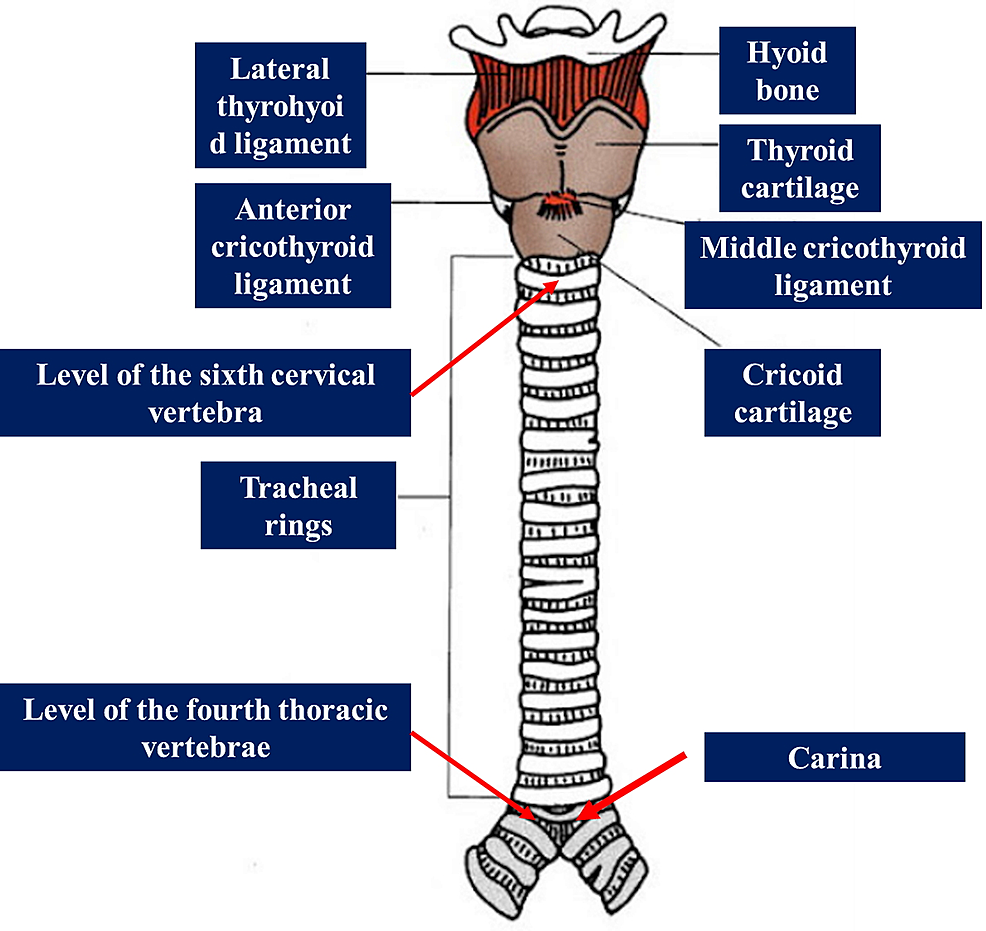
Respiratory System Indian Medical PG Question 6: Bifurcation of the trachea is at which level?
- A. Opposite the disc between the T3-T4 vertebrae
- B. Opposite the disc between the T5-T6 vertebrae
- C. Opposite the disc between the T4-T5 vertebrae (Correct Answer)
- D. Opposite the disc between the T7-T8 vertebrae
Respiratory System Explanation: ***Opposite the disc between the T4-T5 vertebrae***
- The **trachea** bifurcates into the right and left main bronchi at the level of the **carina**.
- In adults, this anatomical landmark consistently corresponds to the intervertebral disc between the **fourth and fifth thoracic vertebrae (T4-T5)**.
*Opposite the disc between the T3-T4 vertebrae*
- This level is generally **above the tracheal bifurcation** in most individuals.
- The superior margin of the **manubrium sterni** is typically at the level of the T3 vertebral body, which is too high for the tracheal carina.
*Opposite the disc between the T5-T6 vertebrae*
- This level is generally **below the tracheal bifurcation**.
- The **inferior mediastinum** begins roughly at the T5 level, which is after the carina.
*Opposite the disc between the T7-T8 vertebrae*
- This level is significantly **below the carina** and corresponds to the approximate level of the inferior aspect of the **heart** or the **diaphragmatic domes**.
- No major tracheal branching occurs at this lower thoracic vertebral level.
Respiratory System Indian Medical PG Question 7: Which structure is most likely injured in a 25-year-old man with a bullet wound in the neck, resulting in a tension pneumothorax and collapse of the right lung?
- A. Costal pleura
- B. Cupula (Correct Answer)
- C. Right mainstem bronchus
- D. Right upper lobe bronchus
Respiratory System Explanation: ***Cupula***
- The **cupula** (or cervical pleura) extends into the root of the neck, superior to the first rib, making it vulnerable to neck injuries [1].
- A penetrating injury to this region can directly damage the pleura, leading to **pneumothorax** and subsequent lung collapse [1].
*Costal pleura*
- The **costal pleura** lines the inner surface of the thoracic wall and would primarily be affected by injuries directly to the chest wall, not the neck [1].
- Injury to this part of the pleura is less likely to result from a **neck wound** causing a pneumothorax unless the wound extended significantly downwards.
*Right mainstem bronchus*
- The **right mainstem bronchus** is located deep within the mediastinum and would typically require a much deeper and more centrally located injury to be affected.
- While mainstem bronchial injuries can cause **pneumothorax**, a bullet wound in the neck is less likely to reach this structure without causing more extensive mediastinal damage.
*Right upper lobe bronchus*
- The **right upper lobe bronchus** is also situated within the mediastinum, deep to the pleura and lung parenchyma.
- An isolated injury to this bronchus from a neck wound is unlikely; simpler, more superficial structures like the **cupula** are more probable targets.
Respiratory System Indian Medical PG Question 8: During thyroidectomy, damage to which nerve leads to loss of high-pitched voice?
- A. External branch of the superior laryngeal nerve (Correct Answer)
- B. Hypoglossal nerve
- C. Vagus nerve
- D. Recurrent laryngeal nerve
Respiratory System Explanation: ***External branch of the superior laryngeal nerve***
- The **external branch of the superior laryngeal nerve** innervates the **cricothyroid muscle**, which is responsible for tensing the vocal cords.
- Damage to this nerve paralyzes the cricothyroid muscle, leading to an inability to tense the vocal cords, resulting in a **monotonous voice** and **loss of high-pitched tones**.
*Hypoglossal nerve*
- The **hypoglossal nerve (CN XII)** controls the muscles of the **tongue**, affecting articulation and swallowing, but not vocal pitch directly.
- Damage primarily causes **tongue deviation** and **difficulty with speech (dysarthria)** and swallowing.
*Vagus nerve*
- The **vagus nerve (CN X)** gives rise to both the **superior laryngeal nerve** and the **recurrent laryngeal nerve**.
- While damage to the vagus nerve trunk would affect vocalization, the question specifically asks about loss of high-pitched voice, which points to a more localized injury to one of its branches.
*Recurrent laryngeal nerve*
- The **recurrent laryngeal nerve** innervates most of the intrinsic laryngeal muscles, including the **thyroarytenoid** and **posterior cricoarytenoid muscles**, primarily affecting vocal cord adduction and abduction.
- Damage typically causes **hoarseness** due to vocal cord paralysis, and in severe cases, difficulty breathing, but it does not specifically lead to the *loss of high-pitched voice* as directly as superior laryngeal nerve damage.
Respiratory System Indian Medical PG Question 9: Cobra poison is:
- A. Vasculotoxic
- B. Myotoxic
- C. Neurotoxic (Correct Answer)
- D. Cardiotoxic
Respiratory System Explanation: ***Neurotoxic***
- Cobra venom contains **alpha-neurotoxins** that block **nicotinic acetylcholine receptors** at neuromuscular junctions, causing flaccid paralysis.
- The primary cause of death is **respiratory failure** due to paralysis of respiratory muscles, making neurotoxicity the dominant mechanism.
*Vasculotoxic*
- Vasculotoxic effects are characteristic of **viper venoms**, causing bleeding, swelling, and tissue necrosis.
- Cobra venom's primary action targets the **nervous system**, not blood vessels.
*Myotoxic*
- Myotoxic venoms directly damage **muscle tissue**, leading to rhabdomyolysis and muscle pain.
- While minor muscle effects may occur, **neurotoxicity** remains the predominant and life-threatening mechanism in cobra envenomation.
*Cardiotoxic*
- Some cobra venoms contain **cardiotoxins**, but these are secondary to the primary neurotoxic effects.
- The main cause of cardiovascular collapse is **respiratory paralysis**, not direct cardiac toxicity.
Respiratory System Indian Medical PG Question 10: Which is associated with vasculitis of medium sized vessels
- A. Wegener's granulomatosis
- B. Temporal arteritis
- C. Polyarteritis nodosa (Correct Answer)
- D. Henoch-Schönlein purpura
Respiratory System Explanation: ***Polyarteritis nodosa***
- **Polyarteritis nodosa (PAN)** is a **necrotizing vasculitis** of **medium-sized or small arteries**, but not arterioles, capillaries, or venules [1].
- It classically affects the **renal and visceral arteries**, sparing the pulmonary circulation, and is associated with **aneurysms** and stenoses.
*Temporal arteritis*
- This is a form of **large-vessel vasculitis** primarily affecting the **temporal and other cranial arteries** [1].
- It is typically seen in older adults and can cause **headache**, **jaw claudication**, and **blindness**.
*Wegener's granulomatosis*
- Now known as **Granulomatosis with Polyangiitis (GPA)**, this vasculitis affects **small vessels** and is characterized by a **granulomatous inflammation** of the upper and lower respiratory tracts and kidneys [1].
- It is associated with **PR3-ANCA (c-ANCA)** positivity.
*Henoch-Schönlein purpura*
- This is an **IgA vasculitis** affecting **small vessels**, typically presenting with **palpable purpura**, arthritis, abdominal pain, and renal involvement (nephritis) [1].
- It is the most common form of vasculitis in children.
More Respiratory System Indian Medical PG questions available in the OnCourse app. Practice MCQs, flashcards, and get detailed explanations.