Functional Anatomy of Reproductive System Indian Medical PG Practice Questions and MCQs
Practice Indian Medical PG questions for Functional Anatomy of Reproductive System. These multiple choice questions (MCQs) cover important concepts and help you prepare for your exams.
Functional Anatomy of Reproductive System Indian Medical PG Question 1: Which rectus muscle is not supplied by the oculomotor nerve?
- A. Superior rectus
- B. Inferior rectus
- C. Medial rectus
- D. Lateral rectus (Correct Answer)
Functional Anatomy of Reproductive System Explanation: ***Lateral rectus***
- The **lateral rectus muscle** is innervated by the **abducens nerve (cranial nerve VI)**, not the oculomotor nerve. [1]
- Its primary function is **abduction** of the eye, moving it away from the midline. [1]
*Medial rectus*
- The **medial rectus muscle** is innervated by the **oculomotor nerve (cranial nerve III)**.
- Its primary function is **adduction** of the eye, moving it towards the midline. [1]
*Superior rectus*
- The **superior rectus muscle** is innervated by the **oculomotor nerve (cranial nerve III)**.
- Its primary actions are **elevation** and **adduction** of the eye, with some intorsion. [1]
*Inferior rectus*
- The **inferior rectus muscle** is innervated by the **oculomotor nerve (cranial nerve III)**.
- Its primary actions are **depression** and **adduction** of the eye, with some extorsion. [1]
Functional Anatomy of Reproductive System Indian Medical PG Question 2: A cyst near the testis is most likely a problem with which structure?
- A. Seminal vesicle
- B. Prostate
- C. Epididymis (Correct Answer)
- D. Urethra
Functional Anatomy of Reproductive System Explanation: ***Epididymis***
- Cysts near the testis are most commonly **spermatoceles or epididymal cysts**, which originate from the **epididymis**.
- These cysts are typically benign and contain fluid, sometimes mixed with sperm.
*Seminal vesicle*
- The **seminal vesicles** are located posterior to the bladder and do not typically form cysts directly adjacent to the testis.
- Cysts in this area are rare and usually associated with congenital anomalies.
*Prostate*
- The **prostate gland** is located inferior to the bladder and surrounds the urethra, far from the testis.
- Prostatic cysts are distinct entities and are not typically found near the testis.
*Urethra*
- The **urethra** is the tube that carries urine and semen out of the body, and it passes through the penis.
- Urethral cysts are uncommon and do not present as a cyst near the testis.
Functional Anatomy of Reproductive System Indian Medical PG Question 3: Which of the following statements about the anatomy of the Fallopian tubes is true?
- A. Length is 20 cm
- B. All of the options
- C. Medial to lateral structures are isthmus, interstitial part, ampulla & fimbriae
- D. Lateral to medial structures are fimbriae, ampulla, isthmus, interstitial part (Correct Answer)
Functional Anatomy of Reproductive System Explanation: ***Lateral to medial structures are fimbriae, ampulla, isthmus, interstitial part***
- The Fallopian tube segments, from the **ovary** towards the **uterus**, logically follow this order to facilitate **egg transport**.
- The **fimbriae** capture the egg, the **ampulla** is the site of fertilization, the **isthmus** is a narrow segment, and the **interstitial part** traverses the uterine wall [1].
*Length is 20 cm*
- The typical length of the **Fallopian tube** is approximately **10-12 cm**, not 20 cm [1].
- A length of 20 cm would be significantly longer than the average human Fallopian tube.
*Medial to lateral structures are isthmus, interstitial part, ampulla & fimbriae*
- This order is incorrect as it describes the segments from the **uterus** towards the **ovary** but places the **isthmus** before the **interstitial part**.
- The correct order from medial to lateral (uterus to ovary) would be **interstitial part**, **isthmus**, **ampulla**, and **infundibulum/fimbriae** [1].
*All of the options*
- Since two of the other options contain factual inaccuracies regarding the length and the medial-to-lateral structural arrangement, this option cannot be correct.
- Only one statement can be entirely true when specifically asked for the "true" statement among given choices.
Functional Anatomy of Reproductive System Indian Medical PG Question 4: What is the incorrect statement?
- A. MIS inhibits the formation of Mullerian duct
- B. WD form male internal genitalia
- C. Zygote is Bipotential at 8 weeks (Correct Answer)
- D. DHT is necessary for the development of external genitals
Functional Anatomy of Reproductive System Explanation: ***Zygote is Bipotential at 8 weeks***
- A **zygote** is formed at conception and is the single-cell diploid organism, not bipotential at 8 weeks.
- The **bipotential gonad** can develop into either testes or ovaries, and this stage of sexual differentiation occurs earlier in gestation, typically around the 6th to 7th week, before differentiating into male or female gonads, not at 8 weeks as an entire zygote.
*MIS inhibits the formation of Mullerian duct*
- **Müllerian Inhibiting Substance (MIS)**, also known as **Anti-Müllerian Hormone (AMH)**, is produced by the Sertoli cells of the developing testes [1].
- Its primary function is to cause the **regression of the Müllerian ducts**, which would otherwise develop into female internal reproductive structures (fallopian tubes, uterus, and upper vagina) [1].
*WD form male internal genitalia*
- The **Wolffian ducts (WD)**, also known as mesonephric ducts, are precursors to male internal genitalia in the presence of testosterone [1].
- stimulated by **testosterone** produced by the Leydig cells of the fetal testes, they develop into the **epididymis, vas deferens, and seminal vesicles** [1].
*DHT is necessary for the development of external genitals*
- **Dihydrotestosterone (DHT)**, a more potent form of testosterone, is crucial for the development of male external genitalia [1].
- The enzyme **5α-reductase** converts testosterone to DHT in target tissues, leading to the formation of the **penis, scrotum, and prostate** [1].
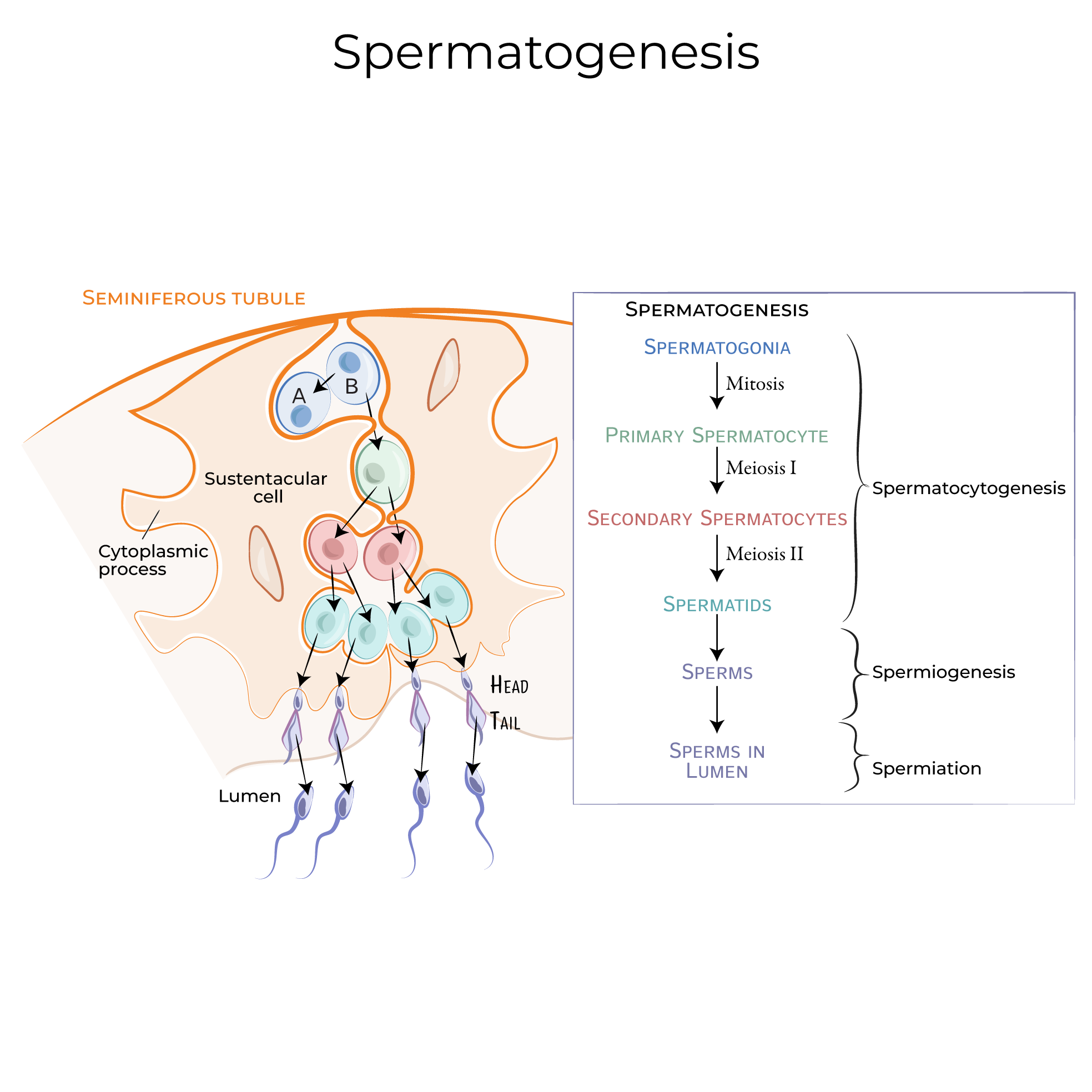
Functional Anatomy of Reproductive System Indian Medical PG Question 5: What is the correct sequential order of sperm formation?
1. Spermatogonia
2. Spermatocyte
3. Spermatids
4. Spermatozoa
- A. 2314
- B. 3214
- C. 1234 (Correct Answer)
- D. 3124
Functional Anatomy of Reproductive System Explanation: **1234**
- The correct order of sperm formation begins with **spermatogonia**, which are germline stem cells that differentiate into **spermatocytes**.
- Spermatocytes then undergo meiosis to become **spermatids**, which finally mature into **spermatozoa** (mature sperm).
*2314*
- This order is incorrect because it places spermatocytes before spermatogonia and then incorrectly places spermatogonia before spermatids.
- **Spermatogonia** are the initial stem cells, preceding spermatocytes in the process.
*3214*
- This sequence is incorrect as it starts with spermatids, which are an intermediate stage, not the beginning of sperm formation.
- **Spermatocytes** develop from spermatogonia and precede spermatids.
*3124*
- This order incorrectly places spermatids before spermatocytes in the sequence of maturation.
- **Spermatocytes** are the cells that undergo meiosis to form spermatids.
Functional Anatomy of Reproductive System Indian Medical PG Question 6: In human males, testosterone is mainly produced by
- A. Leydig cells (Correct Answer)
- B. Seminiferous tubules
- C. Epididymis
- D. Sertoli cells
Functional Anatomy of Reproductive System Explanation: ***Leydig cells***
- **Leydig cells** are located in the **interstitial tissue** between the seminiferous tubules in the testes and are responsible for producing **testosterone** in response to luteinizing hormone (LH).
- These cells are crucial for the development of male secondary sexual characteristics and spermatogenesis.
*Seminiferous tubules*
- The **seminiferous tubules** are the primary sites of **spermatogenesis**, the process of sperm production.
- While essential for male fertility, they do not directly produce testosterone.
*Epididymis*
- The **epididymis** is a coiled tube located on the posterior aspect of each testis, where **sperm mature** and are stored.
- It plays no role in the production of testosterone.
*Sertoli cells*
- **Sertoli cells** are found within the **seminiferous tubules** and provide support, nourishment, and protection to developing sperm.
- They also produce **androgen-binding protein (ABP)** and inhibin, but not testosterone.
Functional Anatomy of Reproductive System Indian Medical PG Question 7: Name the muscles being used in climbing a tree as shown in the figure.
- A. Latissimus dorsi and pectoralis major (Correct Answer)
- B. Teres major and pectoralis major
- C. Teres minor and pectoralis minor
- D. External oblique and pectoralis major
Functional Anatomy of Reproductive System Explanation: ***Latissimus dorsi and pectoralis major***
- The **latissimus dorsi** is a large, powerful muscle responsible for adduction, extension, and internal rotation of the arm, all crucial for pulling the body upward during climbing.
- The **pectoralis major** is a large, fan-shaped muscle that helps with adduction, flexion, and internal rotation of the humerus, also vital for pulling oneself up against gravity.
*Teres major and pectoralis major*
- While the **pectoralis major** is involved, the **teres major** is a smaller muscle that primarily assists the latissimus dorsi in extension, adduction, and internal rotation of the humerus, but is not as dominant in the main pulling action as the latissimus dorsi.
- The primary pulling force comes from larger muscles, making the teres major a less significant contributor to the overall climbing action.
*Teres minor and pectoralis minor*
- The **teres minor** is part of the rotator cuff and primarily functions in external rotation of the humerus, which is not a primary movement for pulling oneself up.
- The **pectoralis minor** is a small, thin muscle that stabilizes the scapula and depresses the shoulder; it does not directly contribute to the powerful pulling action needed for climbing.
*External oblique and pectoralis major*
- The **external oblique** is an abdominal muscle involved in trunk rotation and flexion, providing core stability but not directly contributing to the primary upper body pulling motion for climbing.
- While the **pectoralis major** is correctly identified, the external oblique is not a primary muscle used for the upward pulling motion in climbing.
Functional Anatomy of Reproductive System Indian Medical PG Question 8: Which occupational exposure may cause sterility in females ?
- A. Lead
- B. Carbon monoxide
- C. Mercury
- D. Agricultural insecticides (Correct Answer)
Functional Anatomy of Reproductive System Explanation: ***Agricultural insecticides***
- Exposure to **organochlorine** and **organophosphate** insecticides can have significant **reproductive toxicity** in females, leading to **infertility** or **sterility**.
- These chemicals can disrupt **hormonal balance**, interfere with **ovarian function**, cause **menstrual irregularities**, and lead to **developmental toxicity** in offspring.
- Well-documented occupational hazard in agricultural workers with chronic exposure.
*Lead*
- Lead is a well-established **reproductive toxicant** affecting **both males and females**.
- In females, lead causes **menstrual irregularities**, **ovarian dysfunction**, **reduced fertility**, **spontaneous abortions**, and can contribute to sterility.
- It disrupts the **hypothalamic-pituitary-ovarian axis** and has direct **gonadotoxic effects**.
- While agricultural insecticides are more specifically associated with female sterility in occupational contexts, lead is also a significant reproductive hazard.
*Carbon monoxide*
- Carbon monoxide poisoning primarily causes **hypoxia** by binding to hemoglobin, forming **carboxyhemoglobin**.
- It does not directly cause **sterility** in females; its main reproductive concern relates to **fetal hypoxia** and adverse pregnancy outcomes during exposure.
*Mercury*
- Mercury exposure, particularly **methylmercury**, is a known **neurotoxin** and can cause **developmental abnormalities**.
- While it can affect pregnancy outcomes and cause **menstrual disorders** at high exposures, it is not typically cited as a primary occupational cause of **female sterility** compared to agricultural insecticides.
Functional Anatomy of Reproductive System Indian Medical PG Question 9: Which of the following is true regarding precocious puberty:
- A. Sexual maturity is attained early (Correct Answer)
- B. Mental function is increased
- C. Reproductive function is absent
- D. Body proportions remain unchanged
Functional Anatomy of Reproductive System Explanation: ***Sexual maturity is attained early***
- **Precocious puberty** is defined by the development of secondary sexual characteristics significantly earlier than the average age.
- This early onset of puberty means that affected individuals reach **sexual maturity** at a younger chronological age.
*Mental function is increased*
- Precocious puberty does not inherently lead to an increase in **mental function** or cognitive abilities.
- While hormonal changes can influence mood and behavior, they do not enhance intelligence.
*Reproductive function is absent*
- Precocious puberty implies the premature activation of the **hypothalamic-pituitary-gonadal axis**, leading to the appearance of secondary sexual characteristics and, in many cases, the potential for **reproductive function**.
- Girls, for example, can experience early menarche and boys can produce sperm, meaning fertility is not absent but rather accelerated.
*Body proportions remain unchanged*
- Precocious puberty often results in changes in **body proportions**, particularly due to the early closure of epiphyseal plates.
- Although there is an initial growth spurt, the premature fusion of growth plates can lead to a shorter-than-average adult height.
Functional Anatomy of Reproductive System Indian Medical PG Question 10: Blood testis barrier in testis is formed by?
- A. Germ cells
- B. Sertoli cells (Correct Answer)
- C. Leydig cells
- D. Granulosa cells
Functional Anatomy of Reproductive System Explanation: ***Sertoli cells***
- **Sertoli cells** form tight junctions with each other, creating the **blood-testis barrier** [1]
- This barrier divides the seminiferous epithelium into **basal and adluminal compartments** [1]
- Essential for protecting developing **germ cells** from immune attack and maintaining a specialized microenvironment for **spermatogenesis** [1]
- The tight junctions between Sertoli cells are among the tightest in the human body
*Granulosa cells*
- **Granulosa cells** are found in the **ovary**, not the testis
- They surround the oocyte in ovarian follicles and produce **estrogen**
- Completely unrelated to testicular structure or function
*Germ cells*
- **Germ cells** (spermatogonia, spermatocytes, spermatids, spermatozoa) are the developing sperm cells [1]
- They are **protected by** the blood-testis barrier, not forming it [1]
- Located within the seminiferous tubules but do not create barrier structures [1]
*Leydig cells*
- **Leydig cells** are interstitial cells located in the connective tissue **between seminiferous tubules**
- Their primary function is production of **testosterone**, not forming barriers [2]
- They are outside the seminiferous tubules and not involved in barrier formation [2]
More Functional Anatomy of Reproductive System Indian Medical PG questions available in the OnCourse app. Practice MCQs, flashcards, and get detailed explanations.